The worst part is rarely the court date itself. It's the envelope, the phone call, or the message that lands on the kitchen table and tells a family that a surety bond claim has been filed, and now everyone who signed is looking at the same problem from different angles. If you're a defendant or cosigner in Colorado, you need straight answers fast, because what happens next usually turns on paperwork, deadlines, and whether someone shows up when they're supposed to.
A surety bond claim is not just a complaint. It's a formal demand that the bond holder, the surety, step in after someone failed to do what the bond required. In bail situations, that means the court wants the defendant present and the cosigner is tied to the promise that made release possible. In contract and license bonds, the same basic idea applies, a protected party says the bonded obligation wasn't met and the surety has to evaluate the loss.
For a plain-English overview of bond structure, the relationship between the parties is easier to understand when you see how the bond itself is built, and this what is a surety bond explanation gives that foundation without the legal fog.
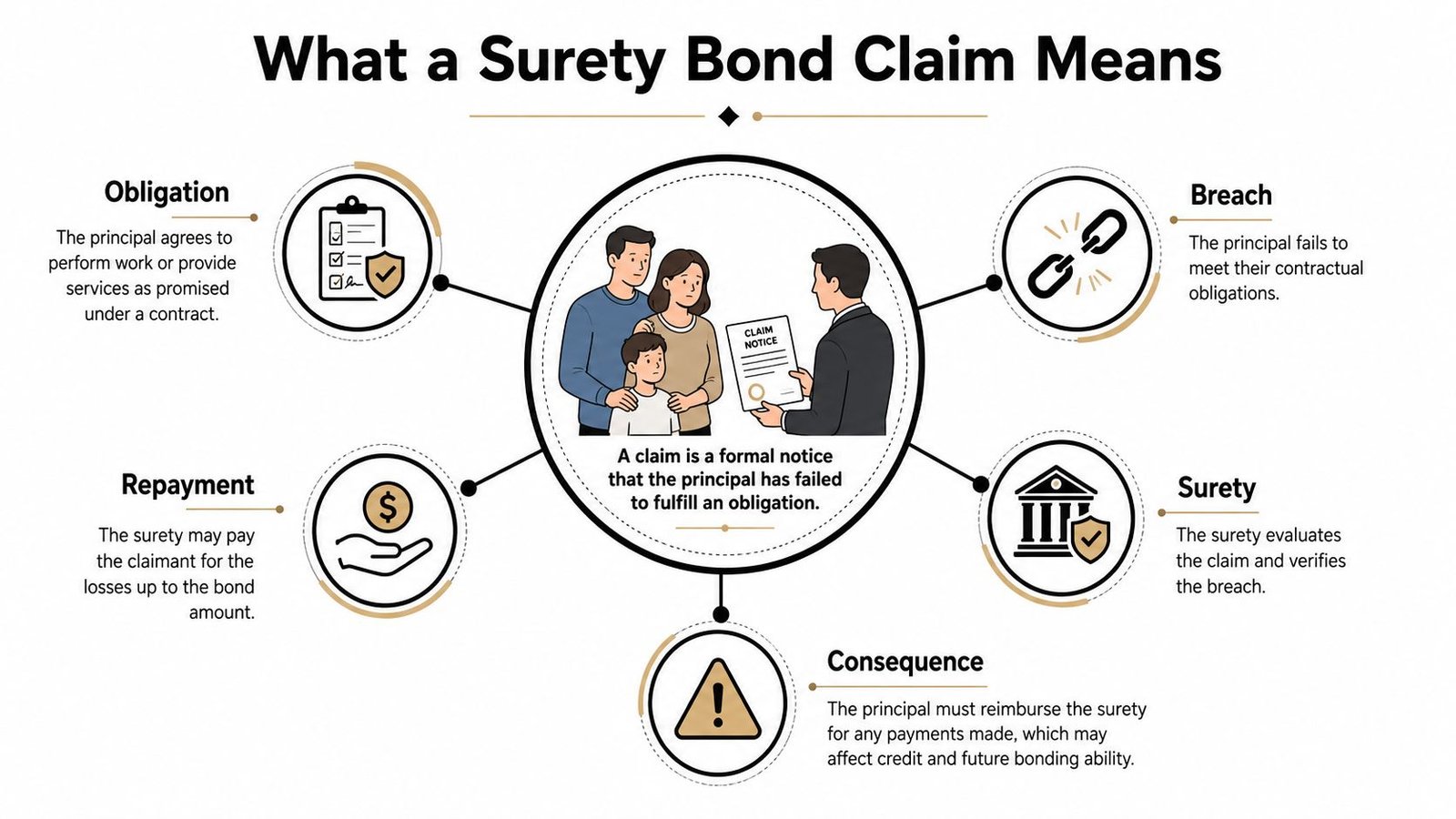
What a Surety Bond Claim Means
A family usually doesn't hear the phrase surety bond claim until something has already gone sideways. Maybe a defendant missed court in Jefferson County, maybe a cosigner is getting calls about collateral, or maybe a contractor defaulted and the project owner sent formal notice. In every version, the bond is doing the same job, it serves as a financial promise that covers a specific obligation if the principal fails to perform.
The three parties matter
The principal is the person or business that had the obligation. The obligee is the party protected by the bond, such as a court, project owner, or another entitled claimant. The surety is the company that investigates the claim and decides whether the bond responds.
Practical rule: a claim being filed is not the same thing as a claim being paid. The surety usually investigates first, because the paperwork has to prove the covered default happened.
That distinction matters in bail, because a filed claim can still be challenged, negotiated, or cured depending on what happened and how fast people respond. It also matters in contract settings, where the surety may pay, deny, or manage completion rather than just mailing a check. The bond works like a guarantee mechanism, not an automatic payout machine.
A Colorado family can usually see the structure more clearly once the bond terms are laid out in plain English. This what is a surety bond explanation gives that foundation without the legal fog.
The claimant says the bonded promise was broken. The surety checks whether the failure fits the bond language, whether the loss is documented, and whether the claim landed inside the bond's active period or deadlines.
Why claims exist at all
Claims exist because a bond gives the protected side a financial backstop when trust alone isn't enough. If the defendant doesn't appear, if the contractor doesn't finish, or if the license holder breaks a bonded rule, the claim process gives the injured side a path to recover. That path is slower and more formal than commonly expected, and that is the point.
A surety bond claim example is about more than the event that triggered it. It is about proof, timing, and consequences. The bond sets the rules, and the claim exists to test whether those rules were broken in a way that creates real financial exposure.
How the Surety Bond Claim Process Unfolds
A claim starts with written notice. A rumor, a phone call, or a tense conversation at the counter does not trigger a surety review. The claimant has to identify the bond, explain the alleged default, and support it with documents the surety can verify. The process moves slowly because the surety checks scope, dates, and evidence before it decides what is covered.
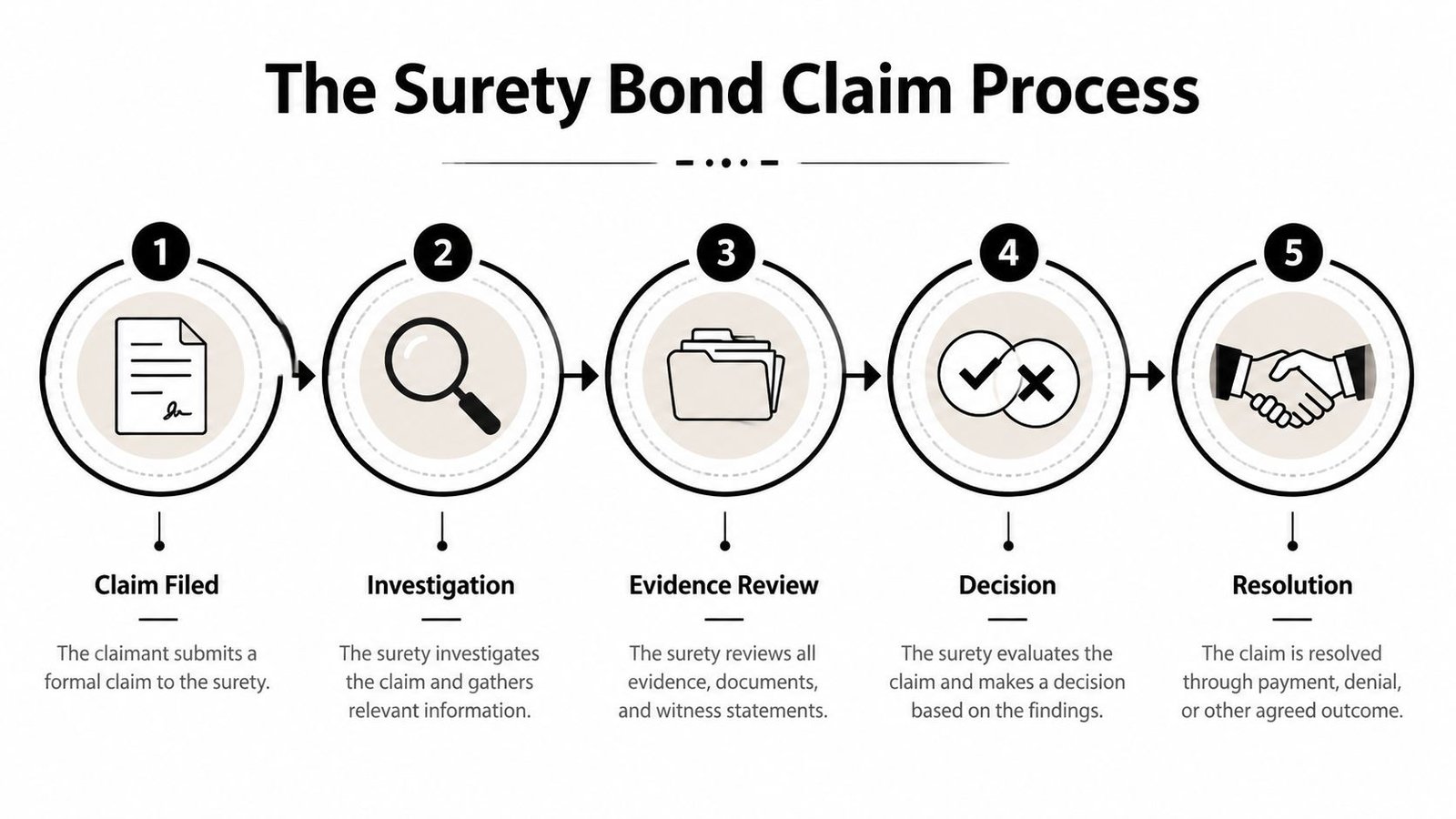
Step by step, the file gets tested
First, the claim is filed with the bond details and the alleged breach. Then the surety opens the file and starts its investigation. From there, the reviewer looks at the bond form, the contract or court obligation, and the evidence supporting the claimed loss.
The claim package should be built like a record with complete documentation supporting the amount owed. Industry guidance says claimants should keep complete documentation supporting the amount owed, and practical filing guidance calls for invoices, delivery tickets, bond copies, correspondence, the contract, and the bond itself. Those records matter because the surety is checking whether the claim falls inside the bond's scope and whether the amount claimed can be supported. The claim form itself often asks for the bond or policy details, the nature of the default, the amount claimed with a breakup, and supporting evidence such as contracts, invoices, correspondence, photos, progress reports, and proof that the invocation happened within the bond validity period.
A family dealing with a bail issue should also expect the surety to look at any recent bond trouble, including a possible bail bond revocation. Once that starts, the review stops being theoretical. The file turns into a question of whether the appearance failure, violation, or other default fits the bond terms and whether the cosigner's paperwork now exposes collateral or indemnity obligations.
A strong file doesn't just say something went wrong, it shows exactly what went wrong and what it cost.
Time is not on anybody's side
This part surprises families the most. One industry source reports an average settlement time of 14 months, with 60% of claims resolved within 12 months and about 75% paid in full, while only 12% are denied due to misrepresentation. That means most claims are resolved by documentation, investigation, and contract terms, not instant payment. The same source says even denied claims may still see follow-up recovery efforts, with a 65% recovery rate on denied claims through follow-up action. See the settlement and recovery data in the industry summary at WorldMetrics on surety industry statistics.
That timeline tells you what to expect. A claim can move, stall, settle, or be denied, but it rarely disappears on its own. If a response is required, the file usually favors the person who answers fast and keeps the paper trail clean.
A good example of how stubborn these files can be is a federal case where the surety issued bonds totaling $7,872,414.10 and later paid losses exceeding $4,500,000 after default. The surety also sent collateral demands for $3,000,000 and later $4,500,000, which shows how quickly the financial pressure can escalate once a loss is real. You can read the court record in the federal case file at govinfo's district court PDF.
Real Surety Bond Claim Examples You Should Know
A real surety bond claim example is useful because it shows how different defaults produce different consequences. Some claims end with a payment dispute. Some trigger completion work. Some threaten collateral, especially when a cosigner signed an indemnity agreement and assumed more than they realized.

Jefferson County bail scenario
A defendant misses a court appearance in Jefferson County, and the court or jail-side process starts moving toward forfeiture. The cosigner gets the first real warning when the bail agent explains that the bond didn't just “expire,” it became a live financial issue because the defendant failed the appearance obligation. The practical damage isn't only legal, it's personal, because the family now has to decide whether they can locate the defendant, get counsel involved, or start organizing proof of communication and travel problems before the claim hardens.
Centennial bail scenario
A cosigner in Centennial hears that a missed court date has triggered collateral concerns. The immediate fear isn't abstract, it's whether the cash deposit, vehicle title, or property pledge is now exposed under the indemnity paperwork. That's the right fear to have, because once a bond is breached, the surety can pursue reimbursement and collateral recovery if the agreement allows it.
Construction performance bond default
Construction claims can get huge because completion costs compound fast. One claims example describes a bonded contractor where the cost to complete became nearly double the contract price / bond limit. Another large-contractor case ended with an ultimate surety loss of about 10% of backlog after the surety managed replacement contractors and the remaining contractor assets over several years. The lesson is blunt, once a principal defaults on a difficult project, the surety may choose completion management over simple payment, and the loss can climb well beyond the original deal economics. That example is drawn from a construction claims presentation at the CAS presentation on surety claim examples.
Contractor license bond claim
A contractor license claim usually starts with a written allegation that the licensed party violated a requirement tied to the bond. The key issue is not just what happened, but whether the conduct fell within the active bond period and whether the claimant can prove the covered default. Deadline sensitivity is often decisive, because some jurisdictions impose tail periods measured from completion or the offense date, and some require notice or suit within very short windows, including claims statements within 90 days of completion and suit within one year. That timing pressure is discussed in a practical industry guide on contractor license bond claims.
The common thread is simple. These claims aren't random events. They're evidence-heavy fights over a broken obligation, a closed or open deadline, and a dollar figure the surety can verify.
Defendant and Cosigner Obligations When a Claim Is Filed
Once a bail bond claim is filed, the defendant and cosigner each have separate burdens, and neither one gets to ignore the file. The defendant's job is obvious, show up, follow court orders, and stay in contact. The cosigner's job is less obvious, but it's the one families usually regret overlooking, because the signature on the indemnity paperwork can outlive the release date.
What the cosigner actually signed
An indemnity agreement is not a courtesy form. It's the contract that lets the surety recover what it loses if the bond goes bad. If the surety pays on the bond, the principal or indemnitors typically owe reimbursement for the amount paid, plus legal and investigation costs, which is why a cosigner's exposure doesn't end when the defendant walks out of custody.
For a plain explanation of that contract layer, see the internal guide on what is an indemnity agreement.
Plain truth: if the surety pays, it usually comes after the family, not before it.
Collateral is where the pressure gets real. Cash deposits, property pledges, vehicle titles, and other pledged assets can be pulled into the reimbursement effort if the agreement permits it. That's why a family should treat the bond packet like a live financial file, not a formality.
Why the defendant's behavior drives the whole file
The defendant controls the fastest way to avoid a claim, and that's making the appearance and following the conditions. If the court date is missed, the bond can move from a release tool to a loss event in a matter of minutes. Once that happens, the surety's next move is often to look for the defendant, confirm the breach, and decide whether recovery efforts are possible.
A related point matters in Colorado because families often assume the bond company will “handle it.” It will handle the claim file, but it won't absorb the loss for free. The surety will protect its own position, and the cosigner's signature gives it the contractual path to do that.
The cleanest way to think about the obligation is this. The defendant owes the court compliance. The cosigner owes the surety cooperation and reimbursement if the bond fails. Those duties are separate, and both of them survive the moment the bond is posted.
Steps to Respond to or Prevent a Surety Bond Claim
If a claim is already filed, speed beats panic. Start by gathering every relevant document, the bond paperwork, court notices, text messages, invoices, receipts, and any written communication with the surety or bail agent. Claim files are won or lost on evidence, not emotion, and the first person to get organized usually has the best shot at limiting damage.
What to do right now
- Gather all documentation. Keep the bond, the contract or court paperwork, invoices, correspondence, and proof of any updates in one place.
- Notify the surety promptly. Deadlines can be strict, and late notice can sink an otherwise arguable file.
- Cooperate fully. If the surety asks for records or clarification, answer quickly and factually.
- Review the contract terms. The bond language and the underlying obligation can differ, and missing a step can hurt recovery.
- Implement preventive measures. Confirm court dates, keep contact information current, and don't let old promises turn into missed appearances.
For a deeper look at how forfeiture starts, the internal guide on what is a bond forfeiture helps connect the courtroom event to the claim process.
How to avoid the claim in the first place
Prevention is mostly discipline. The defendant has to appear every time, and the cosigner has to stay reachable. If plans change, the surety needs to know before the court does, because last-minute silence is how families get trapped in expensive follow-up work.
Good recordkeeping pays off. Keep proof of calls, messages, travel disruptions, medical issues, and every court reminder. If the bond later gets questioned, that paper trail can be the difference between a contained problem and a full reimbursement fight.
There's also a deadline trap people miss. A claim often can only be made for conduct that happened while the bond was active, and in some settings the filing window can be short. That means a family can't sit on a problem and hope it goes away.
How Express Bail Bonds Handles Claims and Collateral
Express Bail Bonds has worked in Colorado since 1988, and that matters because claim problems usually aren't caused by one dramatic mistake, they're caused by missed details, missed dates, and weak communication. Their process is built around electronic documents, clear court instructions, and fast contact by call or text, which lowers the odds of a paperwork error becoming a forfeiture or collateral dispute. They also serve Jefferson County and Centennial, so families dealing with local court pressure can get a statewide agency perspective without waiting around at the jail.
For readers comparing bond resources, how to get a bail bond surety is a useful outside explanation of the surety side of the process. On the practical end, Express Bail Bonds also keeps the bond paperwork and collateral terms organized through its bail bond collateral information, which is exactly where families should pay attention before a problem becomes a claim.
If a family understands the court requirements early, the claim file usually never gets the chance to grow teeth.
That's the key advantage of a responsive bond agency. Clear contract documents, direct communication, and a steady explanation of next steps reduce the chances that a defendant misses something and leaves a cosigner guessing about exposure. If you need help now, Express Bail Bonds is available 24/7 by call or text at 720-984-2245, and the company's Colorado focus means the advice is shaped by the way local courts work.
Protecting Yourself and Taking the Next Step
A surety bond claim gets expensive fast when people wait, guess, or ignore the paperwork. The safest move is straightforward, know the bond terms, keep every document, answer the surety quickly, and treat every court date as binding. If you are a cosigner, treat your signature as a financial commitment, because that is exactly how the surety will treat it.
A defendant in Colorado who misses a court date can trigger a claim even when the family thinks the mistake is minor. A cosigner can also get dragged into the fallout through phone calls, demand letters, collateral issues, and pressure to help locate the defendant or pay what the bond company seeks. Once that claim is filed, the clock is working against you.
If you want a local bail partner that can explain bond paperwork, court expectations, and collateral issues in plain language, start with Express Bail Bonds, then check the Jefferson County page at https://expressbailbonds.com/jefferson-county-golden-colorado/ and the Centennial page at https://expressbailbonds.com/bail-bonds-centennial/. You get a clearer picture of what happens next, and you avoid guessing your way through a claim or forfeiture.
Keep copies of the bond, receipts, text messages, court notices, and any collateral records in one place. If the defendant changes phone numbers, moves, or has trouble getting to court, tell the bond company right away. Silence makes the problem worse, and in a claim situation, silence is often treated like neglect.
A family that reacts early has more options. A family that waits usually has fewer.
If you are dealing with a bond problem right now, call Express Bail Bonds at 720-984-2245 or visit Express Bail Bonds for direct help with bail bond paperwork, court dates, and collateral concerns. The right guidance now can keep a missed appearance from turning into a larger claim, and it can give your family a clear next step before the file gets any worse.