A late-night call from jail can turn a normal evening into a scramble. You're trying to figure out who can help, what the paperwork means, and why somebody keeps mentioning a surety bond bank when what you really need is simple, fast release for a loved one.
That confusion is common. A bank and a surety bond are both financial tools, but they solve very different problems. In bail, the practical answer is usually a licensed bail agency, not a personal bank branch, because the court needs a bond that fits the criminal process, not a consumer loan product.

Surety bonds are one of the oldest financial instruments, with the oldest surviving written contract dating to 670 BC, and the U.S. surety bond industry wrote about $9.3 billion in premiums in 2023 FCIS Group. That history matters because it shows a surety bond is a real, established risk-transfer tool, not some new workaround invented for one courthouse. If you've ever wondered how that differs from bail, a plain-English guide like Illinois bail vs bond explained can help frame the basics.
For readers who want the legal meaning of the word itself, this is also a good time to review secure bond meaning. The short version is simple, a surety bond is a structured promise, and in bail, that promise is about the defendant showing up in court.
What Is a Surety Bond Bank and Can It Help with Bail
A surety bond bank sounds like one service, but it usually blends two different ideas. People often use the phrase when they are looking for a bank to “cover” bail, yet the actual tool used to post bail in criminal cases is usually a surety bond arranged through a licensed bail agency.
A bank can play a role in some commercial guarantee arrangements. That does not mean your personal bank issues a bail bond. Bail is meant to get a person released under court terms, while a bank handles deposits, loans, and commercial credit. Those jobs overlap in finance, but they are not the same.
That difference matters because the court is not asking for a general promise of credit. It wants a bond that secures appearance and follows court rules, much like a signed promise must match the exact terms of the agreement it supports. Families usually get farther by working with a bail bond agency that has the right license and process than by asking a branch banker who manages checking accounts and mortgages.
Practical rule: if the issue is jail release, think bail agency. If the issue is a business contract, think bank guarantee or another commercial credit product.
A surety bond also has a long history in many parts of finance, from construction and licensing to court-related obligations, and its broader use shows that it is an established risk-transfer tool FCIS Group. That wide use can make the terminology feel slippery, but the bail version is much narrower and much more urgent.
For a bail-specific explanation of how the bond works once it is posted, see our guide to what a secure bond means in practice. The key takeaway is simple, a surety bond bank is not the answer to a jail release problem, while a licensed bail bond process is.
Understanding the Three-Party Bail Bond Contract
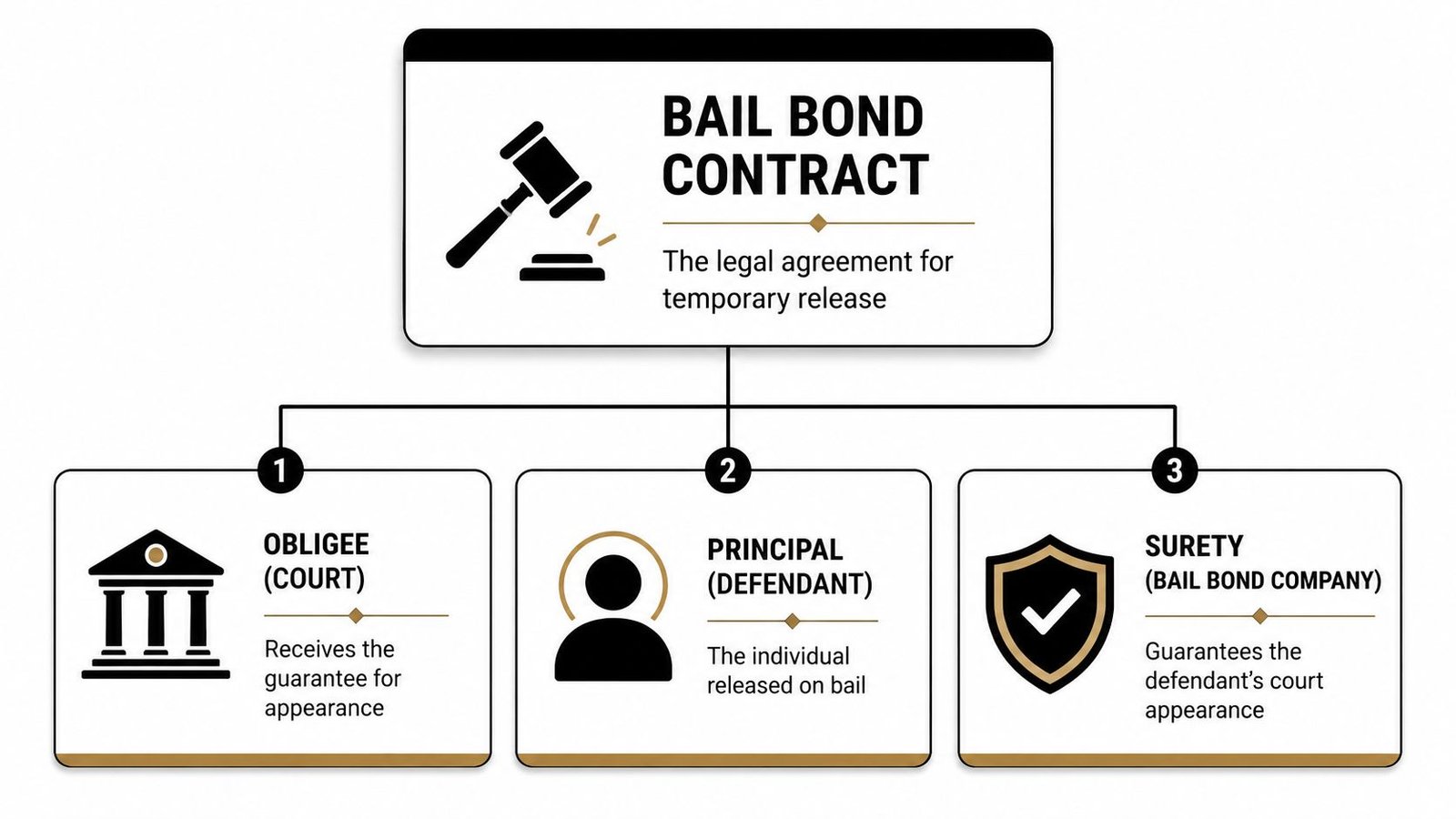
A bail bond works because three people or entities each have a different role. The principal is the defendant, the surety is the bail bond company, and the obligee is the court. In plain terms, the court wants a dependable promise that the defendant will return, and the surety steps in to back that promise.
It's similar to co-signing for a car loan, except the court is watching the agreement, not a lender. The person who needs the help is still the one responsible for the obligation. The co-signer, or in this case the surety, backs the promise if the primary person doesn't do what they agreed to do.
A federal environmental fact sheet gives the same core structure in direct terms, the principal is the party with the obligation, the surety guarantees that obligation, and the obligee is the party protected by the bond EPA surety bond fact sheet. In bail, that protected party is the court, and the obligation is the defendant's appearance.
If the defendant appears when required, the bond does its job quietly. If the defendant doesn't appear, the surety is the party that has to answer for the bond amount.
A useful way to keep the roles straight is to separate responsibility from protection. The defendant carries the duty to show up, the court receives the protection, and the bail agency stands between them as the financial guarantor. That's why the process is built around trust, paperwork, and compliance, not around someone walking into a bank and asking for a cash loan.
For a closer look at the legal paperwork behind that relationship, this indemnity agreement explanation is a helpful companion. Once you understand the three-party structure, the rest of bail becomes much easier to follow.
Why Your Bank Issues Guarantees Not Bail Bonds
Banks and bail bond companies do not play the same role. A bank guarantee is usually designed for a commercial obligation, like a construction contract or a business transaction, while a bail bond is designed for a court appearance. That difference changes everything, from underwriting to speed to who carries the risk.
A commercial bank guarantee is often more layered. In many bank-fronted structures, the bank issues a letter of credit and the surety counter-guarantees the bank, which creates a chain built for corporate finance, not rapid jail release Forbes guide on surety bonds and bank guarantees. Bail doesn't have time for a chain that complex. Families need a process that moves quickly, and courts need a bond that meets release conditions now, not after a long credit committee review.
Bank guarantee versus bail surety bond
| Feature | Bank Guarantee | Bail Surety Bond |
|---|---|---|
| Main purpose | Commercial financial assurance | Court appearance assurance |
| Typical setting | Contracts, loans, business obligations | Criminal bail |
| Structure | Often more layered | Direct three-party bond |
| Practical speed | Slower, more document-heavy | Built for urgent release |
A bail bond is also not the same as a cash deposit. The bond is a promise backed by a surety, which is why families often choose it when they can't or don't want to tie up the full amount in cash. That makes the surety process more practical for release, while bank guarantees stay in the commercial lane.
For another bail-specific comparison, see surety bond versus cash bond. The bottom line is straightforward, a bank can support some kinds of guarantees, but a personal bank does not replace a licensed bail bond agency when someone needs to get out of jail.
Calculating the Cost of a Surety Bail Bond
The cost of a bail bond is usually not the full bail amount. In Colorado, the standard premium is commonly 15%, and for bonds over $5,000 with an approved cosigner, agents often secure 10% according to the publisher's service summary. That premium is the fee for the surety taking on the risk and doing the work to post the bond.
The premium is generally non-refundable. That's where families sometimes get caught off guard, because they expect a bond to work like a refundable deposit. It doesn't. You're paying for the service and the credit risk, not parking money in an account that comes back later.
Premium and collateral are not the same thing
Collateral is different from the premium. A premium is the service fee, while collateral is something a bail agency may ask for as extra security in some cases. Collateral can be property, a vehicle title, or another asset, but it's not always required and it's not the same as the bond fee itself.
Practical rule: ask what part of the payment is the premium, what part is collateral, and what part, if any, may be returned later.
For a clear pricing breakdown, how much a bail bond costs is the right place to compare scenarios. The important thing is to get the numbers early, before stress and urgency make every quote sound the same.
Families should also ask whether a cosigner is needed and what that person is agreeing to. In many cases, the cosigner helps support the application, but the bail agency still makes the final underwriting decision. The smartest next step is to ask for the premium, collateral requirements, and release timing together, so there are no surprises at the jail window.
Your Step-by-Step Guide to Posting Bail Online
Online bail processing saves time when a family member is calling from outside the detention center or from another county. It also helps when the cosigner lives out of state and can't get to the jail quickly. A remote process keeps the focus on the paperwork instead of on travel.
- Call the bail agency first. Give the defendant's full name, booking information if you have it, and the jail location. That lets the agent confirm the bond amount and tell you what comes next.
- Provide the basic application details. The agency will usually ask for contact information, the defendant's charges, and cosigner information. At this stage, the underwriting conversation begins.
- Review the contract electronically. Digital paperwork makes it easier to read the terms without standing in a jail lobby. It also helps cosigners review the obligations carefully before signing.
- Pay the premium online. Many families prefer this step because it avoids extra travel and lets the process move faster. If you want the payment route laid out in advance, pay bail bond online shows how remote payment fits into the workflow.
The same convenience matters across different parts of Colorado, including service areas like Jefferson County and Golden and Centennial. When the jail is far away, electronic processing can keep a release from turning into an all-night drive.
The best way to avoid delays is to have the defendant's information ready before you call. If you're missing something, an experienced agent can usually tell you what matters most and what can wait. That's the value of using a bail process built for speed, not a bank workflow built for scheduled transactions.
Answering Your Top Questions About the Bail Process
Colorado courts and jails accept licensed surety bonds because that's the standard release mechanism in the system. The bond works when it is written correctly, posted by a qualified agency, and tied to the defendant's appearance conditions. If you're worried about whether a bond is “real enough,” the issue usually isn't legitimacy, it's whether the paperwork matches the jail's requirements.
A cosigner takes on real responsibility. That person is usually agreeing to help the defendant meet the bond terms, stay in contact with the bail agency, and appear for all court dates. If the defendant misses court, the cosigner may face financial consequences, so this is not a casual favor.
If someone skips bail, the court can issue a warrant and the bond can be forfeited. That means the surety may have to answer for the bond amount, and the cosigner may be responsible under the bond agreement. This is why release support should never stop at the jail door.
The safest habit is simple, keep every court date, keep every phone number current, and call the agency before a missed appearance becomes a bigger problem.
People also ask whether a bond ends the moment the defendant walks out of jail. It doesn't. The bond stays tied to the case until the court says the obligation is done. That's another reason the cosigner's role matters, because the bond is only as strong as the defendant's follow-through.
For worried families, the next step is to get a clear answer on the bond terms, the payment, and the court schedule before signing anything. If the situation is urgent, contact Express Bail Bonds now, confirm the jail and booking details, and get the release process started with a licensed Colorado bail team that can move quickly.