
The call usually comes at the worst time. Late at night. Early morning. In the middle of work. A son, daughter, spouse, partner, or close friend says they've been arrested, and suddenly you're trying to make decisions while your mind is racing.
Most families in that moment don't need legal theory. They need a calm next step. They need to know what a surety bond is, who has to qualify, what a cosigner is agreeing to, and whether they can handle everything from another city or even another state.
In Colorado, that process has its own rules and its own rhythm. A bond that sounds simple over the phone can still involve questions about the defendant, the cosigner, identification, income, credit, and whether the paperwork can be signed electronically. If you're trying to help someone in Jefferson County, Centennial, Denver, or another Colorado jail, local details matter.
That Urgent Call What to Do When a Loved One Is Arrested
A worried mother in Arizona gets a call from her adult son in Jefferson County. He says he was arrested, he doesn't understand what happens next, and he needs help getting out. She wants to help immediately, but she's asking the same questions almost everyone asks first.
How much time do we have? Can I do this from out of state? What exactly is a bond? What do they need from me?
Those questions are normal. Panic makes everything sound more complicated than it is. In many cases, a surety bond is the most practical path because it allows a licensed bail agent to guarantee the bond to the court, instead of requiring the family to bring the full amount in cash or tie up real estate.
Start with facts, not fear
The first thing to gather is basic information about the person in custody:
- Full legal name so the jail record can be located correctly
- Where they're being held because the county and facility affect timing
- Booking details if available because that helps confirm the case
- Any medical or practical concerns that may matter while they're in custody
If you're unsure what to ask or what happens after booking, this practical guide on what to do when arrested can help you organize the first few steps.
The fastest progress usually starts when one calm person gathers the facts and speaks for the family.
What matters in the first conversation
A bail professional will usually try to sort out two things quickly. First, whether the court allows a bond that can be posted through a surety. Second, whether there's a reliable person who can serve as cosigner and complete the application.
That's where people often get confused. Families think the main issue is whether they love the defendant enough to help. The court and the bonding company look at something different. They look at whether the person released is likely to appear and whether the cosigner is financially stable enough to stand behind that promise.
When you know that, the process gets less mysterious. You stop trying to solve everything at once and focus on the right questions.
Understanding a Surety Bond for Bail
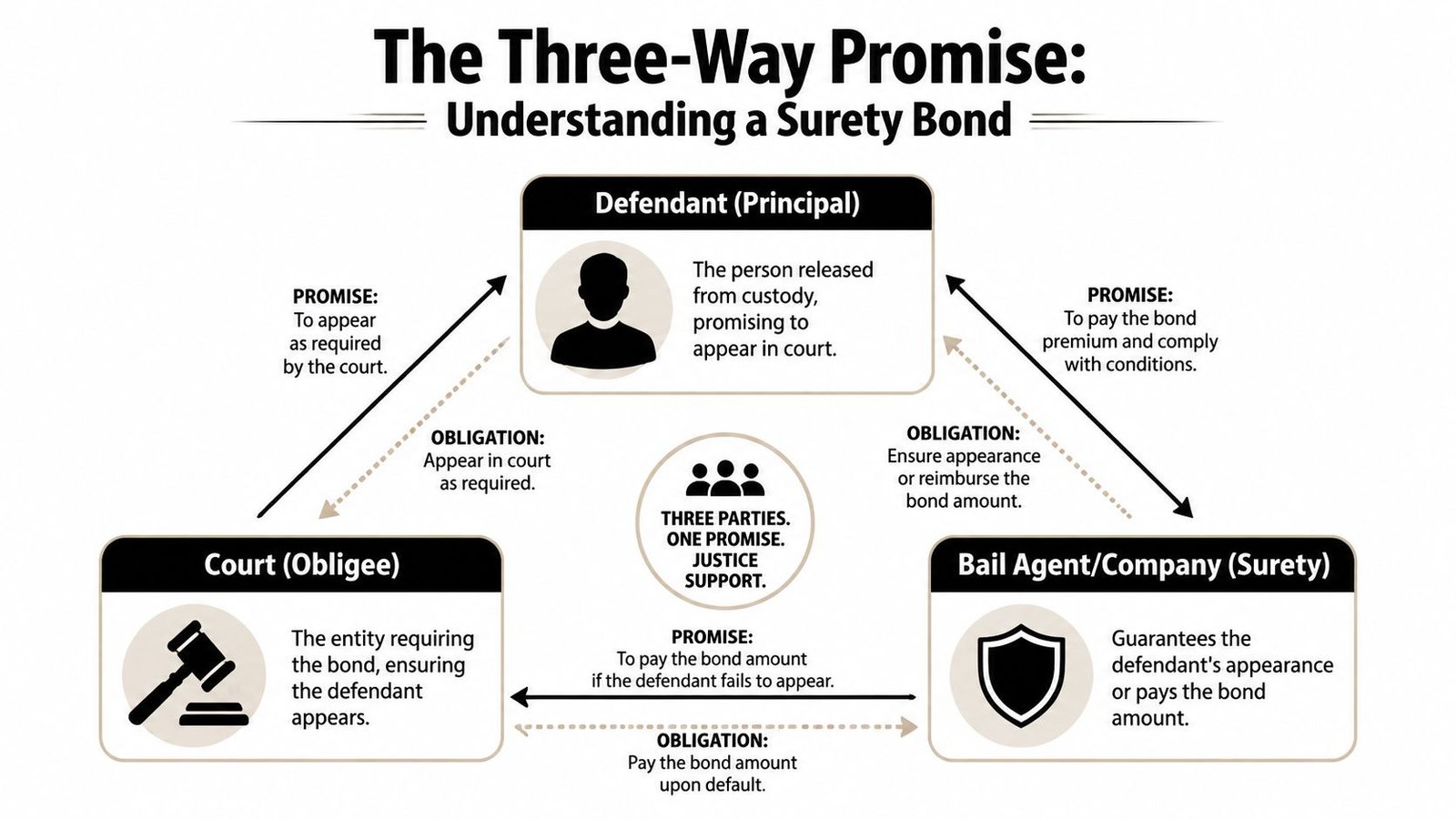
A surety bond works like a three-way promise. The court wants assurance that the defendant will return for court dates. The defendant promises to appear. The bail agent promises the court that if the defendant doesn't appear, the bond obligation will be handled under the bond agreement.
That's why the words can sound formal. In bond language, the defendant is the principal, the court is the obligee, and the bail agent is the surety.
The simple version
Similar to cosigning an apartment lease, the landlord wants a reliable backstop. The tenant wants the keys. The cosigner helps make the arrangement possible by backing the promise.
A bail surety bond works in a similar way, but the promise is about showing up to court, not paying rent.
Why families choose this route
Most families don't have the full bail amount sitting in a bank account ready to use. Even when they do, they often don't want that money tied up. A surety bond is usually faster and more accessible because the family pays a premium for the service, completes the required paperwork, and the licensed bail agent posts the bond.
The alternative can be much heavier. For example, Colorado property bond rules require unencumbered equity equal to at least 1.5 times the bond amount, so a $20,000 bond would require proof of $30,000 in free-and-clear equity. That's one reason many families prefer a surety bond. The property route can involve assessor records, title evidence, mortgage payoff information, and additional court paperwork.
What a surety bond does and does not do
A surety bond doesn't erase the criminal case. It doesn't decide guilt or innocence. It solves one immediate problem. It allows release from custody while the case moves through court, as long as the defendant follows the bond conditions.
Practical rule: A bond buys time outside jail. It does not end the case.
That distinction matters because families sometimes think the hardest part is posting bond. In reality, posting bond is the beginning of a longer responsibility. The defendant must keep every court date, follow conditions, and stay in contact with the people who helped secure release.
Defendant Eligibility What the Court and Bondsman Look For
That part can feel personal for families. A wife in Centennial may be ready to cosign. A parent calling from Arizona may have the money and the paperwork. Even so, the court and the bail agent still need to decide one separate question. Is the defendant likely to follow the release terms and come back to court in Colorado?
That is the core issue.
In Colorado, eligibility is not usually about whether your loved one is a good person. It is about whether release looks manageable and realistic. Judges and bondsmen are both trying to measure the same practical concern. If this person is released from the Jefferson County Jail, the Arapahoe County Detention Facility, or another local jail, will they stay in contact, appear when ordered, and follow the bond conditions?
What “flight risk” usually means in real life
Families hear “flight risk” and picture someone packing a bag and disappearing. Courts often use the phrase more broadly than that. A person can be labeled higher risk because life looks unstable on paper. No fixed address. No clear work schedule. No reliable phone. No family member who can help keep things organized.
A bond file works a lot like a snapshot of daily life. The clearer that snapshot is, the easier it is for a judge or bondsman to get comfortable.
Helpful signs often include:
- Strong local ties in Colorado, such as family in Jefferson County, Denver, Centennial, or nearby communities
- A stable place to live, even if it is with relatives
- Work, school, or caregiving responsibilities that create routine
- A record of showing up for court or handling prior cases responsibly
- A reachable support system, especially one adult who answers calls and stays involved
For out-of-state families, this part causes the most confusion. You may live in Texas or Kansas and still be a strong cosigner, but the defendant usually needs some clear connection to Colorado if release is going to make sense to the court and the bond company.
The charge matters, but it is not the whole picture
A single charge does not answer the eligibility question by itself. Two people charged with the same offense can look very different for bond purposes.
One may have a long history of missed court dates, no steady residence, and no one willing to help. The other may have a spouse in Lakewood, a job to return to, and a parent who is ready to stay on top of reminders and transportation. Same charge. Very different risk picture.
That is also why families should not panic if the arrest sounds serious over the phone. Serious charges can bring tighter conditions, higher bond amounts, or stronger scrutiny. They do not automatically mean a surety bond is off the table.
If you want a clearer picture of how Colorado courts and bond agents discuss these issues before release, this explanation of pretrial risk assessment helps connect the legal language to what families experience.
What a bondsman is trying to confirm
A bail agent is not only asking, “Can someone pay the premium?” The agent is also asking, “Can this defendant be supervised in a realistic way?”
That is why questions can sound so specific. Where will your loved one sleep tonight if released? Who will drive them to court in Golden or Littleton? Do they have a working phone? Is anyone helping them keep track of dates, especially if they have never been through the Colorado court system before?
Those questions are not meant to trap you. They are the practical side of understanding surety bond requirements. The stronger the plan for daily follow-through, the stronger the application usually looks.
Local support can change the outcome
In many Colorado cases, one reliable person makes a real difference. That might be a sister in Westminster who can offer a place to stay. It might be a husband in Centennial who can confirm work hours and court transportation. It might be an out-of-state mother who cannot be there physically but stays reachable, signs quickly, and helps keep the defendant organized with reminders and check-ins.
Courts and bail agents are looking for stability they can verify.
A strong eligibility picture usually includes three things. A place to stay, a way to stay in contact, and a reason to return to court.
If your loved one has weak local ties, say so early and explain what support is in place. Clear facts help more than hopeful promises. Families often worry that bad facts will kill the bond. In practice, incomplete or changing information causes more trouble than a hard situation explained candidly.
Financial Qualifications for the Cosigner or Indemnitor
A lot of families hear the word cosigner and assume it only means, “I'm helping with paperwork.” In Colorado bail cases, it means more than that. You are the person promising the bond company, in writing, that you will stand behind this bond financially if your loved one does not follow the court's release terms or fails to appear.
Another word for that role is indemnitor. The plain-English version is simple. Your signature tells the agency, “If this goes sideways, I am financially on the hook.”
What a Colorado bond company is really checking
For many worried relatives, especially a parent or spouse calling from another state, this part feels personal. It is personal, but it is also practical. A bail agent in Jefferson County or near Centennial is trying to answer a basic question. If this bond is posted, is there a real adult on the other side of the file who can be found, contacted, and trusted to take the obligation seriously?
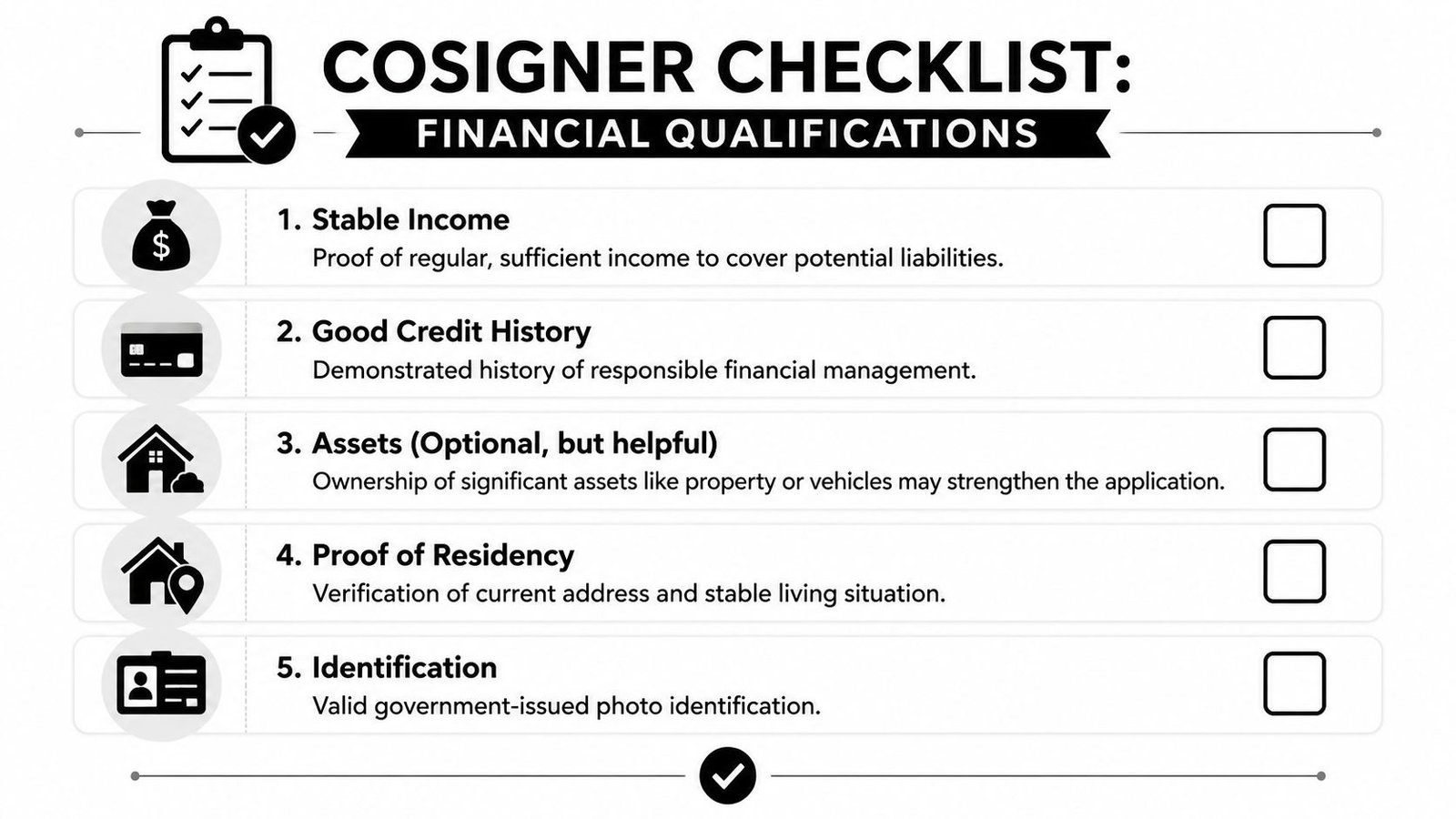
That is why the review usually centers on a few common areas:
- Identity. A valid government-issued ID and matching personal information.
- Residence. A stable address where you receive mail and can be reached.
- Income. Verifiable wages, self-employment income, benefits, or another clear source of support.
- Credit and debt history. Not because perfect credit is required, but because the agency is looking for signs of reliability.
- Assets. Savings, a vehicle, or homeownership can help, though they are not required in every case.
- Responsiveness. Fast, clear answers matter more than families expect.
A cosigner with average credit, steady work, and consistent communication is often in a better position than someone with higher income who cannot provide documents or return calls. That surprises people, but it makes sense. Bail approval is partly about finances and partly about follow-through.
Premium and collateral are two different things
This is one of the biggest sticking points for families.
The premium is the fee you pay for the bond service. In Colorado, that fee is usually treated as earned once the bond is posted. The collateral is separate. It is extra security the agency may request if the bond amount is high, the case has added risk, the cosigner has limited financial strength, or the defendant has a weaker record of showing up.
A simple way to look at it is this. The premium is like paying for the service of getting the bond written and filed. Collateral is more like a safety net the company may hold in case the bond is forfeited.
Some cosigners in Jefferson County cases are approved with no collateral at all. Others may be asked for a vehicle title, cash, or another asset. The difference usually comes from the full file, not one single detail.
What out-of-state cosigners should expect
Many Colorado families get nervous, especially when the person ready to help is in Texas, Arizona, Georgia, or somewhere else entirely. Being out of state does not automatically disqualify you. It does mean the agency will want clean documentation and quick communication, because they cannot ask you to drive over to an office in Golden or Centennial that afternoon.
If you are cosigning from outside Colorado, have these ready before you call:
- A current photo ID
- Proof of address, such as a utility bill, lease, or bank statement
- Proof of income if the agency asks for it
- Basic details about the defendant's case and release plan
- A phone number and email you monitor
It also helps to be honest about distance. If you live out of state, explain how you will still keep in contact with your loved one. Maybe you are paying for their phone, reminding them about court, helping with rides through another relative in Lakewood, or staying in daily contact until the Jefferson County court date. Agencies want a realistic plan, not a polished one.
If you want a clearer picture of what agencies may review, this guide on the cosigner credit check process walks through the documents and credit questions that often come up.
Families sometimes need help with related court requirements after release too, especially if treatment or assessments will happen in another state. This complete guide to evaluations in Georgia shows how state-specific rules can affect what happens after the person is out.
Questions to ask yourself before you sign
Before you cosign, slow the moment down and ask three plain questions.
| Question | Why it matters |
|---|---|
| Do I believe this person will show up for court? | If the answer is shaky, the financial risk to you is real. |
| Can I respond quickly if the bail agent or court needs something? | Delayed communication can create problems fast. |
| Am I prepared for the legal and financial responsibility if this goes wrong? | Cosigning is support, but it is also a binding promise. |
A worried mother in another state often wants to say yes right away because she wants her child out tonight. That instinct is understandable. The safer choice is to say yes only after you understand exactly what you are agreeing to, what documents you need, and what role you will have once your loved one is released.
Navigating Specific Colorado Bail Bond Rules
If you are in another state and your phone rings late at night with news that someone was arrested in Colorado, the hardest part is usually not caring. It is figuring out which rules are state rules, which are county habits, and which details apply to your family right now. A case in Jefferson County can move a little differently from one tied to Centennial-area courts and jails, so local practice matters.
Why Colorado licensing matters
Start with the part that protects your family. Colorado requires bail bond agencies to work under state regulation. Under Colorado regulations on bail bond agency bonding, a bail bond agency must keep its own surety bond in place through a company authorized by the Colorado Insurance Commissioner, and the rule addresses how that liability can end.
For a worried cosigner, that may sound technical. The plain-English version is simpler. Colorado expects licensed agencies to have financial backing and to stay in compliance while they write bonds. If you are signing paperwork from Texas, Kansas, or anywhere else, you want to know the agency handling your loved one's release is operating under Colorado rules, not just answering the phone quickly.
Speed still matters. So does knowing the person guiding you understands Colorado procedure.
Colorado bail bond pricing works differently from other surety bonds
Families often get tripped up here because the term "surety bond" covers more than one kind of bond. A bail bond is a surety bond, but it does not work like a contractor license bond or an auto dealer bond. Different bond types can have different pricing methods, different underwriting, and different paperwork.
For this article, the practical point is that Colorado bail bond premiums follow bail industry practices, not the pricing families may see for unrelated commercial bonds. If a relative tells you, "I saw another surety bond online for a much lower percentage," that comparison usually does not fit a bail case.
The better question is this: what will this specific Colorado bail bond require from the cosigner, and can that be handled tonight?
Remote cosigners need to watch the paperwork details
Out-of-state family members often worry that distance will slow everything down. In many cases, it does not. Remote signing is common, but the documents still have to be completed correctly, and the agency may still need identification, proof of address, income information, or other items before approving the bond.
If you will not be appearing in person, this guide to Colorado bail bond electronic signature requirements can help you understand how remote signing usually works and what to have ready before the forms arrive.
A small mistake on a signed form can create a very real delay.
Local knowledge helps in real Colorado cases
County details shape the release process. A family working on a bond for someone held near Golden may need detention center information that applies in Jefferson County. A family dealing with a case in or near Centennial may run into different jail logistics, court locations, or timing questions. That is why local pages are useful, especially when the cosigner is trying to help from another state and has never dealt with Colorado custody before.
For example, local detention details for Jefferson County in Golden can answer county-specific questions, while support for Centennial bail bonds can help families dealing with jails and courts in that area.
A short overview can make the local process easier to visualize:
For families, especially parents, siblings, or spouses trying to cosign from out of state, the safest approach is to slow down just enough to confirm three things. The agency is licensed in Colorado. The paperwork matches the county where your loved one is being held. You understand exactly what you are signing before you approve the bond.
Your Step-By-Step Guide to Securing a Bond Now
It is 10:30 p.m. Your phone rings. Your brother has been booked in Jefferson County, and you are in another state trying to help from your kitchen table.
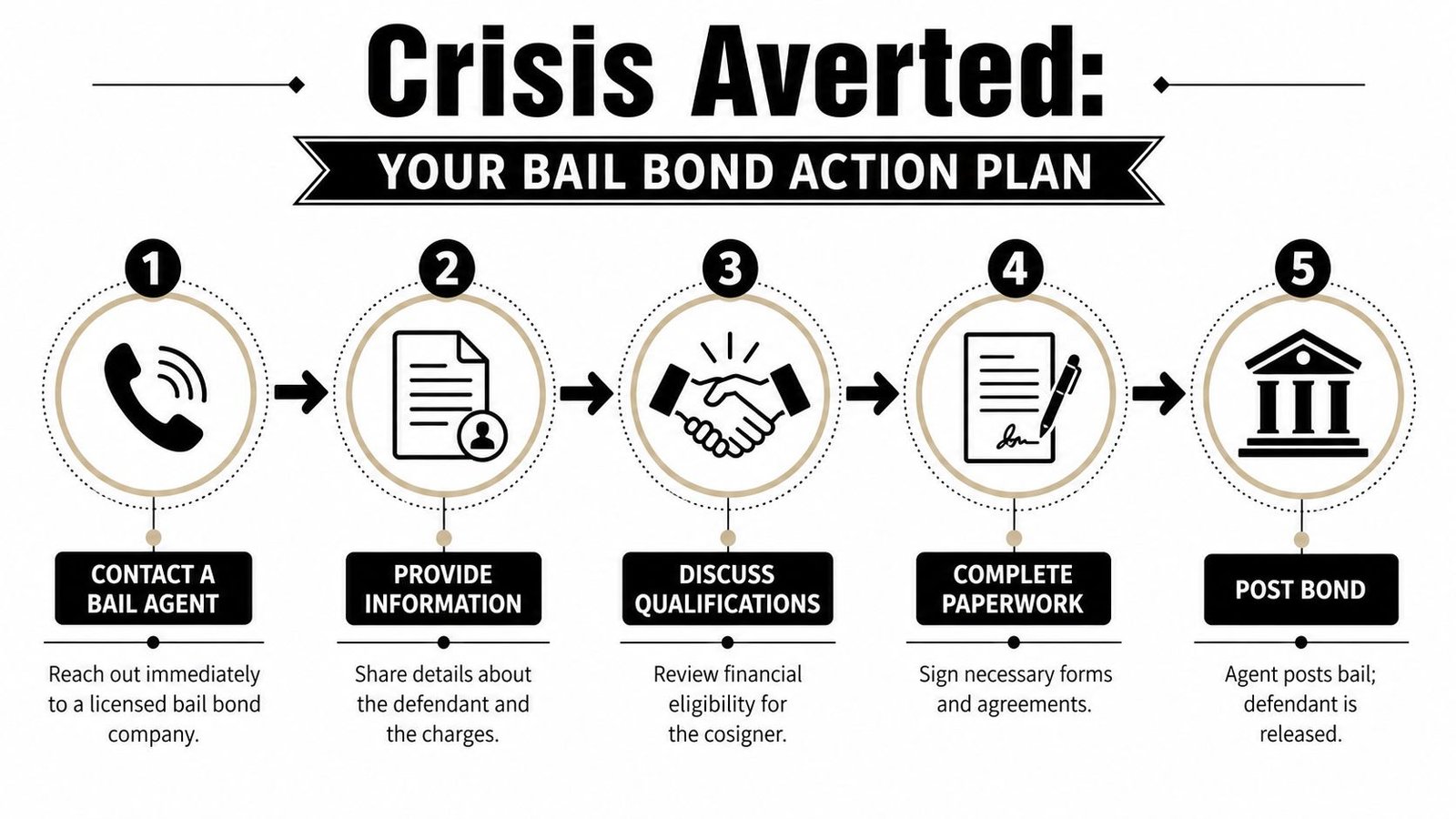
In that moment, the process feels bigger than it is. The fastest path is usually a calm, orderly one. You gather the right details, complete the cosigner review, sign the documents, and let the agent post the bond.
The five actions that matter most
Start with one phone call
Reach out to a licensed Colorado bail agent as soon as you know where your loved one is being held. If the arrest happened near Golden, say Jefferson County right away. If the case is tied to Centennial, mention that too. County and city details help the agent identify the right jail, court, and paperwork from the start.Gather the basic facts
Have the defendant's full name, date of birth if you know it, jail location, and any booking number available. If you expect to cosign, say that early. That tells the agent to begin reviewing your qualifications instead of waiting until the end.Complete the application carefully
Many Colorado bail bond applications can be handled on a phone or laptop, which matters a lot for parents, spouses, or siblings living out of state. The form may ask about your address, job, income, identification, and relationship to the defendant. Answer it like a loan form. Small mistakes can hold things up because the agent has to stop and verify them.Review the agreement before you sign
This is the step worried families try to rush, and it is the step that protects you. Read the premium amount, any payment terms, and your duty as the cosigner. If something is unclear, ask plain questions until it makes sense. A good agent should be able to explain it in everyday language.Pay the premium and stay reachable
After approval, the premium is paid and the bond can be posted. Then keep your phone close. If the jail, court, or agent needs one last signature or a quick confirmation, a fast reply can keep the release process on track.
Why accuracy speeds things up
Speed usually comes from clean information, not hurried information.
A cosigner who answers clearly, uploads the right ID, and signs the correct forms often moves the process along faster than someone who rushes through everything and leaves gaps. That is especially true for out-of-state family members. If you are helping from Texas, Kansas, or Arizona while your loved one is in Colorado, remote paperwork can work well, but only if the details match.
A useful way to picture it is this. The bond process works like checking in for a flight. If your name, ID, and reservation all match, you keep moving. If one detail is off, everything pauses while someone sorts it out.
For families who want a plain-English walkthrough of the release sequence, this guide on how to bail out of jail in Colorado explains what happens after the bond starts.
One final pricing note
Families sometimes hear the word "surety bond" and assume every surety bond works the same way. It does not. Bail bonds are their own category, with their own rules, paperwork, and pricing structure.
So if you have looked up business bond prices or other Colorado surety products, set those examples aside here. Focus on the bail bond terms in front of you, the county where the defendant is being held, and the exact obligation you are agreeing to as a cosigner.
Common Questions from Families and Cosigners
Can I cosign if I live out of state
Yes, in many cases you can. Remote applications, document review, and electronic signatures make that possible for many families. The key is being responsive and able to provide accurate identification and financial information when asked.
What am I legally agreeing to as a cosigner
You're agreeing to stand behind the bond obligation and to help make sure the defendant appears in court as required. In practical terms, that means you shouldn't cosign for someone you can't reach, can't influence, or don't trust to follow the rules.
What usually disqualifies a cosigner
Poor credit can be a problem. Unstable income can be a problem too. Serious red flags in surety review often include unresolved judgments, tax issues, missing paperwork, or information that doesn't match up. In broader Colorado bond underwriting, the documentation checklist can be extensive, including past fiscal year-end financial statements, current bank loan agreements, personal financial statements, owner resumés, and a detailed contractor's questionnaire. Bail files are different, but the lesson is the same. Qualification is about trust, documentation, and financial stability.
Do I get the premium back when the case is over
No. The premium is the non-refundable fee for the bond service. It's separate from the outcome of the criminal case.
Don't try to carry this by yourself when you're stressed and short on time.
If you need help right now, contact Express Bail Bonds. They serve Colorado families around the clock, including out-of-state cosigners who need a fast electronic process and local guidance when a loved one is in custody.