
The phone usually comes at the worst time. Late at night. Early before work. During dinner with your kids. A number you don't recognize, then a voice you know, strained and rushed, telling you they've been arrested and need help.
In that moment, thoughts are often jumbled. They're trying to figure out where their loved one is, what happened, whether bail has been set, and how fast they can get them out. If you're searching for how to bail out of jail in Colorado, you probably need practical answers right now, not legal jargon or vague reassurance.
Colorado's process is manageable when you know the order of operations. The wrong first move wastes time. The right one gets you from panic to action fast.
The Phone Call No One Wants to Get
It is 11:40 p.m. Your phone rings from a number you do not know. The voice on the other end is someone you love, speaking fast, talking over background noise, and saying they were arrested somewhere in Colorado. They may not know the exact jail yet. They may not know whether bond has been set. That is common, especially in the first hours after an arrest.
The first call is rarely clean or complete. People mix up the arresting agency with the jail holding them. They guess at the charge. They say “I'm in Denver” when they are still waiting to be transferred or processed. I have seen families lose hours because they acted on a half-correct location and started calling the wrong facility.

What you need to hear first
In Colorado, release usually happens in stages. Booking comes first. Bond is set after that, often by a judge or magistrate. The Colorado Judicial Branch explains the bond-setting process in its advisement and bond information, and jail release time still depends on staffing, shift changes, medical screening, and how busy that facility is. Some people are released relatively quickly after bond is posted. Others wait much longer, especially overnight or on a crowded weekend.
That is why the first call matters so much. A calm, accurate response saves more time than frantic effort. If you get the right name, the right facility, and the basic booking details, you can make good decisions once bond is set. If you start sending money or calling random jails before you confirm the facts, you can create delays that are hard to unwind.
Keep your focus narrow. Get the full legal name, date of birth if needed, the agency involved, and any detail they can give you about where they are being held. If they do not know, that does not mean you are stuck. It means the booking process is still unfolding.
One problem families run into right away is missed communication. The person in custody gets one short call, the family misses it, and now everyone is trying to piece together what happened from scraps. Good intake and call handling matter here too, which is why work on improving law firm phone support has real value in criminal cases. Fast, accurate phone communication can shorten the time between confusion and action.
If you are still waiting for a call or trying to understand why calls keep failing, read this guide on how to receive jail phone calls. It explains the common blocks, delays, and account issues that catch Colorado families off guard.
Your First Moves After an Arrest in Colorado
The first hour after an arrest usually feels chaotic. In Colorado, the fastest path to release starts with getting the facts straight, because every jail has its own booking pace, bond desk procedures, and release timeline.
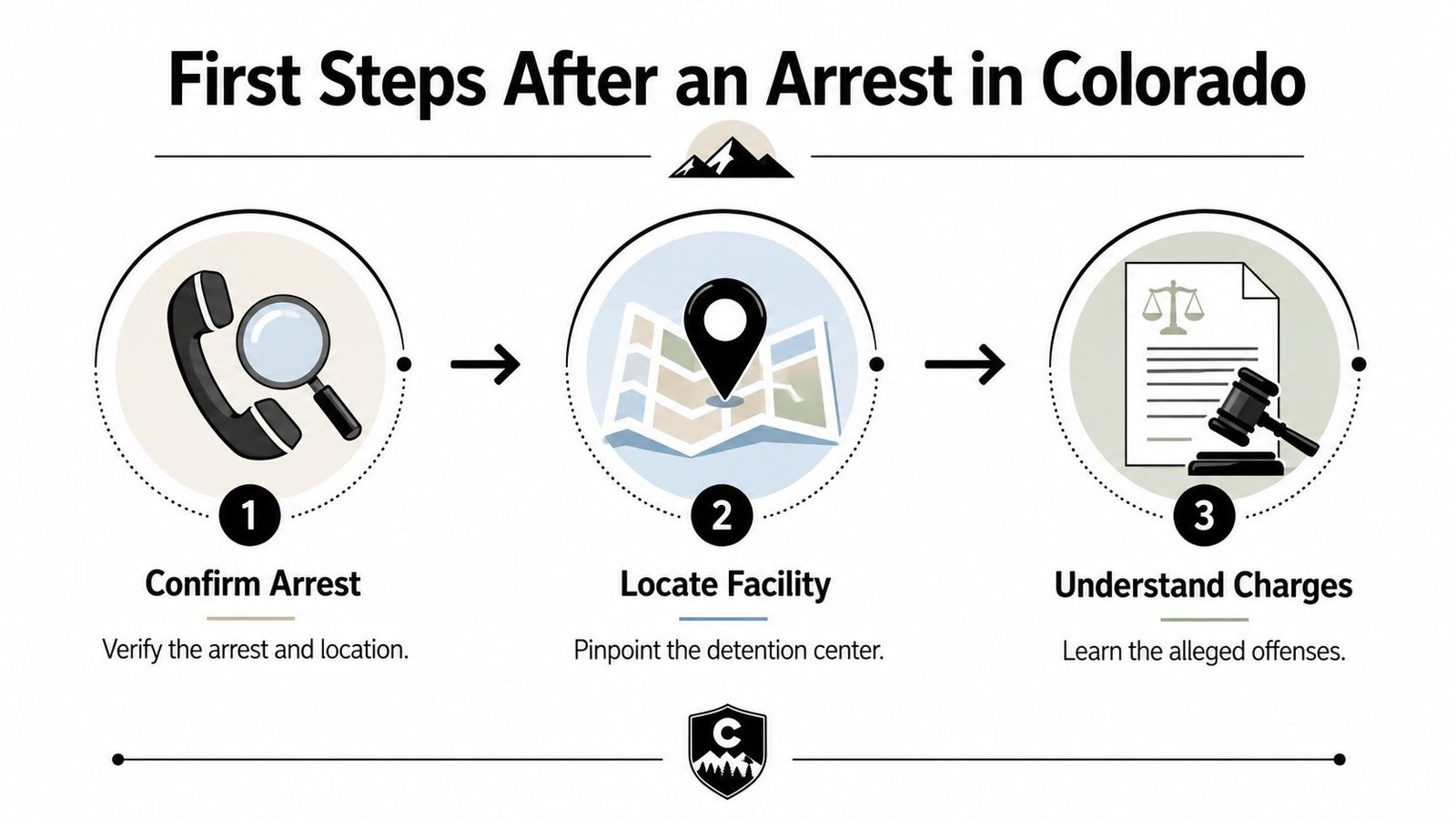
Confirm the arrest and custody location
Families often assume the arresting agency is the same place where the person is being held. In Colorado, that is a common mistake. Someone arrested by a city police department may be booked into a county jail, and transfers can happen before the family gets clear information.
Start by confirming five things:
- The person's full legal name
- The exact jail or detention center holding them
- The booking number or inmate number, if available
- Whether bond has been set yet
- What type of bond applies, such as cash-only, personal recognizance, or surety
If you need a quick Colorado-specific checklist, this guide on what to do when arrested walks through the order that makes the most sense under pressure.
Why clean information saves time
I tell families this every day. A fast call with wrong information slows everything down more than a careful call made ten minutes later.
A bondsman can usually start working as soon as the jail, booking status, and bond type are confirmed. Remote electronic paperwork can speed things up in many Colorado cases, but only if the details are accurate from the start. If the name is misspelled, the person is in a different county, or the bond has not been entered yet, the file stalls and the family ends up repeating the same calls.
Colorado county systems do not all operate the same way. Denver, Jefferson, Arapahoe, Adams, and Douglas each have their own processes, and release timing often depends on staffing, court schedules, and whether the jail accepts electronic bond processing for that case.
Practical rule: Get the jail name, booking number, and bond status before you start discussing payment.
What to gather before you make calls
The right details let a bondsman or attorney give you a real answer instead of a guess.
- Identity details: Full name, date of birth, and any spelling variation the jail might have used.
- Custody details: The exact facility, booking number, and whether the person has been transferred from the original arrest location.
- Case details: The listed charges, the court handling the advisement or first appearance, and whether there is a hold from another county, immigration, or probation.
- Bond details: The bond amount, the bond type, and any release conditions such as no-contact orders, GPS monitoring, drug testing, or curfew.
One missing detail can change the whole timeline. A surety-eligible bond is different from a cash-only bond. A local case is different from a case with a hold attached.
What helps and what causes delays
Some habits speed things up right away.
What helps: Calling with the full legal name, confirmed facility, and booking number.
What causes delays: Calling multiple agencies with partial information and hoping one of them can piece it together.
What helps: Asking whether bond has been entered into the jail system.
What causes delays: Assuming an arrest automatically means the person can be released right now.
What helps: Writing down the charge list exactly as the jail gives it to you.
What causes delays: Softening or changing the charges when you talk to the bondsman, lawyer, or family decision-maker.
I have seen families lose hours because they were told, “He's in Denver,” when he was in a different facility, or because everyone was ready to pay before the bond had even been set. Slow down long enough to verify the basics. In Colorado, that is often the difference between a smooth release process and a long night of wrong turns.
Cash Bond vs Surety Bond Understanding Your Options
Once the court sets bond, the decision gets practical fast. Can you put the full amount into the jail or court today, or do you need another way to get your person home tonight?
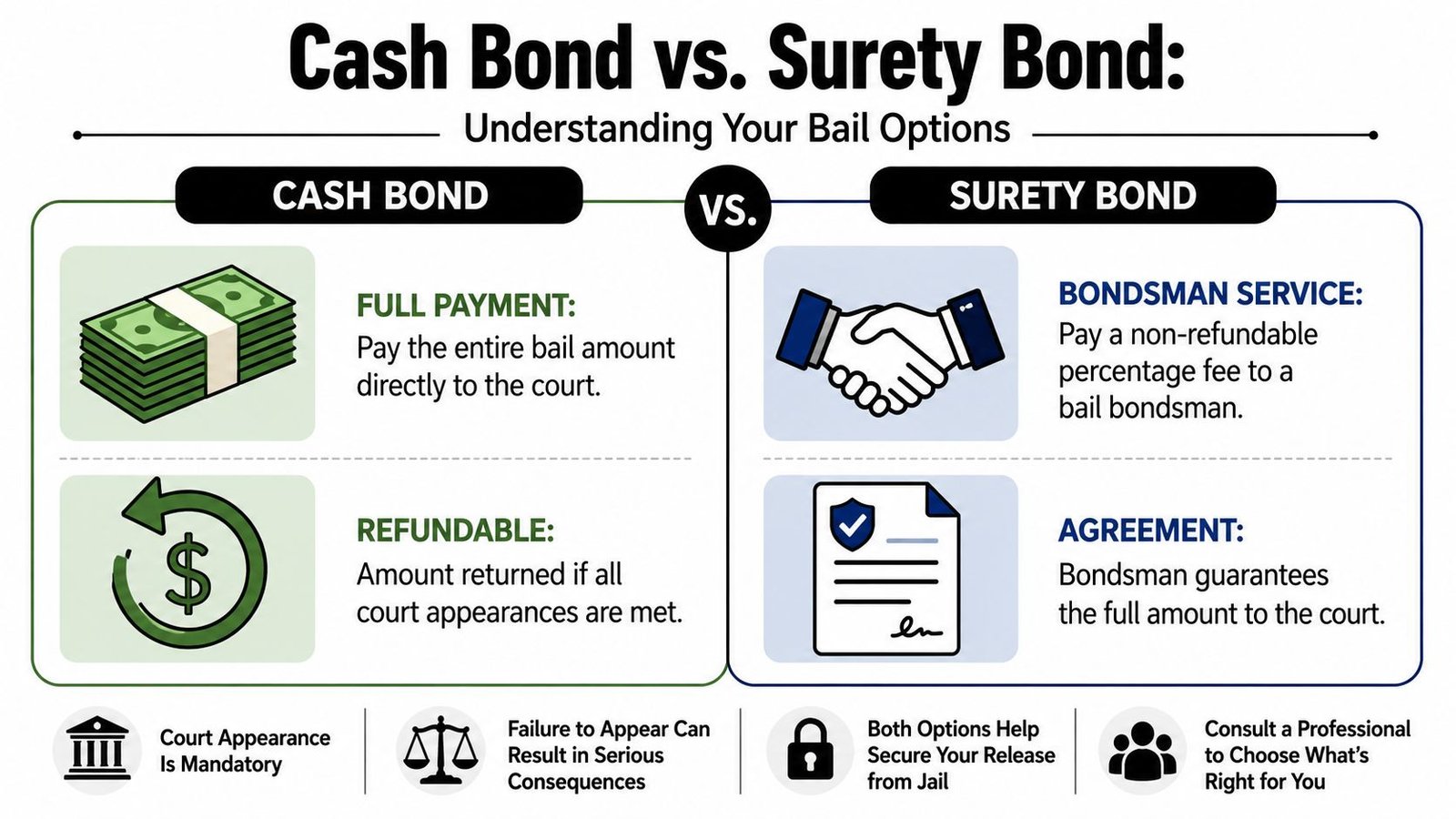
In Colorado, that choice affects more than cost. It can also affect speed, depending on the jail, the bond type the judge set, and whether the facility accepts remote electronic bond processing or requires in-person payment.
Cash bond
A cash bond means paying the full bond amount directly to the court or jail. If the defendant appears as required and follows the bond conditions, that money is generally returned under the court's rules, though fees or costs can affect the final amount returned.
The advantage is simple. There is no premium to a bondsman, no indemnity agreement, and no outside company involved.
The drawback is just as simple. Your money stays tied up while the case is pending, and in Colorado that can mean weeks or months, sometimes longer. If a family has the funds and wants to avoid paying a nonrefundable fee, cash can make sense. If putting up that money means draining rent, payroll, or emergency savings, cash can create a second crisis.
For a more detailed explanation of paying the court directly, see this guide to cash bond meaning.
Surety bond
A surety bond means a licensed bail bondsman posts the bond for the defendant. Instead of bringing the full bond amount to the jail, the cosigner pays a nonrefundable premium and signs an agreement taking responsibility for the bond.
In Colorado, families often choose this route because it lowers the upfront cash needed and can be handled quickly when the jail accepts electronic paperwork and remote posting. That matters in a state where one county jail may process release efficiently overnight, while another may move slower and require tighter cutoffs or in-person steps.
Surety is not cheaper in every sense. It is cheaper upfront. The premium is the cost of getting the person released without tying up the full bond amount, and that premium is usually not returned at the end of the case. A cosigner also takes on real responsibility if the defendant misses court or violates conditions in a way that puts the bond at risk.
The choice for many families is straightforward. Keep the full bond amount tied up with the court, or pay a smaller nonrefundable amount to get a workable release option now.
Cash Bond vs. Surety Bond at a Glance
| Aspect | Cash Bond | Surety Bond (via Bail Bondsman) |
|---|---|---|
| Upfront payment | Full bail amount paid directly | Premium paid to licensed agent |
| Refundability | Usually refundable if conditions are met | Premium is nonrefundable |
| Best fit | People with immediate access to full funds | Families needing a lower upfront outlay |
| Process | Direct payment through the jail or court | Contract, approval, and bond posting through an agent |
| Risk to payer | Full amount is tied up during the case | Cosigner takes contractual responsibility |
One more option people overlook
Some defendants are released without posting money at all. In Colorado, a judge can set a personal recognizance bond or other non-monetary conditions, depending on the charge, history, and risk factors in the case.
That usually is not something a family can force at the jail window. It comes from the court's bond decision. If bond has not been set yet, or if the amount or type seems out of line with the case, defense counsel can raise that issue with the judge. The Colorado Judicial Branch is the best starting point for court information and county-specific contacts.
Before you spend money, confirm one thing. The bond must be one the jail can accept in the form you plan to use. A cash-allowed bond, a surety-allowed bond, and a cash-only bond are not the same, and in Colorado that wording matters.
How to Partner with a Colorado Bail Bondsman
You get the call at 11:40 p.m. Bond has been set, the jail says a surety bond is allowed, and now the family is staring at the same question I hear every day. Who do we call, what do they need, and how fast can this happen in Colorado?
The right bail agent should answer those questions without adding confusion. A good agent gets the facts, tells you whether the bond can be written, explains the cosigner's responsibility in plain English, and starts the paperwork in the fastest format the jail will accept.
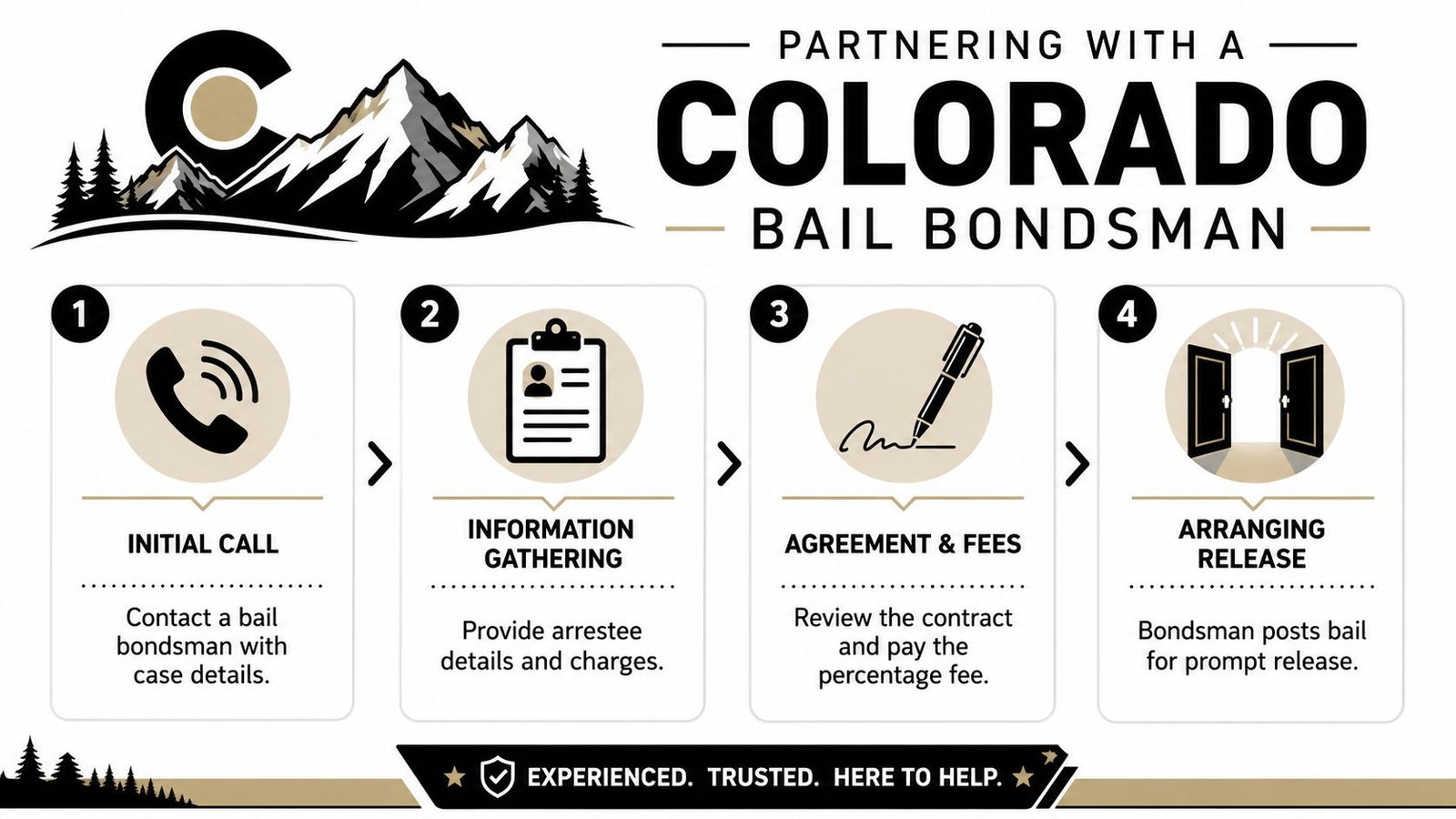
The first call
Keep the first call factual. Emotions are normal, but speed comes from clean information.
Have these details ready if you can:
- Full legal name
- Date of birth
- Booking number
- Jail or detention facility
- Charges, if known
- Bond amount and bond type
- Any hold, warrant, or condition the jail mentioned
If you do not know something, say that directly. Wrong information causes more delay than missing information.
A reliable agent is trying to answer three practical questions right away:
- Can this bond legally be posted through a surety bond
- Who will cosign and take responsibility
- What is missing that could hold up approval or release
If you want a plain-English explanation of the agent's role, this page on what a bail bond agent does is a good starting point.
What the cosigner is agreeing to
This is the part families rush through, and it is the part they need to slow down for.
A cosigner is not just helping someone get out. The cosigner is entering a contract with the bond company. If the defendant misses court, violates bond conditions in a way that leads to forfeiture, or disappears, the cosigner can be responsible for costs and losses under that agreement.
That is why an agent asks about your job, address, length of residence, relationship to the defendant, and sometimes collateral. Those questions are part of basic underwriting. In plain terms, the agent is deciding whether the person signing is stable enough and informed enough to stand behind the bond.
Premiums in Colorado are usually a percentage of the bond, and that fee is generally not refunded once the bond is posted. The exact amount can depend on the bond size, the file, and the agency's approval terms. Ask for the total cost up front. Ask whether collateral is required. Ask what happens if the defendant misses court. A professional agent should answer all three without hedging.
If the contract is not clear to you, stop and ask again. You should understand the payment terms, the indemnity terms, and what the company expects from both the defendant and the cosigner.
Why remote processing often moves faster in Colorado
Colorado families still assume bail has to be handled in person. Sometimes it does. Many times it does not.
Remote electronic processing can save real time, especially if the cosigner lives in another county, works nights, or cannot get to the jail quickly. Electronic applications, document review by phone, identity verification, and online payment can shorten the outside part of the process. That does not mean the jail releases the person instantly. It means you remove avoidable delay before the bond is posted.
That matters in Colorado because jail procedures vary. One county may move quickly once the bond hits the system. Another may take longer because of staffing, shift change, medical clearance, warrants from another jurisdiction, or a separate hold. A good bail agent will tell you which part they control and which part belongs to the jail.
For statewide service details, readers can review the Colorado bail bond agency homepage, and people dealing with west-metro custody can look at Jefferson County bail bond help in Golden. South-metro families often need a local reference point too, especially when handling Arapahoe-area custody and court logistics, which is why the Centennial bail bonds page is useful.
A quick visual helps if you've never seen what an online-first agency setup looks like.
What the actual workflow looks like
In most Colorado cases, the process works like this:
- Confirm the bond type. The jail or court paperwork must allow a surety bond.
- Send the case details to the agent. Full name, date of birth, jail, booking number, charges, and bond amount matter most.
- Complete the cosigner review. Expect identity checks and questions about residence, employment, and relationship to the defendant.
- Read the agreement before signing. Focus on court appearance duties, payment terms, and indemnity language.
- Sign and pay in the format the agency accepts. Electronic processing is often the fastest option.
- Wait for the bond to be posted and accepted by the jail. Release timing depends on the jail's internal process after that point.
This short video gives a helpful overview of the process mindset families need during release:
What helps approval go smoothly
Families usually get through this faster when they do four things well. They give the exact legal name instead of a nickname. They choose the cosigner before the paperwork starts. They disclose facts that may affect the bond, including holds or prior failures to appear. They respond quickly when the agency asks for ID or signatures.
I have seen plenty of late-night files stall for one simple reason. Nobody decided who was going to sign. In Colorado, that can waste an hour you do not have.
Clear facts, a ready cosigner, and remote paperwork usually give you the quickest path to posting the bond. After that, the jail controls the release clock.
Common Pitfalls That Can Delay Release
The hardest delays to watch are the ones a family causes without realizing it. In Colorado, I see that happen more often than a jail shutdown or a slow booking desk.
Giving the wrong information
Bad intake details can stall the whole process. A misspelled legal name, the wrong county, an incorrect date of birth, or confusion about which jail is holding the person can send calls and paperwork in the wrong direction. That matters in Colorado because county procedures differ, and release timing in Denver, El Paso, Jefferson, Weld, or Adams may look very different on the same night.
Write down only what you know for sure. Mark anything else as unconfirmed. Then verify it through the jail roster, a court record, or the bondsman before anyone pays money or signs an agreement.
One wrong detail can cost an hour.
Treating cosigning like a favor instead of a legal obligation
A cosigner is not just helping with paperwork. A cosigner is taking on financial risk and agreeing to help make sure the defendant appears in court and follows bond terms.
That is why rushed signatures create trouble later. If the defendant misses court, disappears, or violates conditions, the cosigner may be dealing with collection efforts, collateral problems, and court deadlines. Colorado families also ask whether posting bond can affect finances outside the case. In many situations, bond activity itself does not show up like a normal loan, but court-related public records can still matter in other contexts. Superior Credit Repair's public record insights gives a useful overview of how public records can affect credit reporting.
Read the indemnity agreement slowly. Ask direct questions about missed court, repayment duties, collateral, and what happens if the defendant stops answering calls.
If property is involved, slow down and verify ownership, insurance, and any liens before signing. The Professional Bail Agents of the United States discusses these underwriting and collateral practices in its industry resources.
Waiting too long to act
Families sometimes lose half a day because nobody wants to make the call. They hope the person will be released on their own, or they wait for one more relative to weigh in. Meanwhile, the bond may already be set, the jail is still processing releases in order, and the clock keeps running.
Once bond is set, make a decision quickly. Pay the court directly if a cash bond makes sense and you can afford to tie up that money. Use a surety bond if speed, lower upfront cost, or remote electronic paperwork makes more sense for your situation. If bond conditions or the amount look wrong, get defense counsel involved right away instead of waiting until the next day.
Families also get tripped up by a basic question: is the money refundable? The answer depends on how the bond was posted. This guide on how bail money is returned after a case ends explains the difference.
Ignoring release conditions
Posting bond does not end the problem. Sometimes it starts the next one.
A defendant can be bonded out and still land right back in custody if nobody plans for the conditions attached to release. In Colorado, those conditions may include a no-contact order, alcohol monitoring, GPS, curfew, treatment, firearms restrictions, or orders to stay away from a home or workplace. I have seen families arrange the bond perfectly, then create a new violation because they drove the defendant straight to the address the court had barred them from visiting.
Read the release paperwork the same night. If there is a no-contact order, do not treat it like a suggestion. If there is GPS or testing, find out where reporting happens and when it starts.
Missing the immigration issue
An immigration hold can change the whole calculation. A county bond may be posted correctly, and the person still may not walk out if ICE has placed a detainer or if there is another federal issue in the background.
The ACLU explains why local release and immigration detention can overlap in this money bail and immigration discussion. If there is any concern about status, prior ICE contact, or a possible hold, speak with an immigration-aware attorney before pushing ahead blindly.
The fastest release usually comes from accurate information, a qualified cosigner who understands the risk, quick action once bond is set, and careful attention to conditions after the paperwork is done. In Colorado, remote signatures and electronic processing can save real time, but only if the family gives clean information from the start.
Life After Bail What Happens Next
Release is the start of a schedule, not a finish line.
In Colorado, the first 24 hours after someone gets out matter more than families expect. The person released needs to know the next court date, every condition on the bond, and who is responsible for checking in with the attorney, pretrial services, or the bondsman. A lot of trouble starts right here. Papers get folded into a pocket, everyone goes home exhausted, and a reporting deadline gets missed the next morning.
The defendant's side of the obligation
The job is simple to say and serious to carry out. Show up to court. Follow every release condition exactly. Stay reachable.
If the court ordered testing, monitoring, treatment, or check-ins, set that up right away. In Colorado, each county can handle release follow-up a little differently, so I tell families not to assume the process in Denver will look the same as the process in El Paso, Weld, or Larimer. Call the number on the paperwork, confirm the deadline, and write down the name of the person you spoke with.
A missed court date can trigger a new warrant and put the bond at risk. It can also put the cosigner on the hook for money, collateral, or both. Some families also want to know whether any of the money comes back at the end. That depends on whether the bond was posted as cash with the court or through a surety bond. This guide on how bail money is returned explains the difference.
The cosigner's role after release
Cosigning does not end when the jail door opens. Keep eyes on the calendar. Ask to see the paperwork. Make sure the defendant has transportation, a working phone, and a plan to get to every court date and appointment.
This is also the point where practical life problems show up fast. A person may need to get back to work, explain an absence, arrange childcare, or avoid a location named in a protection order. One wrong decision can create a fresh violation. I have seen people do everything right on the bond and then run into trouble because nobody stopped to read the release terms carefully at home.
Court involvement can also affect other parts of life outside the criminal case. For a plain-English overview of how public filings may show up later, Superior Credit Repair's public record insights are useful.
The good news is that most post-release problems are preventable. Read the paperwork that same night. Save court dates in more than one phone. Set reminders. If anything on the order is unclear, call the lawyer or bondsman before guessing.
That steady follow-through is what protects the bond and keeps the case from getting harder than it already is.