
The call usually comes right after court. A spouse is crying in the hallway. A parent wants to know whether transfer to the county jail means prison is next. A friend asks the question everyone asks in some form: can we still do anything?
Sometimes the answer is yes. Often, the honest answer is yes, but not fast, not simple, and not through the route people hoped for.
That's the hard truth about how to get out of jail after sentencing. Sentencing feels final because the judge has spoken, deputies move quickly, and the family is suddenly dealing with custody, transport, deadlines, and fear all at once. But post-sentencing custody has its own rules. Some options belong to a criminal defense or appellate lawyer. Some belong to prison administration. Some depend on the person inside doing everything right from day one. And some paths are long shots that only apply in extraordinary situations.
In Colorado, it also matters that families understand who does what. A lawyer challenges the conviction or sentence. A bail bond agent may only have a role if the court authorizes a bond after sentencing. Those are very different jobs, and confusing them wastes time you may not have.
After the Verdict What Comes Next
The sentence gets read. The defendant looks back at the family. A deputy touches an elbow and says it's time to move. In that moment, one often doesn't know whether they're dealing with county custody, a future prison intake, an appeal, or a short period before surrender.

The first thing to understand is that sentencing usually doesn't end the legal story. Release, return to custody, supervision, and later challenges are all part of the system. The U.S. Bureau of Justice Statistics reported that about one-quarter of state prisoners were re-incarcerated within 2 years or less after release, and close to one-third recidivated within 3 years in this BJS publication on returning to prison. That matters because custody after sentencing is often part of an ongoing cycle, not a clean endpoint.
Families also need to know whether their loved one is in a jail holding setting or headed into a prison system, because the procedures, timelines, and decision-makers change. If you need a plain-language distinction, this explanation of the difference between jail and prison is a useful starting point.
What families usually get wrong first
The biggest mistake is thinking there must be one master button that gets a person out. There usually isn't.
What exists instead is a series of narrow doors:
- Immediate court relief: A stay, delayed reporting date, or bond pending appeal in the rare case where the court allows it.
- Attorney-driven litigation: Appeals and post-conviction motions attacking the conviction, sentence, or procedure.
- Administrative sentence reduction: Credits, programs, and classification decisions that affect time served.
- Extraordinary relief: Compassionate release or executive clemency in the right facts.
Practical rule: The faster you identify which door is even available, the less time you lose chasing the wrong one.
Colorado reality at the start
In Colorado cases, families often scramble to call everyone at once. That's understandable, but this stage requires triage. Call the lawyer first for anything involving deadlines, appeals, resentencing, or release requests. Call the jail to confirm location and booking status. Gather paperwork before it disappears into piles: minute orders, mittimus, bond paperwork if any existed earlier, sentencing notes, medical records, and names of witnesses who heard what the judge said.
If you're staring at the paperwork in shock, that reaction is normal. But the next steps are procedural now. Emotion won't move the case. Documents, deadlines, and the right professional might.
The Critical Window Actions Immediately After Sentencing
The hours right after sentencing can matter more than the next month. If there is any chance of avoiding immediate remand, delaying execution of the sentence, or obtaining release while an appeal is pending, the work starts immediately in court or right after court.
What can happen right away
A defense lawyer may ask the court for some form of post-sentencing release. Depending on the case, that might mean a request to stay execution of the sentence, a delayed surrender date, or a bond pending appeal. In everyday conversation, people call that an appeal bond.
That bond is not automatic. It exists only if the court allows it. The judge will look at the case posture, the offense, public safety concerns, flight risk, and whether the appeal raises a serious issue worth review. In some cases, the answer is a quick no.
If the judge doesn't authorize a post-sentencing bond, a bail bond company can't create one by agreement with the family. The court has to open that door first.
Where a bail bond agent fits and where they do not
Families in Colorado often lose precious time at this stage. A bail bond agent is not the person who files an appeal, argues sentencing error, or asks the appellate court for relief. That is lawyer work.
A bail bond agent only becomes relevant if a court sets a bond that can be posted. If that happens, the family may need a surety bond arranged quickly, just as they would in other release settings. If you're trying to understand the custody process before a scheduled surrender or remand, a simple guide on turning yourself in can help families prepare for booking, property, and intake logistics.
What to do in the first day or two
Use this checklist instead of making random calls:
Ask for the exact ruling in writing
Don't rely on hallway memory. Get the written order, mittimus, or minute entry and confirm whether the judge denied or allowed any release pending appeal.Clarify reporting status
Some defendants are remanded immediately. Others receive a report date. That difference changes everything, including how fast counsel can prepare filings.Pin down appellate counsel
Trial counsel may handle the next step, or they may not. Ask directly who is filing what, and by when.Secure the record
Order transcripts if needed. Save text messages, call logs, calendar entries, treatment records, and sentencing exhibits. Small facts often become important later.Prepare family logistics
Medication lists, jail account deposits, attorney contact information, and approved contacts need attention right away.
What doesn't work
Families often ask whether good behavior in the courtroom, community support, or the hardship on children can get someone out immediately after sentencing. Those facts may matter in some settings, but they usually don't produce instant release after a sentence has been imposed.
What also doesn't work is waiting a week because everyone is emotionally exhausted. Deadlines don't care that the family is overwhelmed. If there is a narrow opening for release pending appeal, it won't stay open long.
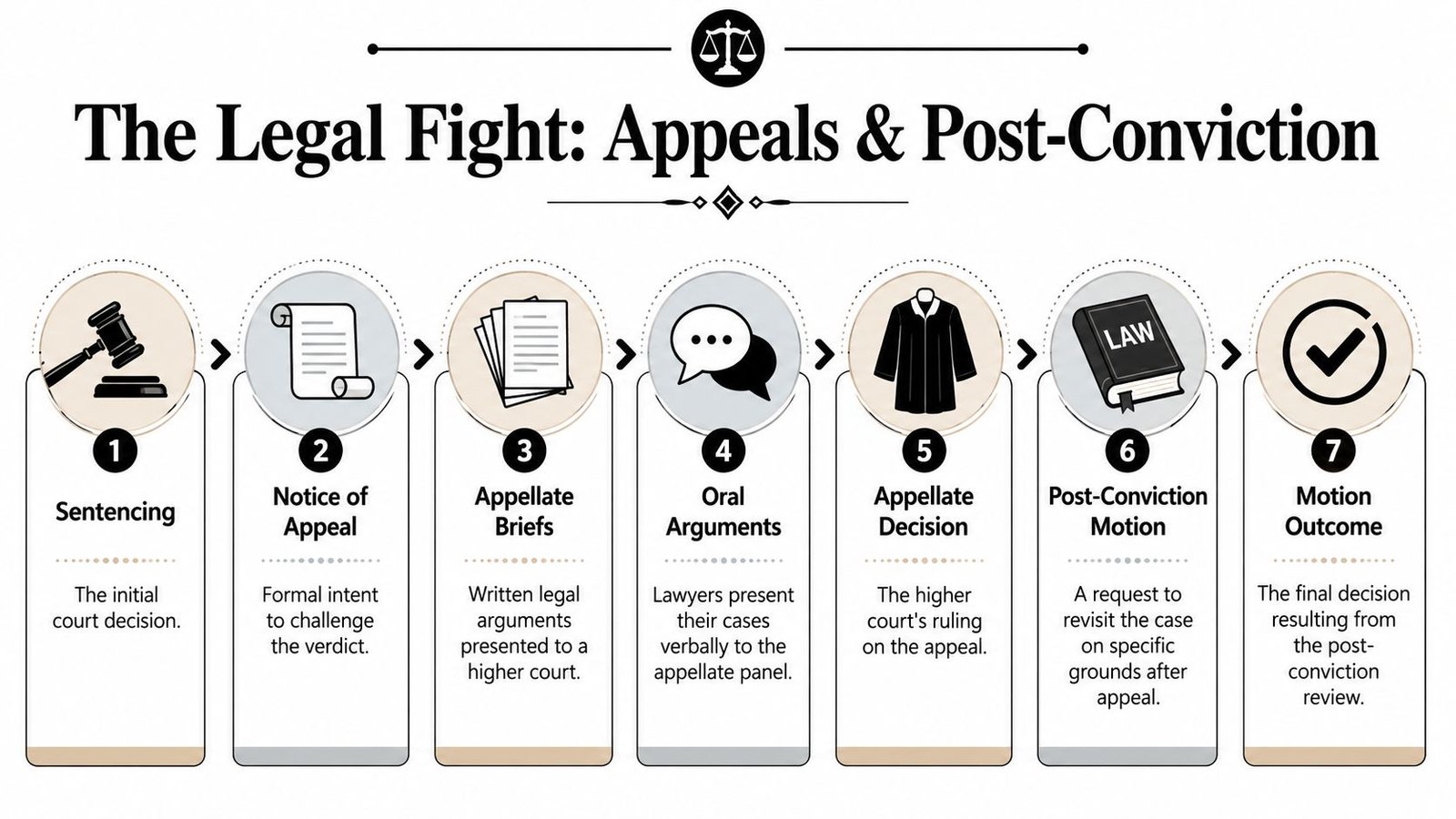
The Legal Fight Appeals and Post-Conviction Motions
An appeal and a post-conviction motion are not the same thing, and treating them like they are can cost you time.
An appeal argues that the trial court made a legal error. A post-conviction motion usually asks the court to revisit the conviction or sentence for a specific reason after judgment, such as constitutional problems, newly developed issues, or sentencing defects. In Colorado, families need a lawyer who works in this terrain regularly, not a general promise that someone “handles criminal matters.”
Appeals are about error, not sympathy
Appellate courts don't retry the facts because the sentence feels harsh. They review legal questions. That may include bad evidentiary rulings, jury instruction problems, constitutional violations, prosecutorial misconduct, or sentencing mistakes.
If part of the case involves digital communication, families should understand that text messages can become important evidence very quickly. This legal guide to text evidence is worth reading because preservation problems often start before anyone realizes an appeal or post-conviction case is coming.
Post-conviction motions can target the sentence itself
Some post-sentencing relief focuses less on guilt and more on the sentence imposed or how it was reached. That can include sentence reconsideration arguments where permitted, correction of illegal sentence issues, or other structured relief under Colorado procedure.
This area is technical, and the details matter more than families expect. A lawyer has to choose the right procedural vehicle. File the wrong motion, in the wrong court, at the wrong time, and the court may deny it without ever reaching the merits.
A practical question to ask counsel is whether the issue is:
- best raised on direct appeal,
- better handled through a post-conviction motion,
- or preserved now and argued later after the record is complete.
What sentence reductions usually look like
People often think sentence reduction means dramatic reconsideration based on fairness alone. In real practice, reductions tend to come through rule-based mechanisms and negotiated outcomes.
One benchmark from federal sentencing practice shows how structured mitigation can affect sentencing before the sentence is final. Under U.S. Sentencing Guidelines Section 3E1.1, acceptance of responsibility can lead to a 2-level reduction, plus an additional 1-level reduction for a timely guilty plea, and downward departures commonly reduce sentences by 15% to 30% when granted, as described in this sentencing reduction discussion. Those figures are federal, not Colorado state sentencing rules, but they illustrate the main point: meaningful sentence changes usually come from specific legal authority, not general pleas for mercy after the fact.
The strongest post-sentencing cases are built on a precise legal theory, a clean record, and a filing made on time.
Questions families should ask a Colorado appeals lawyer
A strong consultation is not about being reassured. It's about hearing whether counsel sees a real issue.
Use questions like these:
- What is the appealable error? Ask counsel to identify the legal issue in one or two sentences.
- What deadlines control this case? You need actual dates, not “soon.”
- What parts of the record need to be ordered now? Trial transcripts, sentencing transcript, exhibits, sealed materials.
- Is there any realistic release request while review is pending? Not every case allows one.
- Who is handling the briefing? The lawyer whose name is on the case may not be the one writing it.
Before any hearing tied to these requests, families often benefit from practical courtroom preparation. This guide on how to prepare for a court hearing helps with expectations, documents, and behavior in court.
What not to do yourself
Don't draft your own motion from internet templates unless a lawyer specifically tells you to file something simple and specific. Don't contact jurors. Don't coach witnesses into rewriting history. Don't flood the court with character letters that don't address the legal issue before the judge.
Post-conviction work is one of the few parts of criminal practice where good intentions regularly produce bad records.
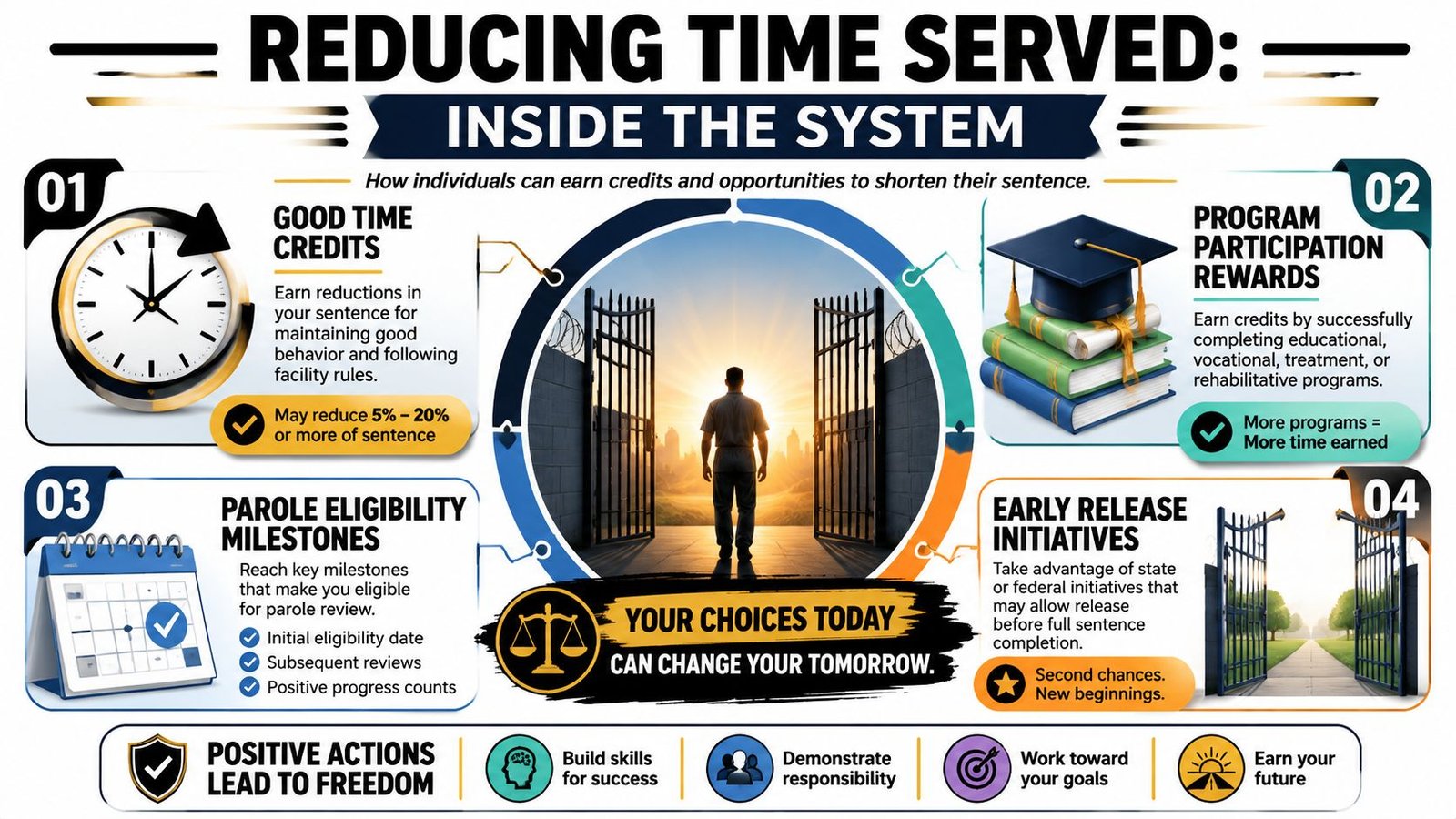
Reducing Time Served Inside the System
Once the person is in custody, another question takes over: if the conviction stands for now, how do you shorten the remaining time lawfully?
That answer usually comes from the institution, not the courtroom. At the institution, conduct, paperwork, classification, programming, and timing start to matter every day.
Credits are earned through rules, not wishful thinking
Federal practice provides a clear model for understanding how sentence reduction works inside a system. A defendant can earn good-time credit of up to 15% on sentences of 12 months and one day or longer, and eligible people can earn First Step Act credits at a rate of 10 to 15 days for every 30 days of successful participation in approved programs. RDAP completion can also reduce a sentence by up to one year, according to the Federal Defender resource on federal sentencing and prison credits.
Colorado families should treat that as a model of the larger principle. Inside any correctional system, release dates often move because the person in custody protects credits, joins approved programming, avoids write-ups, and keeps records straight. It is rarely enough to “stay out of trouble” in a vague sense. The system usually wants documented compliance.
What the person inside should do early
The smartest approach is front-loaded. Waiting until the final stretch leaves opportunities on the table.
Protect discipline from day one
Tickets, fights, contraband issues, and refusal problems can damage classification and release opportunities.Enroll early in approved programs
Education, treatment, job training, and cognitive or rehabilitative programs often matter most when started early and completed cleanly.Keep copies of everything
Certificates, evaluations, treatment participation, work assignments, and requests submitted through the facility all matter later.Confirm sentence calculation
Credit for time served, jail credit, and release calculations need to be checked. Errors happen.
A useful way to think about this
Families often ask whether effort inside really changes anything. The practical answer is yes, but only when the effort matches a recognized path.
| Focus inside custody | What helps | What hurts |
|---|---|---|
| Release credits | Approved participation and compliance | Assuming credits apply automatically |
| Classification | Clean conduct and stable adjustment | Repeated disciplinary problems |
| Program access | Early requests and persistence | Waiting until late in the sentence |
| Reentry planning | Housing, work plans, family support | No release plan or disorganized paperwork |
Inside-custody reality: Staff can't award what the rules don't allow, and they usually won't chase records the inmate failed to keep.
Families still have a role
The person inside has to do the daily work, but families can support the process. They can send records, help organize medical or treatment histories, keep names and dates straight, and avoid sabotaging progress with drama, contraband, or pressure to break rules.
This is also where expectations should stay grounded. A first-time offender does not automatically receive easier treatment, reduced classification, or extra leniency after sentencing. Outcomes depend on offense, conduct, institutional rules, and legal eligibility. For a broader look at why first-time status doesn't guarantee lighter treatment, this article on whether judges go easy on first-time offenders helps frame the issue realistically.
What usually fails
Three things fail over and over.
First, inmates assume staff will identify every beneficial program for them. Sometimes staff help. Sometimes they don't. The person serving the sentence has to be proactive.
Second, families assume “good behavior” equals release. It doesn't. Credits and placement decisions are formula-driven and conditional.
Third, people wait to build a record until they need one. By then, months of potential proof are gone.
Extraordinary Options Compassionate Release and Clemency
Some families are dealing with facts that don't fit the usual channels. A severe medical decline. A terminal condition. A profound change in circumstances. In those cases, people start asking about compassionate release or clemency.
These are real options. They are not routine options.
Compassionate release is procedural and unforgiving
In federal cases, compassionate release usually requires the inmate to first ask the warden and then either exhaust administrative appeals or wait 30 days after the request goes unanswered, as explained in this overview of federal compassionate release procedure. The timing is not a side issue. It is part of the case.
That means families can lose valuable time by sending emotional letters to the wrong office or filing in court before the procedural prerequisites are met. A strong compassionate-release request is usually built like a record, not like a plea. It includes medical documentation, release planning, institutional history, and a legal argument that fits the governing standard.
Clemency is different from court relief
Clemency is not the same as an appeal. It does not depend on showing that the trial judge committed legal error. It is an act of executive grace, usually sought through a commutation request or pardon framework.
In Colorado, that means entering a process that is often slower, more discretionary, and more political than families expect. The case may still need legal help, but not because a court is correcting itself. The argument is different. The audience is different. The burden feels different too.
When these options make sense
These routes are worth discussing when the facts are exceptional, such as:
- Serious medical decline that can be documented clearly
- A major change in law or circumstance that creates unusual unfairness
- Advanced age or severe incapacity affecting continued incarceration
- Compelling humanitarian facts paired with a credible release plan
What matters is not just hardship. Hardship is common in custody. The question is whether the hardship fits a recognized basis for extraordinary relief.
Don't confuse a compelling family story with a legally sufficient compassionate-release record. Sometimes they overlap. Often they don't.
What families should gather
If counsel believes one of these paths is viable, start assembling a usable file:
- medical records and current diagnoses
- medication history
- proposed residence on release
- caregiver information
- proof of treatment availability outside
- disciplinary record if available
- letters from treating providers or facility contacts where appropriate
What families should not do is promise a result. These are hard cases. They can be worthy and still fail.
Assembling Your Support Team and Next Steps
The first 24 hours after sentencing often feel chaotic. A spouse is trying to find the custody location, a parent is calling the trial lawyer, and someone is asking whether a bondsman can get the person released that night. In Colorado, those are three different problems, and treating them as one usually wastes time.

A post-sentencing case works better when each person has a defined job. The lawyer handles court relief. The family handles information and logistics. The person in custody protects every future opportunity by staying out of trouble inside, following rules, and getting into any programming that may help later.
That division matters because families often call the right person for the wrong task. A bail bond company cannot file an appeal. An appellate lawyer cannot post a bond. If you need a plain-English explanation of that difference, review what a bail bond agent does.
Who should handle each part
Use the team you need, not the team you wish you had.
- Appellate or post-conviction lawyer for a notice of appeal, Rule 35 work, sentence challenges, and any analysis of whether a stay or bond pending appeal is legally available
- Trial counsel or sentencing counsel to get the mittimus, sentencing minute orders, plea paperwork, and other parts of the court file to the next lawyer quickly
- Family point person to keep one calendar, one document folder, one contact list, and one record of every court date, transfer, and deadline
- Support contacts to gather medical records, treatment history, housing options, work letters, and transportation plans if any release request will require a stable reentry plan
- Bail bond agent only if the court has set a bond that can be posted after sentencing, or if the family needs help understanding booking, hold status, and release procedure
One Colorado resource families sometimes contact for detention logistics is Express Bail Bonds. Their role after sentencing is narrow unless a judge authorizes a bond, but they can still help a family understand whether they are dealing with a bondable situation or a straight remand into custody.
What to do in the first week
Start with documents. Get the written sentencing order, mittimus if one has issued, case number, next court date if any, and the exact name of the facility holding the person. Verbal summaries from the hallway are not enough. I have seen families act on bad information for days because no one ordered the paperwork.
Then assign one person to communicate with counsel. Five relatives calling the office with five versions of the same question slows the case down and increases the chance that a deadline or instruction gets missed.
Money also needs attention early. Someone should manage commissary, property pickup, mail rules, phone setup, and account access. Those chores sound minor until they interfere with attorney calls, medication follow-up, or the ability to get records signed and sent out.
A realistic benchmark for release planning
Families often picture release as one event. Custody usually works in stages. As Prison Policy's review of long sentences and release structure explains, time reductions and community placement can depend on separate rules, separate decision-makers, and a long paper trail. The practical lesson is simple. Build the file early, because the release plan may matter long before anyone is close to the door.
A short video can also help families reset expectations about what the process asks of them.
Quick answers to common questions
Can you get out of jail right after sentencing
Sometimes. It usually requires a specific court order, such as a delayed surrender, a stay, or a bond pending appeal.
Can a bondsman get someone out after sentencing
Only if the judge has set a bond that can legally be posted. A bondsman cannot override a remand order or create a bond where none exists.
Is an appeal the fastest way out
Usually no. Appeals can be necessary, but they rarely produce immediate release.
What should the family do first
Get the written orders, confirm where the person is being held, identify which lawyer is responsible for the next filing, and start collecting records that may support later relief.