
A call from jail usually comes at the worst possible time. You're trying to figure out where your loved one is, whether bond has been set, how fast release can happen, and whether you can handle it from your phone instead of driving across Houston in a panic.
That's where online bail bonds in Houston can help. But families often get tripped up by one simple misunderstanding. “Online” rarely means every part is fully remote from start to finish. In Houston, the process is often a mix of digital forms, document uploads, phone verification, and county-specific posting rules.
If you're out of town, or even out of state, that hybrid process can still save a lot of time. It just works better when you know what happens on the screen, what happens behind the scenes, and what may still require a call, approval step, or follow-up visit.
Navigating an Arrest in Houston from Afar
If your family member was arrested in Houston and you're not nearby, the first problem is usually confusion. You may not know which jail they're in, whether they've seen a magistrate, or whether a bond amount is already available. That uncertainty makes people rush, and rushing leads to preventable mistakes.
The good news is that remote bail arrangements are much more practical than they used to be. A bail company can often start the intake process by phone, email, or online form, which is a major relief for parents, spouses, and friends who can't immediately get to Harris County. If you're trying to understand what happens before bond is set, this guide to understanding Texas bond hearings helps explain the early court stage that often confuses first-time families.
What remote help can actually do
Online intake can usually help you:
- Start the file quickly: You can submit basic details without waiting for office hours.
- Send documents from anywhere: ID and supporting paperwork can often be shared electronically.
- Coordinate as an out-of-state cosigner: If you aren't in Texas, remote processing may still let you handle much of the front-end paperwork.
For families dealing with distance, posting bail out of state is often the closest comparison to what Houston callers need in practice, even though local rules still control how the bond gets posted.
Practical rule: Treat online bail as a faster intake method, not as a promise that every step is invisible and automatic.
What catches people off guard
The stress point isn't usually the form itself. It's the gap between what families think “online” means and what Houston jails and bond offices still require. A website may let you start from your phone, but approval still depends on identity checks, bond details, and local posting rules.
That's why the best approach is calm and methodical. Get the right information first. Confirm the jail and charge. Ask what part is digital and what part still needs a live signature, phone confirmation, or office follow-up. That simple approach saves more time than trying to force a fully remote process where the local system doesn't allow one.
Finding a Licensed Provider and Gathering Information
The first practical step is choosing a licensed bail bond company that can handle the specific facility where your loved one is being held. In Harris County, the process isn't informal. The sheriff's bonding rules control how surety bonds are accepted, so you want a company that knows the local workflow and can explain it clearly.

A key local point matters here. In Harris County, a surety bond must be posted through an approved bonding company, and the county accepts cash or surety bonds only at the designated jail bonding location at 700 N. San Jacinto Street in Houston, according to the Harris County Sheriff's inmate bonding process. Even if your application starts online, the bond still has to move through that approved county channel.
The information you need before you call
Families often lose time because they contact a bondsman with only a first name and a vague story. Start with the basics:
- Defendant's full legal name: Spelling matters.
- Date of birth: This helps separate people with similar names.
- Jail or holding location: Houston-area detention can involve different facilities.
- Charge information if available: Even partial information helps verify the case.
- Bond amount if already set: If it isn't set yet, say that upfront.
If you have booking paperwork, keep it in front of you during the call. If you don't, write down every detail the jail or clerk gives you. Small errors can slow everything down.
How to judge the provider
A reliable company should answer direct questions without dancing around them. Ask whether they are approved for the jurisdiction involved, what documents they need from the cosigner, and whether the process is fully remote or partly in person.
Use customer feedback carefully. Reviews can show whether a company communicates well under pressure, but they don't replace license verification and clear terms. A good starting point is to compare how agencies present their process and reputation through resources like bond company reviews and service expectations.
If the agent can't explain the exact next step after you submit documents, keep looking.
A simple intake checklist
Before you send money or paperwork, confirm these points:
- The company is licensed for the relevant local process
- They've identified the correct defendant
- They've confirmed the jail or holding authority
- They've told you what paperwork the cosigner must provide
- They've explained whether anyone must appear later in person
That last item matters more than people think. A fast online start is useful, but only if you know what obligations still remain after the bond is posted.
Completing Your Application and Paying Online
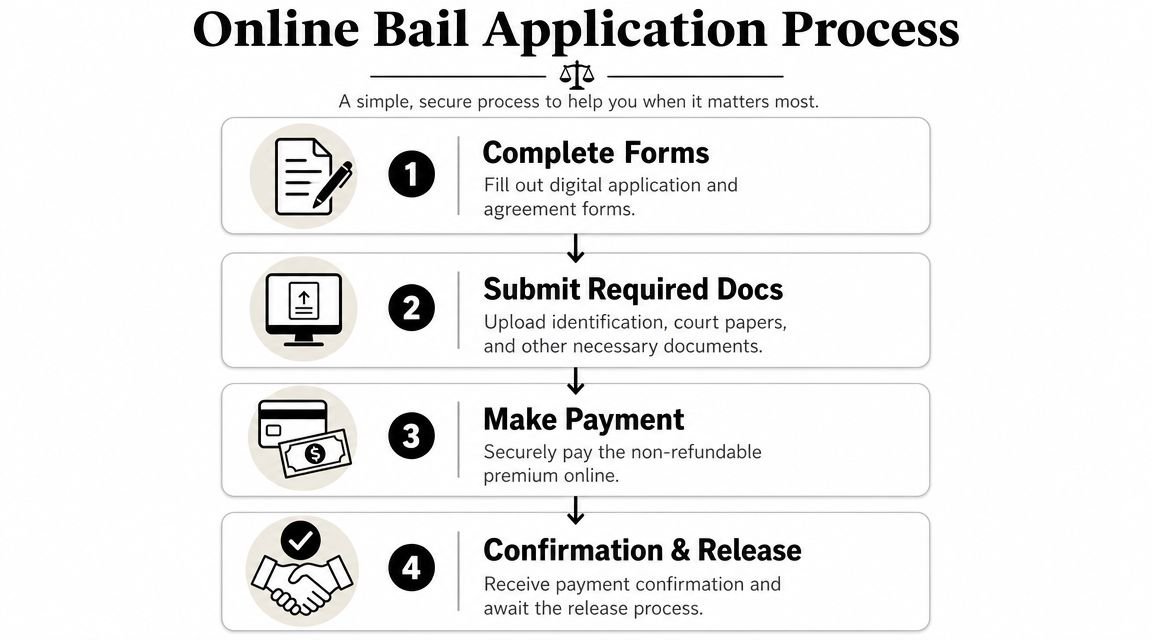
Most Houston families expect the “online” part to be the easy part, and usually it is. You'll fill out an application, provide cosigner details, upload identification, and make payment through the company's system or through a secure link they send you. The trouble starts when people assume that digital intake means no further verification is coming.
That assumption causes frustration. Houston bail processing often works as a hybrid model, not a pure self-serve checkout.
What you'll usually submit
A typical online application asks for the defendant's information, your relationship to that person, your address, your employment details, and your identification. Some Houston providers say the application can be sent by email or fax, but they may still require a recent pay stub, utility bill, and ID, and some require the defendant and co-signer to visit the office within 24 hours after the bond is posted, as described on this Houston online bail bond process page.
That's the practical difference families need to hear early. The front end can be digital. The responsibility side still may not be.
What “paying online” really means
Payment can often be handled remotely, which is one of the biggest benefits for families trying to move quickly. You may be able to review terms, sign documents electronically, and use a card or another electronic payment method instead of showing up with paperwork in hand.
Before you approve payment, slow down enough to read the agreement. If the contract language feels confusing, it can help to streamline legal contract review so you understand the obligations tied to the bond before you sign anything under pressure.
A useful comparison point for understanding digital workflow is how agencies describe electronic payment processing for bail bond clients. The format may differ by company and state, but the underlying idea is the same: digital payment speeds the intake, not the jail's internal release process.
Online payment solves the payment problem. It doesn't eliminate identity checks, bond approval, or jail release procedures.
Where delays still happen
The most common slowdowns after an online application are:
- Missing documents: A blurry ID or missing proof of address can stop approval.
- Charge mismatch: If the charge or defendant details don't line up with jail records, the bond can't move forward cleanly.
- Unclear cosigner obligations: Some people pay first and only later learn that follow-up steps were still required.
- Assuming all jails operate the same way: They don't.
If you want the process to move well, ask one direct question before submitting anything: “After I finish the online application, what exact step still has to happen offline?” A good agent will answer that clearly.
How Long It Takes and What You Will Pay
The two questions every family asks are simple. How fast can this happen, and how much will it cost me right now? Those are fair questions, but they need two different timelines in your mind. One is bond processing time. The other is actual jail release time.
Houston's online bail market puts a lot of emphasis on speed. One provider says bonds handled through its EXPRESS BAIL workflow are posted within 30 minutes to 1 hour, and that same source presents around-the-clock service as a standard part of the offering in this market, which reflects how 24/7 Houston bail processing is marketed locally.
Processing time versus release time
That 30 minutes to 1 hour benchmark applies to posting the bond paperwork, not necessarily to the moment your loved one walks out the door. Once the bond is posted, the jail still has to complete its own internal release procedures.
A simple way to think about it:
| Step | What controls it |
|---|---|
| Application and approval | The bond company and your document readiness |
| Bond posting | The company's speed and county acceptance process |
| Release from custody | The jail's internal processing pace |
If your documents are complete and the charge information is accurate, the bond side can move quickly. If the jail is backed up, release may still take longer than families expect.
What you'll pay
Although people often seek a neat universal number, the amount due depends on the bond amount, the company's terms, and the case details. Because fee specifics weren't provided in the verified Houston data, the safest way to approach cost is to ask for the exact premium due, any collateral requirement, the payment method accepted, and the refund policy for each charge before authorizing payment.
Don't settle for “we'll explain it later.” Get it in writing.
For timing expectations after the bond is accepted, it helps to review a broader explanation of how long bail takes to process. The key lesson is the same in any jurisdiction. Fast posting and fast release aren't always the same event.
Why Houston feels more formal than some markets
Houston families are interacting with a large, visible bail system. Harris County's scale is substantial enough that a prison-policy analysis citing the county referenced $26 million in unpaid forfeitures tied to bond agents and sureties in the local market, a point included in the same Houston market context as the online speed benchmark above. That kind of volume helps explain why companies focus so heavily on documentation, rapid intake, and constant availability.
Avoiding Scams and Navigating Jurisdictions
The fastest way to turn a hard situation into a worse one is to pay the wrong person. Bail is urgent, and urgency attracts bad behavior. Families under stress are more likely to accept vague answers, pressure tactics, and confusing terms if they think delay will keep someone in jail longer.
That's why caution matters just as much as speed.
Red flags that deserve a hard stop
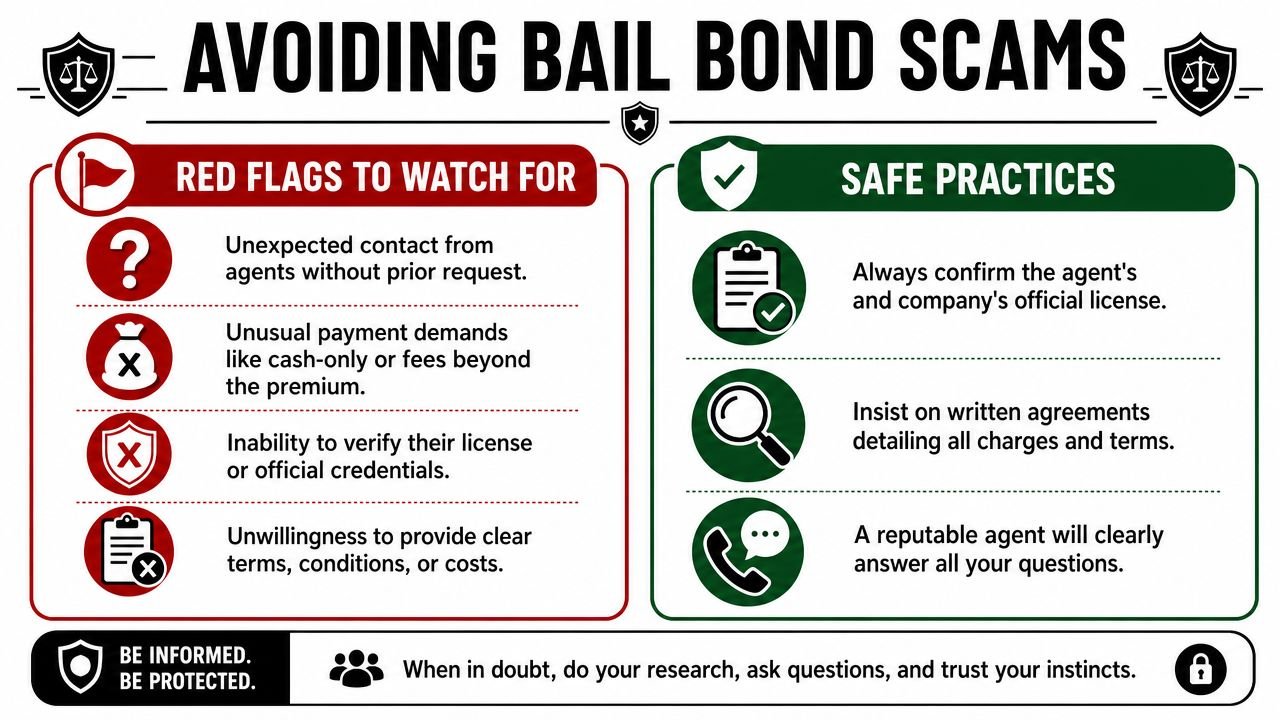
Be careful if you hear any of the following:
- No clear license answer: If the agent can't explain their authority to operate in the relevant area, stop.
- Unclear charges or fees: If they won't break down what you're paying for, stop.
- Pressure to pay before basic verification: You should know the defendant, jail, and bond status first.
- Promises that sound too neat: Real bail work involves checks, paperwork, and local rules.
A trustworthy company should be willing to answer practical questions and put terms in writing. If they avoid specifics, they're telling you something.
Houston-area jurisdiction problems
One of the least understood issues is that the Houston metro bail workflow is fragmented. Providers often separate Harris County, Houston city matters, and surrounding counties such as Brazoria or Fort Bend, which means families can't assume one online process applies to every local facility, as shown in this Houston-area service area breakdown.
That matters because eligibility can vary by jurisdiction and charge type. A family may see “online bail bonds Houston” on a site and assume it covers every nearby jail. In practice, the first question should be more specific: “Can you handle this exact jail and this exact charge?”
A company can be legitimate and still be the wrong fit for your case if they don't handle that facility or that category of charge well.
A better way to verify before paying
Use a quick decision screen:
- Confirm the exact detention location
- Ask whether the online process applies to that facility
- Ask what documents are needed before approval
- Ask whether anyone must appear later
- Get written terms before money changes hands
If you want to see how localized bail service can be, a page like Jefferson County bail bond guidance shows why county-specific knowledge matters. Different markets have different workflows, and that same principle applies in Greater Houston.
For general reputation checking, it also helps to review bail bond reviews and customer experience patterns before choosing who handles something this sensitive.
After The Bond Is Posted Your Houston FAQ
Once the bond is posted, most families finally exhale. That's understandable, but the responsibility side starts immediately after release. The defendant has to follow bond conditions, and the cosigner needs to understand what they agreed to.
What should the defendant do first after release
Read every bond instruction and keep every court-related document. The defendant should know where to appear, when to appear, and whether any reporting or conduct conditions apply.
If the bond company required follow-up paperwork or an office visit, handle that right away. Don't treat release as the finish line.
Does the online part matter after release
Yes, because the online intake creates records, signatures, and payment history that may matter if there's later confusion about terms. Save emails, receipts, and copies of the agreement in one place.
For families comparing processes in different jurisdictions, Centennial bail bond services offer another example of how agencies explain post-release responsibilities clearly. The details vary by location, but the need for written records doesn't.
What happens if someone misses court
Missing court is one of the worst mistakes a defendant can make while out on bond. It can create new legal trouble, put the bond at risk, and create serious problems for the cosigner.
If there's any doubt about a court date, verify it early. Don't rely on memory, a text thread, or what someone “thinks” they heard.
Keep a written list of every court date, every condition, and every contact name tied to the case.
Is Houston's system unusually visible
Yes. In 2022, Harris County launched a public online bail dashboard that lets residents see how bail is being set, what types of bonds are granted, and what charges are involved, and that transparency effort sits within a broader structure overseen by the county's Bail Bond Board, according to ABC13's report on the Harris County bail dashboard launch.
That matters because families aren't navigating a hidden, informal process. Houston's bail environment is unusually visible and regulated. If you approach it with accurate information, clear paperwork, and realistic expectations about what “online” means, the process becomes much easier to manage.
If you need a fast, clear explanation of bail options, paperwork, and next steps, Express Bail Bonds is a helpful place to start. Their site includes guidance on remote processing, timing, reviews, and county-specific bail resources so families can move quickly without guessing.