
The call usually comes late. Someone you care about says they’ve been arrested in another state, they don’t know what happens next, and they need help right now.
At that moment, most families make the same mistake. They focus on the fear first and the details second. The fastest way to help is to reverse that. Stay calm, get the exact booking information, find out what kind of bond is set, and work with a licensed bail agent in the state where the arrest happened.
Posting bail out of state is stressful, but it isn’t mysterious. There’s a process for it, and once you understand the moving parts, the situation gets more manageable.
That Unexpected Call A Guide for When Trouble is a State Away
If your son, daughter, spouse, partner, or friend was arrested far from home, you’re probably juggling three worries at once. You want to know where they are, whether they can get out, and what you can do from hundreds of miles away.
The good news is that out-of-state bail happens every day. In the United States, commercial bail relies heavily on licensed local agent networks for cross-jurisdiction releases, and Bureau of Justice Statistics findings summarized here show that releases on financial conditions in large urban counties rose from 24% to 36% between 1990 and 1998, while by 2004 commercial bonds had only a 3% long-term failure-to-appear rate. That matters because it shows remote cosigning and surety release are established parts of the system, not a workaround.
What usually slows families down isn’t the distance itself. It’s bad information. Someone says, “He’s in Atlanta,” or “She got picked up near Denver,” and that sounds useful until you realize a bail agent needs the exact jail, exact county, and exact booking details.
When a family member is in custody out of state, the first real progress comes from precision, not panic.
One practical first move is to use an inmate lookup resource before you start making calls. If you’re trying to pin down where someone was booked in Colorado, the guide on how to find someone arrested helps you narrow that down quickly.
Release is only part of the picture. In many cases, the person in custody will also need legal advice in the arresting state. If your family is trying to understand how to evaluate counsel under pressure, this overview of hiring a criminal defense lawyer is a useful companion to the bail process.
Your First Hour The Immediate Action Plan
In the first hour, your job is simple. Become the person who gathers clean, usable information.
That means you’re not arguing about the charges, not guessing at the county, and not assuming that one jail equals one city. A lot of release delays happen because the caller has part of the story but not the booking facts the jail or bail agent needs.

Start with identity details
Get the defendant’s full legal name and date of birth exactly right. Nicknames, shortened names, and misspellings create problems fast, especially when a jail search returns multiple people with similar names.
If you have it, also get the booking number. That’s one of the quickest ways to confirm you’re looking at the right record.
Confirm the exact jail and county
“Denver,” “Atlanta,” or “outside of Phoenix” isn’t enough. Bail is handled by the arresting jurisdiction, so you need the exact detention facility and the county attached to it.
If the person is in Colorado, even nearby facilities can mean a different process, a different clerk, and a different timeline. It helps to identify the physical location clearly, such as the Jefferson County Jail location or the Arapahoe County Jail location, so the agent knows exactly where the bond must be posted.
Critical Information Checklist
- Defendant’s full name: Use legal spelling only
- Date of birth: Needed to confirm identity
- Booking number: If available, get it
- Jail name: The exact facility, not just the city
- County: This matters for jurisdiction
- Charges: Ask how the jail lists them
- Bail amount: Confirm the amount and type of bond
- Hold status: Ask if there are any additional holds or restrictions
Ask what kind of bond is set
This point gets missed all the time. You don’t just need the amount. You need the bond type.
A surety bond can often be handled remotely through a licensed bail agent. A cash-only bond is different and may require full payment directly to the jail or court. Some facilities also have holds that prevent release even after a bond is arranged.
Use a simple jail call script
When families are stressed, they talk too much on the phone. Keep it short and direct.
You can say:
“I’m trying to confirm booking information for a family member. Can you tell me the full name in custody, date of birth on file, booking number, charges, bond amount, bond type, and whether there are any holds that would prevent release?”
Write down the answer as you hear it. Don’t rely on memory.
What to avoid in that first hour
A few habits create avoidable delays:
- Don’t guess at the county: A city name alone often isn’t enough.
- Don’t assume bail has been set: In some cases, the person may still be waiting for advisement or processing.
- Don’t send money before confirming bond type: The wrong payment method can waste time.
- Don’t call multiple agents with different facts: Conflicting information slows everyone down.
The first hour is about building a file. Once you have that file, a licensed agent can tell you quickly whether posting bail out of state is straightforward, whether extra documents are needed, and whether the jail is likely to process release the same day.
Navigating Bail from Afar Surety Bonds vs Cash
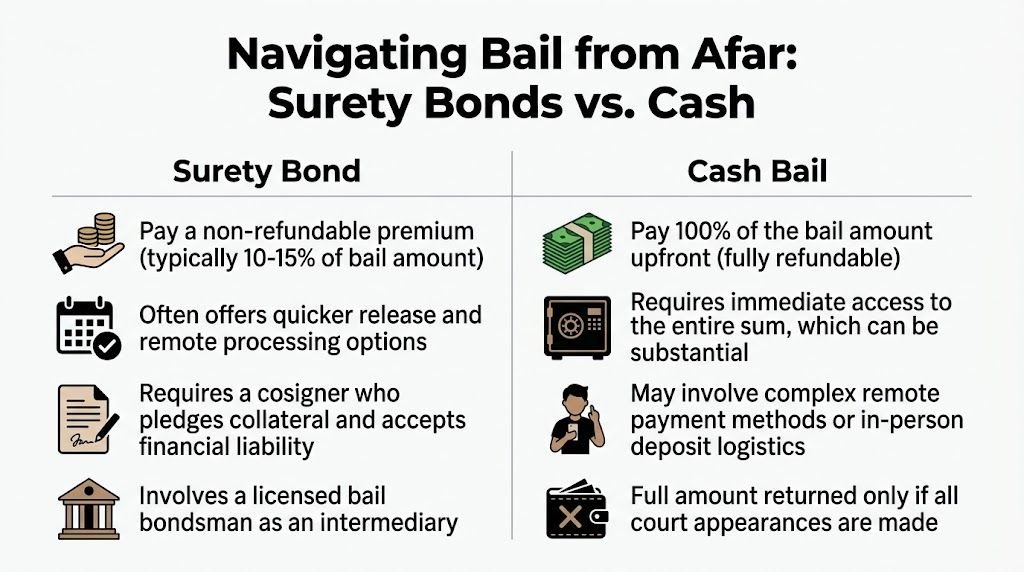
Once you know the bond amount, you usually face two paths. You can post the full amount in cash, or you can use a surety bond through a licensed bail bondsman.
For someone in the same city as the jail, both options may at least be possible. For someone posting bail out of state, they are not equally practical.
Why cash bail is hard from another state
A cash bond means paying 100% of the bail amount up front. If the court allows it and the defendant complies, that money can be returned at the end of the case. But for families helping from far away, cash creates real logistical problems.
You may need to deliver funds directly to the jail or court. You may need certified funds. You may need a person physically present. And if the amount is substantial, tying up that much money for the life of the case is more than most families can comfortably do.
Cash also gives you less flexibility. If a jail requires in-person payment or has limited intake procedures, distance becomes the problem.
Why surety is usually the working option
A surety bond uses a licensed bail agent as the party guaranteeing the bond to the court. Instead of paying the full amount, the cosigner pays a non-refundable premium, typically 10% to 15% of the bail, and completes the indemnity paperwork.
According to this overview of out-of-state bail coordination, posting bail from another state commonly relies on direct remote coordination with a local licensed bondsman or a transfer bond, with 10% to 15% premiums, 90% to 95% success in coordinated cases, and common pitfalls including extra transfer fees and rejection tied to weak cosigner credit. That same source notes that direct contact with a local agent is often more effective than starting with an agent in your home state.
That tracks with how these cases usually go. If the arrest happened in Colorado, the cleanest path is generally to work with a Colorado-licensed agent who can verify the jail, confirm bond eligibility, and post directly.
Side-by-side comparison
| Feature | Cash Bond | Surety Bond (via Bail Agent) |
|---|---|---|
| Upfront payment | Full bail amount | Premium only |
| Refundability | Potentially refundable if the case requirements are met | Premium is non-refundable |
| Remote convenience | Often limited | Commonly handled remotely |
| Need for licensed intermediary | No | Yes |
| Speed in out-of-state cases | Can be slower if in-person payment is required | Often faster when electronic paperwork is allowed |
| Financial exposure | Large cash outlay | Cosigner assumes liability if the defendant fails to appear |
Practical rule: If you’re far away and need speed, a surety bond is usually the option that actually moves the case forward.
When transfer bonds help and when they don’t
Families often call a bondsman near their own home first. That can work if the home-state agent has a strong relationship with a licensed executing agent where the arrest occurred. That arrangement is usually called a transfer bond.
The trade-off is coordination. More people in the chain can mean more fees, more paperwork, and more room for confusion. Direct local handling is often simpler.
For Colorado cases, it helps to review how surety bonds compare with cash bonds before you commit to one route. If the arrest is in the south metro area, practical local details also matter, and families often start by checking resources for Centennial bail bond help so they understand which facility and process they’re dealing with.
The Remote Bail Process A Step-by-Step Walkthrough
Once the jail confirms that a surety bond can be posted, the case becomes a paperwork and verification job. That’s where remote bail either moves smoothly or gets bogged down by missing information.
Step one, call the local licensed agent with complete information
Have your notes in front of you before you call. A good intake call should cover the defendant’s identity, jail, county, charges, bond amount, bond type, and whether there are any holds.
This is one reason local service matters. The agent can often verify details directly with the facility and tell you whether the bond can be posted immediately or whether the jail still has processing steps to complete. If you want a plain-language overview of what the agent does, this guide on how to use a bail bondsman is a useful reference.
Step two, complete underwriting and cosigner review
The cosigner is not just making a payment. The cosigner is entering a legal agreement. That means the agency may ask for identification, employment information, address history, and financial details.
If the bond is larger or the circumstances raise concern, the agency may ask for collateral or additional supporting documents. This isn’t busywork. It’s how the surety decides whether to take on the risk.
A Colorado agency may also be able to process much of this electronically. Express Bail Bonds, for example, handles statewide Colorado surety bonds and allows applications, payments, and contract documents to be completed electronically for many cases.
Step three, sign the indemnity agreement carefully
The indemnity agreement is the contract that puts your responsibilities in writing. Read it slowly.
You’re looking for the key obligations: payment terms, what happens if the defendant misses court, whether collateral is involved, and what the agency can do if the bond is placed in jeopardy. Many out-of-state cosigners frequently rush these considerations, focused solely on securing their loved one's release.
Slow down at the signature stage. A fast release is helpful, but a contract you don’t understand can create a second problem after the first one is solved.
Step four, pay the premium remotely
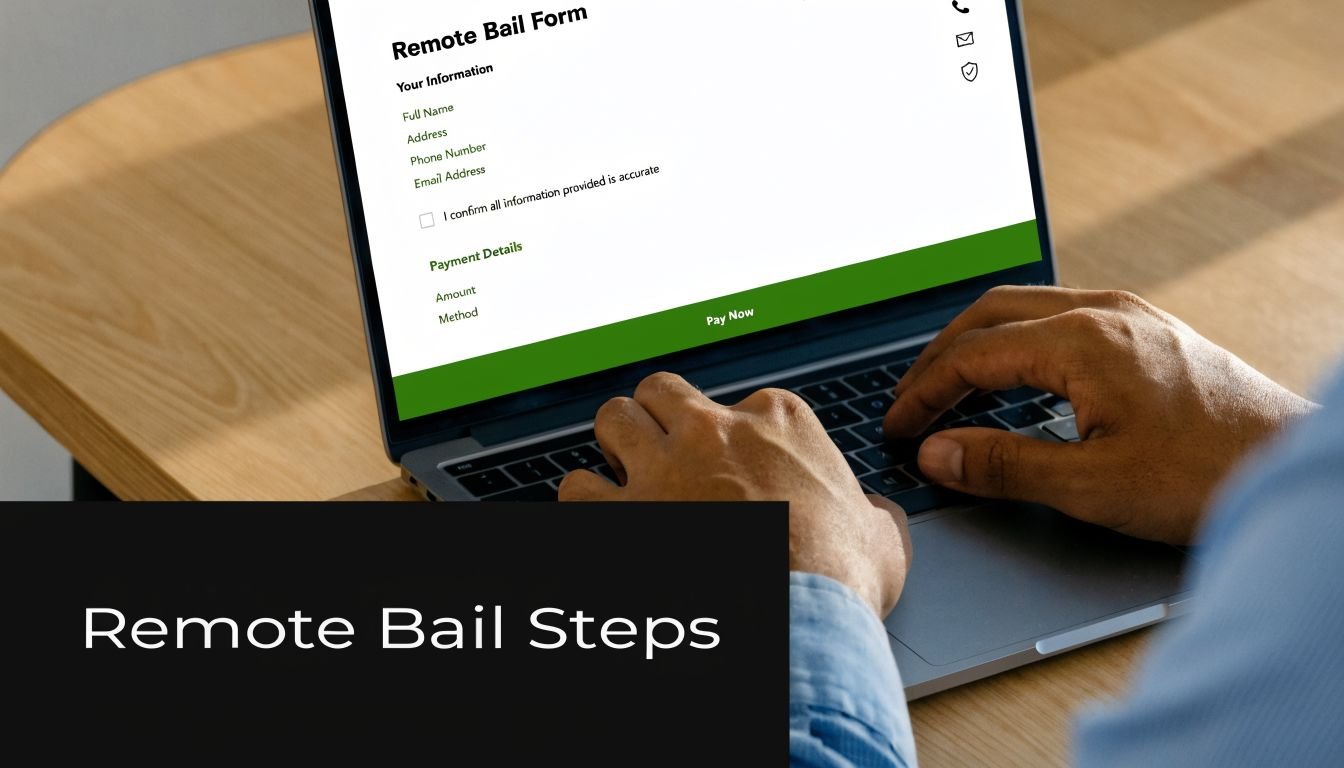
Remote payment is now common in these cases. Depending on the agency and facility, payment may be accepted by card, transfer, or another electronic method.
Electronic bail workflows perform well when the file is complete. This summary of online and phone-based bail processing reports 85% to 92% success for electronic bail processes, with release in under 6 hours in 70% of cases, while noting that 25% of requests are delayed by incomplete information and that direct local contact can reach 95% success, higher than transfer-bond routing. In practice, the biggest avoidable delay is still missing or inconsistent booking information.
Here’s a quick visual walkthrough of how remote bond handling works in practice:
Step five, the agent posts the bond and the jail starts release processing
After documents are approved and payment is complete, the agent posts the bond with the jail or court. That doesn’t always mean the person walks out immediately. Release still depends on the facility’s intake and discharge process.
Some jails move quickly. Others have internal delays, shift changes, medical clearance issues, or holds from another jurisdiction. At this point, families often panic again because “the bond was posted” sounds like “release is happening now.” Sometimes it is. Sometimes the jail still needs time.
The mistakes that cause the most trouble
Posting bail out of state goes better when the file is clean. It goes worse when families improvise.
The common trouble spots are:
- Incomplete booking details: A missing booking number or wrong county can stall verification.
- Cosigner problems: If the cosigner’s financial profile doesn’t support the bond, the agency may decline or ask for more security.
- Rushing signatures: E-signing without reading the indemnity terms causes disputes later.
- Using the wrong agent chain: Too many handoffs can slow communication.
If the arrest is in Jefferson County, local posting details matter, and families often need county-specific guidance for the Jefferson County Jail in Golden. The closer the handling is to the actual arrest jurisdiction, the fewer surprises there usually are.
Your Role and Risks as an Out-of-State Cosigner
A lot of guides talk about how to get the bond posted. Fewer explain what happens after you sign.
That’s a problem, because the out-of-state cosigner is often the person carrying the primary financial risk. If you cosign, you are not doing someone a casual favor. You are guaranteeing performance.

What your signature actually means
When you cosign a surety bond, you’re promising that the defendant will comply with the release terms, especially appearing in court. If that person disappears, misses court, or violates conditions badly enough to trigger forfeiture, the financial responsibility can come back to you.
That can include collection efforts, civil action, and recovery steps that don’t stop at the state line. Distance doesn’t cancel the contract.
The interstate risk many families underestimate
Out-of-state cosigners often assume that because they live somewhere else, enforcement will be harder or less likely. That assumption is dangerous.
As discussed in this review of interstate cosigner liability, cosigners can face wage garnishment and asset liens across state lines if the defendant flees. That source also states that over 20% of federal bail forfeitures in 2024 involved interstate defendants, and that a 2025 Pretrial Justice Institute report found 35% of out-of-state inquiries were abandoned because liability concerns weren’t properly addressed.
Signing from another state doesn’t shrink the obligation. It only makes it more important to understand it before you agree.
Questions every cosigner should ask first
Before you sign, get direct answers to these points:
- What exactly am I liable for? Ask whether you are guaranteeing the full bond amount, fees, costs, or collateral exposure.
- What conduct puts the bond at risk? Missing court is the obvious issue, but ask about travel violations, check-in failures, or new arrests.
- Can the defendant leave the state after release? Don’t assume. Release conditions control that.
- What notice will I get if there’s a problem? You want to know how quickly the agency contacts you if the defendant stops cooperating.
For a plain explanation of this role, it helps to review what a bail bond cosigner is responsible for before you commit.
The practical side of being a good cosigner
A strong cosigner doesn’t disappear after the paperwork is done. The best cosigners stay in communication with the defendant, keep track of court dates, and step in early if the person starts drifting.
That may mean making sure they have transportation, helping them stay organized, or telling the bail agent quickly if something has changed. Silence is what usually turns a manageable issue into a forfeiture issue.
When not to cosign
Sometimes the right answer is no.
If the defendant has a recent history of skipping court, hiding from obligations, or refusing to communicate, you need to take that seriously. The emotional pressure to help is real, but a bond contract should match the person’s reliability, not your hope that things will somehow be different this time.
A reputable agency should be willing to answer hard questions before taking your signature. If the conversation feels rushed or vague, slow it down.
After the Bond Is Posted Next Steps and Potential Hurdles
Release feels like the finish line. It isn’t. It’s the start of the compliance phase, and that phase is what protects both the defendant and the cosigner.
Across the country, the Brennan Center’s review of bail data notes that over 60% of people in local jails are pretrial detainees, and it also points to an 18% failure-to-appear rate in a major BJS study for commercial bonds. For families, the lesson is practical. Once the person is out, the focus shifts to making sure they show up, follow release conditions, and avoid turning one criminal case into several legal problems.
What the defendant needs to do right away
The defendant should keep every piece of release paperwork. That includes court dates, reporting instructions, and any restrictions tied to travel, contact with other people, or substance use.
They also need to stay reachable. If the bail agent or court can’t reach them, small issues can snowball fast.
A short post-release checklist helps:
- Save all paperwork: Court dates, receipts, and bond terms should be kept in one place.
- Confirm the next hearing date: Don’t rely on memory or secondhand information.
- Follow every release condition: Even a minor violation can create trouble.
- Stay in contact with the cosigner and agent: Communication prevents avoidable surprises.
Bench warrants and why they matter
If the defendant misses court, the judge may issue a bench warrant. That means law enforcement can arrest the person for failing to appear.
A missed hearing can also put the bond at risk. If that happens, the bond may move toward forfeiture, and the cosigner may be exposed financially. If you need a plain-language explanation of that process, review what bond forfeiture means.
Missing court is rarely treated as a paperwork mistake. It’s usually treated as a compliance problem with legal and financial consequences.
Extradition concerns in out-of-state cases
Out-of-state arrests sometimes involve more than one jurisdiction. A person may be arrested in one state but have a hold or warrant from another.
When that happens, extradition can become part of the picture. In simple terms, extradition is the legal process of transferring a person from one state to another to face charges. Whether that applies, and how quickly it moves, depends on the case and the jurisdictions involved.
That’s one reason families shouldn’t assume release on one bond ends the matter completely. The defendant may still need to address another court, another warrant, or another county.
Common hurdles after release
These are the problems that come up most often after someone gets out:
- Travel confusion: The defendant assumes they can go home immediately, but the bond or court order may limit that.
- Missed mail or calls: A hearing notice or reminder gets overlooked.
- New charges: A new arrest can affect the existing bond.
- Poor communication: The cosigner thinks the defendant is handling everything, while the defendant thinks nobody needs updates.
The fix is rarely complicated. It usually comes down to routine. Keep the paperwork together. Calendar every date. Answer calls. Tell the agent if anything changes.
For families posting bail out of state, the hardest part is often not the payment. It’s keeping everyone organized after the release, when the urgency fades but the obligations remain.
If you need immediate help with Express Bail Bonds, contact the agency directly for Colorado bail guidance, jail-specific instructions, and remote surety bond help any time of day. If you’re calling for someone in custody, have the full name, date of birth, jail, county, charges, and bond amount ready so an agent can tell you the fastest workable next step.