A ZIP code can tell you a lot about a place, but 19134 tells you more than most. In Philadelphia, this area packs approximately 15,556 people per square mile across 3.84 square miles, while the median household income is $44,066 and the median home value is $135,400, according to GreatData's 19134 profile. That combination points to something important in daily life. This is a dense, working neighborhood where space, cost, transit, services, and local institutions matter in very practical ways.
That's why the 19134 zip code is worth understanding beyond a map pin or a real estate listing. It sits in a part of Philadelphia where community identity runs strong, where local blocks can feel very different from one another, and where neighborhood knowledge helps more than broad city stereotypes.
People usually start with one question. “What's it like to live there?” The honest answer is that 19134 is layered. Housing may look relatively affordable by city standards, but many households still face pressure. The community is diverse and young, which shapes local businesses, schools, and street life. Public infrastructure matters a lot here. So does knowing where to turn for help, whether you need a park, a school option, health support, or legal information.
If you like neighborhood data and practical guidance together, you may also enjoy other ZIP code profile articles that break down places in the same plain-language way.
An Introduction to Philadelphias 19134 ZIP Code
The 19134 zip code covers a section of lower Northeast and River Wards Philadelphia that many locals associate with Port Richmond, while also touching nearby areas that feel connected through commerce, transit, and shared infrastructure. It's urban in the most literal sense. Homes sit close together, streets stay active, and local life often happens block by block rather than in isolated subdivisions.
What makes 19134 stand out isn't just density. It's the way density mixes with economic constraint, neighborhood pride, and practical resilience. A place with compact housing and busy corridors works differently from a spread-out suburb. You notice it in parking, in corner stores, in school pickup routines, in how quickly people learn the useful routes, and in how much daily life depends on nearby services.
What daily life tends to feel like
For a newcomer, 19134 often feels immediate. You're close to other residents, close to storefronts, and close to the systems that keep a neighborhood moving, from water infrastructure to public spaces.
A few realities shape the experience:
- Space is shared: Streets, sidewalks, and parks matter because people use them heavily.
- Local knowledge pays off: The best way to understand the area is to learn specific blocks and corridors, not just the ZIP code as a whole.
- Affordability is relative: A lower home value doesn't automatically mean low financial stress for the people living there.
Practical rule: In a dense Philadelphia ZIP code, quality of life often depends less on broad city averages and more on your exact block, your commute pattern, and the services you need most often.
Mapping 19134 Boundaries and Key Neighborhoods
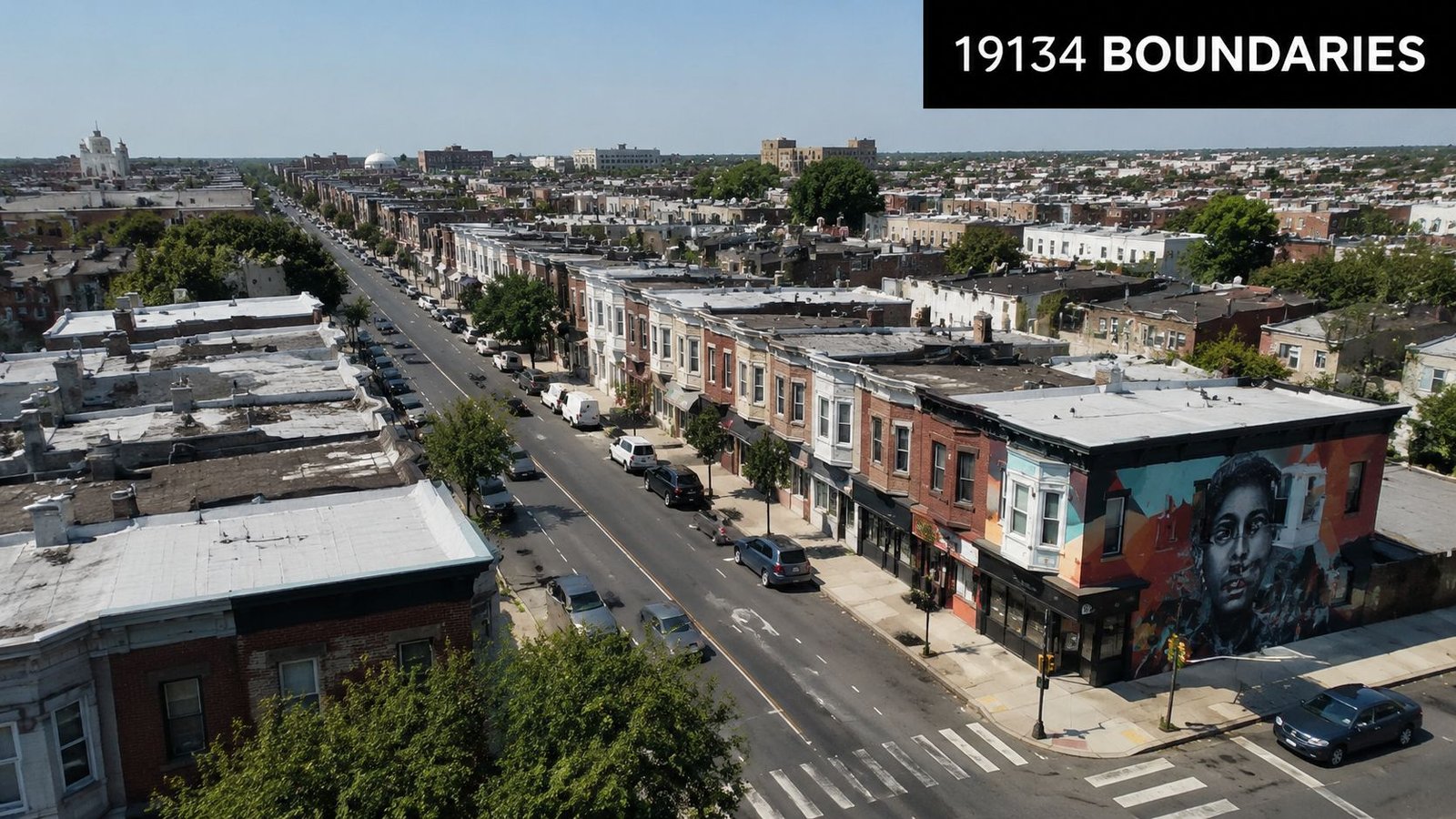
19134 makes more sense when you read it like a city map instead of a mailing label. The ZIP is commonly associated with Port Richmond, but daily life inside its boundaries also touches blocks that residents may describe in more local terms, including parts of the broader River Wards area and Kensington-adjacent corridors. That difference matters. A ZIP code is for delivery and administration. A neighborhood name is what people use to explain where they live.
How to picture the area in real life
Start with Port Richmond as the clearest anchor. If you were giving directions to a friend, that is often the name that would do the most work. From there, your understanding gets sharper by looking at the streets people use for errands, commuting, school drop-off, and bus or train connections.
That street-level view is often more useful than the ZIP line itself.
In practical terms, 19134 works like a set of connected micro-areas. One stretch may feel residential and tight-knit, with rowhomes and familiar corner stores. A busier corridor a few blocks away can feel more commercial, more crowded, or more shaped by traffic and transit. That is why two homes with the same ZIP code can produce very different daily routines.
The three layers that help most
A simple way to read 19134 is to separate it into three layers:
Neighborhood name
Port Richmond gives many people their first mental map of the area.Main corridors
Commercial streets and connector roads show where everyday activity clusters, from shopping to commuting.Service boundaries
ZIP lines, city districts, school catchments, and legal service areas affect which offices, programs, and local resources residents use.
That third layer is easy to overlook, but it affects real decisions. If you are comparing blocks, you are not only comparing housing. You are also comparing access. That can mean commute patterns, nearby recreation, and even which court, legal aid office, or bail bond service is most relevant if a family ever needs help quickly. Readers who want another example of how geography shapes daily logistics can see it in this ZIP code community profile for 15241.
Why these boundaries matter day to day
Boundaries shape habits. They influence where residents shop for basics, which park feels close enough for an after-dinner walk, which pharmacy becomes the default, and which route feels easiest during rush hour.
They also shape reputation, sometimes unfairly. In Philadelphia, people often talk about an area as if every block works the same way. 19134 does not. Street by street, the feel can shift based on housing upkeep, traffic volume, storefront activity, and how close you are to a major corridor.
Here is the practical version:
| Focus | What it helps you understand |
|---|---|
| Port Richmond | The neighborhood identity many residents and visitors recognize first |
| River Wards connection | How 19134 fits into a larger part of lower Northeast and near-river Philadelphia |
| Street-level orientation | What daily life feels like once you factor in errands, transit, schools, and local services |
If you are considering a move, study the specific blocks you would use most. In 19134, the difference between "same ZIP code" and "same lived experience" can be larger than newcomers expect.
A Deep Dive into Population and Demographics
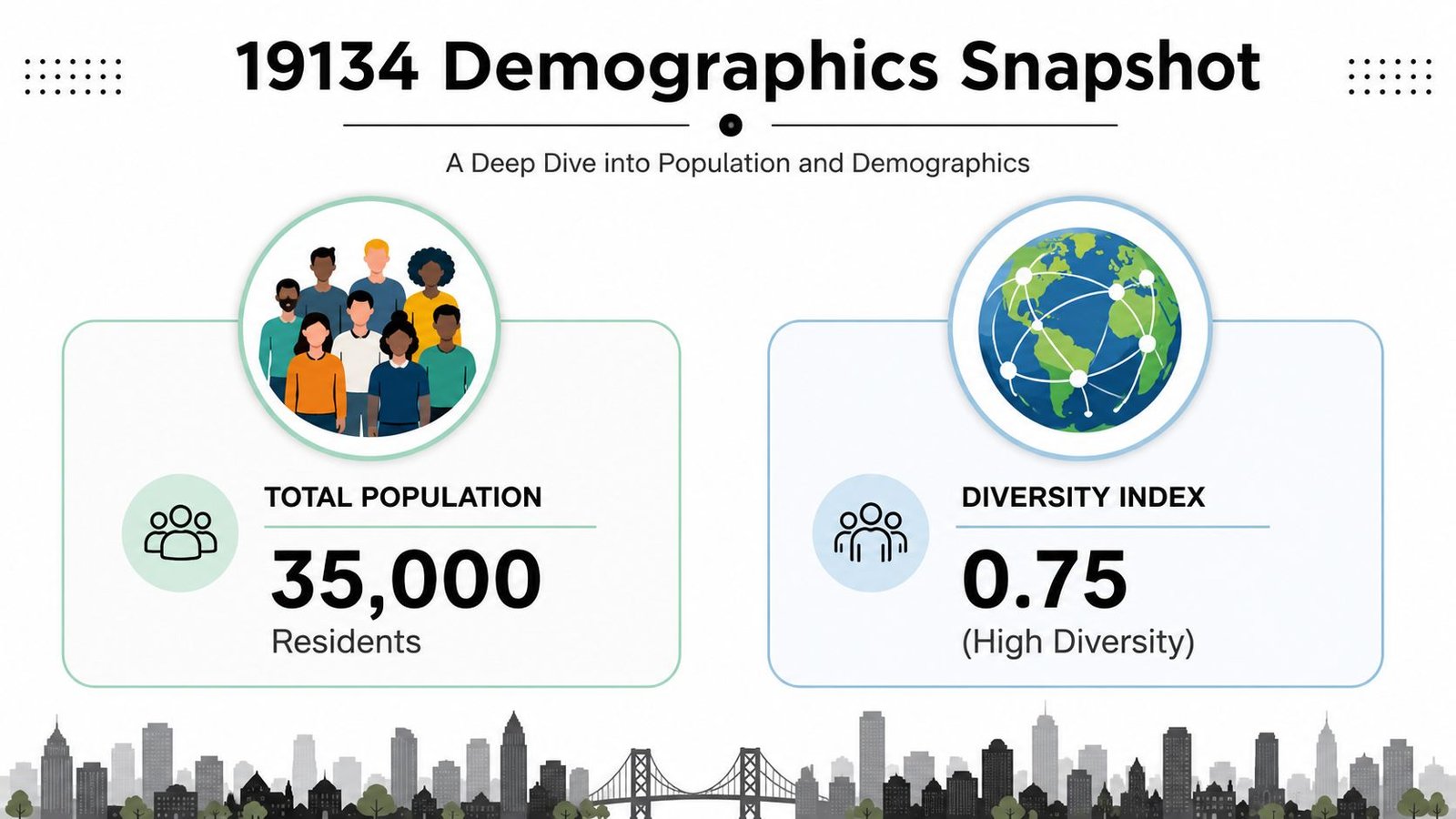
53,594 people live in 19134, and that number matters because population size changes how a ZIP code functions day to day. A place with that many residents needs more than identity and history. It needs schools that can handle demand, stores that match local buying power, transit that works for regular commuting, and public services that can respond when families need help. According to VeritasX demographic data for ZIP 19134, the ZIP code also has a diversity score of 64.1 out of 100. The largest reported groups are Hispanic or Latino at 49.5%, White non-Hispanic at 30.7%, and Black or African American at 13.2%.
What diversity looks like in ordinary routines
A diversity score can feel abstract until you translate it into daily patterns. In 19134, it often shows up in bilingual conversations at stores, different church communities serving nearby blocks, and a business mix shaped by more than one cultural tradition. That affects practical decisions too. Schools may need stronger language access. Clinics and legal service providers may need staff who can explain forms clearly across language barriers. Local shops tend to reflect what nearby households cook, celebrate, and buy each week.
Community life here works less like a single mold and more like a busy intersection. People do not all share the same background, but they often share the same bus stop, corner store, school building, and public concerns.
A younger ZIP code has different pressures
VeritasX also lists the median age at 32.5. That is a useful clue. A younger population usually brings more demand for childcare, K through 12 schools, first-job opportunities, and low-cost essentials such as groceries, transit, and basic healthcare.
That age profile can also shape the feel of the streets. You may notice more parents with children during the day, more school-related traffic patterns, and stronger demand for services that help working families keep routines stable.
For someone considering a move, this matters because age data is not just a trivia point. It helps explain why one area has more family-focused services, why another has heavier daytime foot traffic, and why certain public resources stay busy.
Large numbers need local context
ZIP-level demographics are useful, but they are only the wide-angle view. They show the size and makeup of the community, not the full personality of each block. One stretch may feel heavily residential and family-centered. Another may feel more commercial, more crowded, or more tied to a main corridor.
That is why demographic data works best as a starting map. Then you test it against real life by visiting at different times of day, checking commute patterns, and seeing how close you are to schools, clinics, grocery options, and city services. The same practical approach helps when comparing places with very different community patterns, as shown in this profile of ZIP code 15241 and how local population shapes daily life.
How to read these numbers without oversimplifying the area
A few practical takeaways help:
- A large population usually means heavier demand on transit, schools, health services, and city response systems.
- High diversity often means a richer small-business culture and a stronger need for language access in schools, healthcare, and legal help.
- A younger median age usually points to more families building daily life around affordability, childcare, school schedules, and entry-level work.
Those last two categories matter more than many newcomers expect. If you ever need to handle a school enrollment issue, a housing dispute, an ID problem, or another local legal matter, demographics give context for what kinds of services are likely to exist nearby and why multilingual, neighborhood-based support can matter so much.
The short version is simple. 19134 is not a small, uniform pocket of the city. It is a dense, younger, highly mixed community where the numbers connect directly to lived experience.
The Housing and Real Estate Market
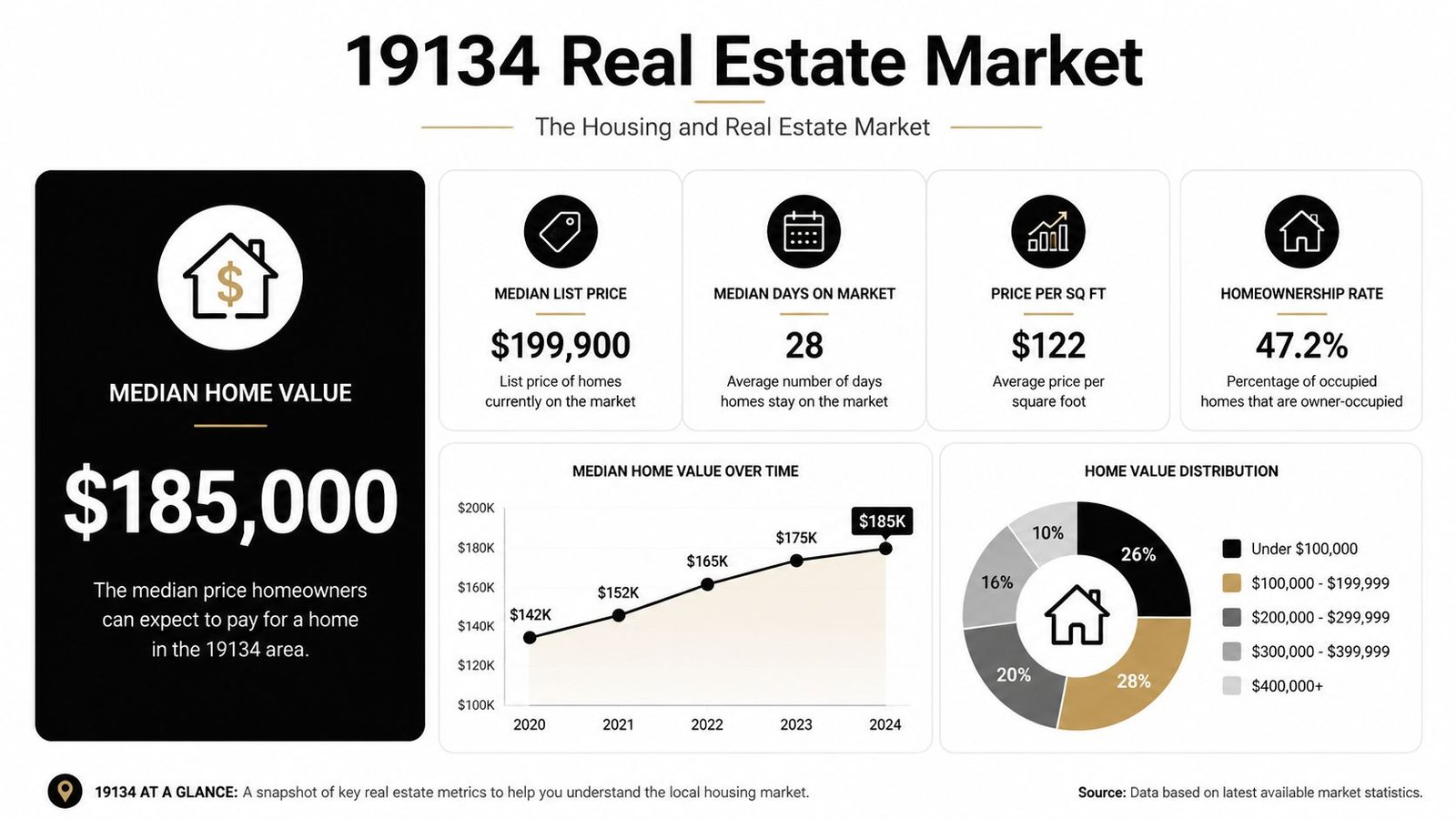
Housing in the 19134 zip code looks straightforward at first glance, but it isn't. According to Pennsylvania Demographics data for ZIP 19134, the median household income was $41,849 in 2023, the median home value was $135,400, and 33.3% of families lived in poverty. Those three numbers belong together. Looking at only one of them gives the wrong impression.
Here's a visual summary before we unpack it.
Why the home value can be misleading
A median home value of $135,400 may sound accessible to readers comparing 19134 with pricier Philadelphia neighborhoods. But affordability isn't just about price. It's about the relationship between housing costs and what local households earn.
When a neighborhood has a median household income of $41,849, even a comparatively lower-priced home can still sit out of reach for many residents. Add the fact that 33.3% of families live in poverty, and the financial picture becomes more serious than a listing search might suggest.
Housing takeaway: A lower median home value can signal opportunity for some buyers, but it can also reflect the larger economic pressure residents are already carrying.
What buyers and renters should pay attention to
For buyers, 19134 may offer entry points that seem more realistic than in higher-cost parts of the city. But you'll want to look beyond sale price and ask practical questions about block conditions, maintenance needs, property taxes, commute demands, and access to services.
For renters, the lesson is similar. Even without ZIP-specific rent figures in the data used here, it's fair to say the housing story can't be separated from household budgets. In a neighborhood where many families already feel squeezed, rent changes, utility bills, and transportation costs can have outsized effects.
This short video adds neighborhood context that can help when you're comparing the feel of the housing stock with the numbers.
A practical lens for evaluating housing here
Instead of asking only “Is this cheap for Philadelphia?” ask these questions:
- Can your budget handle repairs? Older housing stock may bring maintenance costs.
- Does the block fit your routine? Walkability, parking, and transit access can matter as much as square footage.
- Are you comparing homes or lifestyles? A lower price point may come with tradeoffs in space, street activity, or public-resource dependence.
| Question | Why it matters in 19134 |
|---|---|
| What's the monthly budget really like? | Income pressure changes what feels affordable |
| What are the block conditions? | Block-to-block variation is meaningful |
| How close are daily essentials? | Dense areas work best when services are nearby |
If you're interested in how housing pressure and neighborhood character connect in other urban ZIP codes, this 15222 ZIP code profile is another useful comparison point.
Local Schools Services and Community Life
For many households in 19134, quality of life comes down to a simple test. How easy is it to get through an ordinary Tuesday? School drop-off, a walk to the park, a doctor's appointment, a trip to the corner store, and getting home before dinner all matter more than glossy neighborhood labels.
That practical view helps here because community life in 19134 is shaped less by one standout amenity and more by how daily systems fit together. Streets, schools, transit, health services, and public spaces work like gears in the same machine. If one slips, the day gets harder.
Schools and family routines
Families in 19134 often judge schools by two sets of questions at once. One set is academic. The other is logistical. A school may look promising on paper, but the practical test includes walking routes, SEPTA access, after-school pickup, and whether a caregiver can manage the schedule without turning every afternoon into a scramble.
That is especially true in a dense part of Philadelphia, where distance on a map can feel very different from time on the ground. Ten blocks can be manageable for one family and a deal-breaker for another, depending on work hours, stroller use, weather, and who handles pickup.
Families with infants or newborns usually need support that sits outside the school system but still shapes community life. For parents searching for postpartum breastfeeding help, local lactation support can make the first months at home more stable and less isolating.
Parks, city services, and block comfort
Public space does a lot of work in 19134. A park is a place for children to play, but it is also where neighbors see each other, where seniors get fresh air, and where people get a quick read on how active and cared-for an area feels. McPherson Square comes up often for that reason. In a compact neighborhood, even a short walk to open space can change how crowded daily life feels.
City improvement projects matter for the same reason. As noted earlier in the article, parts of 19134 are tied to green corridor work and street-level upgrades meant to improve drainage and reduce heat. Those goals can sound abstract until you connect them to daily experience.
Here is what that can mean on the ground:
- Hot days feel more manageable: Shade and street design can make walking to transit or school less draining.
- Heavy rain causes fewer headaches: Better drainage can reduce puddling and make corners easier to cross.
- Blocks feel more cared for: Cleaner, better-maintained corridors often affect how comfortable residents feel using them.
Infrastructure shapes routine. If sidewalks are passable, crossings feel safer, and public spaces are usable, the neighborhood works better for parents, older adults, and anyone without a car.
Healthcare and practical service access
Healthcare access in 19134 can confuse newcomers because broad ZIP-code labels do not always match what patients experience. A better approach is to treat provider search the way you would treat apartment hunting. The listing is only the starting point. You still need to call, confirm insurance, ask about new-patient availability, and check how long the trip takes from home or work.
That same practical mindset applies to other services, too. Residents often need nearby pharmacies, urgent care options, library branches, recreation programs, and city offices they can reach without losing half a day. A neighborhood can look affordable at first glance but become more expensive in practice if every errand requires extra transit time, rideshare costs, or missed work hours.
For readers comparing how daily services shape neighborhood experience in different parts of the country, this community-focused 32225 ZIP code guide offers a useful contrast.
Crime Safety and Accessing Legal Resources
Safety is one of the first things people ask about any Philadelphia neighborhood, and that's understandable. But broad fear rarely helps anyone make good decisions. In the 19134 zip code, the more useful approach is to think in terms of habits, institutions, and preparedness.
That means learning your specific block, paying attention to lighting and foot traffic, and getting familiar with the police district and court systems that shape local responses when something goes wrong. A ZIP code doesn't have one single safety experience. Residents experience safety through routines, relationships, and how quickly they can act when they need help.
What residents should know about legal navigation
Most neighborhood guides stop at vague advice like “know your surroundings.” That's not enough. People also need to know how to respond if a loved one is arrested, needs court information, or suddenly has to deal with a jail release process.
A practical legal-preparedness mindset includes:
- Keep names straight: Know the full legal name and birthdate of the person you may need to help.
- Confirm where they are held: Different facilities and jurisdictions can change the next step.
- Ask about court dates early: Missing one detail can cause larger problems later.
- Write down every instruction: Families under stress often forget verbal information.
Why legal literacy matters in a neighborhood guide
Legal trouble isn't a lifestyle topic people like discussing, but it's part of real community life. A neighborhood isn't only schools, parks, and home values. It's also the systems people rely on in hard moments. If someone in your household gets arrested, confusion can spread fast. Knowing how bail works in general, what a surety bond is, and what paperwork a family may need can reduce panic.
That's one reason ZIP code education and legal-resource education fit together. They both help people act with less guesswork.
Learn the process before you need it. Under stress, even simple legal steps can feel harder than they are.
Safety as a practical, not abstract, topic
Good safety planning is usually ordinary:
- Learn which local institutions serve your block.
- Save non-emergency contacts.
- Understand how to locate court and detention information.
- Talk through emergency plans with family, especially if children are involved.
That kind of preparation is no different in spirit from learning where the closest urgent care is or which route floods during storms. It's part of living responsibly in a city neighborhood.
If you compare ZIP code guides across regions, this 32809 ZIP code profile shows the same broader lesson. Real neighborhood knowledge includes legal systems, not just lifestyle amenities.
Is The 19134 ZIP Code Right for You
A ZIP code can look affordable on paper and still feel expensive in daily life if the block, commute, school options, and support systems do not match your routine. That is the central question with 19134.
For the right resident, 19134 offers a practical city setup. You are looking at a dense part of Philadelphia where rowhomes, corner stores, bus routes, and long-established community habits shape everyday life. The appeal is not polish. It is access, familiarity, and the chance to live in a place that feels used and lived in, not packaged for newcomers.
That matters because 19134 usually works best for people who judge a neighborhood the way locals do. One block at a time. One commute at a time. One errand route at a time.
19134 may fit you well if your priorities match the area
You may feel comfortable here if you want:
- A true city neighborhood feel: Daily life is close together. Walking for small errands is common, and street activity is part of the environment.
- Housing that deserves a closer look: Buyers and renters who are price-sensitive often pay attention to 19134, but the smart move is comparing property condition, taxes, repair needs, and block-level differences instead of focusing on listing price alone.
- Community texture over uniformity: The area has a strong local identity. For some households, that makes the neighborhood feel grounded and human.
A simple way to frame it is this: 19134 works better for people who are comfortable doing local homework. Reading a listing is only the first step. Visiting at different times of day, timing the trip to work, checking nearby services, and asking about trash pickup, parking, and school options will tell you much more than a sales description.
19134 may be harder if you want predictability above all else
Some residents want a neighborhood where conditions feel consistent from block to block and every service question has a quick answer. 19134 is usually not that kind of place.
Urban density asks more from you. Noise levels can vary. Parking may require patience. Property upkeep can differ sharply within a short distance. If you prefer suburban spacing, quieter streets, or a setting where neighborhood quality feels more uniform, this ZIP code may feel like work rather than value.
That does not make it a bad choice. It makes it a specific choice.
Practical readiness also matters here. If you are comparing neighborhoods the smart way, include legal and civic realities with the usual housing and commute checklist. A good local example is this guide for Philly accident victims, which shows how preparation for everyday emergencies can be just as useful as knowing rent prices or bus lines.
The same idea applies when you compare ZIP codes in other regions. This 32809 ZIP code profile with legal-resource context is a useful example of how neighborhood research can include both lifestyle facts and the systems people may need under stress.
The short version is clear. 19134 is a good fit for people who want an active, established Philadelphia neighborhood and are willing to learn how it functions in real life. If you want easy labels, it may frustrate you. If you want affordability with context, local character, and a more grounded view of city living, it is worth serious consideration.