
Many people use the words "jail" and "prison" interchangeably, but in the real world, the difference is night and day. If a loved one has just been arrested, knowing that distinction is one of the most critical pieces of information you can have.
At its core, the difference is simple: jails are for short-term stays, and prisons are for long-term sentences. Jails are typically local facilities for those awaiting trial or serving sentences under a year. State or federal prisons, on the other hand, house convicted felons serving sentences longer than one year. This fundamental divide shapes everything that happens next.
Jail vs. Prison: The Crucial Post-Arrest Distinction
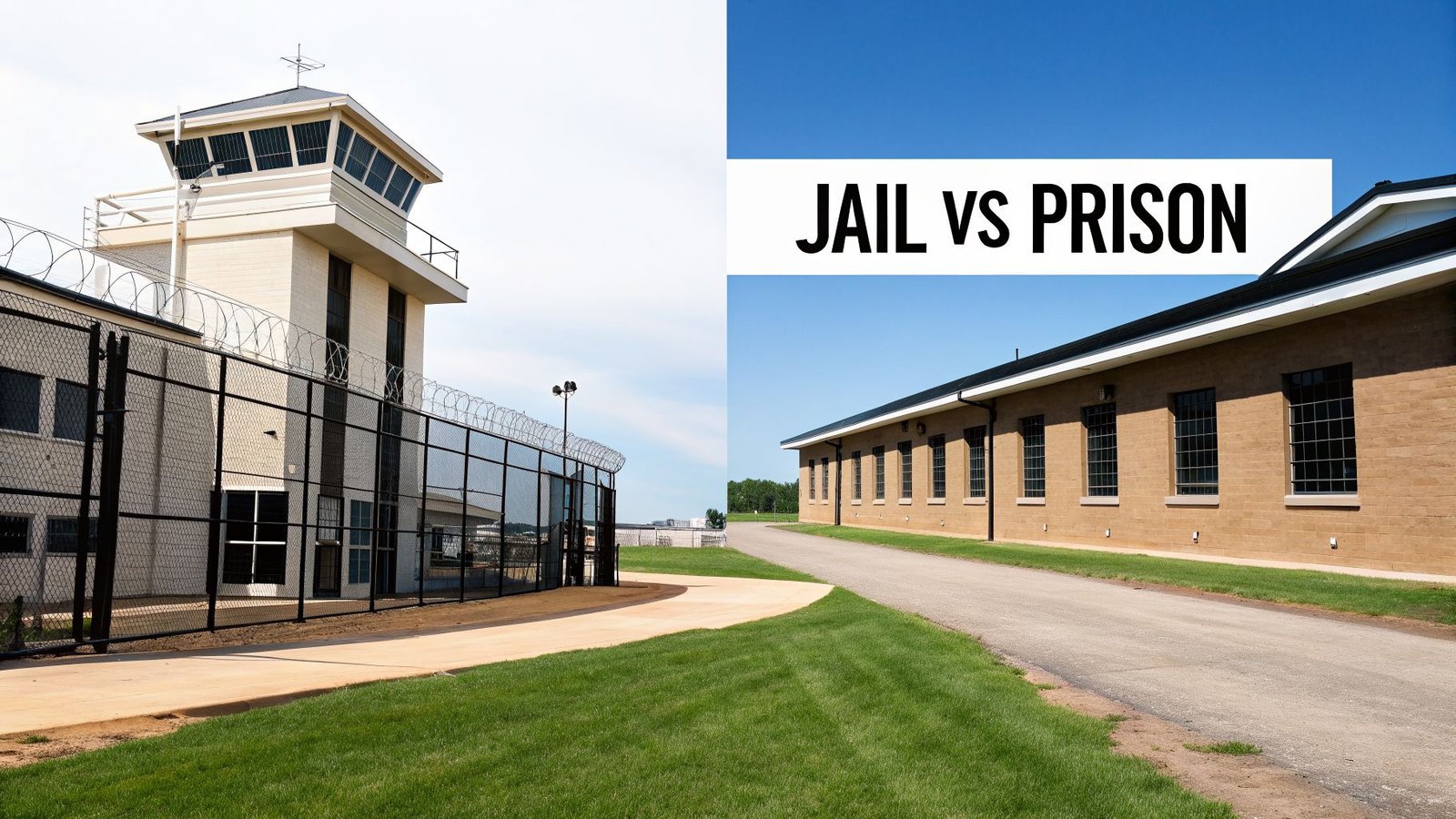
When someone is arrested, their first stop is almost always a local jail, not a prison. This is a vital detail for families to grasp because it opens a time-sensitive window for action. Before you can help, it's useful to understand what happens when you get arrested and the legal process that immediately kicks in.
Jails, which are run by county or city authorities, are essentially high-turnover processing centers. Think of them as the system's intake and holding area. Their main purpose is to hold people who are awaiting trial—and are therefore still presumed innocent—and those serving out short sentences for misdemeanors.
The sheer volume of people cycling through local jails is hard to fathom. In 2022, while jails held around 658,000 people on any given day, they processed a staggering 10.3 million admissions over the course of the year. This constant churn is what defines the jail environment.
Prisons are a different world entirely. Managed by state or federal governments, they are built for long-term confinement. A person is only sent to prison after they have been convicted of a serious felony and sentenced to more than a year of incarceration.
Jail vs. Prison At a Glance
To put it all in perspective, here’s a straightforward breakdown of the key differences between these two types of facilities. This table highlights why understanding where your loved one is located is the first step in providing support.
| Attribute | Jail | Prison |
|---|---|---|
| Jurisdiction | City or County (Local) | State or Federal |
| Primary Function | Pretrial detention; short misdemeanor sentences | Post-conviction confinement for felonies |
| Typical Stay | Days, weeks, or months (under 1 year) | One year to life |
| Population | Defendants awaiting trial, misdemeanants | Convicted felons |
| Bail Eligibility | Yes, most are eligible for pretrial release. | No, inmates are serving a final sentence. |
This table makes one thing crystal clear: the opportunity to secure someone's release through bail only exists while they are in jail.
The most significant takeaway for families is that the opportunity for release via bail exists only at the jail level. Once a person is convicted and transferred to prison, this option is gone.
This is why acting quickly is so important. If someone you know has been arrested and is in a local Colorado facility, their ability to return home pending trial depends on the decisions made in the hours and days after arrest. To learn more about this process, you can explore our guide on what is pretrial release.
For immediate, professional guidance on securing a fast release from any jail in Colorado, the team at Express Bail Bonds is available 24/7 to help you navigate your options. Our clients in places like Jefferson County and Centennial can attest to our rapid and reliable service.
Who Is Held in Each Facility

To really understand what separates a jail from a prison, the best place to start is with the people inside. Jails are essentially the front door to the justice system, managing a constant flow of individuals from all walks of life.
Think of a local jail, like the ones in Jefferson County or Centennial. The person in a cell there could be in one of several situations:
- They might have just been arrested and are waiting for their first court appearance.
- They could be waiting for their trial but are unable to post bail.
- They may already be convicted of a misdemeanor and are serving a short sentence, which is always less than a year.
This mix of people creates a highly transient environment. One of the most telling differences is in the sheer turnover. While U.S. prisons held a fairly stable population of 1.2 million people in 2022, local jails processed an astonishing number of individuals. Despite a daily population of 658,000, jails saw over 10.3 million admissions in 2019 alone.
Who Is in Prison
The story is completely different for prisons. These facilities are exclusively for long-term confinement after someone has been convicted of a felony. The population here is much more stable because everyone is serving a sentence of at least one year, and often much longer.
You will never find someone awaiting trial in a state or federal prison. Every single person there has already been through the court process, been found guilty, and received their sentence.
The simplest way to put it is this: Jails hold people who are often still presumed innocent (awaiting trial) alongside those serving short sentences. Prisons hold only convicted felons serving long-term sentences.
This is an absolutely critical distinction for families to understand. If your loved one is in a local jail, it means you're in a crucial timeframe where you can take action. This is the only period where securing their release by posting bail is possible.
For families in communities like Centennial, recognizing this difference is the first step. Arranging for bail doesn't just bring someone home; it allows them to prepare their defense from a place of freedom and avoids the damage that even a short time in custody can cause. The process can be particularly confusing when a younger person is involved, which you can read more about in our guide to juvenile bail bonds.
Daily Life, Programs, and Visitation: Jail vs. Prison
The day-to-day reality for someone behind bars is where the differences between jail and prison become painfully clear. Life in a local jail is often a masterclass in stress, uncertainty, and a feeling of being stuck in limbo.
Jails in communities like Golden, Colorado are built for short-term, transient stays. Because people are constantly cycling in and out, it's nearly impossible to run meaningful rehabilitation or education programs. The environment is focused entirely on temporary holding, not long-term improvement. The result is an inherently tense atmosphere filled with a volatile mix of individuals—some awaiting trial for serious charges, others serving out a short sentence for a minor offense.
Structure and Opportunities
Prisons, on the other hand, are designed from the ground up for long-term confinement. With inmates serving sentences of one year or more, these institutions operate with a far greater degree of structure and are better equipped to offer services that can actually make a difference.
The goal shifts from simple containment to rehabilitation and eventual reentry into society. Common programs you'll find in prison include:
- Educational Services: Everything from GED completion to college-level courses.
- Vocational Training: Hands-on programs that teach marketable skills in fields like welding, construction, or data entry.
- Counseling and Therapy: Critical support for substance abuse, anger management, and mental health challenges.
These opportunities create a structured routine and offer a genuine path toward personal change—elements almost completely missing from the chaotic holding pattern of a local jail.
At its core, the difference is one of purpose. Jails are all about managing a high-turnover population with basic security. Prisons are set up to manage a stable, long-term population with structured days and a focus on rehabilitation.
Visitation Rules and Family Contact
This difference in purpose also shapes how you can stay in contact with a loved one. Jail visitation is often restrictive and impersonal. It’s frequently limited to video calls from a public terminal, which can feel cold and disconnected. For a closer look at these rules, you can check out our guide on visiting someone in jail.
Prisons, while still having strict rules, typically allow for more meaningful contact. Because families are maintaining relationships over many years, the system is set up for more established routines, often including in-person, face-to-face visits. This can be a lifeline for maintaining strong family bonds through a long sentence.
Securing a quick release from a facility like the one in Centennial, Colorado, does more than just restore someone's freedom. It prevents them from being stuck in the uniquely harsh and program-deficient environment of a local jail. If your loved one is in custody, acting fast is crucial. Contact Express Bail Bonds now for 24/7 assistance.
How Bail Bonds Secure a Release From Jail
When you're dealing with a loved one's arrest, the single most important difference between jail and prison comes down to one thing: the chance to come home. Bail is a process that almost always applies to someone in jail, giving them a way out before their trial even begins. A judge sets a bail amount, which is essentially a financial promise that the person will show up for all their court dates.
This is the critical window of opportunity. Once someone is convicted of a crime and sentenced to prison, the option of bail is off the table. Understanding this is vital because it underscores just how urgent the situation is. During this time, a bail bond company can become your most valuable ally.
The Role of a Bail Bondsman
When a judge sets a bail amount that's too high for a family to pay out of pocket, a bail bondsman is the person you call. At Express Bail Bonds, we've designed our process to be as fast and straightforward as possible. Instead of you paying the court the full bail amount, your family pays a smaller, non-refundable fee—called the premium—to one of our licensed agents.
We then post the entire bail amount with the court for you. This is done through something called a surety bond, and it's what secures your loved one's immediate release from a local or county jail. For those unfamiliar with the process, it's worth noting that systems can vary, such as learning how bail works in Canada to get someone out of pre-trial detention.
A surety bond is a three-way agreement between the court, the person who was arrested, and the bail bond company. The bond company guarantees the person will appear in court, making their release both affordable and fast.
This infographic helps visualize the difference between the temporary, uncertain nature of jail and the more permanent, structured reality of prison.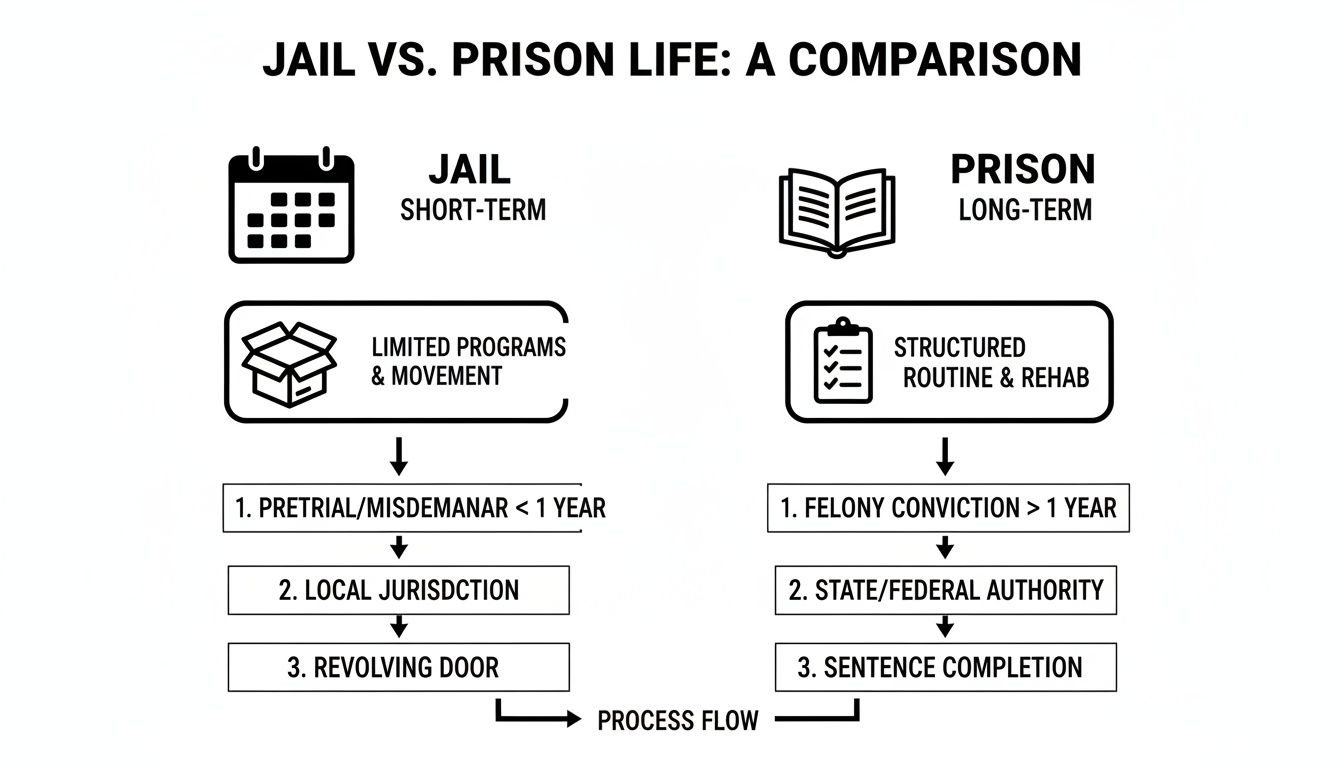
As you can see, jail is a holding pattern. Prison is a long-term sentence. That’s why acting quickly while someone is still in the jail phase is so incredibly important.
Securing Release from Colorado Jails
After an arrest, every minute counts. The faster you can act, the less time your family member has to spend in custody. Our team at Express Bail Bonds is on call 24/7 to help you through this stressful time.
We've focused on making our services efficient to get people out of jails across Colorado as quickly as possible. Here are the key steps we take:
- Immediate Consultation: You can call or text us anytime. We’ll give you clear, direct answers about the situation and what needs to happen next.
- Electronic Paperwork: We can handle all applications and payment documents digitally, so you don't have to waste precious time driving to our office or the jail.
- Fast Posting: As soon as the paperwork is finished, our agents are on their way to post the bond at the facility, no matter where it is in Colorado.
Knowing the difference between jail and prison gives you the power to take the right action. Securing a release from jail is the best thing you can do to help your loved one prepare a strong defense. For a more detailed breakdown, you can learn more about how bail bonds work in our guide.
If someone you care about is in a Colorado jail, don't wait. Reach out to the experienced agents at Express Bail Bonds right away for professional help and rapid service. See what our satisfied clients have to say and check out more of our reviews.
The Path from Conviction to Prison
When a trial concludes with a guilty verdict, or if bail was never posted, the legal process enters its final stage. This is where the distinction between jail and prison shifts from a temporary situation to a long-term reality. The sentence handed down by the judge determines everything that comes next.
For a misdemeanor conviction, the sentence is typically less than one year. In these cases, the individual serves their time right back in the local or county jail, the same facility they may have been held in before trial.
A felony conviction, however, sets a very different course.
From Local Jail to State Prison
A felony comes with a sentence of one year or more, and that triggers a significant move. The individual is transferred from the county jail to a state or federal prison to serve their sentence. This isn't just a change of location; it's the point of no return for pretrial freedom. Once someone is processed into the prison system, the opportunity to post bail is gone for good.
This finality really underscores how crucial the pretrial period is—that window of time when a defendant is still presumed innocent in the eyes of the law. It’s the only chance to fight the case from the outside.
Securing a release from jail before a trial is about more than just comfort. It’s about having a fighting chance. A defendant who is out on bail can keep their job, provide for their family, and work side-by-side with their attorney to build the strongest possible defense—all things that are practically impossible to do from a jail cell.
This is precisely why getting help from a dependable bail bond company is so important. A fast, professional release can completely change the trajectory of a case. The agents at Express Bail Bonds are experts at providing immediate help to families across Colorado during this critical time. Our clients in places like Jefferson County and Centennial can speak to our quick and professional service.
From the moment of arrest, the stakes are incredibly high. Taking swift action is the best way to avoid the path that leads from a temporary jail stay to a long-term prison sentence. If you need someone to walk you through it, our team is ready to help—just see what our satisfied clients have to say. Don't wait to get help; you can see more of our reviews and then give us a call.
Frequently Asked Questions About Jail, Prison, and Bail
When a loved one is taken into custody, the questions can feel overwhelming. The legal system has its own language, and knowing the difference between key terms can make all the difference. We've answered some of the most common questions we hear from families to give you some clarity during a tough time.
Can You Get Bail From Prison?
This is a common point of confusion, and the answer is a firm no. Bail is only an option during the pretrial phase of a case.
In other words, bail is a tool used to get someone out of a local jail while they are awaiting trial. Its entire purpose is to provide a financial guarantee that the person will show up for their court dates. Once an individual has been convicted and sentenced for a felony (typically for a year or more), they are transferred to a state or federal prison to serve their time. At that point, the trial is over, so the option for bail is off the table. This is why acting quickly after an arrest is so critical—that pretrial window is the only opportunity to secure a release.
How Do I Find Someone in Custody in Colorado?
If someone was just arrested, they’ll be in a local city or county jail. The first step is to figure out which one. Most sheriff's departments in Colorado have online inmate search tools. For example, you can check the databases for jurisdictions like Jefferson County or facilities in Arapahoe County, which serves areas like Centennial.
If you think the person is already serving a sentence for a felony, you'll need to check the inmate locator for the Colorado Department of Corrections instead. When you’re not sure where to even start, your best bet is to call a professional. Our team at Express Bail Bonds can quickly locate the person, confirm where they are, and walk you through the next steps for getting them out. Our clients often tell us what a relief it is to have an expert take over, as you can see in our Google reviews.
What Is a Surety Bond and How Does It Work?
Think of a surety bond as the most common path to getting out of jail when you can't afford the full bail amount. It’s essentially a three-way agreement between the court, the defendant, and a bail bond company.
When a judge sets bail higher than what a family can pay out-of-pocket, a bail agency steps in. You pay the company a non-refundable fee, known as the premium (usually a percentage of the total bail). In return, the bail agent provides the court with a bond for the full bail amount, guaranteeing the defendant will appear at all their court dates. This makes posting bail fast and affordable. We break this down further in our article on the difference between bail and a bond.
A surety bond is the key to an affordable release from jail. It allows you to pay a small fraction of the total bail amount to a licensed agent who then takes on the full financial risk with the court.
My Loved One Was Arrested in Centennial. What Should I Do?
Your first and most important move is to call a licensed bail bond agent who serves Centennial and the greater Arapahoe County area. Time is crucial in these situations, so you need a company that’s available 24/7 and knows the local jail system inside and out.
The best thing you can do is call Express Bail Bonds right away. We've helped countless families in Centennial get through this exact scenario. We handle all paperwork and payments electronically, which means we can start the process the second you call. Our agents can then post the bond immediately, drastically cutting down the time your loved one spends behind bars. Many of our clients have shared how grateful they were for the quick response, which you can read about here. Don't wait—call now for fast, professional help.
When you need immediate help with bail bonds anywhere in Colorado, trust the experts at Express Bail Bonds. We are available 24/7 to provide clear guidance and fast service. Contact us today at https://expressbailbonds.com/.