
What is pretrial services? It's a court function that screens, supervises, and reports on defendants before trial. In 2024, the federal pretrial services system opened 72,587 cases, and that volume shows why families in Colorado run into it so often after an arrest. (U.S. Courts pretrial services report)
The phone rings, someone is in custody, and now every question feels urgent. Who talks to the jail, who decides release, and whether a bond still matters are the first things most families need answered.
Pretrial Services Explained for Colorado Families
A family member gets the call from the jail, and the first question is usually, “What happens next?” In plain English, pretrial services is the court's information and supervision arm before trial. Officers gather facts, help the court understand risk, and, when release is allowed, monitor whether the defendant follows the rules.
That matters on day one. The court is not only deciding whether someone goes home, it is deciding how they go home, what conditions may attach, and who will watch for compliance. Federal law says officers must collect, verify, and report release-relevant information before the hearing, including whether the person may pose danger, and they must recommend release, detention, and any conditions that should apply (18 U.S.C. § 3154).
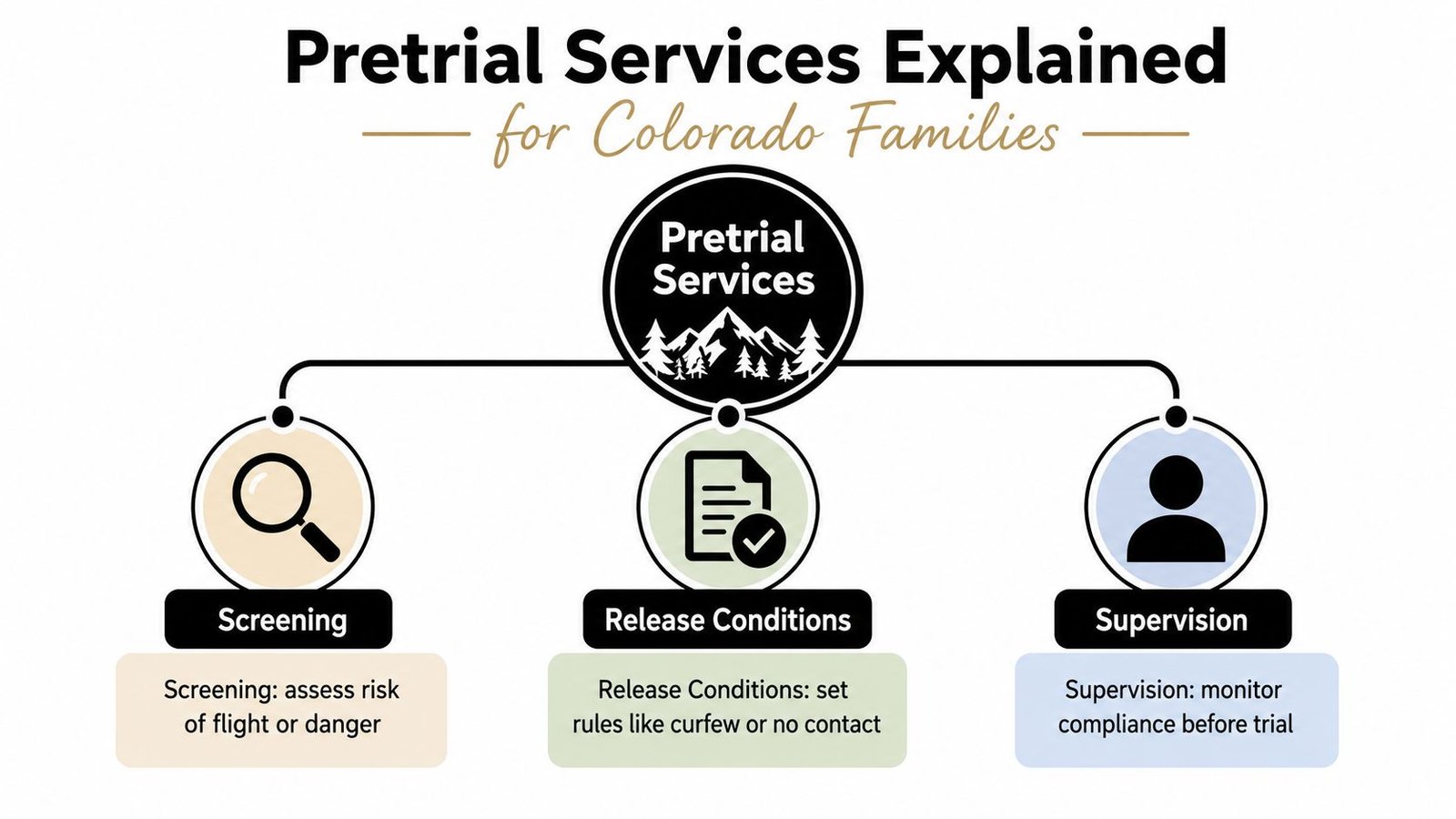
What the officer is doing behind the scenes
Pretrial services officers are usually the people checking records, speaking with the defendant, and preparing a recommendation for the judge. The National Center for State Courts describes this as a pre-first appearance inquiry focused on appearance risk and community safety, followed by release recommendations and supervision when the person is released (NCSC pretrial services).
For families, that means the first hours after arrest are not just waiting time. They are the window when the court gathers the information it needs to decide whether a person can be released on conditions, held, or released with supervision. A surety bond can also enter the picture at that point, because the bond answers the money side of release while pretrial services handles screening and supervision. The two can work side by side, but they are not the same tool.
Practical rule: pretrial services is not a payment desk. It is the court's screening and supervision function, while a surety bond is a financial release tool.
Families often find a helpful plain-language overview in the release guide by Ticket Shield, especially when they are trying to separate court supervision from bail paperwork. If you are comparing release options, the internal explainer on what pretrial release means in practice can help connect the terms to real jail release decisions.
How Pretrial Services Works Step by Step in Colorado
A Colorado arrest usually begins with booking at a county jail and a period of waiting that can feel longer than it is. During that time, pretrial services may interview the defendant, review records, and prepare information for the first appearance. The work moves quickly because officers need to confirm identity, criminal history, and supervision status in time for the court to use that information at the hearing.
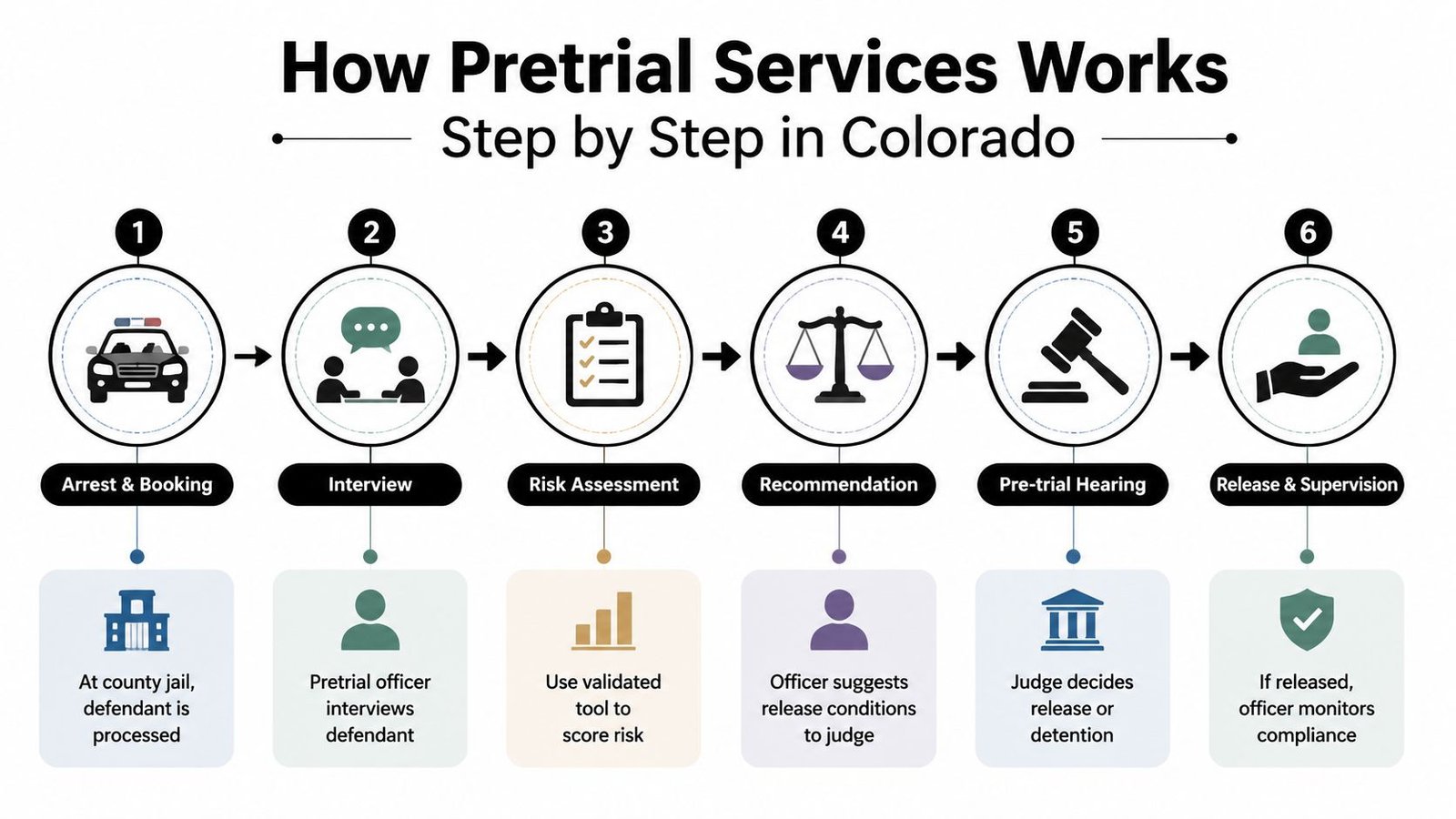
What families usually see from the outside
From the family's side, the process can look quiet and hard to read. A defendant is booked, then someone from pretrial services may speak with them in person, by video, or through a written intake process. The court then gets a recommendation before the pretrial release hearing, and the judge uses that information to decide whether release, detention, or added conditions fit the situation.
Older research helps explain why this stage matters. A Department of Justice review found that in 1994, among the 75 most populous U.S. jurisdictions, 56 out of every 100 felony defendants were either released on money bail or detained because they couldn't post bail, while 37 of the remaining 44 were released under nonfinancial conditions (NIJ review). That background is part of why pretrial services became such a central part of release decisions.
The practical takeaway is simple. The first 12 to 24 hours are often the time when the court is still forming its picture, so families should gather ID, case details, and anything that supports stable release, like a verified address or work schedule. If that information reaches the right people late, the judge may have less to work with when making the release decision.
Core Functions of Pretrial Services Officers
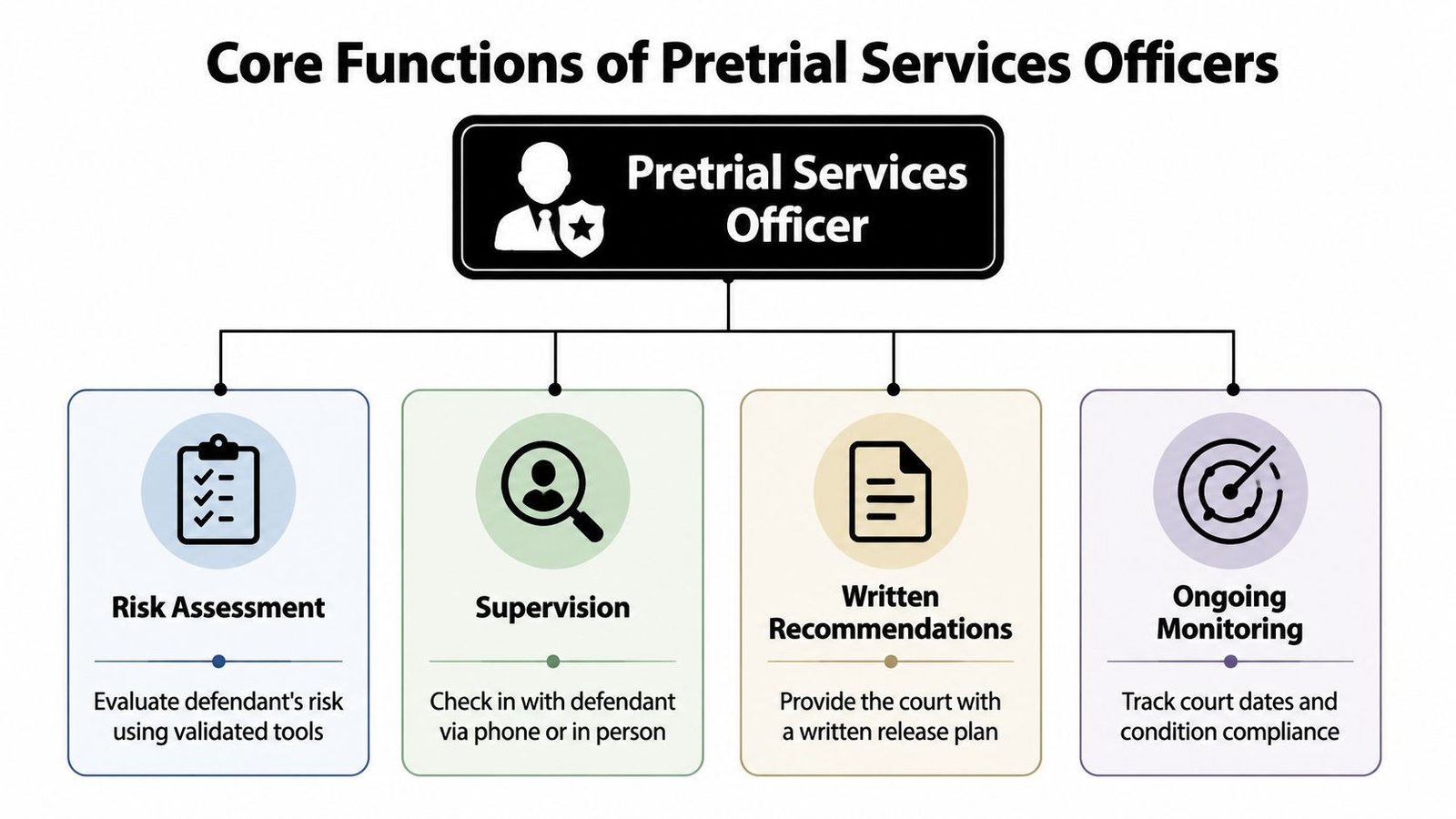
A worried family often wants one clear answer after an arrest, but pretrial services officers handle several different tasks at once. They gather facts, look at release conditions, keep track of compliance, and write recommendations for the court. Those duties overlap, yet each one serves a different stage of the release process.
Risk assessment and court recommendations
The first job is usually to sort out the basics. Officers confirm identity, review criminal history, and check supervision status so the court gets a grounded picture before deciding whether release fits the case. Federal law gives pretrial services officers a role in gathering this information and reporting what may help the judge decide on release conditions (18 U.S.C. § 3154).
That recommendation can be brief or detailed. A person with a stable address and a low risk profile may be suggested for release with simple court appearances. A person with higher concern may be tied to curfew, check-ins, no-contact rules, or other conditions the judge can consider. The National Center for State Courts explains that pretrial services programs use pre-first appearance inquiries to assess risk of nonappearance and community safety (NCSC pretrial services).
The officer does not make the release decision. The officer gives the court information, and the judge decides what conditions, if any, fit the situation.
Supervision and monitoring
Once a person is released, pretrial services may keep tabs on compliance through phone contact, in-person reporting, or treatment-related check-ins. In some cases, technology helps with that work, including electronic bracelets, drug testing, and database tracking, which support faster verification and reporting (technology and pretrial services).
The conditions can be practical and narrow, such as a curfew, GPS anklet placement, or a schedule for reporting. If someone misses court or breaks a major condition, the court can act quickly because the supervision process is built to flag problems fast.
Families often ask why one person is released with very few conditions while another faces closer monitoring. A separate pretrial risk assessment guide helps explain that difference. The point is not to punish people before trial. It is to reduce unnecessary jail time while still protecting the court process and the public.
For families sorting out the first round of release options, release on own recognizance may also come up if the judge is willing to accept a written promise to appear without a surety bond.
The handoff between supervision and a surety bond can feel confusing. A bond through a bondsman is about financial release, while pretrial services is about court oversight and conditions. A person can have both at once, so a family may still need to follow supervision rules even after the bond is posted. That is one reason the first 24 hours matter so much, because the court may still be deciding whether release will happen through supervision, a surety bond, or both.
The chart below gives a quick visual summary of the officer's main duties.
Pretrial Services Compared to Bail Bonds and Probation
Families often hear “pretrial services,” “bond,” and “probation” in the same conversation and assume they're interchangeable. They're not. Pretrial services is a court supervision function, bail bonds are a financial release mechanism, and probation is a sentence that usually comes after conviction.
| Option | Who Controls It | What It Costs | Best Fit |
|---|---|---|---|
| Pretrial services | The court and pretrial officer | Usually no separate fee charged by the court | When the judge wants supervision, reporting, or release conditions before trial |
| Surety bail bond | The court sets the bond amount, a licensed bondsman posts it | A premium paid to the bondsman | When the family needs financial release help and the court allows bond |
| Personal recognizance | The judge | Usually no bond payment | When the court trusts a written promise to appear |
| Probation | The court after conviction | Court-ordered supervision, not a pretrial bond payment | After a guilty finding or plea, not before trial |
The most confusing part for families is the handoff. A surety bond posted through a bondsman is about money and release, while pretrial services is about court supervision and conditions. They can run at the same time, because a person may be released on bond and still have to follow pretrial supervision rules.
A helpful article on building a resilient trust framework makes the same basic point in another context, systems work better when people know who controls what. That logic applies here, too. The court controls the conditions, the bondsman handles the financial posting, and pretrial services monitors compliance.
For families comparing options, the local overview on release on own recognizance can help separate nonfinancial release from bond-based release. In Denver-metro detention situations, that distinction matters because the wrong assumption can cost time.
How Fair and Accurate Pretrial Risk Assessment Really Is
A risk assessment can help a judge sort through a crowded jail docket, and it can do that in a more consistent way than a rushed gut call. Officers use verified records, database checks, and interviews, which can support faster decisions and reduce unnecessary detention. The catch is simple, the tool only works as well as the information going into it.
Where accuracy can break down
Accuracy starts to slip when the intake picture is incomplete. People with unstable housing, no local ties, limited English, or records that do not show the full story can be read in a way that makes them seem higher risk than they are. If a defendant's life does not match the assumptions built into the intake process, the result can be stricter conditions or a recommendation that misses important context. That is why the policy tension around pretrial services keeps showing up, even in systems that are trying to be fair (Arizona pretrial services overview).
Pretrial officers still have to verify identity, criminal history, and supervision status under time pressure, and they often work with fragmented data. Records can be thin, and when the records are thin, the report can be thin too. That is why a person's own details, such as a stable address, a reachable phone number, or an existing treatment plan, can matter so much in the first court review.
Families should treat that as a chance to fill in the blanks, not as a reason to panic. Clear information helps the court see the person as manageable in the community instead of forcing the judge to guess. A careful pretrial report can also work alongside bond decisions, which is where the handoff between court supervision and surety release becomes practical. For a plain-English look at how that evaluation works, see Colorado pretrial risk assessment guidance, and for a broader operational example, the AI receptionist comparison for legal shows how structured intake can reduce confusion when information has to move quickly.
Practical Steps for Defendants and Families
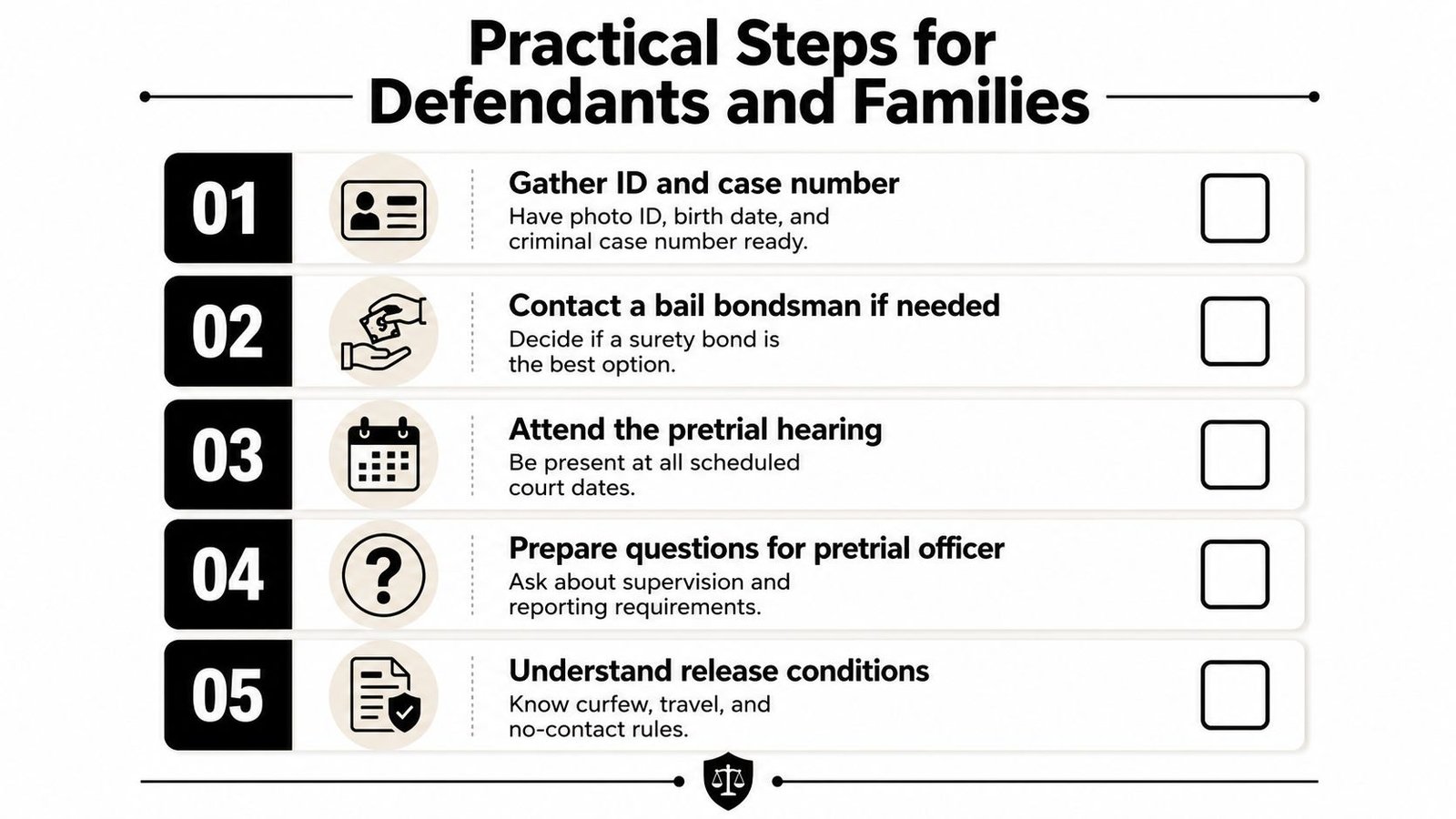
The first day after arrest is not the time to wait and hope for the best. It's the time to organize, call the right people, and avoid mistakes that make release harder. That's especially true if the judge is likely to order both supervision and a surety bond.
What to do in the first 24 to 72 hours
- Gather identification early. Have photo ID, date of birth, and the criminal case number ready so the jail, attorney, and pretrial officer can match the correct file quickly.
- Decide whether a surety bond makes sense. A licensed Colorado bondsman can start preparing paperwork while the court is still sorting out conditions, which saves time if release is allowed.
- Prepare for the pretrial interview. The defendant should be ready to answer questions about address, work, family ties, and any prior court dates clearly.
- Protect the release plan. No contacting witnesses, no new violations, and no ignoring court instructions. Those mistakes can turn a release opportunity into detention.
- Understand monitoring hardware before you leave. If the judge orders GPS, drug testing, or check-ins, the family needs to know how quickly those requirements start.
Colorado families often ask about bond cost before they ask about conditions. The standard premium is 15%, and for bonds over $5,000 with an approved cosigner, Express Bail Bonds often secures 10%. That kind of coordination matters when the court is moving fast and a release window opens unexpectedly.
A local comparison of AI receptionist options for law firms is a reminder that fast intake systems matter in legal workflows. In the bail context, a responsive agent can keep the bond ready while pretrial services finishes its recommendation.
If you need a practical reference for court preparation, the guide on how to prepare for court hearing gives families a straightforward checklist. The goal is simple. Don't let a missed detail delay release.
What to Expect at the First Court Date
The first court date is where the process becomes real. The judge reviews the pretrial report, hears from the parties, and decides whether the person stays in custody or is released under conditions. The pretrial officer's recommendation matters, but it doesn't replace the judge's authority.
What usually shows up in the release order
A release order can include a surety bond, personal recognizance, supervision, curfew, treatment, or no-contact restrictions. If the court wants pretrial services involved, those terms are usually written plainly enough that the defendant can understand what must happen next. The court is deciding both freedom and structure.
Families should pay close attention to the details after the hearing. A bond can post the financial side of release, but the defendant still has to satisfy the supervision terms. If there's a missed reporting date, ignored phone call, or failed test, the court can treat that as a compliance problem even if the bond is already in place.
Read the release order like a contract. If a condition is listed, assume it starts immediately unless the court says otherwise.
A related walkthrough on what happens at arraignment hearing can help families understand the early court rhythm. The same principle applies whether the case is in Denver, Jefferson County, or near Centennial. Confirm the exact courtroom, detention facility, and release instructions before anyone assumes they know the next step.
Frequently Asked Questions About Pretrial Services
Does pretrial services replace a bail bond?
No. Pretrial services is a court supervision process, while a bail bond is a financial tool for release. In some cases, the judge may use one, the other, or both.
Who decides the conditions?
The judge does. The pretrial officer collects and verifies information, then gives a recommendation, but the court makes the final call.
What happens if a condition is violated?
The court can respond quickly, and the response depends on the violation. Missing court, ignoring supervision, or contacting prohibited people can lead to stricter conditions or a warrant.
Can a defendant work or travel while supervised?
Sometimes, yes, but only if the release order allows it. The safest move is to confirm the written terms before making any plans.
If you're sorting through Denver, Jefferson County, or Centennial detention details right now, don't try to guess your way through the process. Call a licensed Colorado bondsman, ask what the court has ordered, and make sure the bond and supervision plan fit together before release happens.
Express Bail Bonds can help families handle surety bond posting, release paperwork, and court-related next steps across Colorado, including Denver, Jefferson County, and Centennial. If you're dealing with a recent arrest and need to keep release options open, visit Express Bail Bonds to start the process and confirm the right local path forward.