
When you hear the term personal bond, it's often the best-case scenario for someone who's been arrested. Also known as a personal recognizance (PR) bond, it’s a judge's way of saying, "I trust you to come back to court."
Essentially, a personal bond is a release from jail based on your written promise to appear for all future court dates. You're let go on your word of honor, without having to put up any money. If you need immediate assistance or have questions about your specific situation, contact the experts at Express Bail Bonds.
Understanding a Personal Bond and How It Works
After an arrest, a judge typically sets a bail amount. This is a financial guarantee to make sure the defendant shows up for their court dates. If a personal bond is granted, that financial requirement is put on hold. The defendant simply signs a document promising to appear in court and follow any other rules the judge sets.
Think of it like getting a loan based on your reputation alone. Instead of needing cash or a co-signer, the court is extending you credit based on things like your ties to the community, your job, and your past criminal history. This kind of release is a huge relief for families, as it avoids the immediate financial stress of paying bail and allows the defendant to get back home while their case moves forward. To get a better handle on the lingo, you can learn more about the difference between bail and bond in our detailed guide.
But make no mistake—this trust comes with serious strings attached. If you violate the terms of a personal bond, the consequences are severe. It often means an immediate warrant for your arrest and you suddenly being on the hook for the full bond amount.
Personal Bond At a Glance
To make it even clearer, here's a quick breakdown of how a personal bond stacks up against other common release options. Knowing these differences is critical whether you're dealing with the legal system in Jefferson County or Centennial.
| Feature | Personal Bond (PR Bond) | Surety Bond | Cash Bond |
|---|---|---|---|
| Upfront Cost | $0 | A non-refundable fee (premium), typically 10-15% of the total bail amount. | The full bail amount, paid directly to the court. |
| Financial Risk | You owe the full bond amount if you fail to appear in court. | The bail bond company assumes the financial risk with the court. | You risk losing the entire cash amount if you fail to appear. |
| Who Is Involved | The defendant and the court. | Defendant, a bail agent from a company like Express Bail Bonds, and the court. | The defendant (or their family/friends) and the court. |
When a personal bond isn't an option, a surety bond is almost always the fastest way to get someone released. Our team has been helping clients navigate this process for decades. Don't just take our word for it—our client reviews show how we can help.
Navigating the Personal Recognizance Bond Process in Colorado
Getting a personal recognizance bond isn't something you can just ask for; it's a specific, court-driven process that kicks off the moment an arrest is made. Knowing how this works can make a very stressful situation feel a bit more manageable, especially if you're trying to help a loved one in Jefferson County or anywhere else in Colorado.
The whole thing starts with the arrest and booking, where the person is processed into the local jail. After that, the first critical event is the bond hearing. This is where a judge takes a formal look at the case to decide on the conditions for pretrial release. Unlike calling a bail bondsman, the personal bond process is entirely in the court's hands.
This infographic breaks down the typical journey from arrest to release when a personal bond is on the table.
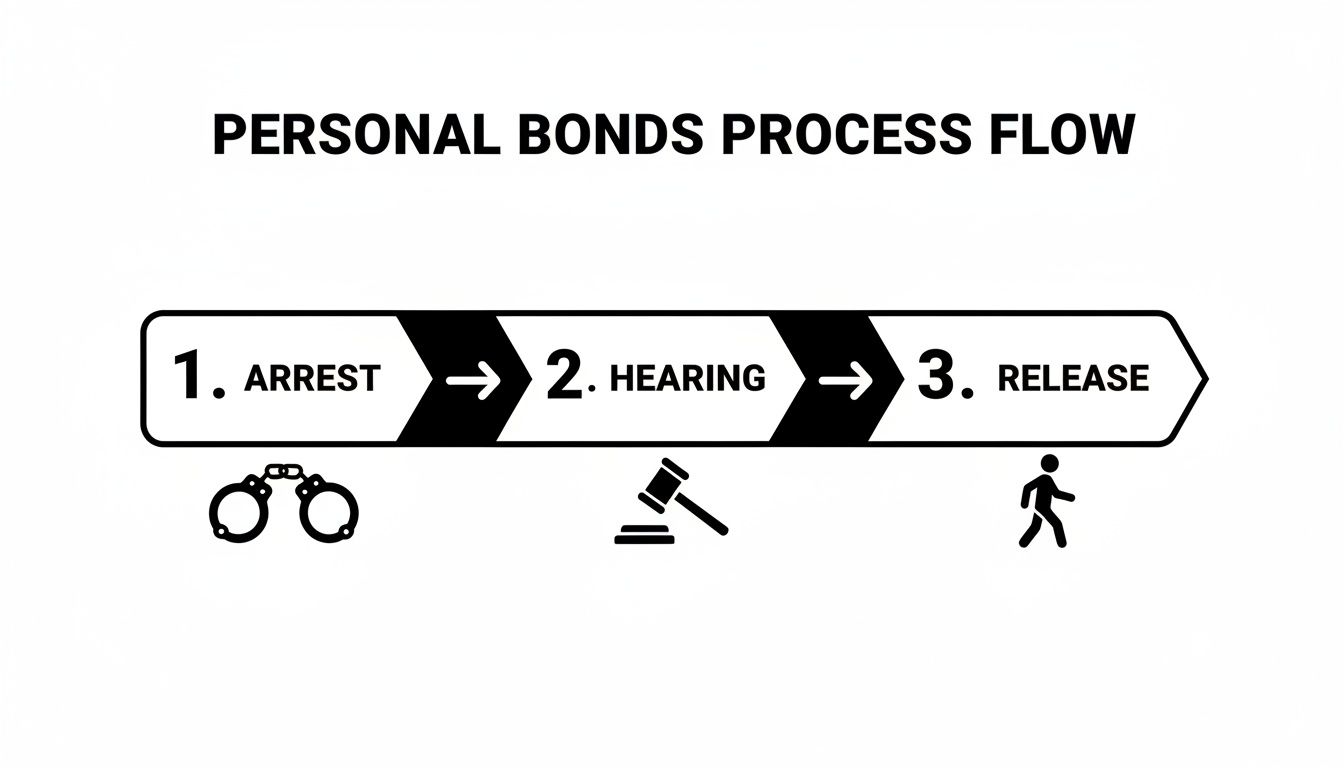
As you can see, it's a three-stage flow: the arrest, the all-important court hearing, and finally, release if the judge grants the bond.
The Role of Pretrial Services
Before the bond hearing even happens, a pretrial services officer usually steps in. You can think of this officer as a neutral fact-finder for the judge. Their entire job is to conduct a risk assessment by interviewing the defendant and checking up on their background.
They dig into several key areas to build a report for the judge:
- Community Ties: Does the person have a steady job, family nearby, or have they lived in a place like Centennial for a long time?
- Criminal History: Are we talking about a first-time offense, or is there a pattern of previous trouble?
- Flight Risk: Is there any real reason to believe they'll skip their court date and disappear?
This report carries a lot of weight in the judge's final decision. Here in Colorado, where Express Bail Bonds has been working since 1988, we see personal bonds granted most often to defendants who seem like a lower risk. In 2022, while over 65,000 people were released before their trial, roughly 15-20% of those were on personal recognizance bonds in the major counties.
If the judge looks at the report and decides the risk is just too high, they'll deny the personal recognizance bond. But that's not the end of the road. It just means you need a different plan to get them released.
The judge has to weigh everything and decide if the defendant can be trusted to return to court on their word alone. If the answer is yes, they're released with a signed promise. If not, the judge will set a monetary bond, which means you'll need to pay cash or use a surety bond. Our guide on how to post bail for someone can walk you through that whole process.
When a PR bond is off the table, the fastest way to get someone home is to call a professional. The team at Express Bail Bonds is available 24/7 to help you secure a surety bond and make sure the release happens as quickly as possible.
Who Qualifies for a Personal Bond in Colorado?
Getting a personal recognizance bond isn't a given—not everyone who's arrested will be offered one. The decision comes down to a single person: the judge. They essentially have to act as a risk assessor, deciding if they can trust you to return to court on your word alone. To make that call, they look at a very specific set of criteria.
Think of it like applying for a loan, but instead of credit, you're proving your reliability. The judge needs to see solid evidence that you’re not a flight risk or a danger to the community. The more you can show that you have a stable, responsible life, the better your odds are of walking out without paying a dime.

Key Factors in the Judge's Decision
When a judge is weighing a personal bond, they’re trying to build a complete picture of who you are. The single most compelling argument you can have on your side is deep, established roots in the community.
A judge is going to be far more inclined to grant a PR bond if you’re anchored to the local area. They’re looking for things like:
- Strong Community Ties: Having a steady job, family who lives nearby, and a long-term home in a place like Jefferson County makes you look like less of a flight risk.
- Minimal or Non-Violent Criminal History: If you have a clean record or maybe just a few minor, non-violent offenses in your past, it suggests you aren't a threat to public safety.
- Nature of the Current Charge: Let’s be realistic—personal bonds are far more common for misdemeanor charges. Serious felonies are often seen as too high-risk for just a simple promise to appear.
On the flip side, some things are immediate red flags. A history of skipping court dates is a big one, as it directly undermines the very promise a personal bond is built on. Likewise, facing serious felony charges or having no local connections often leads to a quick denial.
To make this clearer, let's look at the factors a judge weighs.
Key Factors for Personal Bond Eligibility
| Favorable Factors (Increase Likelihood) | Unfavorable Factors (Decrease Likelihood) |
|---|---|
| Long-term residency in the local area | No stable address or local ties |
| Verifiable, steady employment | History of failing to appear in court ("FTA") |
| Strong family connections nearby | Serious or violent felony charges |
| Clean or minor criminal record | Poses a clear danger to the community |
| First-time offense | The alleged crime involved a weapon |
| Cooperation with law enforcement | Outstanding warrants from other jurisdictions |
Ultimately, a defendant with deep local roots—a job in Golden, kids in local schools, and years of residency—makes a much stronger case for a PR bond than someone who was just passing through Colorado when they were arrested. The first person has everything to lose by running; the second has very little tying them here.
What Happens If You Don't Qualify?
If the judge decides the risk is too great, they’ll deny the request for a personal bond. Instead, they will set a monetary bail amount. This is an incredibly common outcome, especially when the charges are more serious.
When this happens, it’s not the end of the line—it just means it’s time to look at other options.
This is where a surety bond becomes your next move. While a PR bond runs on trust, a surety bond is a financial guarantee. If you find yourself in this situation, our team at Express Bail Bonds is here to help you navigate what comes next. Our deep understanding of how bail bonds work can bring much-needed clarity during a very confusing time. We are ready to act fast to get you or your loved one home.
Comparing Personal Bonds and Surety Bonds
When you're trying to get someone out of jail, understanding the difference between a personal bond and a surety bond can feel like a high-stakes pop quiz. The choice really comes down to one thing: cost versus risk.
At its core, a personal bond is granted based on trust, while a surety bond is all about having a solid financial guarantee in place.
Think of it like this: getting a personal bond is like being approved for a loan based solely on your good name and a promise to show up. A surety bond is more like a secured loan; you pay a small, non-refundable fee to a bail bonds company, and they put up the full amount for you.

Financial Responsibility and Cost
The biggest draw of a personal bond is obvious: it costs $0 upfront. Your loved one gets released without you having to spend a dime. But that "free" release comes with a huge string attached.
If they miss a court date, whoever signed for the bond is on the hook for the entire bail amount. A $20,000 bond instantly becomes a $20,000 debt that you owe directly to the court. It’s a gamble.
A surety bond, on the other hand, works differently. You team up with a bail agency like Express Bail Bonds. You pay us a non-refundable premium—usually 10-15% of the total bond in Colorado—and we post the full amount to the court for you.
By paying this premium, you transfer the primary financial risk from yourself to the bail bond company. We provide the financial guarantee to the court, ensuring your loved one's release without you having to liquidate assets or come up with a large sum of cash.
For families in a tight spot, knowing the difference is everything. A personal bond can be an incredible relief if granted, but a surety bond offers a reliable path forward when you need certainty.
Process and Reliability
The way you get each bond is also completely different. A personal bond is entirely up to the judge. It’s granted at their discretion during a hearing. If the judge says no, that’s it—the option is off the table, and you have to figure something else out. That can lead to a lot of uncertainty and more time spent behind bars.
The surety bond process is much more straightforward. As soon as the judge sets a bail amount, you can call a bail agent. We’re here 24/7 at Express Bail Bonds to get the ball rolling immediately. We handle the paperwork, post the bond, and work to get your loved one released as fast as humanly possible. We’re your advocate in a confusing system.
When a judge denies a personal bond, a surety bond from a trusted agency isn't just the next best thing—it's often the only effective solution. Read our client reviews and check our business profile to see why we are the trusted choice in Colorado.
The Consequences of Violating a Personal Bond
A personal bond can feel like a lifeline, but it's crucial to understand it's not a "get out of jail free" card. Think of it as a loan of trust from the court. If you break that trust, the consequences are swift and severe.
The conditions of your release are legally binding orders, and violating them goes far beyond just missing a court date. A judge can set very specific rules, and ignoring any of them will land you right back in trouble.
Common violations we see all the time include:
- Failing a mandatory drug or alcohol test.
- Contacting the alleged victim or any witnesses in the case.
- Getting arrested for a new offense while you're out on bond.
- Missing a scheduled check-in with a pretrial services officer.
Any of these mistakes will almost certainly trigger a bench warrant for your immediate re-arrest. Once you're back in custody, you can forget about getting a second chance at a personal bond. The court’s trust is gone.
The Financial Fallout of a Violation
This is where things get really serious. The moment you violate the bond’s terms, that "no-cost" release is over. You become personally liable for paying the full bond amount—directly to the court.
So, if the judge set your bond at $15,000, you are now on the hook for that entire sum. Suddenly, what felt like a free pass has turned into a massive personal debt. This is the immense risk you agree to take on with a personal bond.
This is a critical difference from a surety bond, where a company like Express Bail Bonds assumes the financial liability with the court. Our job is to provide that guarantee, protecting you from this exact kind of financial disaster.
Long-Term Legal Problems
The damage doesn't stop with a warrant and a huge debt. Violating a personal bond sends a clear message to the court: you can't be trusted. This makes it nearly impossible to secure any form of pretrial release if you find yourself in trouble again down the road.
A single mistake can complicate your current case and haunt any future legal issues you might face. The financial fallout can be just as devastating. For instance, in Texas, where personal bonds are common, the Office of Court Administration recorded a staggering 12,456 bond forfeitures in 2021 alone. This forced counties to spend millions trying to chase down that money. You can discover more insights about personal bond legal resources on uslegalforms.com.
If you are facing a situation where a bond might be needed in Jefferson County or Centennial, understanding these risks is absolutely essential. If you have questions, our team at Express Bail Bonds is here to help. Our client reviews and business profile show our commitment to helping families navigate these tough situations.
What to Do When a Personal Bond Is Denied
Hearing that a judge has denied a personal bond request can feel like hitting a brick wall. It’s disheartening, for sure, but it’s absolutely not the end of the road. Think of it as a signal to change your game plan and take decisive action right away. This is the moment when other, more common, release options come into the picture.
Once a judge turns down a PR bond, their next step is to set a monetary bail amount. At this point, the quickest and most dependable path to getting someone released is by partnering with a licensed bail bonds agency to post a surety bond.
Your Immediate Next Step Is a Surety Bond
So, what’s a surety bond? It's basically a financial promise made to the court by a bail agent. Instead of you needing to come up with the full bail amount in cash, you pay a much smaller, non-refundable fee—just a percentage of the total. The bail company then takes on the financial risk for the full amount. This is exactly where Express Bail Bonds comes in to lift that burden off your shoulders.
Our team of seasoned agents is on call 24/7, ready to jump into action the minute you call us. We get the urgency of the situation and have the local know-how to cut through the red tape, handle the paperwork efficiently, and post the bond for you. We become your advocates, completely focused on bringing your loved one home as fast as possible.
Don't let a denial send you into a panic. It happens more often than you think, and a professional bail agent is always prepared to act immediately. We bring the certainty and speed you need when every second counts.
Whether you need help in Jefferson County or you’re looking for our team in Centennial, we’ve got you covered all across Colorado. Our decades of experience and glowing client reviews speak to our deep commitment to helping families navigate these stressful times.
The court system can feel like a maze, but you don't have to find your way through it alone. Instead of waiting and losing precious time, the single most effective thing you can do is call a professional. Our business profile is a testament to our long-standing dedication to the community. Don't wait—call Express Bail Bonds now at (720) 984-2245 for immediate help.
Still Have Questions About Personal Bonds in Colorado?
It’s completely normal to have questions swirling around when you’re dealing with the bond process. Let's walk through a few of the most common things people ask us, so you can get a clearer picture of how it all works.
Can a Judge Add Special Conditions to a Personal Bond?
Absolutely, and they almost always do. Getting a PR bond isn't just about giving your word to show up for court. Think of it as a conditional release, where the judge sets specific ground rules you must follow to the letter.
These conditions can include things like:
- Regularly checking in with a pretrial services officer.
- Strict no-contact orders, meaning you can't interact with the alleged victim.
- Submitting to random drug or alcohol testing.
- Travel restrictions that keep you from leaving the county or state.
Breaking any of these rules is just as serious as skipping court. It's a direct violation of the bond and will almost certainly land you back in jail.
How Long Does the Personal Bond Process Take?
This one really comes down to the court’s schedule and how busy they are. After an arrest, the first major step is waiting for the initial court appearance or bond hearing. This can happen in a matter of hours, but sometimes it takes a day or two.
If the judge decides to grant a personal bond during that hearing, the good news is that the release process usually kicks off right away.
Can a Lawyer Help Me Get a Personal Bond?
Having a good attorney in your corner during a bond hearing can make a world of difference. They know how to build a strong case for your release, presenting the judge with evidence of your community ties, a steady job, and anything else that shows you aren't a flight risk.
While no lawyer can ever guarantee a judge’s decision, their expertise and advocacy can definitely boost your chances of being granted a personal bond.
What if I Can't Afford a Surety Bond?
It’s a tough spot to be in. The judge denies a personal bond, and now you’re looking at the cost of a surety bond, which can feel completely out of reach. Don't panic.
This is an unexpected expense for almost everyone, and reputable bail bond agencies get that. At Express Bail Bonds, we work with families every day to figure out flexible solutions. We're here to find a path forward that you can manage because we believe everyone deserves a fair shot at getting back home.
When a personal bond isn't on the table, you need a team you can trust to move quickly. Express Bail Bonds provides professional, 24/7 service across Colorado, including in Jefferson County and Centennial. See what our clients have to say in our Google reviews and check out our business profile. Contact us now for immediate help at https://expressbailbonds.com/.