
When you miss a mandatory court date, it's easy to think you can just call the clerk and reschedule. But in the eyes of the court, it’s a serious failure to follow a direct order. This is where a bench warrant comes into play—and it’s a lot more serious than a missed appointment.
What a Bench Warrant Actually Is
A bench warrant gets its name because it’s issued directly from the judge’s “bench.” It's essentially the court's way of saying, “You didn't come to us, so we're sending law enforcement to come get you.” It’s not an accusation of a new crime; it’s a response to you breaking the rules of your existing case.
Think of it this way: when you're involved in a court case, you're under the court's authority. Any failure to comply with its orders—like showing up for a hearing, paying a fine, or completing a required class—can be seen as contempt of court. A judge’s response is to issue a bench warrant, which gives any police officer the authority to arrest you on sight.
This happens far more often than people realize. Forgetting a court date for a simple traffic ticket can have massive consequences.
A bench warrant is a court-issued order that authorizes law enforcement to arrest someone, typically for failing to appear for a scheduled court date or violating other court-ordered conditions. In Colorado alone, courts issued over 216,000 bench warrants in just five years for people who failed to appear for traffic violations. You can learn more about how this common issue clogs up the justice system at our page covering bench warrants in Colorado.
Bench Warrant vs Arrest Warrant at a Glance
So, what makes a bench warrant different from the arrest warrants you see on TV? While both can land you in jail, they are issued for very different reasons. Knowing the difference is the first step in figuring out how to handle the situation, especially if you're dealing with courts in Jefferson County or Centennial.
Here's a quick breakdown to help you tell them apart.
| Feature | Bench Warrant | Arrest Warrant |
|---|---|---|
| Reason for Issuance | Failure to comply with a court order (e.g., missed court date, unpaid fines). | Probable cause that a crime has been committed. |
| Who Issues It | A judge from the "bench," directly. | A judge, based on a request from law enforcement. |
| Typical Trigger | Contempt of court. | Suspicion of criminal activity. |
Discovering there’s a bench warrant with your name on it is a stressful, time-sensitive problem. The worst thing you can do is ignore it, as it will never just go away on its own. The best thing you can do is act quickly and get professional help.
Whether you need bail bonds in Centennial or have questions about a warrant from the courts in Jefferson County, our team at Express Bail Bonds is here to help you figure out the next steps. Call or text us 24/7 at 720-984-2245 for immediate, expert guidance.
Common Reasons a Judge Will Issue a Bench Warrant
You’d be surprised how often a bench warrant starts with something that feels like a simple mistake. But from the court's perspective, it’s a serious matter. By far, the most common reason a judge issues one is a failure to appear (or FTA) for a required court date. This could be anything from your initial arraignment to a traffic court hearing.
It’s not just about missing court, though. A judge can issue a warrant right from their bench for other reasons, too.
- Violating Probation: If you’re on probation, any slip-up can trigger a warrant. This includes missing a meeting with your probation officer, failing a drug test, or not following any other specific condition of your release.
- Unpaid Fines or Restitution: The court sets deadlines for a reason. If you fail to pay court-ordered fines, fees, or restitution owed to a victim on time, a warrant can be issued for your arrest.
- Incomplete Sentences: Sometimes a sentence includes more than just fines or jail time. If you don't complete required classes (like for a DUI or domestic violence charge) or finish your community service hours, a warrant is likely to follow.
The Snowball Effect of a Missed Court Date
That forgotten traffic ticket or a court summons you misplaced can quickly spiral into a much bigger legal headache. This one action—failing to appear—is a massive contributor to the number of people sitting in local jails.
It's a shocking statistic, but failure to appear is the reason behind a staggering 13% of all U.S. jail bookings. Looking at data from hundreds of jails, researchers found that over a million bookings each year involve an FTA charge. What's more, over half of those people were booked only for the FTA, not for committing any new crime. You can dig into the full data on how a missed court date can lead to jail time over on the Prison Policy Initiative’s blog.
This shows just how critical it is to treat every single court order with the seriousness it deserves. Getting a handle on what happens if you miss court is the first step in making sure a warrant isn't issued in your name.
If you’re worried about a potential warrant in Jefferson County, Centennial, or anywhere else in Colorado, the worst thing you can do is wait. Acting quickly is your best defense. The team at Express Bail Bonds is here to help you figure out the next steps in this stressful situation. Call us anytime, 24/7, at 720-984-2245 for a confidential consultation.
The Hidden Consequences of an Outstanding Warrant
Having an active bench warrant is a problem that won’t just go away on its own. While the most immediate fear is getting arrested, the real damage often starts quietly, creating a web of problems that can affect your life long before you ever see a police officer.

Think about something as simple as a forgotten traffic ticket. You miss the court date, and the judge issues a bench warrant. That warrant alerts the Colorado DMV, and boom—your driver's license is suspended. The next thing you know, a routine traffic stop for something minor becomes an immediate arrest, not just for the warrant but for the new charge of driving on a suspended license.
The Domino Effect on Your Life
What starts as one small issue can quickly knock over every other part of your life. We’ve seen it happen time and time again.
- Your Job on the Line: Many employers run routine background checks. An active warrant is a major red flag that can get you fired or instantly disqualify you from a new job or promotion you were counting on.
- Barriers to Housing and Loans: Trying to rent a new apartment or get a loan? Landlords and banks also use background checks. A warrant can be an automatic denial, leaving you without a place to live or the funds you need.
- Skyrocketing Debt: The original fine never disappears. Instead, courts tack on failure-to-appear fees, and the amount you owe just keeps growing. If you posted bail, you also risk a complete bond forfeiture, losing all that money for good. You can read more about what happens during a bond forfeiture in our guide.
This isn't just a personal problem; it can become a community-wide crisis. The scale of this issue is staggering when you look at the data.
A study of Ferguson, Missouri—a city with just 21,000 residents—found that an incredible 16,000 people had active warrants, most stemming from minor issues. It's a clear example of how easily people can get trapped in the legal system over small infractions.
Even after a warrant is cleared, the arrest can remain on your record, creating a digital ghost that follows you online. It’s worth looking into your options for removing arrest records online to protect your reputation down the road.
If you're in Jefferson County, Centennial, or anywhere nearby, don't wait for these consequences to pile up. Give Express Bail Bonds a call at 720-984-2245 for confidential, no-judgment help, and check out our positive reviews to see how we’ve helped others.
How to Find Out if You Have a Warrant in Colorado
Having a feeling that there might be a warrant out for your arrest is an awful, sinking sensation. But letting that anxiety fester by ignoring it is the absolute worst thing you can do. The good news is that finding out for sure is the first step to getting it handled, and you have a few straightforward options in Colorado.
The first place many people look is online. Most Colorado counties, including larger ones like Jefferson County, have public court record databases you can search. While this is a decent starting point, just remember these online portals aren't always updated instantly. A clear search doesn't always mean you're in the clear.
Other Ways to Confirm a Warrant
You could also call the county court clerk's office directly. The clerk can look up your name and tell you if there’s an active warrant in their system. The downside, of course, is that this can be intimidating—you're calling the very court that issued the warrant.
For a completely confidential and much less stressful route, your best bet is to work with a professional bail bond agent. An experienced agent can discreetly run a search for you across multiple counties, giving you a definitive answer without alerting the courts. More importantly, you're instantly connected to an expert who can walk you through what to do next.
When you work with a professional, you get more than just information; you get a plan. An experienced agent at Express Bail Bonds can confirm your status quickly and advise on the most efficient next steps to resolve the warrant, often without you ever stepping foot in a jail cell.
This whole process gets even more complicated if you're trying to help a friend or family member. If you're looking for someone who may have already been taken into custody, our guide on how to find someone who has been arrested can help.
If you need bail bonds in Centennial or anywhere else in Colorado, don't put it off. Contact Express Bail Bonds 24/7 for immediate, confidential help. Our team is always here to give you clear answers and support, as you'll see in our positive reviews. One quick call to 720-984-2245 can start putting this problem behind you for good.
Your Guide to Resolving a Bench Warrant
That sinking feeling when you find out there’s a bench warrant with your name on it is unmistakable. But what you do next can make all the difference. Your gut reaction might be to head straight to the nearest police station, but there's a smarter way to handle this—a strategy that can dramatically reduce, or even eliminate, any time you spend in a jail cell.
The secret is to be proactive. Instead of just reacting to the warrant, you take control by arranging your bail bond before you turn yourself in. This is often called a "walk-through" or "book and release," and it puts you back in the driver's seat. You're not just showing up and hoping for the best; you're arriving with the keys to your own release already in hand.
This is the exact process we guide people through every day at Express Bail Bonds.
The Proactive Resolution Process
It starts with a simple, confidential phone call. You can call or text our team at 720-984-2245 anytime, day or night. We'll quickly and discreetly confirm that the warrant is active and find out the exact bond amount set by the court.
From there, we get all the necessary paperwork squared away. A lot of this can be handled electronically, which is a huge help if you have family or a co-signer helping out from another city or state. Once the bond is posted, you can walk into the appropriate facility—whether it's in Jefferson County or Centennial—with the bond secured, turning what could be a long ordeal into a simple booking and release.
This approach flips the script entirely. Instead of a scary, unpredictable situation, it becomes a managed process. By pre-arranging bail, you’re also sending a strong message to the court: you're taking this seriously and fully intend to show up for your future court dates.
The visual guide below outlines the first few steps you can take to confirm a warrant exists.
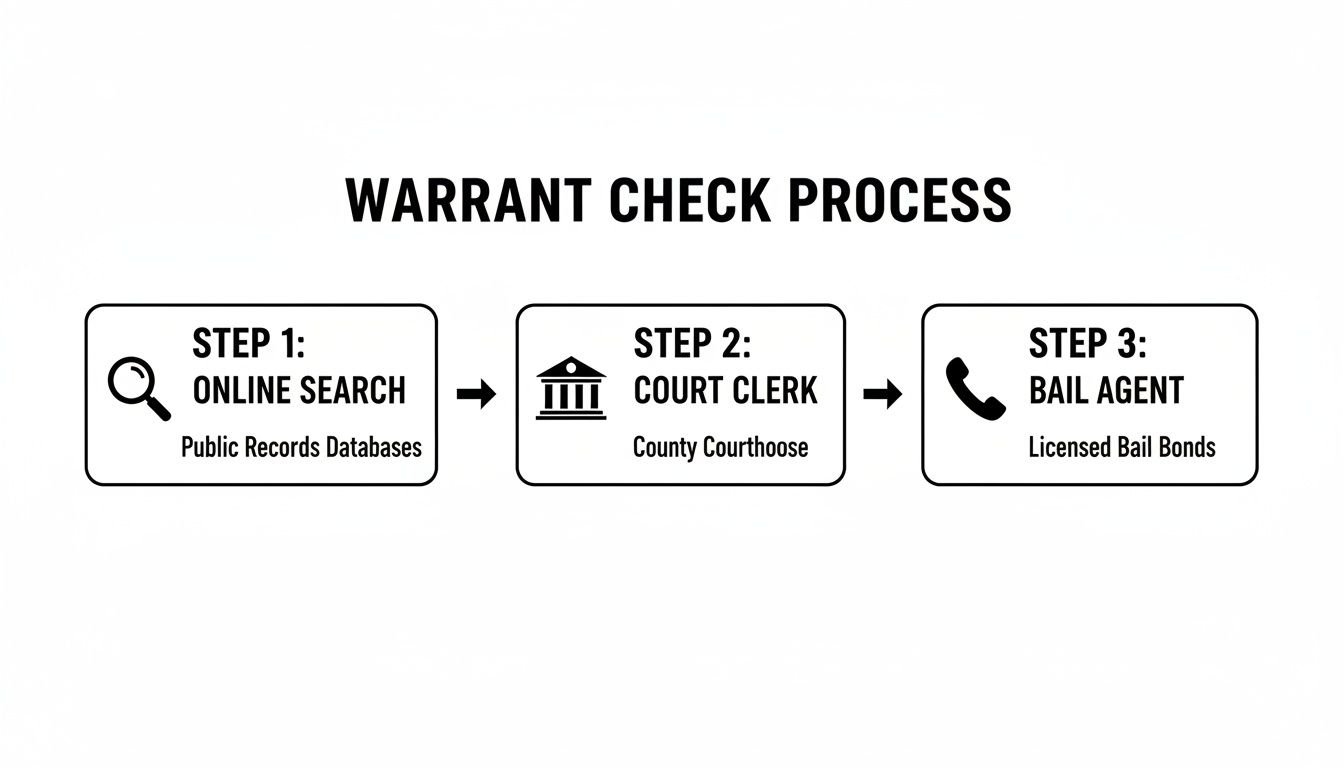
As the infographic shows, while you can do your own digging online or by calling a court clerk, contacting a bail agent is the fastest way to get a clear answer and an immediate action plan. Once you know a warrant is out there, it's also wise to learn about the legal side of things, like how to get a warrant lifted. Keep in mind that specific procedures can vary from one state to the next.
Ultimately, the best way to handle a warrant is to face it head-on, but on your terms. If you'd like to learn more about the specifics, check out our guide on turning yourself in with a bail bond arranged. Don't wait for an unexpected arrest during a traffic stop—take care of it now. We pride ourselves on clear communication and rapid service, and our clients' experiences speak for themselves. You can see what they have to say in our Google reviews.
Frequently Asked Questions About Bench Warrants
Finding out there’s a warrant out for your arrest is incredibly stressful. Your mind probably starts racing with questions. Getting straight answers is the first step to getting things back on track. We've put together answers to the most common questions we hear every day.
How Long Does a Bench Warrant Last in Colorado?
This is a big one: a bench warrant in Colorado does not expire. It stays active forever, or until you are arrested or a judge formally recalls (or "quashes") it.
Hoping an old warrant will just fade away is a mistake. We’ve seen people get arrested for a minor issue from years ago, often during a simple traffic stop. It never just disappears on its own.
Can I Just Pay a Fine to Clear a Bench Warrant?
Unfortunately, no. If a judge issued a warrant because you missed a court date (a "failure to appear"), paying the original fine won't make the warrant go away. The court now requires you to show up in person and answer for the missed appearance itself.
The best way to handle this is often to arrange for a bail bond first. When you post a bond, you're showing the court you’re serious about returning for your hearing. This is usually what a judge needs to see to clear the warrant. An experienced agent at a company like Express Bail Bonds knows exactly how to manage this for you.
What Happens if I Get Arrested on a Warrant Out of State?
If you're arrested in a different state on a Colorado warrant, you’ll be held in a local jail there. The authorities will then check if Colorado wants to extradite you, which is the formal process of bringing you back to face the charges.
Extradition is almost guaranteed for felony warrants. For misdemeanors, it's less certain because of the high cost and hassle involved for the state. Either way, you could be stuck in jail for a long time waiting for a decision.
The smartest move is to immediately contact a bail bondsman in the county where the warrant was issued—like our team at Express Bail Bonds for any Colorado warrant. We can help figure out the fastest way to get you released, whether it’s there or back here.
Will a Bench Warrant Show Up on a Background Check?
Absolutely. An active bench warrant will almost certainly pop up on any detailed background check. This can be a major roadblock, stopping you from getting a job, renting an apartment, or even qualifying for a loan.
The only way to prevent these problems is to deal with the warrant directly. Taking action gets it off your active record and lets you move on with your life. Whether you need help in Jefferson County or are looking for bail bonds in Centennial, being proactive is the key.
Don't let a bench warrant hang over your head. The team at Express Bail Bonds is here 24/7 to offer confidential, expert help and get this situation handled quickly and quietly. Call or text us anytime at 720-984-2245 to get started.