Once a loved one is out on bail, the big question on everyone’s mind is, "What happens now?" This is where the trial process truly begins, and at the heart of it is the petit jury.
So, what does a petit juror mean? The simplest way to think of a petit jury is as the "judges of the facts." They are a small group of everyday citizens tasked with a single, monumental job: listening to all the evidence in a criminal trial and deciding whether the defendant is guilty or not guilty.
The Role of a Petit Juror in a Criminal Trial
A petit juror’s role is very specific. They don't interpret complicated laws—that's the judge's job. Instead, their entire focus is on weighing the testimony and evidence presented by both the prosecution and the defense.
The journey from arrest to securing release with a service like Express Bail Bonds is just the first leg. Understanding the jury is the next crucial step, as this group of people will ultimately decide the case's outcome.
At its core, a petit jury serves as the conscience of the community. Their sole responsibility is to deliver a verdict based only on the facts they hear in the courtroom, ensuring the decision is free from outside noise or personal bias.
This civic duty is a massive undertaking. U.S. District Courts summon hundreds of thousands of petit jurors every year, and Colorado's state courts see a similar demand. It's common for these juries to hear felony cases after a defendant has been released on bail. On average, a juror might serve for 5-7 days on a single trial.
To give you a better sense of their function, here’s a quick summary.
A Petit Juror at a Glance
| Characteristic | Description |
|---|---|
| Primary Role | To act as the "finder of fact" in a trial. |
| Key Duty | Listen to evidence and testimony to determine guilt or innocence. |
| Size | Typically 6 to 12 members in a criminal trial. |
| Decision | Must reach a unanimous verdict (guilty or not guilty). |
| Who They Are | Impartial citizens selected from the community. |
This table highlights just how focused their responsibilities are. They aren't legal scholars; they are fact-checkers for the court.
What to Expect During a Trial
For those seated on a petit jury, their duties are clear and demanding. They must:
- Listen attentively to every witness, for both the prosecution and defense, without taking sides.
- Review all evidence with care, from physical exhibits to documents and photos.
- Follow the judge's instructions to the letter, especially regarding the legal standards they must apply during deliberations.
For families in places like Jefferson County or Centennial who have just posted bail for a loved one, understanding this part of the process is vital. Being out on bail gives the defendant a significant advantage, allowing them to actively help their attorney prepare their defense for these impartial fact-finders.
As the court date approaches, it's also smart to know how to prepare for a court hearing. If you have any questions about how bail fits into this timeline, the team at Express Bail Bonds is always available to help.
How Colorado's Jury Selection Process Works
Ever wonder how an ordinary citizen ends up deciding a court case? It all starts with a letter in the mail. In Colorado, the court system pulls names from public records—think DMV lists and voter registrations—to summon a large group of potential jurors. This initial group is called the jury pool.
But receiving a summons is just the first step. The real vetting happens in a process called voir dire, a French term that means "to speak the truth." This is where attorneys for both the prosecution and defense get to question the potential jurors. Their goal is to uncover any biases, life experiences, or preconceived notions that might prevent someone from being impartial. It’s a crucial filtering process to ensure a fair trial.
The jury phase is a critical point in the legal timeline, coming after the initial arrest and bail proceedings.
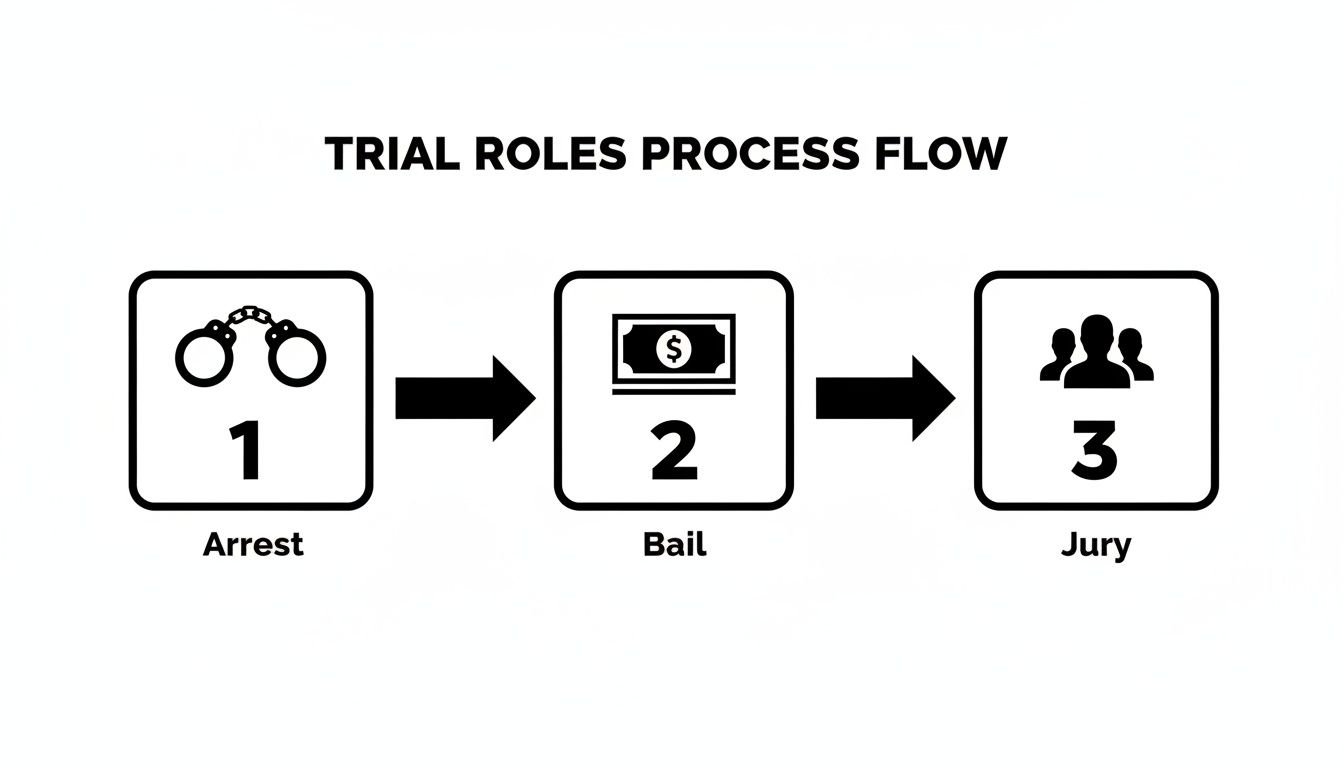
As you can see, securing bail is what allows a defendant to remain free and actively participate in their defense before the jury is even chosen.
The Questioning and Dismissal Phase
During voir dire, if an attorney believes a potential juror cannot be impartial, they can ask the judge to dismiss them. This is known as a challenge "for cause." For example, if someone knows the defendant personally or already has a strong opinion about the case, they'll almost certainly be excused. Each side gets an unlimited number of these challenges.
Attorneys also have a limited number of peremptory challenges. These are incredibly valuable because they allow a lawyer to dismiss a juror without having to give a reason.
This whittling-down process is surprisingly tough. A federal report found that historically, the selection rate could be as low as 20%. Think about that—only one out of every five people summoned might actually end up on a jury. While technology has helped boost response rates in cities like Denver, the core process remains just as rigorous.
For a defendant who is out on bail, being present for jury selection is a huge advantage. They can give their attorney real-time feedback and gut feelings about the people who will ultimately decide their fate. This insight is invaluable. Knowing what to do, how to act, and even what to bring to court can make all the difference during this stressful time.
Petit Jury vs Grand Jury: What's the Difference?
You’ll often hear the terms 'petit jury' and 'grand jury' used in legal discussions, and it’s easy to get them mixed up. They sound similar, but in reality, they play completely different roles in the justice system. Knowing how they differ is crucial, especially if you or a loved one is navigating the court process after being released on bail.
The Grand Jury: The Investigative Gatekeeper
Think of a grand jury as an investigative screening tool. Its entire purpose is to listen to the prosecutor's evidence and decide if there's enough "probable cause" to formally accuse someone of a crime.
If they agree the evidence is strong enough, they issue an indictment, which is the formal charging document that kicks off a criminal case. Their job isn't to determine guilt, but simply to answer one question: "Is there enough here to even proceed to a trial?" The whole process is held in secret, without a judge present, and they only hear the prosecution's side of the story.
The Petit Jury: The Finder of Fact
A petit jury is what everyone imagines from courtroom dramas—it’s the trial jury. This is the group of citizens who sit in the jury box during a public trial, listen to arguments from both the prosecution and the defense, and examine all the evidence presented.
Their responsibility is immense: they must weigh all the facts and deliver a final verdict of "guilty" or "not guilty." While a defendant might face a grand jury before charges are even finalized, they will only encounter a petit jury if their case actually goes to trial.
To clarify these distinct functions, here's a direct comparison of their primary features:
Petit Jury vs Grand Jury Key Differences
| Feature | Petit Jury (Trial Jury) | Grand Jury |
|---|---|---|
| Primary Function | Determines guilt or innocence at trial. | Decides if there's enough evidence (probable cause) to issue an indictment and formally charge someone with a crime. |
| Who They Hear From | Both the prosecution and the defense in open court. | Only the prosecution, in a secret proceeding. |
| Size | Typically 6 to 12 members (plus alternates). | A larger group, typically 16 to 23 members. |
| Outcome | A verdict of "guilty" or "not guilty." | An indictment ("true bill") or a decision not to charge ("no bill"). |
This table makes it clear that while both are juries, their jobs happen at very different stages and serve entirely separate purposes.
Why This Distinction Matters
Understanding this difference helps you anticipate what’s next in the legal journey. For instance, an indictment from a grand jury is what leads to an what happens at an arraignment hearing, where a defendant formally hears the charges and enters a plea.
For families in places like Jefferson County or Centennial, knowing these steps provides a roadmap for what can be a confusing and stressful time. If you need help navigating the bail process or have questions about what comes next, our experienced team at Express Bail Bonds is here for you.
Call or text Express Bail Bonds 24/7 at 720-984-2245. Let us help you prepare for the road ahead. You can also find our convenient locations on Google here and here.
The Responsibilities of a Seated Juror
The moment a petit juror takes their oath, their world shrinks to the confines of the courtroom. It’s a solemn promise to be impartial, and from that point forward, their job is crystal clear—but incredibly demanding.
As a defendant or a concerned family member, it’s crucial to understand what this means. These jurors are tasked with listening intently to every witness, examining each piece of evidence, and applying the law exactly as the judge instructs. The entire justice system hinges on their ability to make a decision based only on what’s presented in court.
Strict Rules of Conduct
To protect the integrity of the trial, jurors live by a strict code of conduct. They are absolutely forbidden from doing their own detective work. This means no Googling legal terms, no visiting the location of the alleged crime, and no independent research of any kind.
A juror's commitment to impartiality is paramount. They cannot discuss the case with anyone outside the jury room—not even a spouse or friend—or allow themselves to be influenced by media reports or online speculation.
This bubble of isolation is a core feature of our legal process. Knowing these rules are in place should give you some confidence that the verdict will be based on the facts presented, not outside noise. Delays, such as a defendant missing a court date, can disrupt this carefully managed process and affect the jury. You can read more about what happens if you miss court in our detailed guide.
This structure also underscores just how vital a strong legal defense is. The defense attorney’s primary job is to craft a clear and persuasive narrative for this small, focused group of citizens. In that room, they are the only audience that matters.
If you need bail assistance in Jefferson County or are looking for bail bonds in Centennial, our team at Express Bail Bonds is here to help. You can also find our offices on Google Maps here and here.
Why Bail Is a Key Part of Your Defense Strategy
Getting out of jail quickly is about far more than just comfort—it’s one of the most important strategic decisions you can make for your legal defense. When your case is heading toward a trial by a petit jury, being free on bail gives you the power to actually work on your own case.
Think about it: when you're out, you can meet with your lawyer on your own terms, help track down evidence, and show up to court looking prepared and professional. That presence alone can make a subtle but significant impression on everyone in the courtroom, including the potential jurors who are watching from the very beginning.
Making the Most of Your Preparation Time
Trying to build a strong defense from behind bars is an uphill battle. Being stuck in pretrial detention puts you at a massive disadvantage, making it nearly impossible to collaborate effectively with your legal team.
This freedom is never more critical than during voir dire, the formal process of selecting the jury. You absolutely want to be present for this. It's a surprisingly intense filtering process where a staggering 70-85% of people summoned for jury duty might be excused for various reasons.
While it’s true that plea bargains now resolve about 97% of all federal criminal cases, the few that do go to trial demand an incredible amount of preparation. Facing a jury has become increasingly rare—federal petit trials have dropped by 80% since the 1980s—which makes every single moment of pretrial freedom that much more precious.
Being able to prepare for your trial while you’re at liberty is the single biggest advantage of securing bail. It lets you be a partner in your own defense, not just a spectator.
If your case is in Colorado, it's crucial to understand your options. Getting a handle on the different types of bail in Colorado can help you and your family make a clear-headed plan to get the freedom you need to prepare for the fight ahead. If you need a bondsman in Jefferson County or need a bail bond in Centennial, contact Express Bail Bonds today.
Common Questions About Petit Juries in Colorado
When you're facing a potential trial, the jury can feel like the biggest unknown. It’s completely normal for defendants and their families to have a lot of questions about how it all works. Let’s clear up some of the most common ones so you know what to expect.
How Many People Are on a Colorado Petit Jury?
You might be surprised to learn that not all juries in Colorado are the same size. The number of jurors actually depends on how serious the charges are.
- Felony Cases: For the most serious criminal charges, the case is heard by a jury of 12 members, plus one or two alternates.
- Misdemeanor Cases: For less serious offenses, the jury is smaller and consists of just 6 members.
No matter the size, one rule is absolute: the verdict must be unanimous. Every single juror has to agree on whether to convict or acquit for the decision to be final.
Can I Refuse a Jury Summons?
The short answer is no. A jury summons isn't an invitation; it's a legal order. Treating jury service as a civic duty is a cornerstone of our justice system, and ignoring a summons can get you into real trouble, including fines or even being held in contempt of court.
That said, the court understands that life happens. You can't just refuse, but you can request to postpone your service for a legitimate hardship, like a pre-planned medical procedure or another major conflict. You'll have to formally request the deferral and get it approved by the court.
A "hung jury" occurs when the petit jurors cannot reach a unanimous decision after thorough deliberation. If the jury is deadlocked, the judge will declare a mistrial. The prosecution must then decide whether to drop the charges, offer a plea deal, or retry the case with an entirely new jury.
How Long Does a Jury Trial Typically Last?
This is one of the toughest questions to answer because the length of a trial varies so much. A straightforward misdemeanor case might wrap up in just a day or two.
On the other hand, a complex felony trial in a place like Jefferson County could easily stretch on for several weeks. This uncertainty is exactly why securing bail is so crucial—it’s the difference between waiting for your trial at home or being stuck in jail for weeks or even months.
If you or a loved one needs help navigating the bail process while preparing for a potential jury trial, Express Bail Bonds is here to help 24/7. Our experienced agents serve every county in Colorado, providing fast, reliable service to get you home. For immediate assistance with bail bonds in places like Centennial or anywhere statewide, call or text us at 720-984-2245, or learn more at ExpressBailBonds.com. You can also find our convenient locations on Google here and here.