
When you hear the term “bounty hunter,” what comes to mind? For most people, it’s a picture straight out of a movie: a lone wolf in a leather jacket kicking down doors, or a dusty gunslinger from the Old West.
The reality today is a whole lot different. In the modern legal system, a “bounty hunter” is actually a bail enforcement agent. They aren’t freelancers chasing rewards; they are skilled professionals hired by a bail bonds agency for one specific reason.
Their job kicks in when a defendant, who was released from jail on a bail bond, fails to show up for their court date. This is often called “skipping bail,” and it puts the bail bonds company on the hook for the entire bail amount. To avoid that massive financial loss, the agency brings in a bail enforcement agent to track down the defendant and return them to custody.
What Are Bounty Hunters? A Modern Definition

Think of it less like a high-speed chase and more like a detailed investigation. The work involves surveillance, background checks, and talking to people—all to locate the individual. The agent's power to make an arrest comes directly from the contract the defendant signed when they got the bond.
This role is an essential piece of the puzzle. It’s what allows bail agencies to take on the financial risk of posting bond for someone. To get a better feel for the whole picture, it helps to understand how the bail bonds process works from start to finish.
The romanticized idea of bounty hunters can be misleading. To clear things up, let's compare what you see in the movies with how things actually work for today’s professionals.
Bounty Hunter Myth vs. Modern Reality
| Myth: The Hollywood Version | Reality: The Modern Bail Enforcement Agent |
|---|---|
| Lone wolf operating outside the law. | Works for a bail bonds agency and operates under state laws. |
| Motivated by a public "bounty" or reward. | Paid a percentage of the bond amount by the agency. |
| Can break down any door they want. | Has specific legal rights to enter the defendant’s home based on the bail agreement, but must follow strict rules. |
| Engages in constant shootouts and car chases. | Focuses on investigation, surveillance, and safe, strategic apprehension. |
As you can see, the dramatic flair of Hollywood is a far cry from the calculated, professional work of a modern agent. It's a job that requires a deep understanding of the law, not just brute force.
From Frontier Justice to Professional Enforcement
The idea of bounty hunting certainly has deep roots in American history, stretching all the way back to the 19th-century frontier. But the profession has come a long way since then. You can explore more about the fascinating history of bounty hunting in America to see just how much has changed.
Today, you'll rarely hear professionals use the term "bounty hunter." Instead, they go by official titles like fugitive recovery agents, bail enforcement agents, or fugitive apprehension agents. Their mission, however, is the same: find defendants who have missed court and return them to the authorities.
This evolution is important for families in places like Jefferson County or Centennial who might need our help. When you work with a respected company like Express Bail Bonds, you can be confident that any enforcement actions are handled by licensed, regulated professionals. The modern agent acts as an extension of our promise to the court system.
You can see our commitment to professional standards by reviewing our work in Jefferson County and Centennial.
The Link Between Bail Bonds and Bounty Hunters

So, how does a bounty hunter get mixed up in someone's legal troubles in the first place? It all starts with a bail bond. When a defendant can't come up with the full bail amount set by the court, their family often reaches out to a bail bonds company for a solution.
The bondsman posts a surety bond, which is basically a financial promise to the court. This guarantees the defendant will show up for all their required hearings. In exchange for putting up this money, the family pays the bail bonds company a non-refundable fee, usually a percentage of the total bail.
But here’s the critical part: what if the defendant doesn't hold up their end of the deal? If they "skip bail" and miss a court date, the bail bonds company is suddenly on the hook for the entire bail amount. We're talking about a massive financial hit, often thousands or even tens of thousands of dollars.
Protecting the Financial Agreement
This is precisely where the bounty hunter—more formally known as a bail enforcement agent—steps in. To avoid taking that huge financial loss, the bail bonds company hires an agent to track down the defendant and bring them back into custody. It's a process we call fugitive recovery.
Think of it this way: the bounty hunter isn't a police officer; they're a private contractor hired to resolve a broken agreement. Their entire job is a civil matter, centered on protecting the bail bonds company's financial stake. This dynamic is what makes the whole bail bond system work. If you want to dive deeper into the people arranging these agreements, you can read our guide on what a bail bond agent does.
Ultimately, this system ensures there are consequences for not appearing in court. Understanding the financial mechanics, including what happens to bail money after it's paid, is key to grasping the whole picture.
Key Takeaway: A bounty hunter only gets involved when a defendant violates their bail agreement. Their job isn’t about punishment; it’s about recovering a person to prevent a major financial loss for the company that bonded them out.
The Real History of Bounty Hunting

When you hear the term "bounty hunter," your mind probably jumps straight to Hollywood Westerns and rugged figures chasing outlaws across the plains. While that’s not entirely wrong, the real story is a bit more practical and is deeply woven into the fabric of 19th-century America.
Back then, the American frontier was a vast, sprawling place with very little formal law enforcement. To make sure fugitives didn't just disappear, local authorities and private citizens relied on a simple but effective tool: financial incentives. This is where the iconic 'Wanted' poster comes in. These posters weren't just reserved for famous gunslingers; they were a standard method for advertising a reward for capturing all sorts of fugitives.
This system created a powerful motivation for everyday people to help bring criminals to justice, laying the foundation for a private industry focused entirely on fugitive apprehension.
From Dollars to Legendary Sums
The reward for this risky work varied widely. It all depended on the crime's severity and how badly the authorities wanted the person back.
In the 1800s, a small-time criminal might only have a bounty of $5 to $50 on their head. More serious offenders could fetch rewards between $100 and $200. Of course, the most legendary example is Jesse James, who at one point had a staggering $10,000 bounty on his head. You can find more fascinating details on these historical reward amounts and their context.
This history of paying for a fugitive's capture is the direct ancestor of the modern bail enforcement world. The core concept has certainly evolved, but its essence—a private party working to return a defendant to the justice system—is exactly the same.
Historical Connection: The 'Wanted' poster of the Old West and the modern bail bond agreement share a common principle. Both are contracts that trigger a financial incentive for returning a fugitive to custody.
The journey from frontier justice to today's regulated profession has been a long one. It’s why bail enforcement agents now go through extensive training and licensing. You can get a sense of the modern requirements by reading our guide on how to become a bail bondsman.
Understanding this legacy helps explain the unique legal authority that today's bail recovery agents operate under. It’s a power that has been passed down and refined over centuries, allowing companies like Express Bail Bonds to offer reliable services with confidence. Our professional partners in places like Jefferson County and Centennial work within a legal framework built on a long tradition of accountability, shaping the high standards you'll see in our Jefferson County operations and our Centennial services.
Bounty Hunter Powers And Legal Limits In Colorado
People are often surprised by what a bounty hunter can legally do. Their authority can seem almost greater than a police officer's in some ways, but it's also incredibly narrow. It all comes down to a single, powerful document: the bail bond contract.
When someone signs a bail bond agreement, they're not just securing their release from jail. They are entering into a civil contract that contains some very important waivers. The most critical of these gives the bail bondsman—and any agent working on their behalf—the legal right to find, arrest, and return them to jail if they miss a court date.
The Power Granted By The Contract
This contract is what gives a bail enforcement agent, or bounty hunter, their teeth. Think of it this way: the agreement essentially gives the agent a key to the defendant's freedom. If the defendant holds up their end of the deal, the agent never has to use it. But if they skip bail, that contract "unlocks" the agent's power to bring them back.
This is why a bounty hunter can do things that seem shocking, like entering a defendant's home without a warrant to make an arrest. Police are bound by the Fourth Amendment and need probable cause and a warrant. A bounty hunter, however, is operating under the authority granted by the contract, where the defendant has already waived that specific right.
Once a defendant skips bail, the enforcement agent effectively becomes their "private jailer." Their power to arrest comes directly from that contract, which is why their authority is laser-focused on the person who signed it.
This power has firm boundaries. It only applies to the defendant, not their friends or family. An agent can't legally force their way into a third party's home, even if they have a strong suspicion the fugitive is inside. Their authority begins and ends with the person who signed the bond agreement.
Strict Regulations In Colorado
To keep this power in check and ensure agents act as trained professionals, not vigilantes, Colorado has put some of the strictest laws in the country on the books. These rules are there to protect the public and the rights of the defendant. You can read a complete breakdown in our guide to Colorado's bounty hunter regulations.
For a quick overview, the table below summarizes what a bounty hunter in Colorado is and is not allowed to do.
Bounty Hunter Do's and Don'ts in Colorado
| Permitted Actions The "Do's" | Prohibited Actions The "Don'ts" |
|---|---|
| Arrest the specific defendant named in the contract. | Arrest anyone other than the named defendant. |
| Enter the defendant's own home (as listed in the contract) without a warrant to make an arrest. | Forcibly enter a third-party's home without consent. |
| Use reasonable and necessary force to apprehend a fugitive. | Use excessive or deadly force unless in self-defense. |
| Cross state lines to pursue a fugitive, following that state's laws. | Impersonate a law enforcement officer with a badge, uniform, or misleading vehicle. |
| Notify local law enforcement of their presence and intent to make an arrest. | Conduct an apprehension without first completing state-mandated training and licensing. |
These clear rules provide real peace of mind for families. The goal is never a dramatic confrontation; it’s always about a safe and lawful resolution. If you need help, don't hesitate to reach out to a trusted professional at Express Bail Bonds.
What to Do If a Bounty Hunter Contacts You
An unexpected knock on the door from a bail enforcement agent is jarring, no question. It can send your heart into your throat. But knowing what to do ahead of time can turn a high-stress moment into a safe, manageable one.
The most important thing? Stay calm and remember your rights. A professional agent's job is simply to resolve the situation without incident. They aren't the police, and their authority is strictly limited to the person who skipped bail. Unless you are that defendant, you are under no obligation to let them into your home.
Verify Their Identity and Purpose
First things first: you need to know exactly who you're dealing with. Before you say or do anything else, ask for credentials. A legitimate agent won't hesitate to provide proper identification and the paperwork to back it up.
Here’s a quick checklist of what you should ask to see:
- State-Issued ID: Confirms their personal identity.
- Bail Agent License: In Colorado, agents must be licensed to operate.
- Copy of the Bail Bond Contract: This is the key document. It names the defendant and gives the agent their legal authority to act.
- A Clear Photograph of the Defendant: This ensures they are actually looking for the right person.
If the person at your door is evasive or can't produce this information, do not cooperate. Your best move is to close the door and consider calling local law enforcement to report the interaction.
This flowchart gives you a peek into how an agent approaches their task.
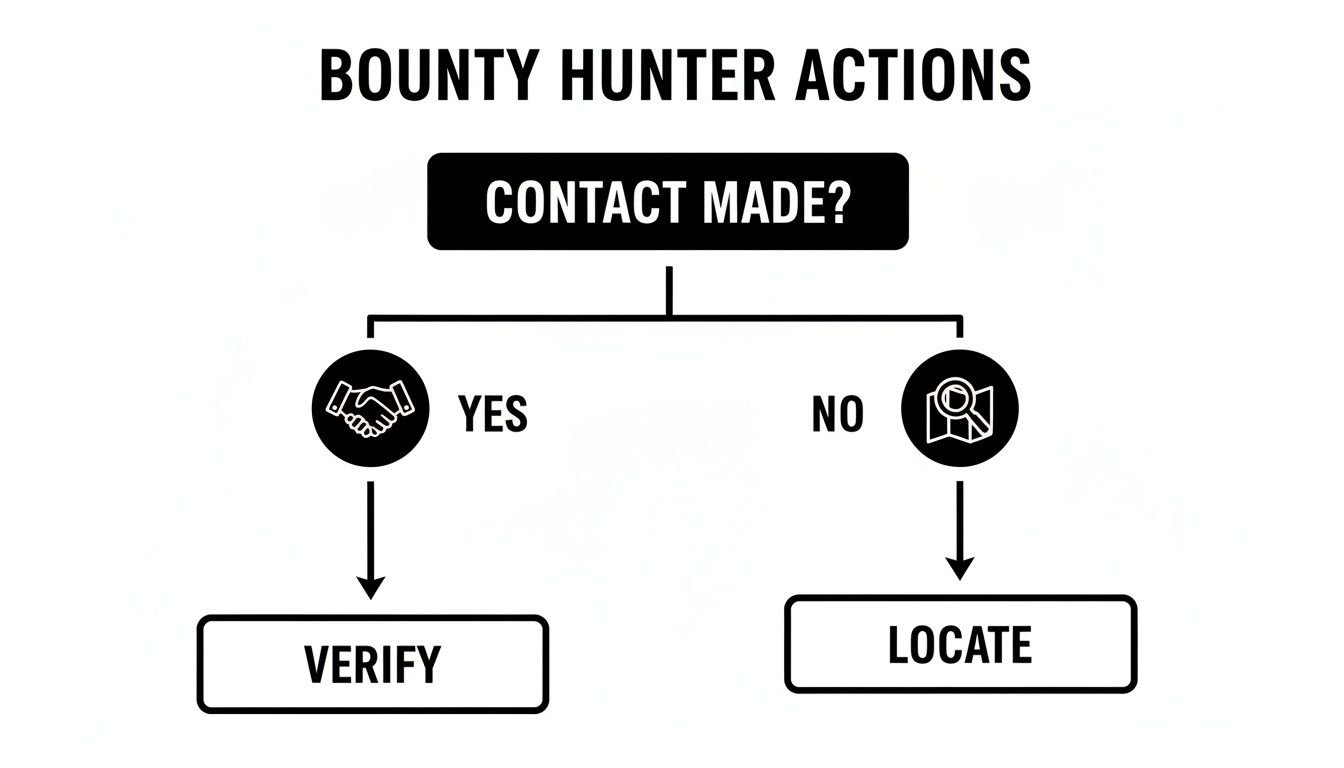
As you can see, their job boils down to two things: locating the defendant and then verifying all the necessary information once they make contact.
Cooperate Calmly and Safely
Once you've verified the agent’s credentials and purpose, the safest path forward is clear communication. If you know where the defendant is, helping to facilitate a peaceful surrender is in everyone’s best interest. It avoids unnecessary conflict and helps get the underlying legal problem—usually a missed court date that triggered a bench warrant—resolved.
If you want to get a better handle on this part of the legal process, take a look at our guide on what a bench warrant is and how it works.
Important Reminder: Professional agents, like those used by reputable agencies such as Express Bail Bonds, are trained to prioritize safety. They understand that cooperation leads to the best outcomes for everyone involved.
Working with a trusted agency from the start ensures that if this situation arises, it will be handled by licensed professionals who respect the law. For peace of mind, see how we serve communities in Jefferson County and Centennial. Our commitment to professional conduct is clear in both our Jefferson County services and our work with clients in the Centennial area.
Why Hollywood Gets Bounty Hunters Wrong
When you hear the term “bounty hunter,” what’s the first image that comes to mind? For most people, it’s a lone gunslinger kicking down doors, chasing a fugitive across the country for a fistful of dollars. It’s a powerful image, one that Hollywood has loved for decades.
But it’s almost entirely a myth.
The reality of modern bounty hunting—or bail enforcement, as it’s properly called—is far more professional and regulated. Even the historical image of a freelance gunman in the Old West is largely fiction. Back then, recovering fugitives was typically a job for official law enforcement or organized detective agencies like the Pinkertons. Pop culture just ran with the more dramatic narrative, and you can see how that view was shaped over time in film and television.
Fact Versus Fiction
This “lone wolf” stereotype simply doesn't square with the modern, professional bail industry. Today's agents aren't vigilantes operating in a legal gray area; they are trained professionals working within a strict set of rules.
The modern bail enforcement agent is a regulated professional contracted by a bail bonds agency. They operate under specific state laws, focusing on investigation and safe apprehension, not dramatic, lawless pursuits.
This is a critical distinction to understand. When a family works with a reputable company like Express Bail Bonds, they aren't hiring some renegade. They are engaging a regulated system designed to ensure accountability. The agents we contract with in communities like Jefferson County and Centennial are an extension of our own commitment to doing things by the book.
Once you separate the Hollywood fantasy from the facts, you can see the bail enforcement industry for what it is: a legitimate and necessary part of the justice system. Trusting a professional bail bonds system means putting your faith in a proven, lawful process—something our satisfied clients in Jefferson County have experienced firsthand.
Frequently Asked Questions About Bail Enforcement
Let's clear up some of the most common questions and misconceptions that pop up when we talk about bounty hunters and bail enforcement. Getting these straight can make a world of difference.
Can I Hire A Bounty Hunter Myself?
That’s a common question, and the answer is a straightforward no. You can't hire a bail enforcement agent—what most people call a bounty hunter—like you would a private investigator.
They work strictly for bail bond companies, like us at Express Bail Bonds. Their job is to recover a person who has skipped bail, protecting the financial stake the bond agency has in that defendant. Their authority comes directly from the bail bond contract, not from a private citizen.
How Is A Bounty Hunter Different From The Police?
The source of their power is the key difference. Police officers get their authority from the law; their duty is to enforce criminal statutes and serve the public. A bounty hunter's power, on the other hand, comes from a civil contract—the bail agreement the defendant signed.
This contract is why an agent can legally enter a defendant's home without a warrant. The defendant essentially gave them permission ahead of time when they signed the paperwork. But this power is incredibly specific: it applies only to the defendant named in the contract and nowhere else.
A police officer's duty is to the public and the law. A bail enforcement agent's duty is to the bail bond agency and the contract they are enforcing.
What Happens After A Defendant Is Caught?
Once an agent has the defendant back in custody, they don't just drop them off at the nearest police station. They must surrender the person to law enforcement in the same jurisdiction where the original charges were filed.
After the surrender, the bail bond is "exonerated." This just means the bond agency is off the hook and no longer financially responsible. For the defendant, things get more complicated. They'll face their original charges plus a new one for failing to appear in court.
For more general information on tricky legal topics like bail enforcement, resources like an AI legal assistant can provide some initial context. Just remember, laws vary widely from state to state, and here in Colorado, the entire system is tightly regulated to keep everyone safe.
Navigating the bail process can feel overwhelming, but you're not in it alone. The team of experts at Express Bail Bonds is ready to guide you. If you need help right now in Jefferson County, Centennial, or anywhere else in Colorado, contact us today. See for yourself what our clients in Jefferson County and Centennial think about our fast and professional service.