
The call usually comes at the worst time. A spouse, parent, sibling, or adult child says they’ve been arrested in Northglenn, and everything gets urgent at once. Where are they being held, when will they see a judge, can they get out tonight, and what are you supposed to do first?
If you’re trying to deal with northglenn municipal court colorado right now, you don’t need broad legal theory. You need a calm plan. The fastest path is usually to confirm where the person is being held, identify whether the case is headed to municipal court, and get ready for the release decision that follows booking and the first court appearance.
Northglenn Municipal Court is a busy local court. It processes over 5,000 cases annually, and in fiscal year 2022 to 2023, 4,872 cases were traffic-related, or 68% of the total caseload. That figure comes from the verified court data provided for this guide. High volume matters because the court and detention staff move quickly, but families still lose time when they chase the wrong jail, wait for incomplete information, or miss a deadline.
Navigating Your First Steps After a Northglenn Arrest
When a family member is arrested, the first mistake people make is trying to solve everything at once. Don’t do that. Start with the next concrete move.
What to do first
Use this order:
- Confirm custody status. Find out where your loved one is being held and whether booking is complete.
- Ask what charge is involved. The charge affects release options, court timing, and what conditions may be attached.
- Find out whether the case is in municipal court. Northglenn Municipal Court commonly handles traffic matters, misdemeanors, and city ordinance issues.
- Get basic identifying details ready. Full legal name and date of birth are usually the fastest way to avoid confusion.
- Prepare for a bond decision or release conditions. That may happen quickly.
A lot of panic comes from silence during booking. That silence is normal. It doesn’t always mean something has gone wrong. It usually means staff are processing paperwork, inventorying property, and entering the arrest into the system.
Practical rule: Don’t wait to gather documents until after a bond is set. Have ID, contact details, and possible cosigner information ready early.
What works and what slows things down
What works is being accurate. Spell the person’s name correctly, use the exact birth date, and don’t guess on the charge if you’re not sure.
What doesn’t work is calling multiple agencies with partial information and getting different answers. Families burn a lot of time that way. If you need a simple overview of the first part of the process, this guide on what happens after you get arrested is a useful starting point.
If your loved one sounds scared, keep your side of the conversation simple. Tell them you’re confirming where they are, checking the court path, and getting ready for the release process. That alone helps more than legal speculation.
Northglenn Municipal Court Key Information
Before you send paperwork, show up for a hearing, or try to resolve a notice, get the court details right.

The mailing address that matters
The official mailing address for Northglenn Municipal Court is PO Box 330061, Northglenn, CO 80233-8061, according to the ServeNow Colorado court listing.
That detail sounds minor until it isn’t. Formal correspondence sent to the wrong place can create avoidable delays. The verified data for this article notes that precise service locations can significantly reduce default judgments in municipal cases, and that’s why bond agencies, defendants, and family members should be careful with every notice and payment-related communication.
Quick reference details
Use this as your basic checklist:
| Item | Detail |
|---|---|
| Court name | Northglenn Municipal Court |
| Mailing address | PO Box 330061, Northglenn, CO 80233-8061 |
| County context | Adams County |
| Common case types | Traffic, misdemeanors, municipal code matters |
Why the detention facility matters first
The court handles the case. The detention facility controls the immediate reality of booking, release timing, and when someone is physically available to leave. If you’re trying to sort out where a newly arrested person may be processed, the most useful companion resource is the Adams County Colorado detention facility page.
Two practical habits that help
- Use the full mailing address exactly as listed. Missing the PO Box or using an outdated location creates unnecessary confusion.
- Keep every document in one place. Bond paperwork, release instructions, hearing dates, and receipts should stay together from the first day.
If you’re mailing something important, use a method that gives you proof it was sent and delivered. That small step prevents a lot of later arguments.
Families often assume that if they know the city, they know the right court contact point. In municipal cases, details matter more than assumptions. A correct address and a clean paper trail make the rest of the process easier.
From Arrest to Arraignment The Court Process Explained
The first stretch after an arrest feels chaotic because several things happen fast, but the sequence is usually straightforward once you lay it out.
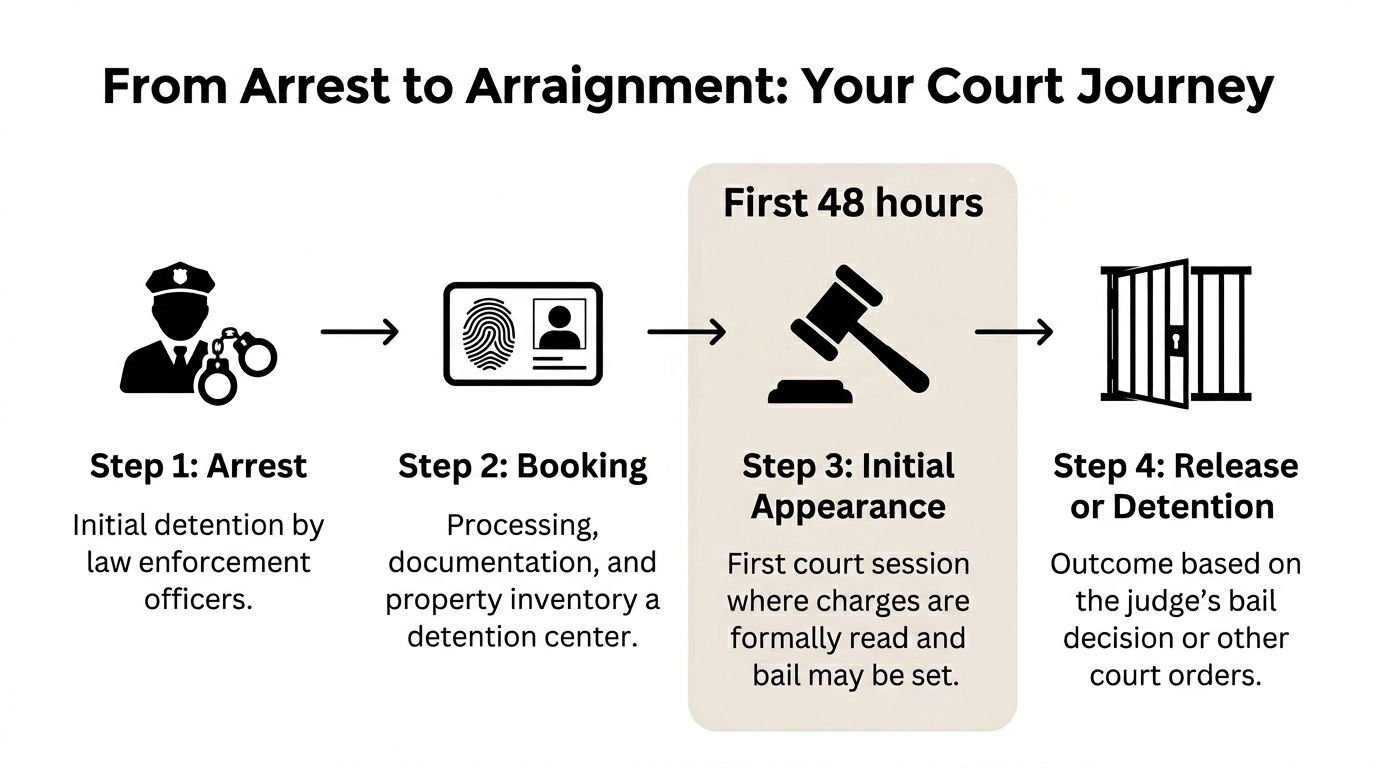
The basic timeline
A Northglenn municipal case often moves through these stages:
Arrest
Law enforcement takes the person into custody based on the alleged offense.Booking
Staff record identifying information, inventory property, and complete intake procedures.Initial appearance
A judge reviews the case at an early court setting. Charges are formally addressed, and release terms may be considered.Release or continued detention
The judge may allow release on conditions, set a bond, or require additional steps before release.
What arraignment means in practice
Arraignment is where the court formally addresses the charge and the defendant responds. For families, the key question is usually simpler than the legal wording. Is your loved one going home, and if so, under what conditions?
That’s why timing matters. If release depends on a bond, you don’t want to be gathering names, identification, and cosigner details after the judge has already ruled.
The court process also changed after Colorado’s bail reform. According to the verified data for this guide, Northglenn saw a 37% decrease in cash bail postings after the 2021 reform, while maintaining a 92% court appearance rate for released defendants. That tells families something important. Courts are paying closer attention to risk and return-to-court expectations, not just who can immediately produce cash.
What families should listen for
During early court activity, pay attention to these points:
The exact charge
Similar-sounding cases can have different release conditions.Any no-contact or protection-related condition
A family can accidentally create a violation if nobody listens carefully.The next court date
Missing that date can create a warrant problem fast.Whether the release is financial or non-financial
That determines your next move.
If you want a plain-language walkthrough of that hearing, this overview of what happens at arraignment hearing is worth reading.
A legal point families often misunderstand
People sometimes think an arrest means the case is already proven. It doesn’t. The court still has to deal with the legal standard required for the charge. If you want a readable explanation of how that standard works, Nares Law Group has a helpful piece on burden of proof.
Early hearings are about procedure and release as much as they are about accusation. Don’t confuse being charged with being convicted.
What works here is staying focused on logistics. Learn the charge, record the hearing date, and follow the release terms exactly. What doesn’t work is debating the facts of the case in panic before you’ve secured the person’s return home.
Common Cases Handled by the Municipal Court
Northglenn Municipal Court handles local ordinance matters and lower-level criminal and traffic cases. That mix matters because each category moves a little differently, and families often prepare for the wrong kind of hearing.
Traffic cases dominate the docket
The verified data shows that Northglenn Municipal Court processes over 5,000 cases annually, and 4,872 of those cases in fiscal year 2022 to 2023 were traffic-related, accounting for 68% of the total caseload.
That tells you two things.
First, traffic matters are normal in this court. Second, court staff and judges see these cases constantly, so they expect defendants to follow instructions precisely even when the charge seems minor.
Traffic cases may involve speeding, driving-related municipal offenses, or other city-level violations. Families sometimes dismiss them as “just a ticket.” That can be a mistake if the person missed a date, ignored a summons, or picked up a related warrant issue.
Misdemeanors and ordinance cases
Municipal courts also handle misdemeanor-level matters within city jurisdiction and code violations tied to local ordinances.
That can include:
City code allegations
Property use, nuisance, or local compliance issues can land in municipal court.Lower-level criminal accusations
Depending on the filing choice and agency involved, some misdemeanor conduct may be handled at this level.Case-specific disputes with unusual facts
Northglenn has had attention on zoning and housing-related legal conflicts, which can turn what sounds like a neighborhood issue into a court matter.
Why case type changes your strategy
A traffic defendant usually needs to focus on appearance dates, documentation, and whether the case can be resolved by plea, payment, or hearing. A misdemeanor defendant may need to focus more on release conditions, attorney coordination, and strict compliance with court orders.
Here’s the practical difference:
| Case category | What families usually need to prioritize |
|---|---|
| Traffic | Court date, paperwork, payment options, license-related concerns |
| Misdemeanor | Release terms, attorney coordination, no-contact issues, future hearings |
| Code or zoning matter | Notices, property records, ordinance language, compliance steps |
A “small” municipal case can become a bigger problem when someone misses court, ignores mail, or assumes the city won’t follow up.
What works is matching your response to the charge category. What doesn’t work is using the same approach for every case. The person with a speeding-related matter and the person facing a city ordinance charge don’t need the same plan, even if both are in northglenn municipal court colorado.
Securing Release with Express Bail Bonds
When a judge sets bail, families usually face a hard choice quickly. Pay the full amount yourself if cash bond is allowed, or use a surety bond so you don’t have to put up the entire amount out of pocket.

Why families choose a surety bond
A surety bond is often the practical option because it lets a licensed bond agent post the bond on the defendant’s behalf. That matters when a family can’t or shouldn’t tie up large amounts of cash while the case is still pending.
The verified data for this article notes Colorado’s standard 15% premium structure, and for bonds over $5,000, approved cosigners may qualify for a 10% premium in some cases. It also notes that, in Northglenn data, surety bonds played a meaningful role in pretrial release.
That doesn’t mean every case qualifies the same way. It means families should ask the right question immediately: is this a cash-only bond, a surety bond, or a release with conditions?
What usually speeds up release
The families who move fastest are the ones who can provide complete information right away.
That usually includes:
Defendant identification
Full legal name and date of birth.Jail and case details
Where the person is being held and what amount or condition has been set.Cosigner readiness
The person responsible for the bond should be ready to provide identification and complete documents promptly.Reliable contact
Missed phone calls and half-completed forms slow release.
If you want a clear explanation of the role itself, this page on what is a bail bond agent lays it out clearly.
What families get wrong
Some people freeze because they assume paying cash directly is always the cleanest route. It isn’t always. Cash may be unavailable, impractical, or the wrong choice for a family already under stress.
Others wait until morning because they think nothing can happen overnight. In many cases, delay only adds more time in custody.
A short overview can help if you’re trying to understand the process visually:
The trade-off in plain terms
Consider this trade-off:
| Option | Main upside | Main downside |
|---|---|---|
| Pay full cash amount | Direct payment if allowed | Ties up the full amount |
| Use a surety bond | Lower upfront cost and faster practical access for many families | Premium is not refundable |
| Wait and do nothing | No immediate paperwork | More time in custody, more stress, more disruption |
That’s why families across Colorado often look for a licensed agency with electronic processing and statewide coverage. For broader service information, visit Express Bail Bonds. If your situation touches another Front Range area, these local resources may also help: Jefferson County in Golden and bail bonds in Centennial. You can also review the business profiles at Google Business Profile one and Google Business Profile two.
Handling Warrants Fines and Special Court Matters
Missed court dates, unpaid obligations, and unusual fact patterns are where families get blindsided. The basic case may be manageable. The complications are what usually create significant damage.

If there may be a warrant
A failure to appear can trigger a warrant and change the tone of the case immediately. Don’t assume it will sort itself out. Usually it won’t.
If you think a missed hearing or unresolved citation may have turned into a warrant, start by checking status and acting on confirmed information. This guide on how to check if someone has a warrant can help you take that first step.
What works is dealing with it directly. What doesn’t work is waiting for the next traffic stop or hoping the court has forgotten.
Fines and payment problems
Some municipal matters end with fines, payment plans, or compliance requirements instead of immediate jail exposure. Even then, details matter. A missed payment can bring a case back to life.
Keep records of:
Payment confirmations
Save receipts and screenshots.Court notices
Don’t throw away mail that looks routine.Compliance documents
If the court required a class, repair, or corrective action, keep proof.
Special Northglenn issues families don’t find explained elsewhere
Northglenn has faced a public dispute with the state over mental health transitional living facilities. As of early 2026, the issue involved safety concerns and increased court involvement in related incidents, and public guidance on bail and court procedure has been lacking, according to Colorado Politics reporting on the Northglenn mental health facility dispute.
That matters because these cases can create extra confusion for families. A relative may be dealing with mental health history, housing placement questions, or communication barriers at the same time the court expects quick compliance with release terms.
Northglenn also has history involving difficult zoning and housing disputes connected to who may live where under local rules. In practice, those cases often feel personal before they feel legal. Families can miss deadlines because they focus on the fairness issue and not the court process itself.
When a case has a mental health, housing, or placement dimension, keep your paperwork tighter, not looser. Courts still expect dates to be met.
The safest approach in any special-case matter is to separate the emotional argument from the procedural task. You can fight the case. But first, you have to protect the person from avoidable detention, warrants, or noncompliance.
Frequently Asked Questions About Northglenn Court and Bail
When people call about northglenn municipal court colorado, the same urgent questions come up again and again. Here are the short answers families usually need.
| Question | Answer |
|---|---|
| How fast can someone get out after bond is posted? | Release timing depends on the jail’s processing speed, booking status, and any court-imposed conditions. In practice, delays usually come from incomplete paperwork, waiting on booking, or uncertainty about the bond type. |
| Can I help if I live out of state? | Yes, many bond situations can be handled remotely when electronic paperwork is available and the cosigner can provide the required identification and signatures. |
| What if I don’t know whether the case is municipal or county? | Start with the arresting agency, the jail location, and any paperwork already issued. Those details usually point you to the right court track. |
| Does a minor traffic case really matter? | Yes. Municipal traffic cases can become much more serious if someone misses court, ignores notices, or lets a warrant issue develop. |
| What if the court set conditions, not just money bail? | Follow every condition exactly. No-contact terms, appearance dates, and location restrictions can affect release status and future bond consequences. |
| Can I just wait for the court date instead of fixing the issue now? | That’s rarely the best choice if someone is in custody or there may be a warrant. Delay usually increases stress and limits options. |
| What should I have ready before I call for bond help? | Full legal name, date of birth, jail location, charge information if you have it, and the name of the person who may cosign. |
| What if the case involves a mental health facility or a zoning-related dispute? | Treat it like any other active court matter procedurally. Confirm the charge, follow release rules, keep every notice, and don’t assume the unusual facts will excuse missed deadlines. |
One more point matters. Families often think they need every answer before they act. They don’t. They need enough accurate information to take the next right step.
If you need fast help securing release, contact Express Bail Bonds. They serve Colorado statewide, offer electronic processing, and can walk you through the bond process clearly when time matters most.