
Getting that call is every parent's nightmare. Your child has been arrested, and in an instant, your world is filled with a thousand questions and a heavy dose of fear. The first thing to understand is what a juvenile bail bond is: it's a financial promise made to the court that allows your child to come home from a detention center while they wait for their court dates.
It’s crucial to know that this isn't like the adult system you see on TV. The juvenile system is built around the idea of rehabilitation, not just punishment. Its main goal is to get your child back on the right track. If you need help now, contact Express Bail Bonds for immediate assistance.
Your First Step When a Minor Is Arrested

The moment you find out your child is in custody, it feels like the ground has disappeared from beneath your feet. But take a deep breath. In Colorado, the juvenile justice system operates with a completely different mindset than its adult counterpart. The focus is squarely on supporting family reunification and guiding the minor toward a better path.
This is where a juvenile bail bond becomes so important. It’s the tool that allows your child to return to the familiar comfort and stability of home. Being at home is incredibly important for their mental health, keeping up with school, and preparing for what's ahead. The court recognizes that keeping a family together is often the best thing for everyone.
Navigating the Initial Shock
It's completely normal to feel overwhelmed. But the first few hours are critical for getting clear information and making the right moves. The good news is the system is designed to be less daunting than adult court; it aims to make the process clearer and less stressful for both you and your child.
As a parent or guardian, you are central to this entire process. The court will be looking to you to provide supervision and support, and your involvement will be a huge factor in their decisions.
The core purpose of the juvenile system is to provide care, guidance, and control that will lead to the child's welfare and the best interest of the state. It is a protective process rather than a punitive one.
Keeping this fundamental difference in mind helps you approach the situation with a clearer head. This is also where getting professional help can make all the difference. If you're not even sure where your child is being held, our guide on how to find someone arrested can help. For immediate, confidential assistance, call Express Bail Bonds now.
Why Professional Help Is Essential
Navigating the legal system alone is tough, and that's why the bail bond industry exists. It’s a service that provides a real lifeline for families in crisis. The U.S. bail bond market is projected to become a $3.5 billion industry by 2026, largely because over 60% of people in many local jails are simply waiting for their trial. For a family with a child in detention, a professional bondsman offers a direct path to getting them home.
At Express Bail Bonds, we're that partner for you, available 24/7. With decades of experience helping families across Colorado, including in Jefferson County and Centennial, we know how to make this difficult time as smooth and straightforward as possible. Please, don't hesitate to call us for immediate help. You can find our Golden office here or our Centennial office here.
How the Juvenile Justice Process Really Works
When your child is in trouble with the law, it’s easy to feel lost. The juvenile justice system operates on a completely different set of rules than the adult courts you see on TV. It’s crucial to understand that its main goal isn't punishment—it's about rehabilitation and getting your child back on the right track.
When a minor is taken into custody, the language itself is different. They aren't "arrested"; they are "detained." The first and most critical step is the detention hearing. Think of this not as a trial, but as an urgent meeting to figure out the best and safest place for your child while the case moves forward.
The Critical Detention Hearing
This hearing happens fast, usually within 48 hours after your child is detained. A judge or magistrate runs the meeting, and their job isn't to decide if your child is guilty. Instead, they have one primary focus: to determine if the minor needs to stay in a detention center or if they can be safely released back home.
During the hearing, the judge looks at a specific set of factors to make this call. It’s not a gut feeling; it’s a careful evaluation meant to protect both your child and the community. Knowing what they’re looking for can help you understand what's happening.
Factors Influencing the Judge’s Decision
The court weighs several key things to decide what to do next. Unlike the adult system where a bail amount is often the first thing discussed, the juvenile system takes a much broader look at the child's entire situation.
Here’s what the judge is typically considering:
- The Nature of the Alleged Offense: The seriousness of the charge matters a lot. A minor accused of a non-violent offense has a much better chance of being released than one facing serious felony charges.
- The Minor's History: The judge will look at any past involvement with the justice system. A first-time mistake is seen very differently than a repeated pattern of behavior.
- Risk to Public Safety: A key question is whether releasing the minor would pose a danger to anyone. The court has to balance your child’s well-being with the safety of the community.
- Family and Community Ties: This is where you come in. The judge wants to see a stable home, proof of school enrollment, and other positive connections that provide structure and support.
After weighing these factors, the judge makes a ruling. If they decide detention isn't necessary, they will set specific conditions for release. This is where options like juvenile bail bonds can become a factor, acting as a financial promise that your child will show up for all future court dates.
The core principle of juvenile justice is to act in the "best interest of the child." This means every decision, from detention to final disposition, is meant to provide the care, guidance, and control that will lead to the child's welfare and rehabilitation.
For parents, this whole process can feel overwhelming, but your presence is a huge positive. Simply being there, showing support, and demonstrating that you can supervise your child can make a world of difference in the judge's decision. If you're in Jefferson County or the Centennial area, knowing the local procedures is especially helpful. Our team at Express Bail Bonds is ready to help you navigate this process.
The juvenile and adult systems really are worlds apart. The table below breaks down some of the most important distinctions.
Juvenile vs Adult Bail Process Key Differences in Colorado
| Aspect of Process | Juvenile System | Adult System |
|---|---|---|
| Primary Goal | Rehabilitation and acting in the child's best interest. The focus is on correcting behavior and family support. | Punishment and public safety. Bail is primarily set to ensure the defendant appears in court. |
| Release Decision Maker | A judge or magistrate makes a holistic decision based on risk assessments, family situation, and the minor's history. | Bail is often set according to a predetermined schedule based on the crime, with less judicial discretion initially. |
| Common Release Options | Release to a parent/guardian, personal recognizance, or a juvenile bail bond. | Primarily cash bail, surety bonds, or property bonds. Release to a guardian is not a standard option. |
| Terminology and Environment | Uses terms like "detained" and "adjudication." Hearings are typically less formal and may be closed to the public. | Uses terms like "arrested" and "trial." Proceedings are formal, public, and adversarial in nature. |
At the end of the day, the juvenile justice process is built to be a corrective experience, not just a punitive one. At Express Bail Bonds, we know this system inside and out and are here to help you navigate it 24/7. Whether you need to visit our Golden office or our Centennial location, our team is ready to give your family the guidance and support you need.
Understanding the Costs of a Juvenile Bail Bond
The last thing you need when your child is in detention is more stress, especially financial stress. When a judge sets a bond, figuring out the costs is the first step to getting your child home. Thankfully, the process is often more straightforward than parents think and is designed to be a manageable path forward during a very tough time.
The main cost you'll encounter is called the premium. This is a non-refundable fee you pay to a bail bond agency. In return for that fee, the agency posts the entire bond amount with the court on your behalf. It’s a lot like an insurance premium—you pay a smaller, predictable amount, and the bondsman takes on the full financial risk of making sure your child shows up for their court dates.
Breaking Down the Premium Fee
In Colorado, the premium is a set percentage of the total bond amount. This rate is regulated by the state, which protects families from being overcharged. This fee is how the agency covers its own costs, the risk it takes on, and the work involved in getting your child released.
Here’s a simple, real-world example to show how it works:
- Total Bond Amount Set by the Court: $2,000
- Standard Premium (let's say 15%): $300
- Your Non-Refundable Payment: $300
In this situation, you would pay the bail bondsman $300. The bondsman then gives the full $2,000 to the court, which secures your child's release. As you can see, this makes getting them home much more affordable than having to come up with the full bond amount in cash. To get a more detailed look at these expenses, you can learn more about how much a bail bond costs in our complete guide.
The Role of the Cosigner or Indemnitor
When you arrange a juvenile bail bond, a parent, guardian, or another responsible adult has to act as the cosigner (sometimes called an indemnitor). The cosigner is the person who officially signs the bail bond agreement, which is a legal contract with the bail agency.
This role comes with one very important responsibility: guaranteeing that the minor will be at all of their required court hearings. By signing the contract, you are giving your financial word to the bail agency. If the minor doesn't show up to court and the bond is forfeited, you become responsible for paying back the full bond amount. It's this guarantee that gives the bondsman the security they need to post the bond in the first place.
A cosigner's commitment is the bedrock of the bail bond agreement. It provides the court and the bail agency with the assurance needed to release a minor back into the care and supervision of their family, where they belong.
Flexible Payment Solutions and Modern Processing
We know that even the premium can be an unexpected financial hit. At Express Bail Bonds, we’re committed to offering flexible payment solutions to help lighten that load. We’ll work with you to create a payment plan that fits your budget, because a temporary financial hardship should never be what keeps your child in detention.
We’ve also designed our process to be as simple and convenient as possible. You can fill out and sign all the necessary contracts and make payments electronically, right from your home. This is a huge help for family members who might live out of state or can't easily travel to one of our offices in Jefferson County or Centennial.
Our secure online system lets you handle everything from a computer or smartphone. This allows us to post the bond immediately and get the release process started without delay. Don't let distance or logistics add to your worries. Our team is here to help—contact Express Bail Bonds 24/7 or visit our Golden office or Centennial location for immediate assistance.
Alternatives to Securing a Bail Bond for a Minor
When a judge decides your child can be released from a detention center, a commercial bail bond is a common option, but it's not the only one. The Colorado juvenile system actually has several other methods designed to get a minor back home with their family, often without an immediate financial burden.
Knowing what these alternatives are helps you see the whole picture and advocate for the best possible outcome for your child. The court’s primary goal is rehabilitation, which means the first instinct is usually to return a child to a stable, supervised home.
Release to a Parent or Guardian
For less serious offenses, especially if it's a minor's first brush with the law, the most frequent outcome is a Release to Parent/Guardian on Promise to Appear. It’s exactly what it sounds like: the court releases your child directly to you without asking for any money.
By accepting this, you are formally promising the court that you'll make sure your child shows up for all their court dates and follows any other rules the judge sets, like a curfew. It’s the system's way of saying it believes a supportive family is the best place for a child.
Personal Recognizance Bonds
Another common alternative is a Personal Recognizance (PR) Bond. This is a lot like being released to a parent, but it’s based more on the minor’s own reputation—their ties to the community, school attendance, and whether they have a prior record.
A PR bond is a “signature bond,” which means no money changes hands upfront to secure the release. It's not a get-out-of-jail-free card, though. If the minor doesn't show up for court, the family could be on the hook for the full bond amount. The main difference between a PR bond and a surety bond is who takes on the initial risk. You can dig deeper into how these work in our guide comparing surety bonds vs. cash bonds.
The push for bail reform has put a spotlight on alternatives to cash bail, particularly for young people. The idea is to make sure a family's bank account isn't the deciding factor in whether a child has to stay in detention.
This isn't just a theory; the data backs it up. The Bail Project, for example, found that 92% of the thousands of people they've bailed out made it to court. This shows that releasing people doesn't have to compromise public safety, a principle that’s even more powerful in juvenile cases where family support is a huge motivator. Read more about these important findings on bail reform.
While these alternatives are great, they aren't guaranteed. If the alleged offense is serious or if the minor has missed court dates in the past, a judge will likely require a surety bond to ensure they return. This is where a professional bail bondsman is essential.
At Express Bail Bonds, we offer a clear, fast, and supportive process to bring your child home. Whether you need help in Jefferson County or Centennial, our team is available 24/7. You can find us at our Golden office location or our Centennial office.
Your Step-By-Step Guide to Getting Your Child Home
Discovering your child is in custody is every parent's nightmare. Your world can feel like it's spinning out of control. In these moments, having a clear plan isn't just helpful—it's essential for regaining your footing and focusing on what truly matters: bringing your child home. This guide cuts through the confusion, giving you a straightforward roadmap for securing a juvenile bail bond.
The process might seem intimidating at first, but with the right partner, it’s far more manageable than you think. At Express Bail Bonds, we’ve spent years refining our system to be as quick and painless as possible for families across Colorado.
Step 1: Call Us Immediately
The first and most critical step is to call us. Don't wait. The sooner you reach out, the faster we can get to work on securing your child’s release. All you need to start the process is your child’s name and the detention center where they're being held.
Our experienced agents are on call 24/7. We know these emergencies don’t stick to a 9-to-5 schedule, which is why we’re always here to provide immediate support, day or night. Contact Express Bail Bonds for a free, confidential consultation.
Step 2: We Gather the Facts and Explain Everything
Once you’ve made that initial call, our team jumps into action. We’ll contact the detention facility to confirm all the details, including the exact bond amount required. While we handle the logistics, we’ll walk you through the entire process, explaining what a juvenile bail bond is and what you can expect next.
We'll also clarify the role of the cosigner—the parent or guardian who signs the agreement and guarantees the minor will show up for court. We believe in total transparency, making sure you understand every detail and feel confident about your decisions. We’ll also cover the different paths to release, which can range from a judge releasing your child directly to you to needing a commercial bond.
This infographic lays out the common routes a judge might take for a juvenile's release.
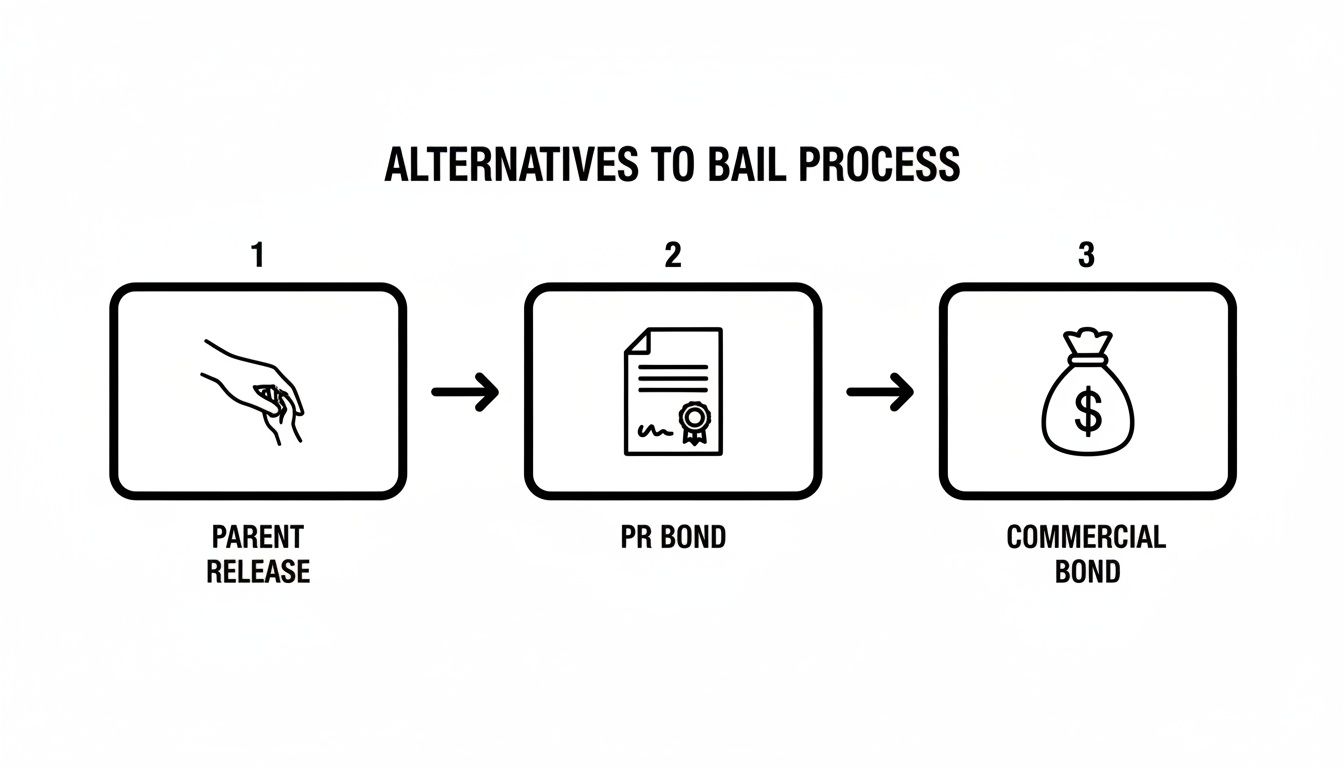
As you can see, while a commercial bond is a crucial tool, the court often prioritizes family-focused solutions, like releasing a child directly into their parents' care.
Step 3: Complete Paperwork from Anywhere
To make a stressful situation a little easier, we’ve moved all our paperwork online. You can complete and sign every necessary contract securely from your computer or smartphone, no matter where you are. This is a huge help for family members who might live out of state or can't easily get to one of our offices.
Our digital process cuts out the delays, allowing us to move forward the moment everything is signed. It's a simple, confidential, and efficient way to handle the legal documents without adding travel time or extra stress. To get a broader picture of the general process, take a look at our complete guide on how to bail someone out.
Step 4: Submit Your Payment Securely
After the paperwork is done, the next step is paying the premium. This is our non-refundable fee for the service, which is a set percentage of the total bond amount. Our secure online system makes payment simple, and we offer flexible options to fit your family’s budget.
The bail bond industry is a significant part of the U.S. justice system. In fact, the global market for these services generated $5.7 billion in revenue in 2024, with the vast majority of that demand coming from North America. Unlike many countries where commercial bail is rare, it’s a standard practice here, creating a real need for specialized services like juvenile bail bonds across Colorado. We serve clients in Jefferson County, Centennial, and beyond.
Step 5: We Post the Bond and Your Child Comes Home
The second your payment is processed, we post the full bond amount with the court. Our agents have long-standing relationships with detention center staff, which helps us finalize the release as quickly as possible. We’ll keep you in the loop the entire time, letting you know exactly when you can expect your child to be released.
Our goal is simple: to reunite your family. If you need help, don’t hesitate. Contact Express Bail Bonds right now. We serve all of Colorado, with local agents ready to assist in Jefferson County and Centennial. You can visit our Golden office or our Centennial location for in-person support.
Common Questions from Worried Parents
When you get that call, your mind starts racing. It's an overwhelming and confusing time, and it's completely natural to have a million questions. We've been there with countless families, and we know that getting straight answers can bring a little bit of calm to the chaos.
Think of this as a conversation about the questions we hear most often from parents dealing with juvenile bail bonds. Our goal is to give you the practical information you need to feel more in control and take the next right step.
What Information Do I Need to Start the Bail Process?
To get things moving fast, it helps to have a few key details handy. But please, don't worry if you don't have everything. We can help track down any missing pieces.
Here’s what’s most helpful to have ready:
- Your Child's Full Name and Date of Birth: This is the most crucial piece, as it helps us identify your child in the system without any mix-ups.
- The Detention Center's Location: Knowing which facility is holding your child, whether it's in Jefferson County or Centennial, tells us exactly who to call.
- The Alleged Charge: If you know what the charge is, it gives us a better idea of what to expect with the bond amount and case specifics.
- The Bond Amount: The court sets this number. If you know it, we can immediately calculate our fee and get the paperwork started.
Again, even if all you have is your child's name, that's enough. Give us a call at Express Bail Bonds, and we'll take it from there.
How Long Does the Release Process Usually Take?
This is usually the very first question parents ask, and for good reason. While every situation is a little different, the timeline really depends on how quickly the detention facility can process the paperwork after we post the bond.
Once you’ve completed the agreement with us and paid the premium, we post the bond with the court right away. From there, the actual release can take anywhere from 30 minutes to a few hours. Things like how busy the facility is, their staffing on that particular day, and their internal procedures all play a part. We’ve built strong professional relationships with the staff at detention centers across Colorado, which helps us move things along as smoothly as possible. We’ll keep you in the loop the entire time so you're never left wondering.
Can I Post a Bail Bond from Another State?
Yes, absolutely. We work with families all the time where a parent, grandparent, or other relative lives out of state but wants to help. You do not have to be physically present in Colorado to get a juvenile bail bond for your child.
We've set up a secure electronic system that lets you do everything remotely:
- Fill out and sign all the necessary contracts right from your computer or phone.
- Pay the premium securely online.
- Get all confirmations and updates sent directly to you via email or text.
Distance should never be a barrier to getting your child home. Whether you're across the country or just can't get away, we can handle it all for you. Our agents are ready to assist you no matter where you are, whether you need services in Jefferson County or Centennial.
What Happens if My Child Misses a Court Date?
This is incredibly important. Missing a court date is a serious issue with major consequences. When you cosign a bail bond, you are making a legal and financial promise to the court that your child will show up for every single hearing.
If a court date is missed, the judge will issue a warrant for the minor’s arrest and the bond is "forfeited." This means the full bond amount becomes due immediately. As the cosigner, you would be on the hook for paying that entire amount to us.
Communication is key. If you know there’s a potential conflict with a court date, call us and your attorney right away. Being proactive can sometimes allow the hearing to be rescheduled, preventing the bond from being forfeited.
It is absolutely critical to keep track of every court date and make sure your child is there. This is the single most important part of being a cosigner. If you have any concerns, please contact us immediately.
Is My Personal Information Kept Confidential?
Your privacy is a top priority for us. We handle every case with the highest level of discretion. Any information you share—from personal details and financial data to the specifics of your child's situation—is kept strictly confidential.
Our systems are secure and designed to protect your data. We know this is a sensitive family matter, and you can trust us to treat it that way from start to finish.
Many parents also have questions about the arrest itself, like whether juveniles get mugshots and how youth records are handled. Another common question is what happens financially after the case is over. To learn more about that, you can read our guide on whether you get bail money back which explains the key difference between the non-refundable premium you pay a bondsman and a cash bond paid directly to the court.
Having a child caught up in the justice system is a stressful, emotional road. We hope these answers have helped clear things up a bit. If you have any other questions, or if you need help right now, our team is here for you 24/7.
Don't go through this alone. The team at Express Bail Bonds has decades of experience helping Colorado families navigate the juvenile bail process with compassion and efficiency. We are available 24/7 to answer your questions and start the process of bringing your child home.
- Contact Express Bail Bonds 24/7
- Get Help in Jefferson County
- Find Bail Bonds in Centennial
- Visit Our Golden Office Location
- Visit Our Centennial Office Location