
When a loved one is detained by Immigration and Customs Enforcement (ICE), every moment feels like an eternity. An immigration bail bond is a lifeline in this situation. It's a financial guarantee made to the U.S. government that allows for the release of a non-citizen from an ICE detention facility while they await their court hearings.
Without a bond, that person could be held in custody for months or even years as their case moves through the overloaded immigration court system. This bond is their path back to their family and community during that long wait. If you need immediate assistance, contact Express Bail Bonds today.
Understanding The Basics Of Immigration Bail Bonds

At its core, an immigration bail bond is a formal contract. It tells the government that if they release the individual, you promise they will show up for all their required court dates. This isn't just a handshake deal; it's backed by a significant amount of money.
To get a clear picture, you need to know who is involved in the process:
- The Detainee: The person—the non-citizen—being held in an ICE facility.
- The Obligor: This is typically a friend or family member who steps up to sign the bond contract. They take on the financial responsibility and guarantee the detainee will comply with all court requirements.
- The Surety Company: This is a licensed bail bond agency, like Express Bail Bonds, that works with the family to post the bond with the government.
The Critical Role Of A Surety Company
Immigration bonds can be set at very high amounts, often thousands of dollars. Most families simply don't have that much cash readily available to hand over to the government. This is where a surety company becomes your most important partner.
Instead of paying the full bond amount yourself, you pay a much smaller, non-refundable premium to a bail agent. The agent, backed by their surety company, then posts the full bond amount with ICE. They take on the primary financial risk, making release a real possibility for your family.
The most important thing to understand is that an immigration bail bond is a civil matter, not a criminal one. It's handled at the federal level by the Department of Homeland Security (DHS). This makes it completely different from a state or local criminal bond, with its own set of rules and procedures.
This distinction is essential. Navigating federal immigration law is complex, which is why specialized legal support is so valuable. For a deeper dive into the legal side of these cases, you can explore our comprehensive immigration law services.
The process can feel overwhelming, but securing an immigration bail bond is a well-established procedure that requires federal expertise. If you're in Colorado and need help now, the team at Express Bail Bonds is available 24/7. We’re here to walk you through every step of securing a loved one’s release from facilities in Jefferson County, Centennial, and anywhere else in the state. See what our clients are saying on Google and find our location details here.
To better understand how surety bonds work in a different context, you can read our guide on what is a surety bond for jail?.
How Immigration and Criminal Bonds Differ
It’s easy to assume a bond is just a bond, but in reality, immigration and criminal bonds operate in completely separate legal worlds. Getting them mixed up can cause huge headaches, costing you precious time and money. The single biggest difference comes down to who’s in charge.
An immigration bail bond is a federal affair, handled exclusively by the Department of Homeland Security (DHS) and its enforcement agency, Immigration and Customs Enforcement (ICE). That means all the rules, paperwork, and payment locations are dictated by the federal government.
A criminal bond, on the other hand, is a state or local issue. If a person gets arrested for a state crime—think DUI or theft—their bond is set by a local court, like those in Jefferson County or Centennial. Everything about that process is governed by Colorado state law and managed by local authorities.
A Tale of Two Bonds
To see how this plays out, picture this common scenario: a non-citizen is pulled over for a simple traffic ticket, but the officer discovers an old warrant. They’re arrested and booked into the county jail, where a judge sets a state criminal bond. The family quickly posts the bond, expecting their loved one to be released.
But they aren't. Because the arrest flagged them in federal databases, ICE steps in and places an "immigration hold" on them. So, even with the criminal bond paid, they're transferred directly from the county jail to a federal ICE detention facility. Now, a completely separate, federal immigration bail bond must be posted for their release.
This situation reveals a hard truth: Posting a criminal bond does not resolve an immigration hold. The two are entirely separate processes. One gets you out of the county jail; the other gets you out of federal ICE detention.
Different Systems, Different Rules
This divide means families are forced to navigate two very different systems. The key distinctions to remember are:
- Jurisdiction: Criminal bonds operate under state law, while immigration bonds are strictly a matter of federal law.
- Authority: For a criminal bond, you’ll deal with local courts and sheriff’s departments. For an immigration bond, you’re dealing directly with ICE.
- Payment: You can post a criminal bond at the local jail or courthouse. An immigration bond must be paid at a specific, designated ICE ERO field office.
Posting an immigration bail bond successfully requires specialized expertise in the federal system. It's also worth noting that the commercial bail industry itself is quite unique to the United States and the Philippines. In both countries, bail bond companies are the main way people secure pretrial release, a system that you can discover in more detail about bail reform challenges.
Because you're dealing with two different legal arenas, it's absolutely critical to work with a bail bondsman who understands both. At Express Bail Bonds, our team has spent decades mastering Colorado's state criminal bond system while also building the specialized knowledge needed to manage federal immigration bonds. For a deeper dive into the state system, you can check out our guide on the different types of bail in Colorado. Whether you need help in Jefferson County or are dealing with a case in Centennial, we know the local landscape. You can see what our clients say about us on Google and find us here when you need expert help.
Who Qualifies for an Immigration Bond
One of the first questions families ask when a loved one is detained by Immigration and Customs Enforcement (ICE) is, "Can we get them out on bond?" Unfortunately, not everyone is eligible. The decision rests with either an ICE officer or an immigration judge, and it all comes down to two critical questions: Is this person a flight risk, and are they a potential danger to the community?
Essentially, the judge has to feel confident that if the person is released, they will show up for all future court hearings without fail. They also need to be assured that releasing the individual won’t put public safety at risk.
The Two Main Risk Factors
So, how do they make that call? An officer or judge will dig into the person's life story to build a complete picture of who they are. They're looking for signs of stability and trustworthiness that can tip the scales in favor of granting a bond.
Here are some of the key details they'll scrutinize:
- Family Ties in the U.S. Having a spouse, kids, or other close relatives who are citizens or legal residents is a huge plus. It shows deep roots and a strong reason to stay.
- Length of Time in the U.S. Someone who has lived here for a decade is seen very differently than someone who arrived last month.
- Stable Employment History: A steady job is a powerful indicator of responsibility and a connection to the local community.
- Criminal History: This is a big one. Any past convictions, especially for serious crimes, will weigh heavily against the person.
- Previous Immigration Violations: If someone has a history of missing court dates or ignoring immigration orders, it’s going to be very difficult to convince a judge they won’t do it again.
It's important to know that some individuals are automatically ineligible for a bond due to a strict policy called mandatory detention. If someone has been convicted of certain serious crimes, particularly those classified as "aggravated felonies," the law requires them to remain in custody throughout their entire immigration case.
Understanding the Types of Immigration Bonds
If an immigration judge decides your loved one is eligible, the next step is determining the type of bond. There are two main kinds, and each one serves a very specific purpose.
The vast majority of immigration bail bonds are delivery bonds. In fact, recent data showed that of 20,494 ICE bonds posted, a staggering 91% were delivery bonds meant to guarantee attendance at removal hearings. You can see how these numbers reflect current trends and get a better sense of the landscape.
Knowing which bond you're dealing with is crucial. Let's break them down.
Delivery Bond (Form I-352)
This is, by far, the most common immigration bond. Its job is simple: to guarantee the person will show up for every single court hearing and ICE appointment. As long as they comply, the bond is eventually returned. If they miss even one date, the bond is considered "breached," and the government keeps the full amount.Voluntary Departure Bond
This bond is for a completely different situation. It's used when someone agrees to leave the U.S. voluntarily by a set date. The bond acts as a financial promise that they will actually follow through. If they provide proof of their departure on time, the money is returned. If they fail to leave, they forfeit the bond.
Grasping these qualifications and bond types is the first step in a complex process. While these bonds are unique to the federal immigration system, you can also learn more about the concept of a personal bond in other legal contexts. When you're ready to take action, the team at Express Bail Bonds is here to guide you, whether your loved one is in a facility near Jefferson County or Centennial. You can read our client reviews on Google and see our location details here.
The Step-by-Step Release Process
Getting the call that a loved one has been detained by ICE is overwhelming. The situation feels chaotic, and the last thing you need is more confusion. What you need is a clear, straightforward plan. Let's walk through the practical steps to navigate the immigration bail bonds process and get them home.
The entire process hinges on one key piece of information. Before you can do anything else, you have to locate your loved one and find their Alien Registration Number, or A-Number. This is a unique nine-digit number that acts as the master key to their entire immigration case.
Once you have the A-Number, the next step is to find out the bond amount. An immigration judge or an ICE officer will set this figure. With that number in hand, it’s time to call in an expert.
Finding The Right Partner
This is arguably the most important step you can take: contact a licensed surety agent who truly specializes in immigration bail bonds. A company like Express Bail Bonds has the federal authority required to post these types of bonds, something most local bail bond agencies simply don't have. Our agents live and breathe the federal system and can get to work for you immediately.
After you connect with an agent, they’ll walk you through gathering the needed documents for the person who will financially guarantee the bond (often called the "obligor" or cosigner). You might need to provide personal documents, and if they aren't in English, it's good to know the official requirements for translating documents for USCIS to avoid any frustrating delays.
We handle the entire process with your peace of mind as the top priority.
One of the biggest reliefs for our clients is that they don’t have to deal with the stress of going to an ICE office in person. At Express Bail Bonds, we take care of all the paperwork and payments electronically. This lets you focus on your family while we cut through the federal red tape.
This flowchart breaks down the two main questions a judge considers when deciding if someone is even eligible for a bond in the first place.
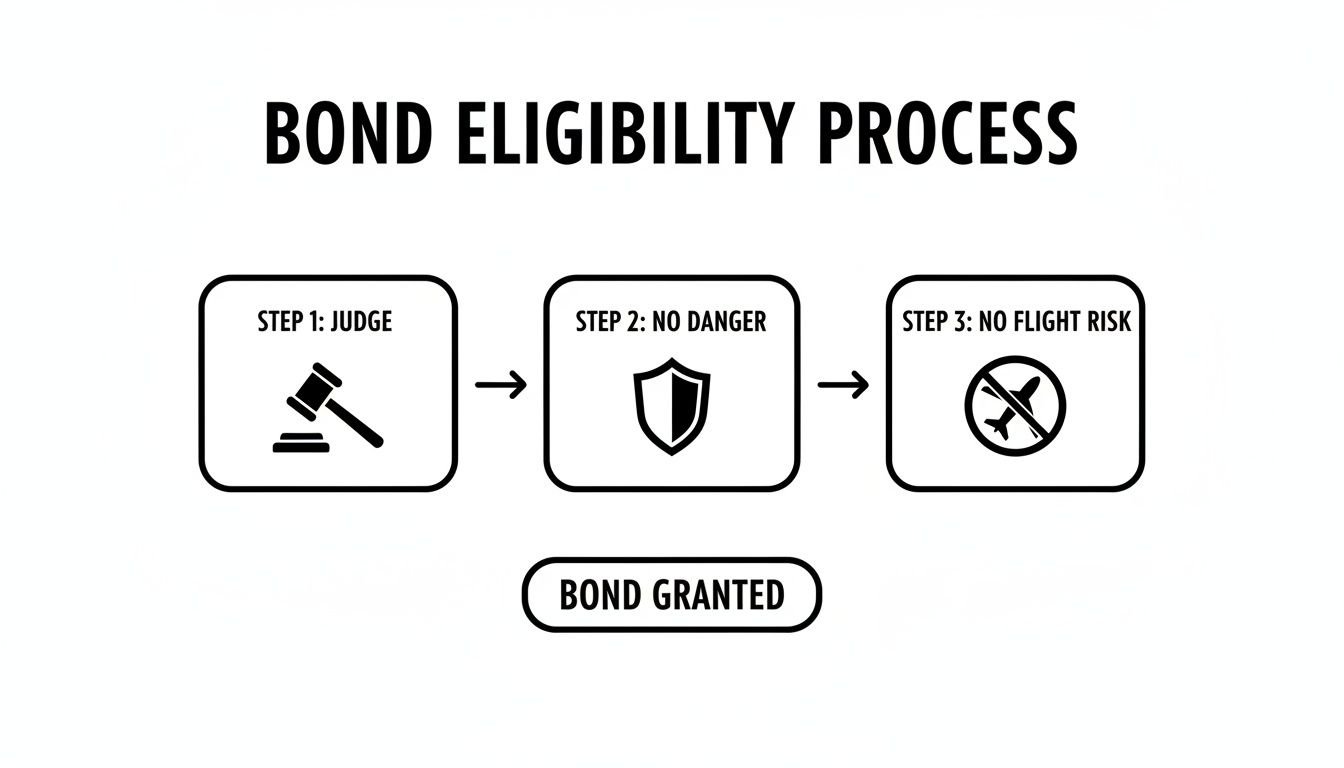
As you can see, the judge needs to be convinced that the person is not a danger to the community and is not a flight risk. If they can't be sure of both, a bond won't be granted.
The Final Steps to Release
Once you've submitted all the necessary paperwork and paid the premium, your bail agent takes the wheel completely. Here’s what happens next:
- Bond Is Posted with ICE: Our agent submits the official bond and financial guarantee directly to the correct ICE ERO Field Office.
- Detention Facility Processes Release: ICE officials then send the release order to the specific detention facility where your loved one is being held.
- The Release: The staff at the facility processes the discharge paperwork, and your loved one is finally released.
This last part can take anywhere from a few hours to 48 hours, all depending on how busy the facility is at that moment. Our team at Express Bail Bonds will keep you in the loop the entire time. If you want a deeper dive into the general mechanics of bail, our guide on how does bail bonds work is a great resource.
Navigating the Costs and Fees
When you get the call that a loved one is in ICE detention, one of the first and most stressful questions is always, "How much is this going to cost?" Let's break down the financial side of an immigration bail bond so you know exactly what to expect.
The process starts with the total bond amount, which is set by either an ICE officer or an immigration judge. This number isn't pulled out of a hat; it's determined by their assessment of the detainee’s flight risk, criminal history, and ties to the community. While the legal minimum is $1,500, it's far more common to see bonds set at $10,000, $25,000, or even higher, depending on the case's specifics.

The Bail Bond Premium
Coming up with thousands of dollars in cash on short notice is a huge challenge for most families. That’s where a bail bond company comes into the picture. Instead of paying the full bond amount to ICE, you pay a smaller, non-refundable fee to us called a premium.
This premium is our service fee for taking on the massive financial risk of guaranteeing the entire bond amount to the government.
In Colorado, the standard premium for bail bonds is typically 15% of the total bond amount. For a $10,000 immigration bond, that means you would pay a $1,500 non-refundable premium. Once that's paid, we post the full $10,000 on your behalf, and your loved one is released.
We do have some flexibility. For larger bonds, we can often secure a reduced 10% premium if there is a qualified cosigner with a strong financial background. You can find more details in our complete guide on how much a bail bond costs.
What Is Collateral?
Sometimes, particularly for very large or high-risk bonds, we may also need collateral. This is simply an asset of value—like real estate, a vehicle title, or a cash deposit—that you pledge to secure the bond.
Think of it as an insurance policy for the bond. If the person who was released fails to show up for their hearings and the bond is forfeited, the collateral is used to help cover the loss of the full bond amount. It’s a way to make a high-risk situation workable.
Don't worry—this isn't something you lose automatically. Once the immigration case is officially closed and all court appearances are complete, the collateral is returned to you in full.
Understanding the Cosigner's Responsibility
The person who signs the bond agreement is called the cosigner (or obligor), and their role is built on trust and a serious financial commitment. When you cosign, you are entering into a legally binding contract.
This is much more than just a favor for a friend; you are personally guaranteeing to the bail bond company that the person being released will attend every single one of their court hearings.
If that person disappears, the cosigner immediately becomes legally responsible for paying back the full bond amount to the bail company. It’s a significant responsibility, but it’s the legal promise that ensures everyone involved is committed to seeing the case through to the end. For expert help in Centennial or Jefferson County, call our team today.
Your Checklist Before Calling an Agent
When you get the news that a loved one is in detention, your world can feel like it’s spinning. Time is critical, and the fastest way to get help is to be prepared before you even pick up the phone.
The more information you have on hand, the quicker an agent can start working to bring your family member home. A few moments of preparation can shave hours—or even days—off the process and cut down on a lot of unnecessary stress.
Gather These Essential Details
Before calling, take a moment to collect the key pieces of the puzzle. This is the information an agent absolutely needs to locate the person and start the immigration bail bonds process.
- Detainee's Full Name: Make sure you have their complete, legal name as it would appear on any official ID or document.
- Alien Registration Number (A-Number): This is the single most important detail. It’s a unique nine-digit number that ICE uses to track individuals, and it’s the fastest way for us to find them in the system.
- Name of the Detention Facility: Knowing the exact facility where they are being held is crucial. If you're not sure, a good agent can often help you track them down, but having the name upfront saves a lot of time.
- Exact Bond Amount: If an immigration judge or ICE officer has already set a bond, you’ll need to know the precise dollar amount.
Once you have these details, you’re halfway there. But there’s one more person whose information is just as critical.
The next step is all about the person who will financially guarantee the bond. This individual, often called the cosigner or obligor, is promising to pay the full bond amount if the detainee doesn't follow the rules of their release. Having their info ready is just as vital as having the detainee's.
Prepare the Cosigner's Information
The cosigner provides the financial security for the immigration bail bonds contract, so their information needs to be accurate and ready to go.
Here's what the cosigner should have on hand:
- Cosigner's Full Name and Address: We’ll need the complete legal name and current home address of the person signing for the bond.
- Proof of Legal Status: The cosigner must be able to prove they are legally in the U.S. This is usually done with a U.S. passport, birth certificate, or a permanent resident card (Green Card).
For families here in Colorado, working with a local agency that understands these specific challenges makes all the difference. At Express Bail Bonds, we help families secure release by offering surety solutions for a premium, which is typically 15% of the bond amount. For larger bonds, we can often offer a lower 10% rate with a well-qualified cosigner. Since 1988, we’ve provided 24/7 electronic processing across the state, so you don’t have to scramble to come up with the full cash amount. The system of bail has evolved over time, and you can read more about the history of bail reform to understand how it works today.
With your checklist complete, you’re ready to take decisive action. Call or text our expert agents at Express Bail Bonds immediately. We’re standing by to help clients in Jefferson County, Centennial, and statewide. You can find our location and contact information here and see what our clients have to say on our Google review page.
Frequently Asked Questions
When you're trying to get a loved one out of ICE detention, a flood of questions comes to mind. It's a stressful and confusing time, and getting clear answers is the first step toward taking control. Here are the answers to some of the most common questions we hear from families every day.
How Long Does Release Take After an Immigration Bond Is Posted?
This is usually the very first thing people ask. While the timing can shift a bit depending on the specific ICE facility, you can generally expect a release anywhere from a few hours up to 48 hours after ICE gives the final green light on the bond.
At Express Bail Bonds, we don't waste a second. We use an entirely electronic system to file the bond the moment your paperwork is in order, cutting out any potential delays on our end. We’ll also stay in constant contact with you, so you know exactly what’s happening every step of the way.
What Happens If the Person Misses a Court Date?
This is incredibly important. If a court date is missed, the consequences are immediate and severe. The immigration bond is automatically forfeited, which means the cosigner is now on the hook for paying the full bond amount to the bail company.
It is absolutely crucial that the person who was released shows up to every single court hearing. No exceptions. We help by providing reminders and clear guidance because we know just how much is on the line for your family.
Is the Bail Bond Premium Refundable?
No, the premium you pay is a non-refundable fee. It's the cost for the service of getting your loved one released from detention. Once the bond is posted with ICE and the person is freed, that fee is considered earned.
Think of the premium as the fee for a critical service. It covers the significant financial risk the surety company, like Express Bail Bonds, takes on by guaranteeing the entire bond amount to the U.S. government, regardless of the immigration case's final outcome.
Can I Post a Bond if I Live Out-of-State?
Yes, absolutely. We work with families from all over the country and even internationally. It’s very common for the person paying for the bond to live in a completely different state from where their loved one is being held.
Our entire process is set up to handle this. We can manage all applications, contracts, and payments securely online. Whether you're down the street or thousands of miles away, our team can secure a release for someone detained in any Colorado ICE facility. Our clients in Jefferson County and Centennial can speak to how efficient our remote process is. Don't just take our word for it—check out our great reviews on Google.
When you need an experienced and compassionate partner to guide you through the immigration bond process, you can trust the team at Express Bail Bonds. We have the federal authority and statewide experience to act fast. Don't wait—contact us today to get the immediate help you need. You can find our location and contact information right here to get started.