Deciding to become a bail bondsman is a big step. You’re not just starting a job; you’re entering a high-stakes world where you become a crucial part of the justice system. The path requires meeting specific state requirements, passing an exam, and getting the right financial backing before you can write your first bond.
Here in Colorado, the whole process is overseen by the Division of Insurance. It involves specialized education, background checks, and partnering with a surety company to get the authority you need to operate. For a comprehensive overview, visit Express Bail Bonds.
Your Career in the Colorado Bail Industry
Before you get tangled up in the licensing paperwork, it’s important to understand the reality of this business. This isn't your typical 9-to-5. It's a demanding, 24/7 career that throws you right into the middle of law, finance, and genuine human crisis. You'll need more than just business smarts; you need empathy and a serious tolerance for risk.
The great thing about the bail bond industry is its stability. Unlike other professions that rise and fall with the economy, the need for our services is constant. With millions of arrests happening every year in the U.S., there’s a steady demand that creates a solid foundation for anyone willing to put in the work.
A Look at the Market and Opportunity
Just how big is this industry? The U.S. bail bond services market is valued at $3.5 billion. As of 2025, nearly 21,000 bail bond businesses were operating across the country. That number shows a market where small, local agencies can really make a name for themselves.
This creates a real opportunity for new agents looking to get started. Even in a state like Colorado, where a firm like Express Bail Bonds has served every county since 1988, there's always room for more dedicated professionals. The state helps by standardizing bond premiums at 15%, which gives you a clear and predictable revenue model from day one.
Key Takeaway: The demand for bail bonds isn’t seasonal or tied to market trends. It’s a constant need directly linked to the justice system, offering a level of career stability that is hard to find anywhere else.
Professionalism in a High-Stakes Environment
While you don't need a four-year degree to get in, don't mistake that for the job being easy. Day-to-day success in this field comes down to professionalism, ironclad ethics, and sharp risk management. You’re doing more than just posting money; you’re making a judgment call on a person's reliability to show up for court—a decision with huge financial consequences.
In this business, your word truly is your bond. Building a reputation for being reliable with the courts, local attorneys, and your clients is everything. It doesn't matter if you're working a case in Jefferson County or arranging a bond out of Centennial; your professionalism is what will make or break your career.
Joining an established agency is one of the best ways to get the mentorship and structure you need to learn the ropes. For a solid introduction to the role, you can start with our guide on what a bail bondsman does. Learning from people who’ve been there helps you sidestep common mistakes and build your career on a firm foundation. When you’re ready to take the next step, the team at Express Bail Bonds is here to talk. Contact us to learn more or see what our clients think from our Denver location and our positive reviews.
So, you're thinking about a career as a bail bondsman in Colorado. It's a fast-paced and rewarding field, but it's not something you can just jump into. The state has a very clear set of rules you have to follow, and they aren't flexible.
These regulations, managed by the Colorado Division of Insurance, are in place for a good reason. They ensure that everyone who writes a bond is trustworthy and understands the serious responsibility they hold. Let's walk through exactly what you'll need to do to get started.
Meeting Colorado's Core Licensing Requirements
Before you spend a dime on classes or exam fees, you need to be sure you actually qualify. Think of this as the first hurdle; if you can't clear it, you can't move forward.
The eligibility requirements are non-negotiable. To help you see where you stand, we've put together a simple checklist that breaks down what the state of Colorado is looking for.
Colorado Bail Bondsman Eligibility Checklist
Here’s a quick summary of the must-haves for anyone wanting to get their bail agent license in Colorado.
| Requirement | Details | Why It Matters |
|---|---|---|
| Age | Must be at least 18 years old. | This is the minimum legal age to enter into binding contracts, which is a core function of the job. |
| Residency | Must be a legal resident of Colorado. | As an agent, your business is tied directly to the state's legal system, so residency is a must. |
| Criminal History | Must pass a comprehensive background check. | A clean record is essential. Any felony conviction is an automatic disqualifier. The state needs to trust you as an officer of the court. |
| Work Authorization | Must be legally authorized to work in the U.S. | This is a standard requirement for any professional license in the United States. |
That background check is the big one. If you have a felony on your record, your application will be denied, plain and simple. The state has to be able to vouch for your character, and a serious criminal history makes that impossible.
Tackling Your Pre-Licensing Education
Once you’ve confirmed you meet the basic criteria, your next step is the mandatory pre-licensing education. This isn't just about cramming for a test—it's your foundation for a successful career.
Colorado requires a specific training course that covers the laws, ethics, and hands-on realities of the bail industry. You'll dive into topics like:
- The specific Colorado Revised Statutes that govern bail bonding.
- Professional ethics and your responsibilities to clients, courts, and your surety.
- Contract law, especially as it applies to the bail agreements you'll be writing.
- The different kinds of bonds and their legal weight, including a deep dive into what a surety bail bond entails.
This educational requirement puts Colorado in line with the majority of the country. In fact, 37 states require some form of licensure for bail agents. While the specifics can vary, most demand a clean record, a minimum age of 18-21, and anywhere from 20 to 120 hours of pre-licensing coursework.
Getting these initial steps right is incredibly important, especially in a busy area like Jefferson County where the local courts have their own specific ways of doing things. Take your time, master the fundamentals, and you'll set yourself up for a much smoother journey.
If you have questions about the process or need some guidance, the team at Express Bail Bonds has been through it all. We're happy to share what we know.
Passing the Exam and Navigating Your Application
You've finished your pre-licensing course, which is a huge step. Now comes the part where the rubber really meets the road: the state exam and your official license application. This is where all that hard work gets turned into your professional credentials.
The Colorado Bail Bonding Agent exam isn't just a pop quiz. It's a serious test designed to make sure you truly understand the laws, procedures, and ethics of this industry. Honestly, it trips a lot of people up.
Mastering the Colorado Bail Bonding Exam
Think of the state exam as your first real test in this business. With pass rates for these types of professional exams often hovering around 70%, you can't afford to just wing it. A good chunk of applicants don't pass on their first attempt, so solid preparation is key.
Your course materials are your bible, but just reading them isn't enough. You have to actively dig in.
- Drill the Legal Core: Get intimately familiar with the Colorado Revised Statutes that govern our work. You absolutely must know the laws on bond forfeitures, client contracts, and what's expected of you as an agent.
- Run Through Scenarios: Don't just memorize rules; apply them. Ask yourself, "What are the exact steps I need to take if my client no-shows their court date?" Thinking through these situations is what makes the knowledge stick.
- Make Your Own Study Tools: Flashcards and practice quizzes might seem old-school, but they work. Actively quizzing yourself is way more powerful than just passively reading a textbook.
The exam focuses on practical knowledge. To really nail these concepts, it helps to understand the big picture of how bail bonds work in real-world scenarios. Having that context makes the legal jargon and procedural questions on the exam make a lot more sense.
A Walkthrough of the Application Process
Once you've passed the exam, you need to submit a perfect application to the Colorado Division of Insurance. I can't stress this enough: a single mistake or missing piece of information can cause major delays or even get your application thrown out, forcing you to start from scratch.
Treat this paperwork with the same care and attention to detail you’ll give your first client. It’s your first impression on the state regulators.
Here’s a great visual that breaks down the core requirements. It shows how you have to clear each hurdle—the basic eligibility, the education, and the background check—before you can move on to the next.
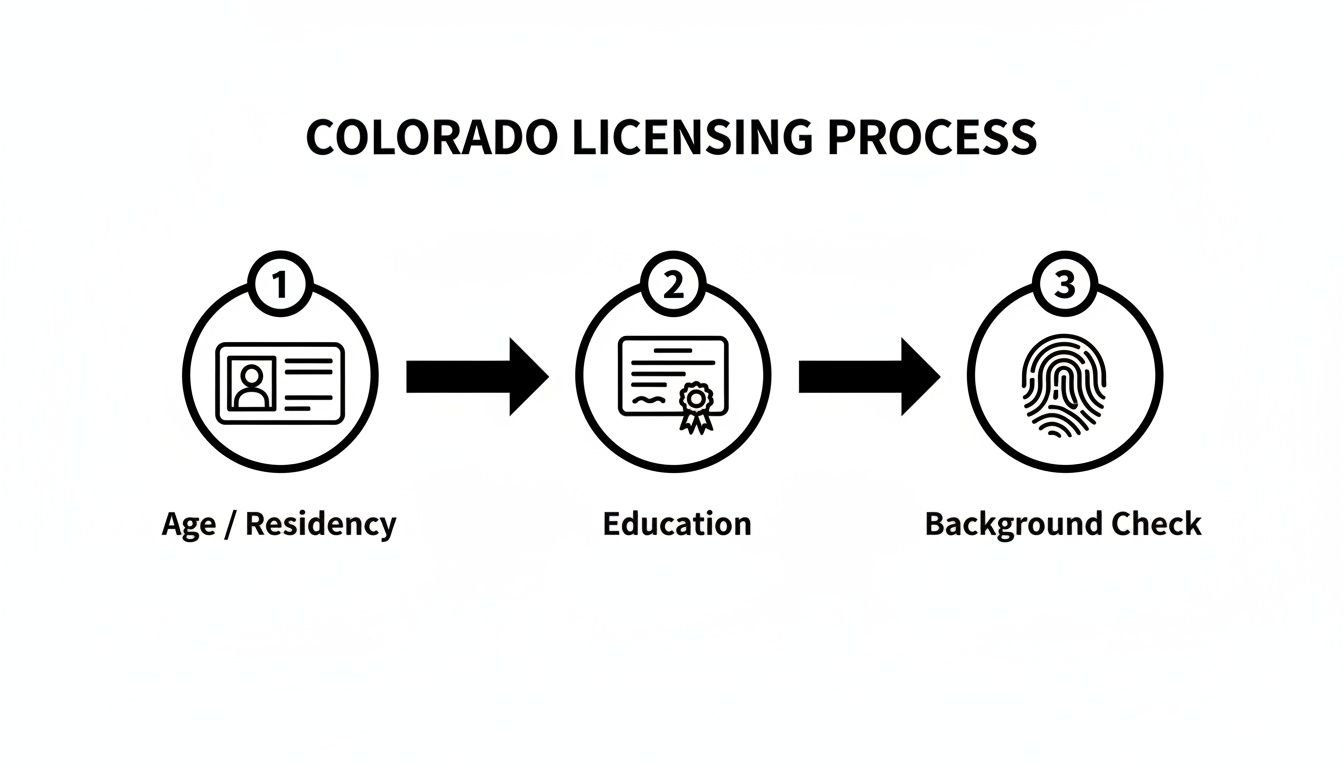
Seeing it laid out like this really drives home that you have to follow the process step-by-step. There are no shortcuts.
Insider Tip: Before you even think about mailing that packet, have someone else look it over. The most common hold-ups we see are from simple, avoidable things like a typo in a social security number, a wrong date, or a missed signature.
The background check is a huge part of this. You'll have to get your fingerprints taken by a state-approved vendor, which kicks off a deep dive into your history by both the Colorado Bureau of Investigation (CBI) and the FBI. Be brutally honest here. If you try to hide something, they will find it, and that’s a fast track to getting disqualified.
Finally, you’ll have to pay all the required fees, and they are non-refundable. That's another reason to get it right the first time—a rejected application means you’re out that money and have to pay all over again when you reapply. It’s a demanding process, but if you’re meticulous, you’ll get through it just fine. For help navigating these steps, contact the experts at Express Bail Bonds.
Setting Up Your Business and Securing Financial Backing

Earning your Colorado bail bondsman license is a major milestone, but it's just the beginning. A license gives you the legal right to work, but it doesn't give you the financial power to actually write bonds. This is where the real business begins, and it all starts with securing the right financial partnerships.
Finding a Surety Company to Back Your Bonds
The entire bail bond industry is built on the foundation of surety companies. Think of them as massive insurance providers that underwrite and guarantee your bonds. When you post a bond for a client, you aren't just using your own capital; you're using the financial might of your surety partner, which promises the court the full bond amount if a defendant skips their court date.
Your first order of business is to get "appointed" by a surety. This appointment grants you the authority to act as their agent and write bonds on their behalf. The application process is intense—similar to applying for a major business loan. The underwriters will dig into your personal finances, your character, and your professional background.
They’re essentially vetting you as a business partner. Your clean background check, professional license, and any previous business experience you have are all crucial for proving you're a low-risk investment for them.
Key Insight: Your relationship with a surety is the lifeblood of your career. It determines the size of the bonds you can write and gives you the support system you need to handle forfeitures and other tricky financial situations.
Protecting Your Business with E&O Insurance
Once you have a surety backing you, the next step is to protect yourself. Errors & Omissions (E&O) insurance is absolutely essential—it's not optional. This is a special type of liability coverage that shields you from financial ruin if a client accuses you of negligence or claims you made a mistake in your work.
Something as simple as a clerical error on a bail agreement could spiral into a lawsuit that costs you everything. E&O insurance is your financial safety net. It’s important to understand all financial aspects, including the structure of various bail bond payment options and how they function.
Choosing Your Path: Join an Agency or Go Independent?
With your license, surety appointment, and insurance in place, you’ll face your first big career decision: Should you join an established bail bond agency or strike out on your own?
Joining an Established Agency: For most new bondsmen, partnering with a respected firm like Express Bail Bonds is the smartest move. You get instant access to experienced mentors, a trusted brand name, and a proven business model. The startup costs are dramatically lower, and you're not shouldering all the risk alone. It's a structured way to learn the ropes from people who have seen it all.
Starting Your Own Agency: Going independent gives you complete autonomy, but it comes with significant risks and steep costs. You'll be responsible for everything—marketing, finding an office, building a reputation, and establishing relationships with local courts and attorneys from the ground up.
The U.S. bail bond market is substantial, with an estimated $14-15 billion in bonds posted each year, leading to as much as $2.4 billion in agent premiums. To claim a piece of that, independent agents in Colorado need serious capital.
Estimated Startup Costs for a New Bail Bondsman
Starting your own bail bond agency from scratch involves significant upfront and ongoing costs. Here's a realistic look at what you can expect to spend to get your business off the ground.
| Expense Item | Estimated Cost Range (One-Time) | Estimated Cost Range (Annual) |
|---|---|---|
| Pre-Licensing Education & Exam Fees | $500 – $1,000 | N/A |
| State Licensing & Background Checks | $200 – $400 | $100 – $200 (Renewal) |
| Errors & Omissions (E&O) Insurance | N/A | $1,500 – $3,500 |
| Business Registration & Legal Fees | $500 – $1,500 | $100 – $300 |
| Office Rent & Utilities (Deposit) | $2,000 – $5,000 | $24,000 – $60,000 |
| Marketing & Website Setup | $1,000 – $5,000 | $3,000 – $10,000+ |
| Build-Out Account (Surety Requirement) | $10,000 – $25,000+ | Varies |
| Total Estimated Initial Outlay | $14,200 – $38,400+ | $28,700 – $74,000+ |
As you can see, the initial investment to go independent is substantial, often requiring $50,000 to $100,000 or more just to get started and satisfy state and surety requirements. This is why many new agents choose to begin their careers at an established agency.
No matter which path you choose, getting your name out there is vital for success in places like Jefferson County or Centennial. A great first step is listing your business in key local directories. You can find some of the most effective ones in this guide to the Top 5 Online Directories for Western Colorado Businesses.
Building a Successful Career in Your First Year

Getting your license is a huge accomplishment, but it's just the beginning. The real education starts now. Your first year in the bail bonds industry is where the textbook theory gets put to the test, and it will absolutely shape the rest of your career.
This is your apprenticeship, plain and simple. You'll be learning on the fly, building good habits, and figuring out how to dodge the classic rookie mistakes that can sink a new agent. From the first panicked phone call to navigating the maze of a local courthouse, every move counts. Let's walk through how to not just survive, but actually build a solid foundation in your first year.
Mastering Client Intake and Risk Assessment
That first call from a potential client is a critical moment. This is where you have to shift from being a newly-licensed agent to a calm, professional problem-solver. Your most important job here is to develop a gut instinct for risk, a skill that only comes with experience.
When a family is in distress, you need to be their rock. Your ability to calmly collect accurate information is everything. You're not just evaluating the defendant; you're also sizing up the cosigner, who is your best line of defense if the defendant decides to "skip" court.
To get a clear picture, you need to ask the right questions every single time:
- What are the exact charges and the full bond amount? This sets your premium and tells you how much financial exposure you're taking on.
- Does the defendant have a history of failing to appear in court? Past behavior is the single best predictor of future actions. A prior "FTA" is a major red flag.
- What is the cosigner's relationship to the defendant? A parent or spouse is almost always more invested in making sure the defendant shows up than a cousin or a friend.
- Is the cosigner financially stable and a homeowner? This gives you a concrete idea of their ability to cover the bond if it gets forfeited. It’s also wise to explain to them what happens during a bond forfeiture.
Rookie Mistake to Avoid: Never, ever rush the intake process. I’ve seen it happen time and again. Taking an extra 15 minutes to properly vet a client and their cosigner can save you from months of headaches and thousands of dollars in a potential loss.
Navigating Local Jail and Court Procedures
Every county plays by its own set of rules—and many of them aren't written down. Your pre-licensing class taught you the state laws, but it couldn't prepare you for the specific quirks of the jail in Centennial compared to the one in Jefferson County. Your first year is all about becoming an expert on these local nuances.
You'll quickly learn which detention centers use electronic paperwork and which ones still demand a physical signature in the middle of the night. Knowing the jail staff's shift changes, the cutoff times for posting a bond, or the best person to call at the court clerk's office will make you incredibly efficient.
This "on-the-ground" knowledge is what separates the pros from the amateurs. A seasoned agent knows exactly who to call at the Arapahoe County courthouse to confirm a hearing, saving valuable time and preventing a costly miscommunication.
The Art of Professional Communication
Being a great bail bondsman is as much about managing people as it is about managing risk. Your clients are scared, confused, and stressed. The way you communicate—with clarity, empathy, and professionalism—can make all the difference.
You have to become an expert at clearly explaining three key things:
- The non-refundable premium: Make it crystal clear that your fee is earned for the service of posting the bond. It is not returned, no matter how the case ends.
- Court date responsibilities: Drill this home. The defendant's appearance at every single court date is non-negotiable.
- Cosigner obligations: Ensure the cosigner fully grasps that they are on the hook for the full bond amount if the defendant fails to appear.
When you build a reputation for being direct and honest, you become a trusted resource. It also dramatically cuts down on future arguments or "misunderstandings" about how the process works. Read our client reviews to see how much people value clear communication.
Building Your Professional Network
You can't succeed in this business by yourself. The relationships you forge in your first year will become your most valuable assets. Make it a point to get out there and introduce yourself to local defense attorneys, court clerks, and even other bondsmen.
Attorneys, in particular, can become a fantastic source of referrals. Once they see you handle their clients with speed and professionalism, they’ll put you on speed dial. A good relationship with the court staff can also be a lifesaver when you need to quickly solve a procedural issue.
For anyone asking how to become a bail bondsman and have a long career, the advice is simple: don’t go it alone. Partnering with an established agency like Express Bail Bonds is the fastest way to shorten your learning curve. You get instant access to a built-in network, a proven system, and the kind of real-world mentorship that turns a new agent into a top performer.
Frequently Asked Questions for Aspiring Bail Bondsmen
If you’re seriously considering a career in bail bonds, you probably have a ton of questions. It's a unique field, and it’s smart to know what you’re getting into. We’ll tackle some of the most common questions we hear from people just starting out in Colorado.
How Much Can I Realistically Earn as a New Bail Bondsman?
Let's get straight to the point: money. Your income is directly tied to the bonds you write. Here in Colorado, the standard premium for a bail bond is a non-refundable 15% of the total bond amount.
So, if you write a $10,000 bond, the agency collects a $1,500 premium. As an agent, you earn a commission on that premium. It definitely takes time to build a network and get your name out there, but a driven agent who makes connections can earn a very good living. Your income potential really climbs once you become a go-to agent in busy markets like Jefferson County or Centennial. You can see just how much our clients appreciate fast, reliable service by checking out some of their glowing reviews.
What Are the Biggest Risks in This Profession?
The number one risk, without a doubt, is a "skip"—that's when a defendant fails to appear for their court date. When that happens, the court can forfeit the entire bond, and the agency is on the hook for the full amount. Your job instantly becomes a race against the clock to find the defendant and return them to jail or pay the court.
This is precisely why learning to assess risk and secure financially sound cosigners is the most important skill you'll ever have in this business. Beyond that, there are other realities of the job:
- The 24/7 Schedule: Arrests don’t stick to a 9-to-5. You have to be ready to answer the phone and spring into action at 2 a.m. on a Tuesday just as you are at 2 p.m. on a Friday.
- Navigating County-Specific Rules: Every county jail has its own way of doing things. Keeping all the different procedures straight for posting bonds requires sharp attention to detail.
Expert Insight: The best way to handle these risks is by not going it alone. Working with an established agency like Express Bail Bonds gives you access to proven systems and mentorship, so you have the support to confidently manage even the toughest situations.
Can I Become a Bail Bondsman with a Criminal Record?
This is a huge question, and the honest answer is, it depends. The Colorado Division of Insurance runs a thorough criminal background check on every single applicant. A felony conviction is almost always a dealbreaker, especially for crimes related to finance, violence, or what the state calls "moral turpitude."
Certain serious misdemeanors can also stop you from getting licensed. The state needs to know that licensed agents are trustworthy. If you have anything on your record, your best bet is to talk directly with the Division of Insurance before you spend any time or money on classes and exams. They can give you a clear answer based on your specific situation.
Do I Need a Physical Office to Get Started?
A brick-and-mortar office, like our highly visible Denver location, absolutely helps build trust and a professional image. That said, you don’t need one to get started. Many agents operate very successfully without a traditional storefront.
With tools like electronic applications, digital document signing, and online payments, we can help clients anywhere in Colorado from just about anywhere. This approach keeps overhead low and allows you to be incredibly responsive. As a new agent, your main focus should be on being professional and available, whether that’s from an office or a well-organized remote setup. The goal is always the same: be there when your clients need you most.
Becoming a bail bondsman is a demanding path, but for the right person, it's incredibly rewarding. If you're ready to take the next step with the backing of a trusted, statewide agency, contact Express Bail Bonds today. Our team has been navigating Colorado's justice system since 1988, and we’re here to help you build a successful career from the ground up.