That first phone call—the one where you find out a friend or family member is in jail—can send your mind racing. It's a stressful, confusing moment, but the path to bailing them out starts with one simple, focused action: getting the facts straight.
Before you do anything else, you’ll need their full legal name, their date of birth, and to know exactly which jail is holding them. Having these details ready from the get-go makes the entire process faster and much less overwhelming. If you need help, we are here to help 24/7.
What to Do Immediately After an Arrest in Colorado

The first few hours after an arrest are chaotic. Your job is to cut through the confusion and gather the essential information. Acting quickly and methodically here will set the tone for a smooth release. Without the right details, even the most experienced bail bonds agent can't start the process.
Your main goal is to get three key pieces of information before you pick up the phone to call for help. This initial prep work is the single most important part of bailing someone out efficiently.
Find Their Location and Booking Number
First things first, you have to confirm which jail they're in. Colorado has countless facilities, from the Denver County Jail to smaller municipal jails and the Arapahoe County Detention Facility. It's easy to assume they are in a local city jail when they've actually been transferred to a larger county facility. You need to know for sure.
Once you have the location, the next critical piece of information is their booking number. This is the unique ID the jail uses to track inmates, and it's absolutely essential for posting a bond.
Luckily, most major counties in Colorado have online inmate search tools that make this part fairly straightforward. These websites let you search by name and date of birth to confirm where they are and find all their booking details.
- Full Legal Name: Make sure to use their complete name, including any middle names or suffixes like Jr. or III.
- Date of Birth: This is the best way to narrow down the search and confirm you've found the right person.
- Booking Number: The search result should provide this number—write it down immediately.
To make things easier for you, we've put together a list of helpful resources, including direct links to many of these search tools. You can find our comprehensive list of bail bonds links to jails, courts, and search tools on our website to speed up your search.
Having this information organized before you call a bail bonds agent is the single best thing you can do. It turns a frantic, stressful phone call into a productive one, allowing us to get to work on the release right away.
Why This Information Is So Important
Think about it like trying to mail a package without a name or an address—it's just not going to get there. The same logic applies to bail. A bail bonds agent needs the defendant’s name, the jail's location, and their booking number to pull up their file, confirm the bail amount, and start the paperwork.
Without these details, the agent has to do the search themselves, which just adds unnecessary delays. By getting this information first, you take control of the situation and shave precious time off the process. Once you have everything you need, the next step is to call for professional help. Contact Express Bail Bonds to get started immediately.
Understanding Bail Bond Costs in Colorado
After the initial shock of an arrest wears off, the first question almost everyone asks is, "How much is this going to cost?" It's a critical part of figuring out how to bail someone out, but thankfully, the numbers aren't as daunting as they might first appear. The key is understanding the difference between the judge's full bail amount and what you actually have to pay.
When a judge sets bail at $10,000, for example, that doesn't mean you need to come up with ten grand in cash right now. That massive figure is just a guarantee for the court that the person will show up for their future court dates.
This is where a licensed bail bonds company comes in. Instead of paying the court the full amount, you pay us a small, non-refundable fee called a premium. We then post the full bail amount on your behalf, taking on the financial risk.
The Premium Explained
The premium is simply a percentage of the total bail. Here in Colorado, the Division of Insurance sets the standard rate at 15%. So, for that $10,000 bond, the premium you would pay a bondsman is $1,500.
This fee is how we get paid for guaranteeing the entire $10,000 to the court. It’s a smart move because it gets your loved one out of jail without you having to drain your savings or liquidate assets for what could be months or even years.
At Express Bail Bonds, we do everything we can to make it even more affordable. For bonds over $5,000 with a qualified cosigner, we can often drop the rate to just 10%. On that same $10,000 bond, your out-of-pocket cost plummets to just $1,000, which is a huge immediate savings.
Why a Surety Bond Is a Smart Financial Move
Working with a bail agent on a surety bond is almost always the best financial route. Let's look at the alternative: paying a cash bond directly to the court.
- Cash Bond: You'd have to hand over the full $10,000 to the court. While that money is supposed to be refundable (minus court fees) once the case is over, it could be tied up for a very long time, completely unavailable for emergencies or bills.
- Surety Bond: You pay the much smaller, non-refundable premium to your agent. This keeps your own money free and transfers the massive financial liability over to the bail bond company.
This is a lifeline for most families. The entire bail bond industry exists to make pretrial release affordable and accessible. In Colorado, where Express Bail Bonds has served every county since 1988, our standard 15% premium (or 10% for larger bonds with a cosigner) makes all the difference. The global bail bond services market is a $5.7 billion industry, and it's no surprise North America leads the way. With 20,886 bail bond businesses in the US as of 2025—a number that's grown 3.7% annually since 2020—it’s clear this is a competitive and necessary service.
The most important takeaway is this: you are only responsible for paying the small premium. The bail bonds company handles the full bond amount with the court, ensuring your loved one can return home while awaiting their trial.
Flexible Payment Options
We get it—even the premium can be a sudden, unexpected expense. That’s why we sit down with clients to figure out solutions that work for their budget. Thinking about general payment options for legal services, like accepting credit cards, can also give you a good idea of how professionals in the legal world handle payments.
At Express Bail Bonds, we provide several ways to cover the premium so that financial stress doesn't get in the way of bringing someone home. Learn more about our affordable payment options and let us help you find a plan that works for you. Don't let cost stand in the way; we are here to help.
Why Working with a Bail Bonds Agent Is Your Best Move
When someone is in jail, figuring out how to get them out is the most critical decision you'll make. In almost every situation, bringing a professional into the mix is the smartest, fastest, and least stressful path forward.
A licensed bail bonds agent is much more than just a service provider. Think of them as your advocate and your guide through a system that can feel incredibly overwhelming. Their job is to sweat the details so you don't have to.
When you're already under a ton of stress, the last thing you want to do is try to decipher confusing jail procedures, paperwork, and payment rules on your own. A seasoned agent handles all of that for you. They know the specific protocols for every facility, from the Adams County Detention Facility to the Jefferson County Jail, making sure every step is handled correctly and without unnecessary delays.
The Value of Local Expertise and Speed
The real magic of working with an agent from a company like Express Bail Bonds is their deep, on-the-ground knowledge and their ability to move quickly. They know the clerks at the jail, they understand the shift changes that can slow everything down, and they are experts at cutting through the red tape that trips up most people.
This insider knowledge is what separates a quick release from a long, frustrating wait.
One of the biggest game-changers is the ability to post bonds electronically. Instead of you having to get in your car—often in the middle of the night—drive to a detention center, and wait for hours to fill out paperwork, an experienced agent can handle everything remotely. This is a massive relief, especially if you're trying to help from another city or even another state.
Think of a bail agent as an expert navigator for a maze you've never been in. You could try to find your way through alone, but you'll almost certainly hit dead ends and waste precious time. An agent already knows the fastest route and gets you to the finish line—your loved one's release—as quickly and efficiently as possible.
This speed isn't just about convenience; it's part of a well-oiled system. Bailing someone out is a personal crisis, but it’s also part of a massive global industry projected to be worth $5.7 billion by 2025. In the US alone, the industry is expected to hit $3.5 billion, driven by the constant need for fast pretrial release.
That scale and professionalism translate directly into faster processing times for you at local jails in places like Weld or Douglas Counties.
Bail Options Comparison Surety Bond vs. Full Cash Bond
When deciding how to proceed, it's helpful to see a direct comparison between using a bail bonds agent (a surety bond) and paying the entire bail amount yourself (a full cash bond). Here’s a quick breakdown of the differences.
| Feature | Surety Bond (Using Express Bail Bonds) | Full Cash Bond (Paid to Court) |
|---|---|---|
| Upfront Cost | You pay a small percentage (premium), typically 10%–15%. | You must pay 100% of the full bail amount. |
| Financial Risk | Your financial liability is limited to the premium and any collateral. | Your entire cash amount is at risk if the defendant misses court. |
| Speed & Process | An agent handles all paperwork and posts the bond quickly, often electronically. | You must physically go to the jail or court, navigate the process, and wait. |
| Expertise | You get guidance from an experienced professional who knows the system. | You are on your own to figure out procedures and requirements. |
| Payment Options | Flexible payment plans are often available for the premium. | No payment plans; the full amount is due upfront. |
As the table shows, a surety bond makes the process far more accessible and less financially draining, allowing you to secure a release without liquidating your assets.
What to Look for in a Bail Bonds Agent
Not all bail bond services are the same. When you're making that critical call, you need to know you're working with a true professional who can deliver on their promises.
Here’s what separates the best from the rest:
- 24/7 Availability: Arrests don’t stick to a 9-to-5 schedule, and your agent shouldn't either. You need someone you can reach by phone or text at any hour, day or night.
- Statewide Coverage: A great agent can post bonds in any county in Colorado. This ensures that no matter where your loved one is being held, they have the connections and authority to get them out.
- A Fully Remote Process: In this day and age, there's no reason for you to leave your home to bail someone out. Look for an agency that handles everything electronically—from the application to the payment.
This modern, remote capability is a lifeline for out-of-state family members who want to help but can't physically be there. An agent who can manage the entire transaction by phone and email makes it possible to help from anywhere.
To see how this works, learn more about our simple and secure online bail bonds process. Our experienced agents at Express Bail Bonds are ready to guide you through these exact steps, ensuring a fast, professional, and stress-free release.
The Cosigner's Role and Responsibilities
When you’re trying to figure out how to bail someone out, the role of the cosigner is absolutely essential. Agreeing to cosign is a huge act of trust and a very serious commitment, so it’s critical to know exactly what you’re signing up for.
At its core, a cosigner is the guarantor for the bail bond. Your signature on the agreement is a legally binding promise to the bail bond company that the person you're helping will show up for all of their required court dates. No exceptions.
This guarantee is what gives the bail agent the confidence to post the full bond amount with the court. Without a qualified cosigner backing the bond, getting someone released can become much more complicated—sometimes, it’s just not possible.
Who Qualifies as a Cosigner
Bail bond agencies are looking for one thing above all else in a cosigner: stability. They need to know the person guaranteeing the bond is reliable and has solid roots in the community. While the fine print can vary, the basic qualifications are pretty standard.
A cosigner usually needs to be:
- At least 21 years old
- A legal resident of the United States
- Currently employed with a steady source of income
- Able to provide a valid, government-issued photo ID
Your financial stability and local ties are what matter most. The bail agent needs to feel confident that you aren't a flight risk yourself and that you have the means and motivation to make sure the defendant follows through on their legal obligations.
Becoming a cosigner means you are the bail bond company's primary point of contact and their insurance policy. You are taking on the full financial liability for the bond if the defendant fails to appear in court.
Because the bail process involves a lot of personal data, knowing how to manage everything securely is a key part of your responsibility. Taking a moment to learn how to secure your sensitive legal documents is a smart way to protect everyone's privacy.
Understanding Your Financial and Legal Obligations
This is where the real weight of the role comes in. As a cosigner, your obligations are serious and legally enforceable. If the defendant misses a court date, a series of events kicks off, and you are right in the middle of it.
First, the judge will issue a warrant for the defendant's arrest. At the same time, the court will forfeit the bail bond, which means the entire bail amount is now due. So, for a $20,000 bond, the bail company is suddenly on the hook for paying the court $20,000.
Since you cosigned, the company will then look to you to cover that full amount. This isn't a minor risk; you could be liable for thousands of dollars. It's also why the bail agent will work closely with you to help find the defendant and get them back to court before the bond is permanently lost.
A Critical Conversation Before You Sign
Before your pen ever touches paper, you need to have a completely honest and direct conversation with the person you're bailing out. This is not the time to be polite or avoid tough questions. You have to gauge their commitment to seeing this through.
Here are a few things you absolutely must discuss:
- Court Dates: Make it crystal clear that attending every single court date is non-negotiable.
- Communication: Set up a clear plan for staying in touch. How will they update you? How often will you check in?
- The Stakes: They need to understand that if they skip court, you are the one who will face the immediate financial fallout.
Your signature is your word. It’s a powerful tool that can get someone out of jail, but it also ties your financial health to their actions. If you have any doubt about their reliability, you should think long and hard before moving forward.
Deciding to be a cosigner is a major decision that requires clear eyes and a full understanding of the risks. If you have questions about what it means to be a cosigner, we are here to help and can walk you through every detail of your responsibilities.
What Happens After the Bond Is Posted?
Once you’ve signed the paperwork and paid the premium, your part is done for now. The ball is now in our court, and then in the hands of the jail staff. Knowing how this handoff works is key to setting the right expectations for when your loved one will actually be released.
Your Express Bail Bonds agent will immediately take the finalized documents and post the bond at the jail where your loved one is being held. Our agents are pros at this—they know the ins and outs of every detention facility in Colorado, from the Denver County Jail to the lockup in El Paso County. That expertise means the bond gets filed correctly the first time, avoiding any unnecessary hiccups.
From Posting the Bond to Walking Out the Door
Posting the bond itself happens pretty fast. Your agent delivers the legal paperwork to the jail, which officially kicks off the release process. But here’s something you absolutely need to understand: our agent delivers the "key," but it's the jail staff who actually turn it to unlock the door.
The time it takes from the moment we post the bond until the person is actually out can vary—a lot. This part of the timeline is completely out of our hands and depends entirely on how busy the jail is and how many staff members they have on duty.
Important Takeaway: While your agent can post a bond very quickly, the jail’s own release process can take anywhere from two to eight hours, and sometimes even longer. This is totally normal, so try to be patient during this final waiting game.
So, what's happening during that time? The jail staff has their own out-processing checklist to complete. They have to run final warrant checks, gather and return the person's personal property, and finish up their internal records before anyone can be released. If it's a busy night or the facility is short-staffed, that process just takes longer.
The First Few Steps After Release
The moment they walk free is a massive relief, but it’s also when the real work begins for both the defendant and you as the cosigner. To make sure everything stays on the right track, there are a few things that need to happen right away.
These steps are non-negotiable and are required to keep the bail bond in good standing.
- Initial Check-In: The defendant needs to call our agency immediately. This first check-in lets us know they’re out and gives us a chance to walk them through their responsibilities and court schedule.
- Know Your Court Dates: We will go over all upcoming court dates. The number one, most important rule is to never miss a court appearance. Missing court automatically forfeits the bond, and a new warrant will be issued for their arrest.
- Stay in Touch: It's essential that the defendant keeps both us and the cosigner in the loop with any changes to their address or phone number. Clear and open communication is the key to a smooth process from here on out.
Staying on Track Until the Case Is Closed
The bail bond stays active for the entire duration of the court case. It doesn’t end until the case is fully resolved, whether that means the charges are dropped, a plea deal is made, or a verdict is reached after trial. Until that day comes, the defendant is accountable to us.
Our team is here to support you both through the whole thing. We send out court date reminders and are always here to answer your questions. If you ever need to chat with an agent in person, you can easily find the nearest office on our locations page. Our goal is simple: to make sure everyone knows what they need to do to successfully see the bond and the court case through to the end.
Common Questions About the Bail Bond Process
Navigating the bail bond system for the first time is confusing, and it's natural to have a lot of questions. We’ve been helping families in Colorado since 1988, and trust me, we've heard them all.
This section is designed to give you quick, direct answers to the most common concerns people have. My goal here is to clear up any lingering confusion so you can move forward with confidence, even after the paperwork is filed and the release is in motion.
Can I Bail Someone Out If I Live in a Different State?
Yes, absolutely. This is one of the most frequent questions we get, and the answer is a definite yes. You do not need to travel to Colorado to help your loved one.
Modern bail bond agencies like ours are set up to handle the entire process remotely. Everything from the initial application and cosigner agreement to the final payment can be managed securely over the phone, through text, or via email. Our experienced agents will walk you through each document and make sure you understand every step before you sign. We handle out-of-state situations every single day.
What Happens to the Money I Pay the Bail Bondsman?
The fee you pay a bail bonds company is called a premium. This payment, which is typically 10% to 15% of the full bail amount, is non-refundable. It's crucial to understand this from the very beginning.
Think of the premium as a service fee. You're paying the bail agent for their expertise, for handling all the complex paperwork, and most importantly, for taking on the full financial risk of the bond with the court. It’s similar to an insurance premium; you pay a small, manageable fee to protect against a much larger potential loss. This fee covers our services and the guarantee we provide to the court, no matter how the case turns out.
What If the Charges Are Dropped After Bail Is Posted?
If the court decides to drop the charges after the defendant has been released on bond, the bail bond is then dissolved, or "exonerated." This simply means our financial obligation to the court has ended.
However, the premium you paid to us is still non-refundable. The service you paid for—securing the person's release from jail—was successfully completed. The later dismissal of charges doesn't change the fact that our agency fulfilled its part of the agreement by getting them out of custody.
What Happens If the Defendant Misses a Court Date?
This is the most serious problem that can happen after someone is released. If the defendant fails to appear for a scheduled court date, the judge will immediately issue a warrant for their arrest.
At the same time, the court forfeits the bail bond, meaning the full bail amount is now due. As the cosigner, you are legally and financially on the hook for that entire amount. Our first step is to contact you immediately to figure out what happened and get the defendant back into the court system as quickly as possible. To fully understand the severe consequences, it's essential to know what happens if you miss court.
The absolute most important responsibility for both the defendant and the cosigner is to ensure every single court appearance is attended without fail. This is the cornerstone of the entire bail agreement.
How Long Does It Take to Get Released After a Bond Is Posted?
Posting the bond is just the first step in the final stage of release. This infographic shows the typical flow after we submit the paperwork to the jail.
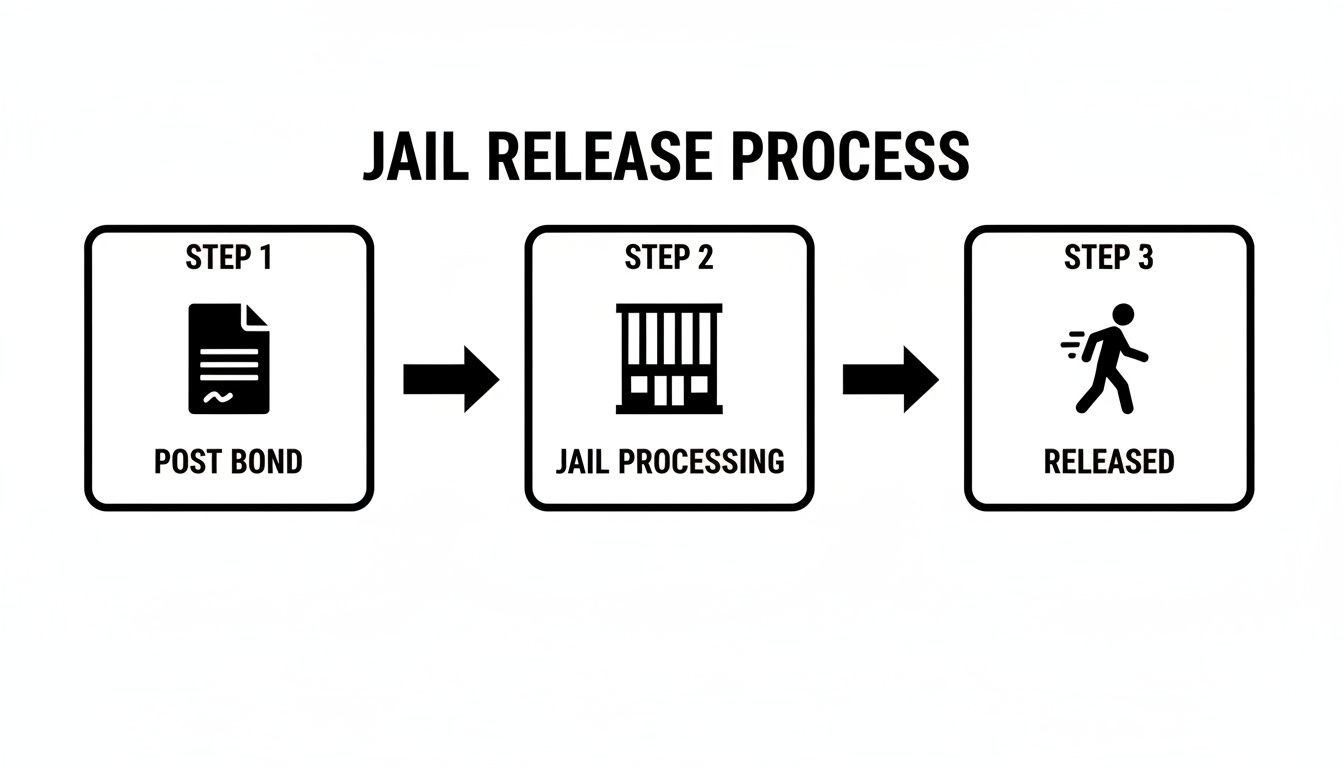
As you can see, once the bond is posted, the process moves into the hands of the jail staff for final processing before the individual is actually released.
Once our agent posts the bond at the jail, the timeline is completely out of our hands. The release process itself can take anywhere from two to eight hours—and sometimes longer. It all depends on how busy the facility is, their staffing levels, and their specific internal procedures. While we work to get the bond posted as fast as possible, this final wait is a normal part of the process.
If your question wasn't answered here, please don't hesitate to give us a call. Our team is available 24/7 to provide the specific answers you need for your situation. Contact us now to get started.