
When you're trying to help a loved one get out of jail, you're facing a lot of stress and uncertainty. One of the biggest questions on your mind is probably, "Do we get this money back?" The answer isn't a simple yes or no. It really hinges on how you post the bail.
There are two main paths you can take, and each one has a completely different outcome for your wallet. If you pay the full bail amount in cash directly to the court, that money is generally returned to you after the case concludes—as long as the defendant shows up for every single court date.
Two Paths, Two Different Financial Outcomes
The choice you make right at the beginning—paying cash versus using a bail bond service—is the single most important factor that determines if you'll see that money again. Understanding this distinction is critical for making an informed decision during a very difficult time.
Getting this wrong can mean losing thousands of dollars you weren't expecting to lose. Getting it right, on the other hand, can bring some much-needed financial peace of mind. For immediate assistance in Colorado, contact Express Bail Bonds today.
Cash Bail vs. Bail Bonds
Let's break down your two main options:
- Paying Cash Bail: Think of this as a security deposit for the court. You're giving the court the full bail amount, say $10,000, as a guarantee the defendant will return. Once the case is over and all rules have been followed, you get that $10,000 back, though they might subtract some minor court fees or fines.
- Using a Bail Bond: This is where you hire a professional for a service. Instead of coming up with the full $10,000, you pay a bail bondsman a smaller, non-refundable fee (called a premium). This fee is the bondsman's payment for posting the full bail amount on your behalf and taking on all the financial risk.
Here’s an easy way to look at it: cash bail is like a temporary loan to the court that you expect to get back. A bail bond premium is the fee you pay for a professional service that secures someone's release without you having to put up the full amount.
This fee allows a company like Express Bail Bonds to step in and guarantee the defendant's appearance, getting them home for a fraction of the total cost. If you want to dive deeper, you can read our article explaining the difference between bail and a bond.
The most important thing to remember is this: Cash bail paid directly to the court is refundable. The premium you pay to a bail bond company for their service is not refundable.
To make this even clearer, here’s a simple comparison:
Refundable Cash Bail vs Non-Refundable Bond Fee
| Feature | Paying Cash Bail to Court | Paying a Fee to a Bail Bondsman |
|---|---|---|
| Initial Payment | You pay the full bail amount set by the judge. | You pay a small percentage of the full amount. |
| Is the Money Returned? | Yes, minus any court fees or fines. | No, this is a non-refundable service fee. |
| Who Takes the Risk? | You risk losing the entire amount if the defendant flees. | The bail bond company assumes the full financial risk. |
| Best For… | Those who have the full cash amount readily available. | Those who can't afford the full bail amount upfront. |
This table shows the fundamental trade-off. With cash bail, you put up more money but can get it back. With a bail bond, you pay a much smaller, non-refundable amount to achieve the same result: getting your loved one released from custody.
Whether you're in Jefferson County, Centennial, or anywhere else in Colorado, we've helped countless families navigate this process. We're here to provide clear answers and professional help when you need it most. See what our clients have to say in our Google Reviews.
How Refundable Cash Bail Actually Works
The best way to think about cash bail is to see it as a security deposit for the court. You're giving the court the full bail amount in cash as a promise—a financial guarantee—that the defendant will show up for all their court dates.
As long as they keep that promise, you get your money back. It’s that simple.
This direct payment to the court is what makes a cash bail 100% refundable. It’s completely different from using a bail bondsman, where you pay a non-refundable premium for our service. With cash bail, your money is just being held as collateral.
It's a really important difference to grasp. If you want to dig deeper, we break it all down in our guide comparing surety bonds vs cash bonds.
The Cash Bail Process Step By Step
Walking into a courthouse to post bail can feel overwhelming, but the actual process is pretty straightforward. Whether it's a family member or the defendant paying, it boils down to a few key actions.
- Pay the Court: You'll need to pay the full bail amount directly to the court clerk. They usually accept cash, a cashier's check, or a money order.
- Keep Your Receipt: You will be given a receipt for the payment. Hold onto this! It’s your proof of payment and absolutely critical for getting your money refunded later.
- Ensure Compliance: The defendant has to show up for every single court appearance and follow any other conditions the judge sets until the case is completely over.
This method works. The financial stake gives people a powerful reason to see their case through. In fact, one report noted a failure-to-appear rate of just 15% for those on cash bail, which means the overwhelming majority did exactly what was required to get the money back.
Conditions For Getting Your Money Back
So, does that mean you get back every single penny you put down? Most of the time, yes, but there are a few things to keep in mind. The defendant must meet all court obligations until the case is officially closed—whether it’s dismissed, settled with a plea, or decided by a verdict.
The core principle is simple: if the defendant does everything the court asks, the person who posted the cash bail is entitled to get it back. This refund process is managed directly by the court's administrative office.
However, the final refund check might be a little less than what you originally paid. The court has the right to subtract certain costs before sending your money back.
Common deductions include:
- Unpaid court fees
- Fines related to the case
- Restitution payments owed to a victim
These administrative steps are all part of a complex system. For those interested in the backend processes, you can find some fascinating insights into modern legal operations and technology.
Why Your Bail Bond Fee Is Non-Refundable
When you work with a bail bondsman, the money you pay isn't a deposit you get back later. It’s a fee for a professional service and a major financial guarantee. That’s the key reason why the premium you pay to a company like Express Bail Bonds is non-refundable.
The easiest way to think about it is like an insurance premium. Let's say your car is worth $30,000. You don't park $30,000 in a savings account just in case you get into an accident. Instead, you pay an insurance company a much smaller fee, and in return, they take on that massive financial risk for you. A bail bond operates on the very same principle.
For a small percentage of the total bail amount—usually 10-15% here in Colorado—a bondsman posts the full bail amount on your behalf. That non-refundable premium is the fee they've earned for putting their own money on the line and taking on 100% of the financial risk if the defendant misses a court date. If you want to get into the nuts and bolts, you can learn more about what a surety bail bond is in our detailed guide.
The Value Behind the Service Fee
That non-refundable premium covers a lot more than just the financial risk. It pays for the round-the-clock work our agents do, from handling all the initial paperwork to making sure the defendant gets to every single court appearance. It's a 24/7 service built for one thing: getting someone out of jail, fast.
The real value here is giving a family the power to bring a loved one home immediately. You don't have to scramble to liquidate assets, empty your life savings, or sell property to come up with a huge pile of cash. For a $20,000 bond, you don't need $20,000 today; you just need the much more manageable premium.
This is exactly why the bail bond system is so common. Over the years, the industry has become essential for many families. A landmark report showed that from 1990 to 2009, the use of bail bonds in felony cases shot up from 24% to 49% across the country. Those non-refundable premiums now generate over $2 billion in revenue for the industry each year. You can read the full report on bail industry trends here.
Why the Fee Is Never Returned
Once we do our job—the bond is posted and the defendant is released from jail—our end of the bargain is fulfilled. The fee is considered earned at that exact moment.
The non-refundable premium is the cost of transferring the financial risk from your family to the bail bond agency. It's payment for immediate freedom and professional case management, regardless of the final outcome of the legal proceedings.
Even if the court drops all the charges the very next day or the defendant is found not guilty down the road, the bondsman already took on the full financial liability and provided the service you hired them for. The fee is kept as payment for that service and risk, just like you wouldn’t expect a refund on your car insurance premium after a year of safe driving.
For help in Golden, CO or nearby communities, our team is always on standby. You can see what our clients say about how we handle these stressful situations. Whether you need bail bonds in Centennial or anywhere else in the state, our promise to you is the same. Just read our reviews to see how we help families get through this every single day.
Navigating The Colorado Bail Refund Process
So, you've paid the full bail amount in cash directly to the court in Colorado. Now comes the big question: what happens next, and how do you get that money back? Knowing how the court system handles refunds can save you a lot of headache and worry down the line.
The process kicks off only after the case is completely over. This means the defendant has shown up to every single court date and the case has reached a final resolution—whether it’s a dismissal, a plea agreement, or a verdict at trial. Once the judge closes the book on the case, the court clerk begins the refund procedure.
From our experience, the timeline can vary quite a bit depending on the court's workload. Generally, you should plan on waiting anywhere from 30 to 90 days after the case concludes to receive a check in the mail.
Who Gets The Money Back?
This is one area where the courts are incredibly strict. The refund check is always made out to the person who originally posted the cash bail. When you paid, the court took down your name and information, and that's the only person they'll release the funds to.
Keep that original bail receipt in a safe place. This piece of paper is your proof of payment, and you'll almost certainly need it to claim your refund without a hitch. Losing it can cause major delays.
This is a world away from how a bail bond works. With a bond, the fee you pay is for a service that has been rendered—securing the release from jail.
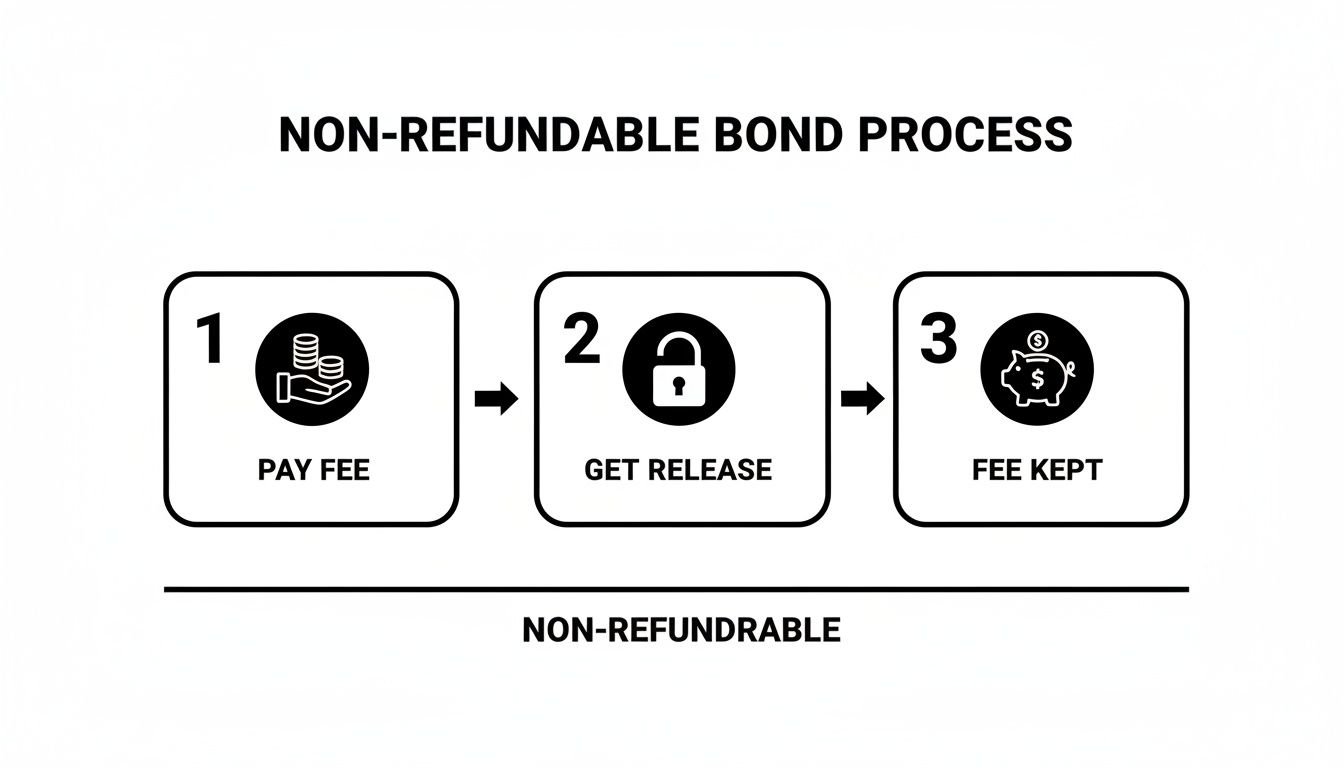
As you can see, the fee paid to a bondsman is earned once the person is released. It’s a straightforward trade-off: you pay a much smaller, non-refundable amount to get your loved one out immediately, and you don’t have to deal with the court's refund system later.
A Simpler Path Forward
For most families, the thought of tying up thousands of dollars for months—sometimes even years—is simply not realistic. When you add the hassle of tracking court dates, keeping paperwork, and chasing down a refund, the whole situation becomes another layer of stress during an already difficult time.
This is exactly why so many people find that working with a professional bondsman from the start is the most practical choice.
At Express Bail Bonds, we take the guesswork and financial strain out of the equation. You pay a simple, non-refundable premium, and we handle the full bail amount and all the associated risk and paperwork. You won't have to wonder about court timelines or how to get your money back. We get the release secured quickly so you can focus on what really matters—your family.
If you're trying to figure out your next steps, our guide on how to get someone out of jail can walk you through the process.
Understanding The Consequences Of Bail Forfeiture
When a defendant doesn't show up for their court date, it's called bail forfeiture, and it kicks off a series of serious financial events. What happens next, however, depends entirely on how the bail was paid in the first place. This is a critical distinction to understand.
If you paid the full bail amount in cash directly to the court, the outcome is pretty brutal and straightforward: the court keeps it all. Whether it was $5,000 or $50,000, that money is gone for good. It has fulfilled its purpose as a financial guarantee, which is now claimed by the court.
What Happens When a Bail Bond is Involved?
The game changes completely when a bail bond was used. In this case, the immediate responsibility for the full bail amount shifts from the family to the bail bond agency. But the financial obligation doesn't just vanish—it lands squarely on the shoulders of the person who signed the bond agreement as the indemnitor, or cosigner.
This means if you cosigned for the bond, you are now on the hook and legally liable to pay the full bail amount to the bail bond company. This is exactly where working with a professional and reputable agency like Express Bail Bonds makes all the difference. Instead of coming after you for the full amount right away, our first job is to get the situation under control and minimize the damage. We immediately work to find the defendant and get them back into the system to resolve the forfeiture. You can learn more about bail forfeiture and how we handle these situations in our detailed guide.
When a defendant fails to appear, the cosigner on a bail bond becomes legally responsible for paying the full bond amount. A professional bondsman's role is to manage this crisis, working to locate the defendant and prevent catastrophic financial loss for the family.
Interestingly, most people do show up for court. A huge dataset from The Bail Project, which posted free bail for over 27,000 people, found that the court appearance rate was over 91%. This tells us that even when people don't have their own money on the line, the vast majority still meet their legal obligations. Discover more insights from this bail data.
This just reinforces how serious a failure to appear really is. It’s a major breach of trust that has huge financial fallout, especially for the family members who cosigned a bond. For support in local jurisdictions, our team provides expert help for bail bonds in Centennial and across Colorado. You can see what our clients say about us and read our reviews to understand our commitment. For those in Jefferson County, we offer specific guidance for the Golden, Colorado area.
Making The Right Choice For Your Family
When someone you love is in jail, you're forced to make huge financial decisions under incredible stress. Now that you understand the difference between getting your cash bail back and paying a non-refundable bond premium, you can weigh the pros and cons for your family.
The choice really boils down to a few practical questions.
Weighing Your Financial Reality
First, look at the full bail amount. Is it a number you can comfortably pay out-of-pocket without derailing your finances? If so, posting cash might seem appealing since it's refundable. But you also have to be prepared to navigate the court system on your own and wait—sometimes for months—to get that money back after the case ends.
For most people, that's where the calculation changes. Very few families have thousands of dollars in spare cash they can afford to have tied up for an unknown length of time. This is why bail bonds are often the more practical solution. You pay a small fraction of the total bail, and your loved one gets out of jail right away without you having to liquidate savings or empty your bank account.
Finally, consider your own peace of mind. Keeping track of court dates, filing the right paperwork, and making sure you follow every step perfectly to get your cash bail returned adds a whole new layer of stress to an already difficult situation.
Choosing a bail bond service isn't just about money; it’s about choosing a partner to manage the process for you, providing speed, expertise, and peace of mind when you need it most.
If you need a fast, professional, and compassionate partner, the team at Express Bail Bonds is here to help 24/7. We have decades of experience guiding families through this process in Jefferson County and Centennial.
Don’t just take our word for it—see what our clients say about us and read our reviews to see how we help. Contact us today for the expert guidance your family deserves.
Your Top Questions About Getting Bail Money Back
Even when you think you have a handle on the bail process, questions always pop up. It’s completely normal. Here are some straightforward answers to the questions we hear most often from families across Colorado.
How Long Does It Take to Get a Cash Bail Refund?
Once you’ve paid cash bail directly to the court, the waiting game for a refund doesn't start until the case is completely over. After the judge officially closes the case, you can generally expect to see a check in the mail within 30 to 90 days.
The exact timing really depends on the court's current workload and how quickly they process paperwork. Some counties are faster than others, but it’s rarely an instant process.
Who Exactly Gets the Refund Check?
This is one detail where the court system is incredibly strict: the refund check is always made out to the person who originally posted the bail. Whoever’s name is on that court receipt is the only person who will get the money back.
Think of it this way: if your mother paid the cash bail for you, the check will be written to her. It doesn't matter whose money it was originally; the name on the court's paperwork is the only thing that counts. Always hold on to your receipt!
Can I Get My Bail Bond Premium Back if the Charges Are Dropped?
No, the premium you pay a bail bond agent is a non-refundable fee. That payment is for the service of getting the defendant out of jail and for the bondsman taking on the full financial risk of the bail amount.
Once the defendant is released, that service is considered complete. The outcome of the case—whether charges are dropped or not—doesn't change that.
What Happens if I Move Before the Refund is Issued?
If you paid cash bail and have a move coming up, make it a top priority to update your address with the court clerk. If you don't, the refund check will be mailed to your old address, and that can create a huge headache and long delays.
This is honestly one of the big reasons so many families just prefer using a bail bond. You don't have to worry about chasing down a refund from the court months or even years down the road.
Navigating the bail system can feel like a maze, but you don't have to find your way through it alone. The team at Express Bail Bonds is here to provide fast, professional, and understanding service across Colorado. Whether you need help in Jefferson County or Centennial, our agents are ready to help 24/7. See what our clients are saying in our Google reviews and other testimonials, and then contact us for the expert help your family needs.