
Generally, no, you can't leave the country on bail without explicit court permission. Because approximately 75% to 90% of bail bonds in the United States include specific travel restrictions, trying to leave anyway can trigger immediate re-arrest, revocation of bail, and bond forfeiture.
That question usually comes up at the worst possible time. You've just gotten out, everyone is trying to settle down, and then life keeps moving. A parent gets sick overseas. Your employer says you're needed for a critical trip. A family event you can't miss is suddenly on the calendar. The pressure is real, but at this point, one bad decision can turn a manageable case into a much more serious one.
In Colorado, the safe answer is simple. Assume you cannot travel internationally unless a judge has already approved it in writing and, if you used a surety bond, your bail bond company has also agreed. Anything less is gambling with your freedom.
An Urgent Question After Your Release
The first mistake people make is treating international travel like a scheduling problem. It isn't. It's a release-condition problem.
When a court releases you on bail, the court is taking a calculated risk. You're being allowed to stay out of custody because the judge believes there's a workable way to keep you tied to the case and get you back into court when required. Leaving the country cuts directly against that goal.
That's why the answer to can you leave the country on bail is almost always no unless you've gone through the formal process first. The concern isn't whether your reason sounds understandable. The concern is whether the court believes you'll come back, whether your bond terms allow it, and whether every required step has been completed before you board a plane.
The situations that trigger this question
Most travel requests fall into a few categories:
- Family emergencies: A funeral, serious illness, or urgent caregiving issue abroad.
- Work obligations: An employer asks for an in-person meeting or trip outside the United States.
- Medical needs: Specialized treatment or family support related to health.
- Personal events: Weddings, religious obligations, or major family milestones.
Some of those reasons are sympathetic. A few may even be strong enough to support a formal request. But sympathy is not permission.
Practical rule: If your case is pending and your release paperwork doesn't clearly authorize international travel, assume the answer is no until your lawyer and bondsman confirm otherwise.
What matters right now
If this issue is sitting in front of you today, slow down and check four things before you make any plans:
- Read your bond paperwork carefully. Travel restrictions are often written directly into the release terms.
- Call your attorney first. International travel requests have to be handled formally.
- Call your bail agent immediately if you used a bond company. Your bond agreement may require separate approval.
- Do not rely on verbal assumptions. Airport check-in is too late to discover you never had permission.
The people who stay out of trouble with bail conditions are usually the ones who act early, document everything, and treat travel as a legal issue instead of a personal choice.
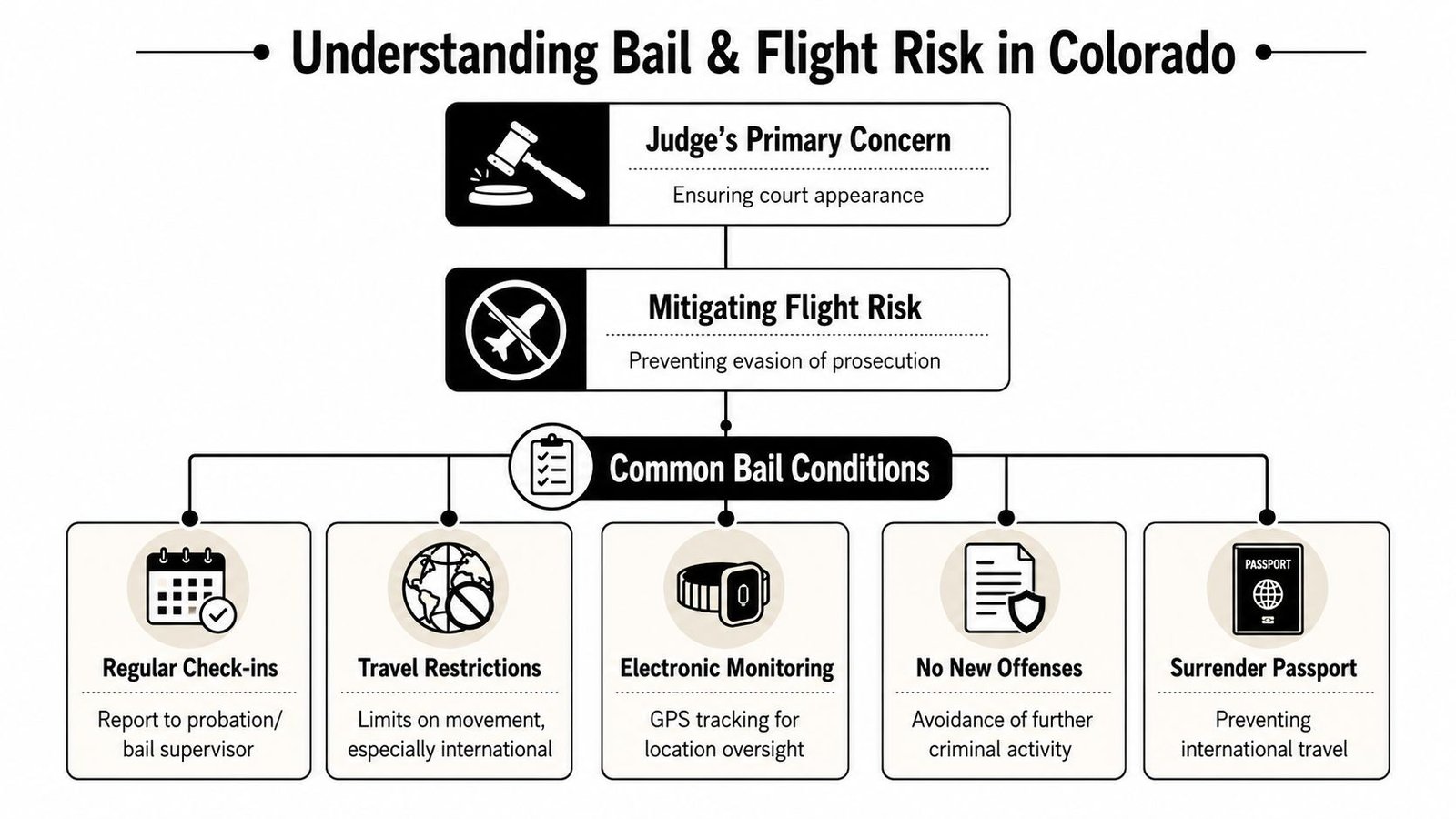
Understanding Bail Conditions and Flight Risk in Colorado
You may be standing in your kitchen with your passport in hand, thinking the hardest part is over because you made bail. It is not. In Colorado, release means freedom with limits, and travel outside the United States is one of the first things a judge treats as a serious risk.
Judges set bond conditions to answer a practical question. Will you show up when the court orders you back? International travel raises that concern fast because once you leave the country, supervision gets harder, return dates become less certain, and fixing a problem can turn into a federal issue instead of a local one.
Colorado courts can impose a wide range of release terms, and those terms control your movement. Reviewing your conditions of bail in Colorado matters because the written order decides what you can and cannot do, not your personal plans, not what happened in someone else's case, and not what an airline is willing to board.
What travel restrictions actually look like
Travel conditions are usually layered. A defendant may be free to work, care for family, and live at home while still facing tight limits on where they can go.
| Restriction type | What it usually means |
|---|---|
| Local limits | You must stay in a county or nearby area unless approved |
| State limits | You may not leave Colorado without permission |
| International limits | You cannot leave the United States unless the court specifically authorizes it |
| Passport-related conditions | The court may require passport surrender or limit how it can be used |
A common misconception is that retaining your passport means travel is allowed. It doesn't.
The passport issue in state and federal cases
This is one point clients often misunderstand. A passport is only one part of the restriction.
In some cases, especially in federal court, a defendant may keep a passport but still be barred from international travel unless the judge signs off on exact dates and terms. As discussed in this analysis of overseas travel while on federal release, federal release can allow passport possession while still requiring strict, court-approved travel with no room for informal changes. State cases can be stricter or looser on passport surrender, but the same rule applies. The court order controls.
That distinction matters because people often focus on the wrong question. They ask, "Do I still have my passport?" The better question is, "What does my release order permit?"
Why judges view international travel as a higher risk
A trip to another state is one problem. A trip to another country is a different one.
Judges look at whether you can be supervised, whether you can return reliably, and whether the court has any realistic way to respond if you do not come back on time. They also consider the destination itself. Some countries present more enforcement problems than others. Some have entry rules that can create delays or denials with no warning. That matters because even a person who intends to return can still miss court if the trip goes sideways.
There is another problem many defendants never consider until it is too late. Court permission does not guarantee that your destination country will admit you. A pending criminal case, the type of charge, or your immigration and entry history may lead border officials abroad to deny entry or question you extensively. I have seen people focus so much on getting approval from the court that they ignore the separate risk of being turned away by the country they plan to visit.
Courts do not evaluate travel the way families or employers do. They evaluate risk, enforceability, and the odds that your case will stay on track. If your paperwork requires approval, treat that as a hard legal limit.
The Severe Consequences of Leaving Without Permission
You get released, book a quick international trip, and tell yourself you will be back before anyone notices. That decision can put you back in custody fast.
Leaving the country without court approval is not a minor paperwork problem. In a Colorado case, it can be treated as a direct violation of your release conditions. In a federal case, the response can be even harsher because federal supervision rules are often tighter and travel restrictions are enforced more aggressively.
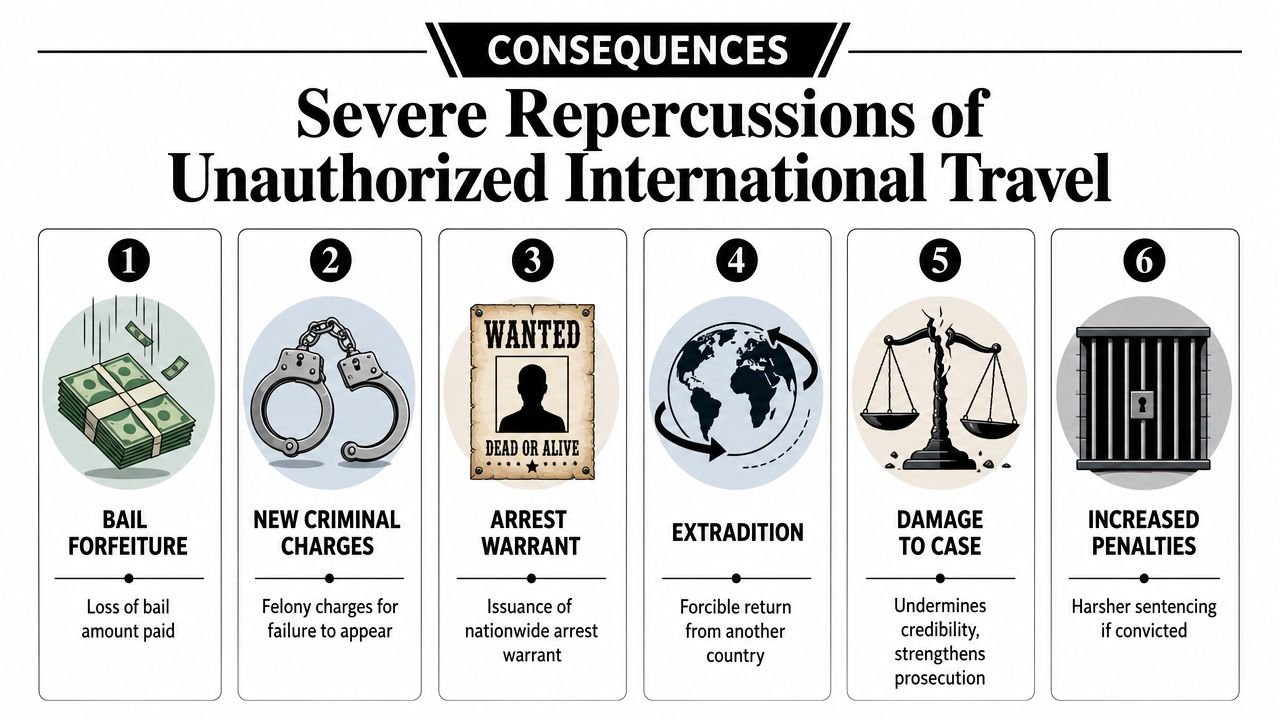
Once the court learns you left without permission, the usual sequence is straightforward and ugly. The judge can revoke bail. A warrant can issue. Law enforcement can detain you on return, or sooner if your travel triggers an alert. Prosecutors may also argue that your conduct proves you are a flight risk, which can make future release much harder.
The immediate problem is not limited to missing court. Unauthorized travel tells the court you were willing to ignore the release order. Judges remember that. So do prosecutors and bonding companies.
What this can cost you
The practical consequences reach several parts of your case at once:
- Loss of release: You can be taken back into custody and held while the court reconsiders whether you should be out at all.
- A new warrant: Any police contact, airport screening issue, or return through customs can turn into an arrest.
- A weaker position in court: The judge may impose stricter conditions later or deny any future request to travel.
- New criminal exposure: Depending on what happened, you may be accused of failure to appear or bail jumping.
If you are not clear on how that separate charge works, read this overview of what bail jumping means in Colorado practice.
There is also a financial side that families often underestimate. If a bondsman posted a surety bond, your violation can trigger recovery efforts, added costs, and serious strain on the cosigner who trusted you to follow the order. I have had to explain to families that one unauthorized trip can create legal trouble for the defendant and financial fallout for the people who helped get them out.
This short video gives a useful general overview of the risk:
Avoid these common, but flawed, justifications
| Bad assumption | Why it fails |
|---|---|
| “I'll only be gone a day or two” | The violation happens when you leave without approval, not when the trip becomes long |
| “I won't miss court” | You can violate release terms even if every hearing date is still on your calendar |
| “I still have my passport” | A passport lets you travel internationally. It does not change a court order |
| “It's an emergency” | Real emergencies can support a request for permission, but they do not erase the need for permission |
One more point matters here. Even if you planned to come back, international travel adds another layer of risk that state courts and federal courts both take seriously. Your destination country can deny entry because of a pending criminal case, your record, or its own border rules. If that happens, you may still end up delayed, detained, or unable to return as expected. From the court's perspective, that is your risk, not theirs.
If you leave first and try to explain it later, you have already undercut the strongest position you had, which was showing the court you were willing to follow the process.
How to Legally Request International Travel Permission
You get released, a family crisis hits overseas, and the next question is immediate. Can the court let you go?
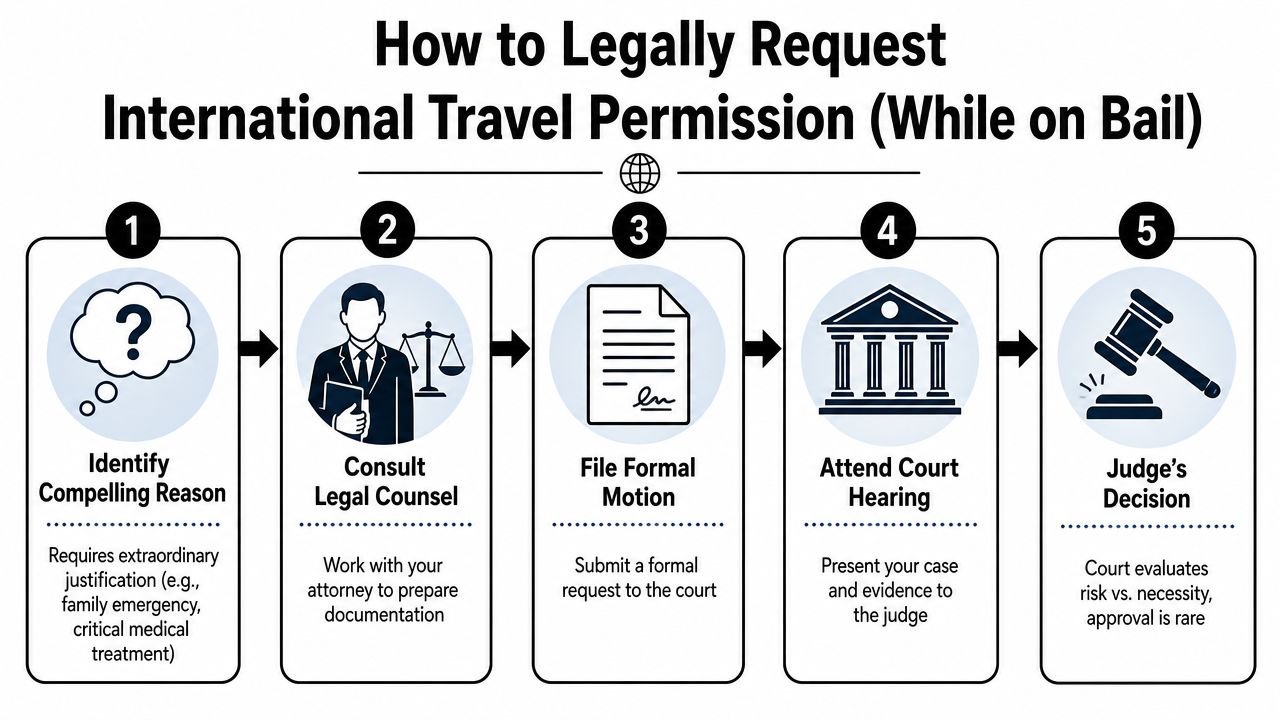
Sometimes, yes. In practice, international travel while on bail is hard to get approved because the judge is weighing more than your reason for the trip. The court is also weighing whether you will return, whether the trip creates enforcement problems, and whether the destination itself adds new risk. In federal cases, scrutiny is often tighter. In state cases, the process can be more flexible, but that does not mean easy.
Start with a formal motion through your lawyer
International travel permission starts with a request to modify your release conditions. Your lawyer files that request with the court and gives the judge a specific, documented reason to make an exception.
Last-minute requests usually go badly. Judges want time to review the purpose of the trip, the dates, the destination, and your plan to return.
What a strong request usually includes
A specific and necessary reason for travel
The court is more likely to listen when the trip is tied to a funeral, urgent medical issue, or a business obligation that cannot be handled remotely.Proof the court can verify
That may include medical records, a death certificate, a letter from an employer, or other documents your lawyer can attach to the motion.A complete itinerary
Exact departure and return dates matter. So do flight details, hotel information, and the address where you will stay.A clear return plan
Judges want to see how you will get back, how you will stay in contact, and whether you can appear quickly if the court calls you in.Facts that reduce flight-risk concerns
Strong ties to Colorado help. Steady work, family here, compliance with prior court dates, and a record of following release terms all matter.
Judges look for weak spots fast
I have seen requests fall apart for predictable reasons. The paperwork is thin. The travel dates are loose. The purpose sounds personal rather than necessary. Or the defendant asks for international travel when there is already a trust problem in the case.
The court also asks a practical question. If something changes while you are gone, how hard will it be to get you back under the court's control? That concern is one reason international requests get much closer review than the issues covered in our guide to traveling out of state while on bail.
Permission from the court is only half the problem
An often-overlooked issue is whether the destination country will allow you to enter.
As explained by Accused.ca on travel with pending charges, admission decisions can turn on the type of pending charge and the destination country's own border rules. The broader point is what matters here. Even if your judge says yes, another country can still say no.
That creates a real problem. If you are delayed at the border, refused entry, or held up in transit, the court may still view the disruption as your responsibility.
Court permission deals with your bail conditions. It does not control a foreign country's immigration rules or guarantee admission at the border.
Before your lawyer files anything, check the entry rules for the country you plan to visit. In a lot of cases, that step saves people from spending money on a motion that had no realistic chance of ending in actual travel.
The Critical Role of Your Bail Bondsman and Cosigner
If a bail bond company posted your bond, the judge is not the only decision-maker who matters. The surety matters too.
A surety bond means the bonding company has financial exposure if you don't appear as required. Because of that, your bond paperwork often requires you to get the company's approval before traveling outside the allowed area. In practice, that makes your bail bondsman part risk manager, part compliance checkpoint.

According to Path Forward Legal on out-of-state travel while on bail, a defendant must obtain a consent of surety from the bail bonding agent in addition to filing a motion with the court.
Why the surety's consent matters
The court wants to know whether the company that backed your release is still willing to stand behind the bond if you travel. If the answer is no, your request gets much harder.
That consent isn't just paperwork. It tells the court that the bonding company has reviewed the plan and is willing to accept the additional risk under the modified terms.
A good explanation of what a bail bond agent does helps here. The agent isn't just processing forms. The agent is evaluating whether the defendant is likely to comply and return.
What cosigners should pay attention to
Cosigners often focus on getting a loved one out of jail, which is understandable. But once release happens, their financial interests are tied to compliance.
For that reason, a cosigner should ask direct questions before any travel request moves forward:
- Has the attorney prepared a formal motion?
- Has the bail company agreed in writing?
- Is the itinerary exact, not flexible?
- Is there any court date or reporting obligation during the travel window?
If the defendant wants to travel without the surety's approval, that's a warning sign. It means the people financially responsible for the bond either haven't reviewed the plan or won't support it.
A travel request becomes much stronger when the court, the attorney, the surety, and the family are all working from the same written plan.
That coordination protects everyone. It protects the defendant from a needless violation, the cosigner from unexpected exposure, and the surety from being forced to react after the fact.
Your Next Steps and Getting Expert Help in Colorado
You get released, book a flight for a family emergency, and assume you can sort out the paperwork on the way. That is how people end up back in custody.
If your case is still open, treat international travel like a legal exception that must be approved before you leave. The practical first step is simple. Stop planning the trip until your lawyer reviews your release terms, your court dates, and any bond paperwork tied to your case. In Colorado, I have seen travel problems start because a defendant relied on memory, a relative's advice, or the fact that no one physically took their passport.
Use this checklist before you spend money on tickets:
- Read every release condition yourself: Look for travel limits, passport restrictions, reporting rules, and upcoming court dates.
- Tell your attorney the full reason for travel: Judges are more likely to consider a specific, documented request than a vague explanation.
- Gather proof early: Medical records, employer letters, funeral details, and a fixed itinerary matter.
- Confirm the surety's position: If a bond company posted the bond, its approval may affect whether the request is realistic.
- Check entry rules for the destination country: Court permission to leave the United States does not guarantee another country will admit you, especially with a pending criminal case.
Trouble often arises from the same pattern. A defendant assumes the reason for travel is obviously valid, assumes keeping a passport means travel is allowed, or waits until the last minute and asks the court to act fast. Judges and sureties usually respond poorly to rushed international requests because rushed requests look disorganized and higher risk.
This is also where state and federal cases can separate quickly. In a Colorado state case, the court and the surety may be the main hurdles. In a federal case, pretrial services, stricter supervision, and surrender requirements can make approval much harder. Even with approval, border officers in the destination country make their own entry decision.
If you are unsure what your bond paperwork requires, get help before you make a bad call. Bond consulting services in Colorado can help you review the surety side of the case, spot problems early, and avoid turning a preventable mistake into a warrant.
Colorado defendants and families who need clear, around-the-clock help can also review local service information for Jefferson County and Golden bail bond support and Centennial bail bond support.
If you are dealing with a travel issue, a hold, or confusion about your bond conditions, contact Express Bail Bonds. Their Colorado team is available 24/7 and can help you understand the surety side of the process before a preventable mistake puts you back in custody.