
Your phone rings late at night. A police officer, a caseworker, or a detention staff member tells you your child has been taken to juvenile detention. Most parents ask the same question first: can you get bailed out of juvie?
In Colorado, the honest answer is usually not in the way adults do. Juvenile court normally doesn't work through standard money bail. It works through detention decisions, guardian release, and court-imposed conditions.
That said, this is not a dead end. A child can often be released. The path is just different, and if the case is pushed into adult court, bail can suddenly become a very real issue.
Your Child Is in Juvenile Detention What Happens Now
The first few hours feel chaotic. Parents often hear bits of information, but not the full picture. You may know your child was picked up, but not whether they're staying overnight, when a judge will review the case, or whether you should be trying to post money somewhere.
In Colorado, a juvenile case usually starts with placement in a youth facility, not an adult jail booking process. If your child has been taken to a facility like the Marvin Foote Youth Services Center, the immediate question isn't, "How much is bail?" It's, "Will the court release my child to a parent or keep them detained until the next hearing?"
Why the answer is different for kids
Juvenile court is built around rehabilitation and supervision, not just punishment. That changes everything about release.
The court will look closely at things like:
- Home stability: Is there a responsible adult available tonight?
- Safety concerns: Does the court believe the child or someone else could be at risk?
- School and routine: Can the child return to a structured environment quickly?
- Compliance history: Has the child followed past court rules, if any?
When a child is in detention, the fastest path home is usually a strong release plan, not a checkbook.
What helps right away
Parents do best when they shift from panic to information gathering. Get the facility name, the alleged charge, the intake status, and the hearing time if one has already been set.
Then focus on what the court will want to know: who can supervise the child, where the child will stay, how school attendance will continue, and whether counseling or monitoring can be arranged if ordered.
That may not feel like "bail," but in practice it's the release process that matters most in juvenile court.
Understanding Juvenile Detention Hearings vs Adult Bail
A lot of confusion comes from using adult terms for a juvenile system. Parents hear "detained" and assume there must be a bond amount somewhere. In most Colorado juvenile cases, there isn't.
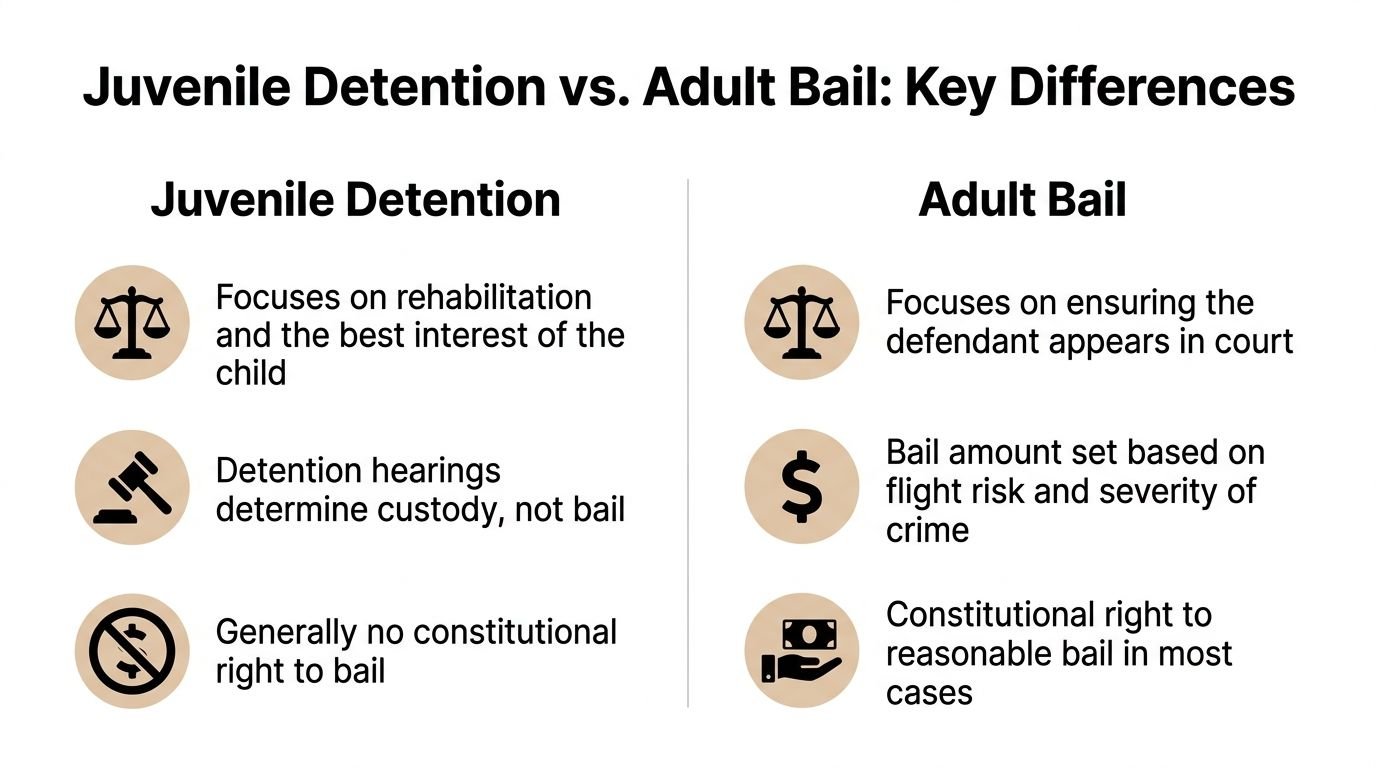
Under Colorado juvenile procedure, cases do not typically allow surety bonds. Instead, detention decisions occur within 48 hours at a shelter hearing, with the court focused on risk and placement rather than bail posting, as noted in this Colorado-focused juvenile detention discussion.
Think principal's office, not adult booking
An adult bail process is mostly a financial release mechanism. The court sets a number. The defendant pays cash, uses a property bond, or hires a surety company if a bond is allowed.
A juvenile detention hearing is different. It's closer to a structured review of whether the child can safely go home with conditions. The judge is asking whether release supports accountability and safety, not whether someone can post enough money.
If you want a broader look at release concepts in Colorado, this overview of what pretrial release means helps frame the adult side of the comparison.
Juvenile hearing vs adult bail at a glance
| Factor | Juvenile Detention Hearing | Adult Bail Process |
|---|---|---|
| Primary goal | Best interests of the child, safety, supervision | Temporary release while the case is pending |
| Main decision point | Judge reviews detention and release conditions | Judge sets bail or uses an existing schedule |
| Money role | Usually not the driver of release | Often central to release |
| Who matters most | Parent or guardian, home plan, stability | Defendant, charges, bond amount, surety eligibility |
| Typical outcome | Release to guardian with rules, or continued detention | Bond posted, release on recognizance, or hold |
| What the court examines | Supervision, risk, school, services, family support | Flight risk, public safety, charge severity |
What works and what doesn't
Some parents lose valuable time calling around for a bond amount that doesn't exist. That usually doesn't help.
What does help is preparing for the hearing itself.
- Have a supervision plan: Judges want to know who will physically supervise the child.
- Be ready to discuss school: A return-to-school plan shows structure.
- Accept realistic conditions: Curfew, counseling, and monitoring can make release more likely.
- Don't argue the whole case at intake: The early hearing is about custody and safety, not final guilt or innocence.
Practical rule: In juvenile court, the parent often functions like the release plan. If the court trusts the home, release becomes more realistic.
Your Step-by-Step Guide to the Colorado Juvenile Release Process
Parents need a checklist, especially in the first two days. The process moves fast, and missing details can hurt more than people realize.
Nationally, about 1 in 5 confined youth await trial pre-adjudication, and the reported cost of youth detention averages $588 per day in the cited national data, which shows why moving quickly matters for families and for the child's future, according to the Bureau of Justice Statistics summary and related youth confinement figures.
Start with the intake facts
When you get the first call, write down:
- The full facility name
- The booking or intake time
- The alleged offense
- The staff member's name
- The expected hearing window
If you're not sure what basic custody information you should be collecting in any release situation, this guide on how to bail someone out of jail is useful for organizing the practical details, even though juvenile court follows a different release structure.
Build the release plan before court
By the time the hearing happens, you want answers ready. Not legal theories. Practical answers.
Where will your child live
The court wants a clear home address and a responsible adult who will be present. If the child splits time between households, be ready to explain which home is best for immediate supervision.
How will your child be supervised
A weak answer is "I'll keep an eye on him." A strong answer is specific. "She'll be with me after school, she won't be left alone, and I've already arranged transportation."
What structure starts immediately
School attendance matters. So do counseling appointments, medical needs, and curfew enforcement. If the court believes home release will look unstructured, detention becomes more likely.
Expect conditions, not a simple release slip
If the judge allows release, it may come with terms. Common examples include:
- Curfew requirements
- School attendance rules
- No-contact orders
- Counseling or treatment
- Electronic monitoring
- Regular check-ins
The hearing often turns on one question: "If I release this child today, who will make sure the court's rules are followed tonight?"
If the hearing doesn't go your way
Ask counsel what changed the judge's view. Sometimes it was lack of a verified address. Sometimes no adult was present. Sometimes the court wanted a stronger support plan.
That matters because the next hearing may be your best chance to show the court something new and concrete, not just more emotion.
When Can a Bail Bond Company Help a Juvenile Defendant
There is one major exception to the usual rule. If a juvenile case is moved into adult court, bail can enter the picture.
That can happen through transfer, waiver, or direct file mechanisms, depending on the charge and the posture of the case. Once that shift happens, the release analysis starts to resemble the adult criminal system much more closely.
A Colorado-focused source states that District Attorneys filed over 150 direct files in 2025, a 12% increase from the prior year, and that these cases often involved bail amounts averaging $50,000 or more. That same source notes that the surety premium in these situations is typically 10% to 15%, which is why families suddenly need a workable bond plan if the juvenile is being handled in adult court, as discussed in this article on whether you can bail out a minor from jail.
What changes when the case becomes adult court
The biggest shift is legal status. The youth is no longer just arguing for release through a juvenile detention review. Now the court may set a bond amount, impose adult-style conditions, or in some cases deny bond based on the charge.
At that point, a family may need:
- A cosigner with acceptable qualifications
- Funds for the premium
- Government-issued identification
- Prompt communication with counsel
- A fast way to complete paperwork remotely
If you're dealing with that exception, information on juvenile bail bonds can help you understand the surety side of the process.
Trade-offs families need to understand
A bond can secure release. It can also create obligations.
The premium is generally not refunded. The cosigner may take on financial risk. The defendant must follow all court dates and conditions. If the court sets special restrictions, release isn't freedom in the ordinary sense. It's supervised release under strict rules.
Adult-court treatment may make bond possible, but it usually means the case itself has become much more serious.
In this situation, families need two tracks at once. One track is release. The other is defense strategy. If the case can still be challenged on transfer issues, counsel should be handling that immediately.
Your Role as a Parent in Securing Your Child's Release
In juvenile court, parents aren't background figures. They're central to the release decision.
A source on juvenile bond practice notes that minors can't legally post their own bond, require guardian consent, and that conditions such as curfews and counseling improve appearance rates, with cited figures of 88% for juveniles versus 70% for adults in the referenced material. The same source emphasizes how heavily courts weigh family stability during detention decisions, as explained in this guide for parents about bail bonds for juvenile offenses.
What judges want to see from you
Parents help most when they present themselves as organized, realistic, and dependable.
Bring or prepare:
- School information: attendance records, schedule, or contact details
- Home plan: where the child will sleep and who will supervise
- Treatment options: counseling, substance use support, or other services if needed
- Transportation plan: how the child will get to school, court, and appointments
If your family needs outside support to stabilize the home quickly, a referral for family therapy support can strengthen the structure a court wants to see after release.
If the case moves into adult court
Your role changes, but it doesn't shrink. You may become a cosigner, which means you are doing more than helping with paperwork.
You may be agreeing to:
- Guarantee appearance obligations
- Stay in contact with the defendant
- Report problems early
- Accept financial exposure if the bond terms are violated
Before signing anything, understand what a bail bond cosigner is responsible for. A rushed signature can create new problems for the whole family.
The most effective parent posture
Stay calm. Stay factual. Don't minimize what happened, but don't surrender your role either.
A judge doesn't need a perfect parent. The judge needs a credible adult with a workable plan for tonight, tomorrow, and the next court date.
That approach carries more weight than anger, blame, or broad promises.
Answering Your Questions About Juvenile Detention in Colorado
Parents usually ask the hardest questions after the first shock wears off. These are the ones that come up most often.
What if the parents aren't available or the home isn't appropriate
Another responsible adult may be able to step forward, but that depends on the court, the legal relationship, and the facts of the case. A relative can be helpful, but the court still needs confidence that the placement is safe and stable.
If the charges are serious, or if there are complicated custody issues, it can help to review how defense lawyers approach juvenile offenses so your family understands the legal side alongside the release issue.
Can an out-of-state family member help if bond becomes relevant
Yes, sometimes. If the case is transferred into adult court and bond is allowed, an out-of-state relative may be able to assist as a cosigner if the bond company accepts the arrangement and the documentation checks out. Remote processing can make a big difference in urgent situations.
Families often want to know whether electronic paperwork works under pressure. Reviews on the Express Bail Bonds profile show the kind of service experience people look for when time matters.
My child was arrested on a Friday night. Do we wait until Monday
Not automatically. In juvenile matters, the timing rule is tied to the required hearing window, not just the next calendar weekday. You still need to confirm the exact schedule with the facility and counsel right away, because local practice and court timing can affect the next step.
What if this is a federal juvenile case
Federal juvenile detention is different. Under the Department of Justice manual discussing 18 U.S.C.A. § 5034, a minor cannot post a traditional bail bond. A magistrate must decide whether detention is necessary for appearance or safety, and if those criteria aren't met, the child must be released to a parent or guardian, according to the DOJ's guidance on bail and detention for juveniles.
Is there a difference between a juvenile facility and adult jail
Yes. The staffing, court process, and release framework are different. Juvenile placement usually centers on detention review and guardian release. Adult jail booking usually centers on bond type, amount, and posting method.
That distinction is why the answer to "can you get bailed out of juvie" is usually "not in the normal adult sense."
Your Next Steps for Securing Release in Colorado
If your child is in juvenile detention, act fast and stay organized. Most Colorado juvenile cases turn on release planning, not traditional bail. If the case is pushed into adult court, then a bail bond may become the key issue.
Use this checklist now:
- Confirm the facility and intake status
- Get the hearing date and time
- Prepare a supervision plan
- Gather school, counseling, and home information
- Speak with counsel immediately if transfer to adult court is possible
- If adult court bond applies, ask about cosigners, remote paperwork, and surety options
For county-specific help, local resources matter. Families often need quick jail and court information in places like Jefferson County and Centennial. If you're checking reputation and availability before making a call, this Google business profile is another practical place to start.
If you're dealing with a juvenile detention crisis in Colorado, contact Express Bail Bonds. Their team has served Colorado since 1988 and is available 24/7 by call or text at 720-984-2245. Even when a standard juvenile case doesn't allow a traditional bond, they can help you understand the release process, identify when adult-court bail may apply, and move fast when a surety bond is needed.