
Yes, a cosigner can be removed from a bail bond, but it’s a question we get all the time, and the answer isn't a simple yes or no. Getting your name off that contract is possible, but it’s rarely easy and depends heavily on the bail bond agency's cooperation. It usually means finding someone else to take your place or, in a more drastic move, having the bond revoked, which sends the defendant back to jail. If you're in this position, the best first step is to get expert advice by contacting Express Bail Bonds for a confidential consultation.
The Reality of Being a Bail Bond Cosigner

Before we even talk about removal, let's get real about what you signed. When you became a cosigner (the legal term is indemnitor), you became the bail agency's financial guarantee. It’s a serious commitment, one that makes you the insurance policy for the defendant's release.
Your signature on that paperwork legally binds you to two critical duties: making sure the defendant shows up for every single court date, and paying the full bail amount if they don't. That upfront 10-15% premium? That's just the bondsman's fee. You are personally on the hook for the entire value of the bond set by the judge.
Understanding the Financial Risks
The stakes are incredibly high, and the consequences for you as the cosigner can be immediate and severe if the defendant skips court. This isn't just a theoretical risk. When a bond is forfeited, the bail agency will come to you to cover the loss.
Here's how that plays out in the real world:
- Loss of Collateral: If you put up property to secure the bond—like the deed to your house or a car title—the agency has the legal right to seize and sell it.
- Civil Lawsuits: The bail company can sue you directly for the full bond amount. This can quickly lead to garnished wages, frozen bank accounts, and a massive hit to your credit score.
- Recovery Costs: On top of the bond amount, you can also be held responsible for the costs of finding and apprehending the defendant, including the fees for recovery agents (bounty hunters).
A bail bond agreement is a legally binding contract. Your role as a cosigner makes you the financial backstop, placing your personal assets and financial future on the line until the case is fully resolved.
Understanding your specific duties is key. To get a clearer picture, it’s worth reading more about what it means to be a bail bond cosigner.
The Importance of Communication
Your best strategy in this situation is always open and honest communication with your bail agent. Reputable agencies, like us here at Express Bail Bonds, want to avoid a forfeiture just as much as you do. We depend on our cosigners to be our eyes and ears on the ground.
If you're worried about the defendant's behavior, think they might flee, or have lost contact with them, you need to call your agent immediately. Hiding the problem and hoping it resolves itself is the fastest way to increase your financial risk. A proactive approach is always the best policy.
How a Cosigner Is Typically Released From a Bond
If you’ve cosigned a bail bond, you're probably asking yourself, "How and when does my responsibility for this finally end?" For most people, the answer is simpler than you might think: you just have to wait for the court case to run its course.
The most common way your obligation ends is when the case concludes and a judge officially exonerates the bond. Think of exoneration as the final step. It's the court's official declaration that the bond has done its job—getting the defendant to show up—and your financial and legal duties are now completely dissolved. At that moment, you're off the hook, and any collateral you put up is returned to you.
This isn't some rare, lucky outcome; it's the standard procedure. It happens every single day in busy Colorado court systems like those in Jefferson County, Arapahoe County, and Denver. The case finishes, the judge signs off, and your role as the cosigner is officially over.
What Triggers Bond Exoneration?
You don’t have to file a motion or petition the court for exoneration. It’s an automatic judicial action that happens when the case reaches a final conclusion.
Here are the most common events that lead to a judge releasing the bond:
- Case Dismissal: If the prosecutor decides to drop the charges for any reason, the case is over, and the bond is exonerated.
- Acquittal: When a defendant goes to trial and is found not guilty, the bond is released as soon as the verdict is read.
- Sentencing: Even if the defendant is found guilty or takes a plea bargain, the bond is exonerated once the sentence is imposed. Your liability ends the moment the judge hands down the sentence, whether it’s jail time, probation, or just fines.
These three scenarios are what we in the industry call the "good behavior" path to freedom for a cosigner. The defendant upheld their end of the bargain by seeing the case through to the end. Because they did, your agreement with the bail bond company is complete. To better understand the contract you signed, take a look at our guide on what a surety bond is and how it works for jail release.
The Timeline for Release
So, how long does this usually take? While every case is different, national data shows that about 40% of U.S. cases are resolved within 90 days. Here in Colorado, things can move even faster for smaller offenses.
In major local jurisdictions like the Denver Metro area (which sees over 25,000 bookings a year), Arapahoe County, and El Paso County, local court records indicate that judges exonerate bonds in roughly 65% of misdemeanor cases immediately after a plea is entered. For a deeper dive into how this might affect your finances, you can read more on the impact of cosigner removal on your credit.
The moment a judge exonerates the bond, your financial liability stops. Your agreement is fulfilled, and you can breathe a sigh of relief. This is the goal for every cosigner and bail agent.
The Major Obstacle to Exoneration
There’s one major event that brings this entire process to a screeching halt: a Failure to Appear (FTA). If the defendant skips a court date, the judge won't exonerate the bond. Instead, a bench warrant is issued for their arrest, and the bond immediately goes into forfeited status.
This is the absolute worst-case scenario. At this point, the exoneration process is frozen, and your liability as the cosigner is at its highest. You are now responsible for paying the full bail amount unless the defendant is brought back to court so the case can get back on track. It's the one situation every cosigner hopes to avoid, and it highlights just how critical your role is in making sure the defendant makes it to every single hearing.
If you find yourself in a difficult situation and need guidance, the team at Express Bail Bonds is here to help. Whether you're in Golden, Jefferson County or need assistance with bail bonds in Centennial, our experienced agents are available 24/7. Don't hesitate to reach out to Express Bail Bonds for a confidential consultation. See what our clients have to say about our services by reading our customer reviews in Denver and our client feedback in Golden.
Ideally, a bail bond ends when the court case does. But life is rarely that neat. Relationships break down, people move, and a defendant you once trusted might start making you nervous. When that happens, you don't have to just sit and wait—you can take action to get your name off that bond.
So, can you be removed as a cosigner before the case is over? Yes. But it won't happen automatically. You have to be the one to start the process, and the most straightforward way is to find someone to take your place. Think of it as a clean swap, where you transfer the financial responsibility to a new person, allowing the defendant to remain out of jail while you get peace of mind.
Of course, your first call should always be to your bail agent. Here at Express Bail Bonds, we've seen it all. We know these things can get complicated, and our job is to navigate the situation discreetly and find a workable solution for everyone involved.
Finding a Qualified Replacement Cosigner
You can't just have a friend volunteer to take over. The bail bond company has to approve the replacement, and that means putting them through the same rigorous qualification process you went through. We need to be sure the new person is a reliable and financially sound guarantor.
Based on years of experience with these situations across Colorado, a strong replacement candidate usually has:
- A steady job with income we can verify. They need to show they have the means to cover the full bail amount if the defendant absconds.
- A decent credit history. A credit check is a standard part of assessing someone's financial responsibility.
- Proof of Colorado residency, like a utility bill or lease agreement, showing they have stable ties to the community.
The potential replacement will need to gather documents like recent pay stubs and a valid ID. Once you’ve found a willing and qualified person, the paperwork itself is fast—we can often handle it digitally in just a few hours. The real challenge is finding the right individual willing to accept such a serious obligation. For more on the financial side of things, our guide on how to pay a bail bondsman is a great resource.
The Last Resort: Revoking the Bond
What if you can't find a replacement? Or worse, what if you genuinely believe the defendant is about to skip their court date, has violated their release conditions, or has even threatened you?
In a serious situation like that, you have a powerful—and drastic—option. You can call your bail agent and ask to have the bond revoked. This is your "break glass in case of emergency" move. It protects you from financial liability, but it has immediate and severe consequences for the defendant.
Asking to be removed is you officially telling the bail agent, "I no longer guarantee this person will show up to court." At that point, your agent has no choice but to arrange for the defendant to be surrendered back to jail.
A Critical Point for Cosigners: Revoking the bond is your absolute right if you believe the defendant won't honor their legal commitments. It's a final safety net for you, but it means the defendant will be re-arrested.
This chart breaks down the common paths to getting released from a bond.
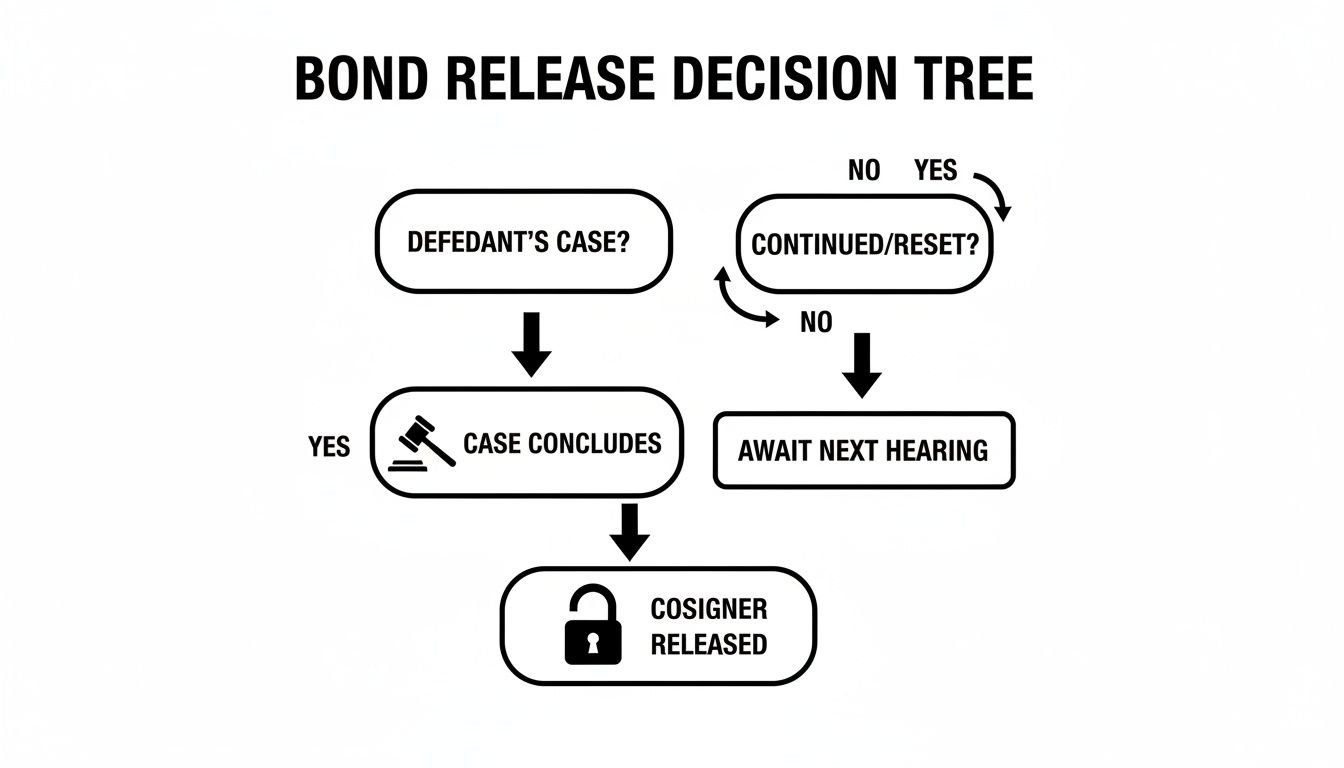
As you can see, the simplest road is letting the case finish naturally. Taking proactive steps to get removed mid-case is the exception, not the rule, and it's a much more involved process.
The Financial Reality of Revoking a Bond
Before you make that call, you need to understand that revoking the bond isn't a clean financial slate.
First, the non-refundable premium you paid stays with the bail company. That fee was earned the moment they posted the bond and secured the defendant's release. Second, if your agent has to hire a recovery agent (often called a bounty hunter) to find and surrender the defendant, you could be on the hook for those costs.
Cosigners are the backbone of the bail industry for a reason. When someone is arrested, their cash is often impounded and bank accounts frozen, making it nearly impossible for them to pay the 10-15% premium on their own. This is especially true here in Colorado, where Express Bail Bonds has been working statewide since 1988. By law, the premium is set at 15%, though it can drop to 10% for bonds over $5,000 if there's a qualified cosigner. This legal framework makes your role crucial, and removing yourself is a decision with serious financial weight. It's never a one-sided choice; it always requires the bail company's approval after they've fully vetted and underwritten a replacement.
What Happens After a Cosigner Is Removed
Getting your name taken off a bail bond is a huge relief, but it’s not the end of the story. Whether you successfully substituted yourself with a new cosigner or had to revoke the bond entirely, there are real-world consequences for everyone involved—you, the defendant, and the bail agent. It's so important to know what comes next before you make a final decision.
Once your removal is approved and processed, the single most critical document for you is the Indemnity Release Agreement. This is the legal paperwork that officially cuts your financial responsibility to the bond. Signing it marks the finish line. It's the absolute proof that you are no longer on the hook for the full bail amount if the defendant skips court.
Your Final Legal and Financial Obligations
Even with an indemnity release in hand, a couple of financial loose ends might remain. First things first: the premium you paid to the bail bond company is never refunded. That fee was considered earned the minute the agent posted the bond for the defendant's release.
You might also face one last expense if your removal came about because the defendant broke their bond conditions, which would have forced the agent to revoke the bond.
- Recovery Costs: If a recovery agent (often called a "bounty hunter") was needed to locate and surrender the defendant, you could be responsible for those expenses.
- Timing is Everything: Your liability for any recovery costs usually stops the moment the bond revocation is officially processed. You can, however, be held accountable for any expenses racked up before that point.
The Indemnity Release Agreement is your official exit pass. Make sure you get a signed copy from your bail agent. It’s the ultimate proof that your financial obligations for that specific bond are over.
Severe Consequences for the Defendant
While you get your peace of mind back, the defendant's situation takes a serious downturn if the bond was revoked. Your action to remove yourself directly results in the defendant being put back in jail. The court is immediately notified, and the fallout is swift.
The judge will issue a bench warrant for their immediate arrest. Once they're back in custody, they are often seen as a "red flag" by both the courts and the bail industry. This new reputation creates a whole new set of obstacles, signaling to judges and bail agents that the defendant is a much higher risk.
Trying to Secure a New Bond
After a bond revocation, getting out of jail a second time becomes incredibly difficult. From the court's perspective, the defendant is now untrustworthy.
Here’s what they’re up against:
- Higher Bail Amount: Judges almost always increase the bail amount after a revocation, sometimes by 50% or more, to account for the increased flight risk.
- Stricter Bond Conditions: Any new bond is guaranteed to come with much tougher rules, like mandatory GPS monitoring or daily check-ins with the bail agent.
- Refusal from Bail Agencies: Frankly, most bail bond companies will flat-out refuse to write a new bond for someone whose last bond was revoked by their cosigner.
Revocation initiated by a cosigner is a major event in our industry. Across the country, defendant non-compliance leads to bond cancellations in roughly 10-15% of all bail cases each year. Here in Colorado, where Express Bail Bonds has worked in all 64 counties since 1988, we see revocations spike when defendants miss court. In fact, state data shows Failure to Appear (FTA) rates in places like Jefferson and Weld counties can climb as high as 22%, forcing cosigners into tough decisions.
If you're in a difficult position and trying to figure out what to do, our team at Express Bail Bonds can offer you confidential, practical advice. Whether you need assistance in Jefferson County or with bail bonds in Centennial, our experienced agents are available 24/7.
Understanding all your rights and the potential results, like a bond forfeiture, is the best first step you can take. Contact Express Bail Bonds today to talk through your situation, or see how we've helped other families by reading our customer reviews from the Denver area and our feedback from clients in Golden.
Where Do You Go From Here?
It's completely normal to feel stressed and unsure about what to do next as a bail bond cosigner. We get it. You've just taken in a lot of information, but the most important thing is turning that knowledge into the right action.
The good news is that this situation isn't always as complicated as it might feel right now. For most people, the simplest outcome is the most common one: your responsibility ends automatically when the defendant’s case is over. Once the judge closes the case and exonerates the bond, you're officially off the hook without having to lift a finger.
Your Most Important Takeaways
If you remember nothing else from this guide, remember that open, honest communication is your most powerful tool. Going silent or hoping the problem disappears on its own is a recipe for disaster.
Here’s what you absolutely need to keep in mind:
- Talk to Your Bail Agent. They are your single best source of information and want to avoid a forfeited bond just as much as you do. Keep them in the loop.
- Getting Removed Isn't a Casual Request. It’s a serious legal step that usually requires finding a new, qualified cosigner or, in more extreme cases, revoking the bond and returning the defendant to jail.
- The Easiest Way Out is the Case's Conclusion. Your liability is most cleanly resolved when the defendant fulfills all their court obligations and the judge closes the case.
Before you make a move that could affect your financial future or the defendant's freedom, talk to an experienced professional. A good bail agent will listen without judgment and lay out all your options clearly.
Don't Guess—Get Expert Guidance
The moment you start feeling overwhelmed by the responsibility, become worried about the defendant’s choices, or just feel uncertain about what to do, it’s time to pick up the phone. A simple conversation can bring immense clarity and help you sidestep costly mistakes. To get a better handle on who you'll be working with, it’s worth reading our overview of what a bail bond agent actually does.
Here at Express Bail Bonds, our team is on standby 24 hours a day, 7 days a week to answer your questions with the confidentiality you deserve. We've seen just about every scenario imaginable over the years and can give you practical, no-nonsense advice for your specific situation.
We’re a statewide network, ready to help whether you're in Jefferson County, Centennial, or anywhere else in Colorado. We believe in being upfront and giving you the information you need to make the right call. You can see what our clients think by reading our customer reviews from the Denver area and our feedback from clients in Golden.
Don't wait for a small problem to become a big one. If you’re a cosigner worried about your bond, contact Express Bail Bonds today for a no-pressure consultation. We're here to help you handle this with confidence.
Common Questions We Hear From Cosigners
When you're a cosigner on a bail bond, a lot of "what-if" scenarios can run through your mind. It's completely normal. After years in this business, we've heard just about every question imaginable. Here are some of the most common ones we answer for cosigners in Colorado, with the straightforward answers you need.
If I'm Removed as a Cosigner, Do I Get the Premium Back?
The short answer is no. The bail bond premium is non-refundable, period.
Think of it like paying for car insurance. Once you pay the premium, the insurance company is on the hook for the risk. The bail bond premium works the same way—it's the fee you pay for our agency to post the full bond amount and take on the financial risk. As soon as the defendant walks out of jail, that service has been fully provided, and the fee is considered earned. This is true whether the case is resolved the next day or you're replaced by another cosigner down the road.
Can I Get Off the Bond Without Telling the Defendant?
Yes, you can, and you should if you're concerned. Your agreement is with the bail bond agency, not the defendant.
If you genuinely believe the person you bailed out is going to skip court, has violated their release conditions, or has just become a flight risk, your first call should be to your bail agent. You can confidentially request to have your liability removed. This process is called surrendering the defendant, and it will involve the agent revoking the bond and returning the defendant to custody. It’s a serious step, but it’s your primary way to protect yourself from losing the full bail amount.
How Quickly Can a Replacement Cosigner Be Approved?
The approval part is fast. The hard part is finding the right person.
Once you’ve found someone willing and qualified to take over your responsibilities, we can move very quickly. Here at Express Bail Bonds, our digital application process means we can often vet and approve a new cosigner the same day. They'll just need to provide the standard proof of identity, income, and Colorado residency. The paperwork itself can be done in a couple of hours. The real challenge, and your main responsibility, is finding that replacement.
An Agent's Perspective: The paperwork is simple. The real work is finding someone who truly understands what it means to be a cosigner and has the financial stability to qualify. We can’t find that person for you.
What Happens if the Defendant Gets Arrested Again?
A new arrest can be a messy situation, but it often provides a clear path to ending your responsibility as a cosigner. When a defendant is re-arrested on a new charge, the judge in the original case will almost always revoke the existing bail.
When that happens, the judge will typically exonerate the bond, which is the legal term for terminating it. This officially ends your financial obligation for that specific case. The key thing to remember is that your liability is still active until the judge makes that formal ruling in court. This is where communication is crucial. A proactive bail agent will be tracking the case and will let you know the second the bond is exonerated. You shouldn't be left wondering.
Trying to figure out your obligations as a bail bond cosigner can feel overwhelming, but you're not in this alone. The experienced team at Express Bail Bonds is here 24/7 to offer confidential advice. Whether you need help from our office in Jefferson County or are looking for bail bonds in Centennial, we proudly serve every corner of Colorado. You can see what our clients think by reading our Denver reviews and Golden testimonials. For immediate and professional assistance, contact us at Express Bail Bonds today.