
The call usually comes at the worst time. Late at night. Early morning. A shaky voice saying someone has been arrested, the charge is serious, and nobody knows what happens next.
If you're dealing with a felony arrest in Colorado right now, the first thing to know is this: panic doesn't help, but a clear plan does. Felony bail bonds can feel confusing when you're tired, scared, and trying to make fast decisions. The good news is that the process is usually more manageable once you know what the jail, the court, the bondsman, and the cosigner each need.
What matters most in the first few hours is getting accurate information, finding out whether a bond has been set, and moving quickly once the case is bondable. Families lose time when they guess, rely on rumors, or assume they need to show up in person before anything can happen. In many Colorado cases, there are faster ways to handle the paperwork and move the release process forward.
The Urgent Call What to Do After a Felony Arrest
A common scenario goes like this. Someone calls from jail. They say they're being held on a felony. They might not know the exact charge, whether bond has been set, or which facility is holding them. The family hears one word, felony, and assumes the worst.
Serious doesn't always mean hopeless. It means you need to slow down and get the right facts in the right order.
Start with the basics
When that call comes in, gather the details you can confirm:
- Full legal name: Nicknames slow everything down.
- Date of birth: This helps identify the right person if names are common.
- Jail or county: Denver, Jefferson, Arapahoe, and other Colorado counties all process differently.
- Booking status: Ask whether they've been booked yet or are still waiting.
- Charge level: If they know the actual charge, write it down exactly as stated.
If you don't have all of that, don't wait forever trying to perfect the information. Start with what you know and verify the rest.
Practical rule: The fastest families aren't always the ones with the most money. They're the ones who get accurate booking information first.
In major U.S. counties, commercial surety bonds were used in 42% of felony releases, compared with 5% for cash bail, which means working with a bondsman is the standard path in felony cases, not an unusual one, according to the Bureau of Justice Statistics overview on bail.
What helps in the first hour
A worried family member often wants to solve the entire case in one night. You don't need to do that. You need to answer three immediate questions:
- Has bond been set?
- Is the case bondable right now?
- Who can cosign if needed?
If you're trying to understand the earliest stage after booking, this guide on what happens after you get arrested gives a useful breakdown of the first steps.
The key is to replace panic with sequence. Confirm the jail. Confirm bond status. Confirm who can act as the responsible party. Once those pieces are in place, the next decisions get much easier.
Understanding Colorado Felony Bail Bonds
A felony bail bond is a surety agreement. The court sets a bail amount, and a licensed bondsman guarantees that amount to the court if the defendant fails to appear. The defendant or cosigner pays a non-refundable premium, typically about 10% to 15% of the total bail amount, according to this explanation of how bail works and how surety premiums are charged.
Think of it as a guarantee to the court
The easiest way to understand felony bail bonds is to think of them like a financial guarantee. The court wants assurance that the defendant will come back to every required court date. The bondsman takes on that risk. The cosigner agrees to the contract terms and helps back that promise.
That doesn't mean every felony bond is the same. Felony cases usually involve more scrutiny than misdemeanor cases. Judges look harder at the charge, background, and conditions of release. Bond companies do the same.
For a plain-language explanation of how surety bonding works, this page on what is a surety bail bond is worth reading.
The people involved
Here's who usually matters in a felony bond:
| Person | Role |
|---|---|
| Defendant | Must follow all court dates and bond conditions |
| Judge or court | Sets the bail amount and release conditions |
| Bondsman | Posts the surety bond once approved |
| Cosigner | Signs the contract and may be financially responsible if terms are violated |
The confusion usually starts when families mix up cash bail, bond premium, and collateral. Cash bail means paying the full amount directly to the court. A surety bond means paying the bond company's fee so the company can post the bond. Collateral is separate and only comes into play in some cases.
If you want another jurisdiction's plain-English overview for comparison, this Brazoria County bail bond guide does a good job of explaining how bond mechanics work for families who are new to the process.
A felony bond doesn't decide guilt or innocence. It decides whether someone can wait for court outside the jail, under conditions the court accepts.
How Colorado Courts Determine Felony Bond Amounts
Families often ask the hardest question first: why is the bond set at that number?
The short answer is that courts are trying to balance release against risk. In Tennessee court guidance, bail must be set "as low as the court" considers appropriate, and that principle reflects the core purpose of bail. It should be high enough to support appearance in court, but not used as punishment before a conviction, as described in this overview of how bail works in Tennessee and the different release mechanisms.
What judges usually weigh
A felony bond amount usually reflects several practical questions at once:
How serious is the charge
Violent allegations, repeat allegations, or conduct that suggests a broader public-safety concern usually draw more scrutiny.Does the defendant have a record
Prior cases matter, especially if they involve missed court dates, pending matters, or supervision issues.Are community ties strong
Stable work, local family, and a long-term residence can help show the person is likely to return.Is there a specific safety concern
Allegations involving threats, protected parties, or no-contact concerns can affect both amount and conditions.
These factors don't operate in isolation. One strong positive fact can help, but a serious negative fact can outweigh it.
Why many families need a surety bond
Nationally, about 731,000 people are in local jails each day, and nearly two-thirds are pretrial detainees who haven't been convicted, according to the Civil Rights Corps report on pretrial detention and money bail. Many people remain in custody because they can't afford the amount the court set. That's one reason felony defendants often turn to surety bonds rather than trying to pay the full amount directly.
A bond number can feel random when you're hearing it in the middle of a crisis. Usually it isn't random. It's tied to the court's view of appearance risk, public-safety concerns, and the facts available at the hearing.
Hearing discretion matters
Some cases start with a schedule or standard practice. Others turn on what happens in front of the judge. That's why the same charge doesn't always lead to the same result for every defendant.
If you want a clearer picture of how that hearing works, this page on what happens at a bail hearing helps families understand what the court is deciding.
One practical point matters here. Bond amount and bondability are not the same thing. A high bond can still be posted if approved. A no-bond hold or outside hold is a different problem entirely.
The True Cost of a Felony Bond Premiums and Collateral
The number that matters most to families isn't always the full bond amount. It's the amount needed to get the bond posted.
Premium is the fee for the bond
In Colorado, the standard premium for a surety bond is 15%, and for bonds over $5,000, qualified clients may be able to secure a 10% premium with an approved cosigner, based on the published information from how much a bail bond costs through Express Bail Bonds.
That premium is non-refundable. This is the part many families misunderstand the first time around. It is the fee paid for the bond company's service and financial guarantee. It is not a deposit sitting with the court waiting to come back later.
Collateral is a separate issue
Collateral is not the same as the premium.
A bond company may ask for collateral when the bond is large, the risk is higher, the indemnitor profile is weak, or the facts suggest a stronger financial backstop is needed. In some cases, no collateral is required. In others, collateral can be the deciding factor in whether a bond is approved.
Common forms of collateral can include:
- Real property interest: Often tied to a deed of trust or other verifiable ownership interest
- Vehicle title: Sometimes used when equity and ownership are clear
- Valuable personal property: Considered more selectively
- Financial backing from a stronger cosigner: Sometimes this reduces or replaces the need for hard collateral
The premium pays for the bond. Collateral secures the risk behind the bond. Those are two different obligations.
This explainer may help if you're sorting through the cost questions with family members:
What doesn't work well
Families lose time when they treat every bond like a simple retail transaction. Felony bail bonds work better when you ask direct questions up front:
- What is the premium?
- Is a cosigner required?
- Will collateral be required in this case?
- What documents should the cosigner have ready?
If a family can answer those questions early, the posting stage usually moves more smoothly. If they can't, the process stalls while everyone scrambles for documents, signatures, or backup plans.
The Release Process A Step-by-Step Action Plan
When a felony arrest happens, speed comes from sequence, not chaos. The cleanest releases usually happen when the family handles each stage in order and doesn't skip ahead.
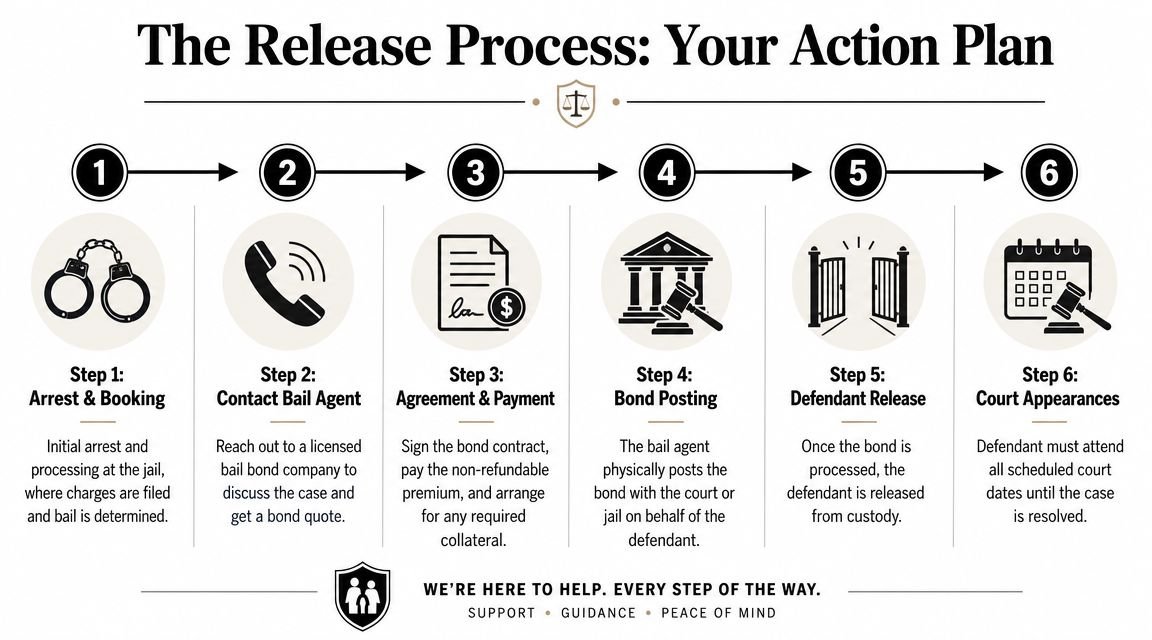
Step 1 gather the right booking details
Before anything can be posted, you need enough information to identify the case correctly.
Write down:
- Defendant's full legal name
- Date of birth
- County and jail
- Booking number if available
- Known charge information
- Whether bond has already been set
If the caller from jail is upset or rushed, don't argue over details they can't confirm. Get the basics and verify the rest through the jail or bond agent.
Step 2 contact a bondsman who handles felony cases
Not every question is legal. Many of them are operational. Is the case bondable. Is a cosigner needed. Can documents be signed remotely. Can the bond be posted tonight if approval happens tonight.
The bail process is increasingly digital. The ability for a nonlocal relative to cosign remotely, submit ID and pay stubs electronically, and move the bond forward after approval has become a major practical advantage, especially for after-hours arrests in metro areas, as noted in this overview of digital and remote felony bail processing.
Step 3 complete the application and cosigner review
Many delays happen at this stage.
The cosigner usually needs to provide identity information, contact details, and supporting documents if requested. A remote process can make this much easier for families who live in another county or state. Instead of driving across town or sitting in a detention-center lobby, they can handle contracts and document submission electronically.
One Colorado option for this kind of workflow is Express Bail Bonds, which offers online applications, electronic contracts, and statewide surety bond service.
Fast release usually depends on paperwork quality. Missing signatures, unreadable ID, and incomplete cosigner details slow things down more than families expect.
Step 4 pay the premium and address any collateral issue
Once the bond is approved, the next step is paying the premium and handling any collateral requirement. Some cases are straightforward. Others involve additional review because of bond size, risk level, or the strength of the cosigner.
This is also the moment to ask practical questions, not just financial ones:
- Will the defendant have conditions on release
- Is there a no-contact order
- Are there travel limits
- What court date information should the family track immediately
Step 5 posting and release
After approval and paperwork, the bond gets posted with the jail or court. Families often think posting the bond means the person walks out immediately. Sometimes release is quick. Sometimes jail processing takes longer than expected.
A good local contact point for families dealing with Arapahoe County is this Centennial bail bonds page, which is useful when the arrest happened in that area.
The most practical mindset is this: once the bond is posted, the release is in the jail's hands. Staff still have to process the release, clear internal procedures, and make sure there are no other holds blocking the person from leaving.
Common Roadblocks Holds and No-Bond Scenarios
Sometimes the family is ready, the money is ready, and the paperwork is ready, but release still doesn't happen. When that happens, there's usually a hold or a bondability issue behind it.
Pretrial release is not automatic for felonies. Release outcomes vary by offense type and criminal history, and judges can deny bond based on public-safety concerns, prior failures to appear, or other statutory factors, as explained in this discussion of when a felony case may not be bondable.
What a hold usually means
A hold means another legal issue has to be cleared before release can happen.
Common examples include:
- Another county wants the person held
- Probation or parole issues are pending
- An immigration-related hold exists
- A separate warrant is attached to the booking
In those cases, posting one bond may not be enough. The defendant may still remain in custody until the other issue is addressed.
What no bond means in practice
A no-bond situation is different. It means the court has not authorized release through a normal bond at that point.
That can happen when the allegation is severe, when the court sees a major appearance risk, or when the facts suggest a serious danger to another person or the community. It can also happen temporarily while the defendant waits for a hearing where bond will be argued.
If you're trying to sort out that language, this page on what no bail means gives a straightforward explanation.
A family can be fully prepared and still hit a legal roadblock. That doesn't mean anyone made a mistake. It means the release problem is legal, not logistical.
The best move in a hold or no-bond scenario is to identify exactly what is blocking release. Once you know that, you stop wasting time chasing a bond that can't be posted yet.
Your Next Steps and Felony Bail FAQs
A felony arrest changes the tone fast. Families feel pressure to act immediately, but the fastest path is still the one built on correct information, clean paperwork, and a realistic understanding of whether the case can be bonded right now.
If you're helping someone in Denver, Jefferson County, Arapahoe County, or anywhere else in Colorado, keep the first priorities simple. Confirm the booking. Confirm the bond status. Identify the cosigner. Ask whether there are any holds. Then move on the bond process without waiting for perfect conditions.
For Jefferson County cases, this local page for Golden and Jefferson County bail help is a useful starting point when you're trying to narrow things down by facility and location.
Quick answers families ask all the time
What happens to the premium if charges are dropped
The premium is the fee for posting the surety bond. It isn't tied to the case outcome. If charges are dropped later, that doesn't make the premium refundable.
What is a cosigner really agreeing to
A cosigner is taking responsibility under the bond agreement. That can include financial responsibility if the defendant violates the bond terms or fails to appear. A cosigner should never sign first and ask questions later.
Can a felony bond be posted at night or on a weekend
Yes, a bond can often be handled outside normal business hours if the case is bondable and the needed paperwork, approval, and payment are in place. The practical limit is usually jail processing, not the clock.
What should I have ready before I call
Keep this short list in front of you:
- Defendant's full name and date of birth
- Jail location
- Booking number if known
- A working phone and email for the cosigner
- Photo ID and any requested income or employment documents
The goal isn't to learn the whole legal system tonight. It's to get your person through the next door in the process without losing hours to confusion.
If you need immediate help with felony bail bonds in Colorado, contact Express Bail Bonds. They provide 24/7 call or text support, statewide Colorado surety bond service, and online applications, payments, and electronic documents so families and cosigners can move the process forward without spending the night driving from jail to jail.