
Bounty hunters can often carry guns, but the law is a patchwork, not a blanket rule. In some states the practice is banned entirely, in others it’s allowed under very different standards, and in Colorado the answer depends on strict compliance with the rules that apply to bail enforcement.
When a loved one misses court, families usually aren’t thinking about legal categories or statutory language. They’re thinking, “Who’s going after them, are they armed, and is this going to turn into a dangerous situation?” That concern is reasonable. The media version of a bounty hunter makes it look chaotic, aggressive, and half outside the law.
Real bail enforcement isn’t supposed to work that way.
The first thing to understand is that “can a bounty hunter carry a gun” isn’t a simple yes-or-no question. It depends on where the agent is operating, what authority they have, what role they’re serving in, and whether they’re following the rules of that state and county. For families in Colorado, that local detail matters more than anything else.
The Urgent Question When a Loved One Skips Bail
A family member misses a court date. The phone starts buzzing. Someone says there may be a warrant. Someone else says a bounty hunter might be involved. Then the question hits fast: if someone is coming to find your loved one, can they legally be armed?
That question usually comes with fear underneath it. Families worry about a confrontation at a home, a workplace, or during a traffic stop. They worry about mistakes. They worry about someone acting like law enforcement when they aren’t.

In practice, the safest first move is to get clear on the legal status of the missed appearance and any possible warrant. If you’re trying to sort that out, this guide on how to check if someone has a warrant is a useful starting point.
What families are really asking
Individuals aren’t asking about the Second Amendment in the abstract. They’re asking three practical things:
- Is the person coming to my house legitimate: Not everyone who claims to be a recovery agent is operating correctly.
- Will they act within the law: Authority changes by state, and crossing a line can create serious liability.
- How likely is force: Professional recovery work should prioritize identification, planning, and controlled contact.
Practical rule: If an agent is involved, the important issue isn’t just whether they have a gun. It’s whether they have the legal authority, training, and judgment to avoid using it.
Why the answer feels confusing
Families hear conflicting advice because the legal system itself is inconsistent. Some states allow bounty hunting. Some ban it. Some allow armed carry with conditions. Some split the rules based on job title or licensing category.
That’s why broad internet answers often make the situation worse. They tell you what “bounty hunters” can do in general, but your family doesn’t live in “general.” You live in a specific state, a specific county, and in Colorado that local reality matters.
The National Patchwork of Bounty Hunter Firearm Laws
A family in Colorado may hear that a "bounty hunter" can carry a gun and assume the answer is simple. It is not. Across the country, bail enforcement authority changes from state to state, and firearm rules often change with it.
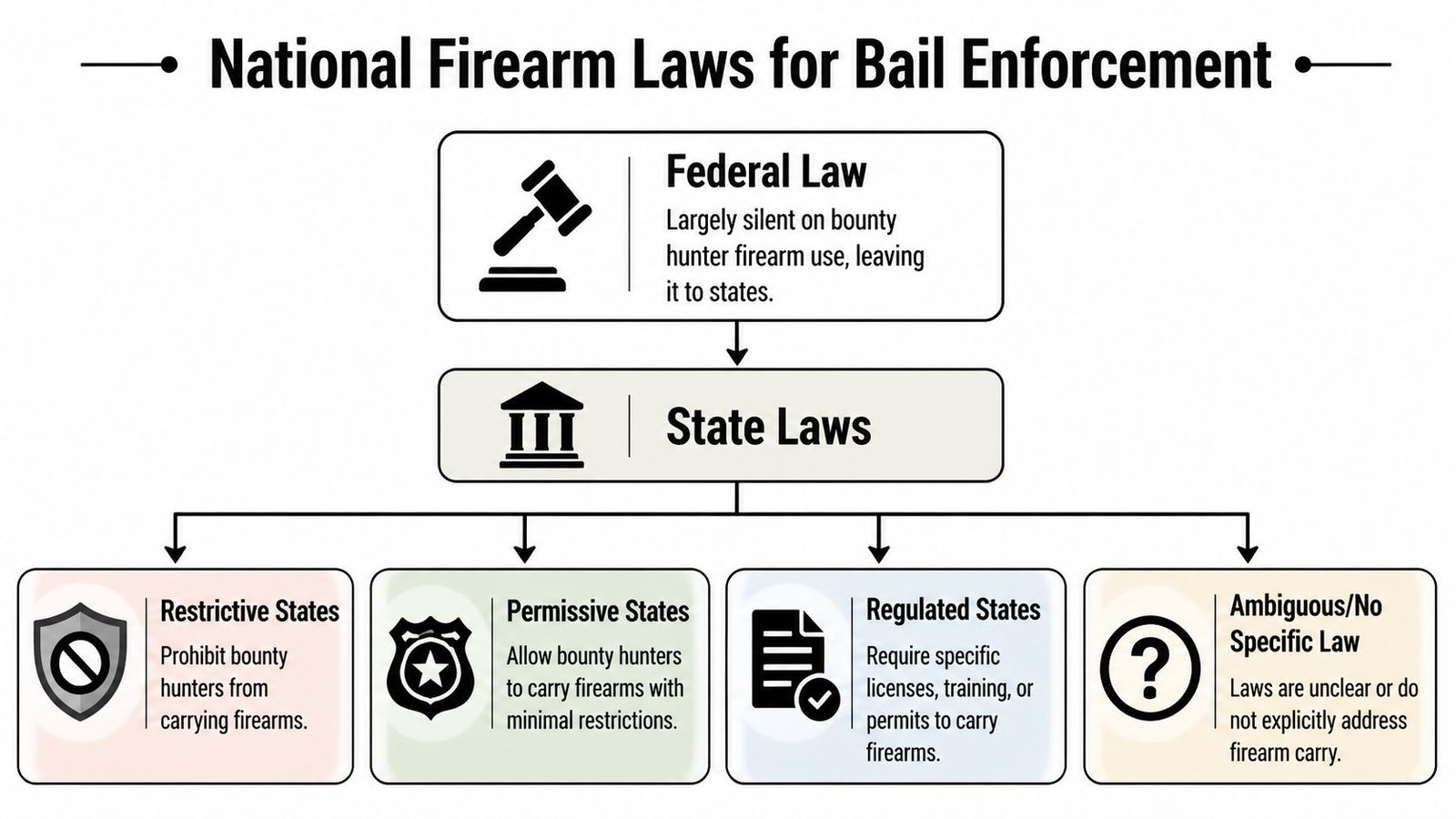
That is one reason broad online answers cause trouble. A recovery agent may be on solid legal ground in one state and create serious criminal or civil exposure by carrying, transporting, or acting the same way across a border.
Where the biggest differences show up
Some states bar traditional bounty hunting altogether. Others allow bail enforcement only under specific licensing structures, employment relationships, or supervision rules. In practical terms, the firearm question usually sits on top of a bigger legal question. What is the person’s legal status in that state, and what authority comes with that status?
A general state-by-state review of bounty hunting laws shows just how uneven the rules are. That unevenness matters to families because the same person might be treated as a lawful recovery agent in one jurisdiction, a private security professional in another, or someone with no authority at all in a third.
Why crossing state lines raises the risk
Interstate recovery work carries more risk than people expect. Firearm possession, concealed carry rules, transport requirements, notice obligations, and limits on entry can all change at the state line. A person who talks confidently about "bounty hunter rights" may still be handling the job incorrectly.
From a bail bond professional’s standpoint, that is the main concern. The issue is not just whether a gun is present. The issue is whether the person carrying it has lawful authority, proper documentation, and a plan that keeps everyone safe.
For a plain-English look at how quickly firearm transport rules become state-specific, Ship Restrict firearm shipping advice is a useful reference.
Families also benefit from understanding the role itself before focusing only on weapons. Our guide explaining what bounty hunters do in the bail process gives that background.
The practical takeaway is simple. National answers are a starting point, not a decision tool. In Colorado, the safer question is whether the agent working your case is operating lawfully, locally, and with the kind of restraint a licensed bail bond agency expects.
Firearm Rules for Bail Enforcement in Colorado
A family in Colorado usually asks the same question first. If the person sent to recover my loved one is armed, are they allowed to be armed, and are they handling the job the right way?
That is the right concern. In Colorado, the firearm question is tied to authority, identification, and judgment on the ground. A weapon does not make a recovery lawful. The agent’s conduct does.
Colorado cases are won with local control
Colorado is not a place for generic advice pulled from another state. Recovery work in Jefferson County, Denver, Centennial, and smaller jurisdictions can play out very differently because jail procedures, court practices, and surrender logistics are different from one area to the next.
From a bail bond professional’s standpoint, that local knowledge matters more than bravado. The safest recovery often starts long before any contact is made. We verify the bond file, confirm the defendant’s status, review likely addresses, and look for a controlled surrender option first. That approach lowers the chance of a confrontation and keeps families out of the middle.
What lawful, professional firearm handling looks like
In Colorado, a serious bail enforcement effort should look measured and documented. If an agent is armed, the focus should stay on legality and restraint, not intimidation.
That usually means:
- Clear identification: The agent identifies their role truthfully and does not present themselves as law enforcement.
- Lawful authority: The recovery is tied to a valid bond matter, with the right paperwork and a clear basis for action.
- County-specific planning: The team knows where a surrender should happen, which jail will accept the defendant, and how to avoid unnecessary contact at a home or workplace.
- De-escalation first: A firearm is not a shortcut. Good agents use communication, timing, and controlled settings to get compliance safely.
Families often assume the gun question has one simple statewide answer. It usually does not. The safer question is whether the person handling the case knows Colorado practice well enough to avoid turning a recovery into a legal problem.
What raises red flags
Problems start when someone treats bail enforcement like freelance muscle work. That is where families, agents, and bond companies all get exposed to unnecessary risk.
Warning signs include:
- showing up armed and acting like a police officer
- making threats instead of arranging a surrender
- pushing a residence encounter when safer options exist
- assuming authority works the same in every county or across state lines
For a clearer explanation of the legal framework behind these decisions, see our guide to Colorado bounty hunter regulations.
Colorado families do not need theatrics. They need a licensed bail bond agency that handles recovery work carefully, uses local process, and puts safety ahead of ego.
Required Training and Realities of the Job
One of the most surprising things for families is how uneven the training picture can be. In some places, agents face permit or licensing requirements. In others, the formal entry barrier is lighter than expected.
That doesn’t make the work simple. It makes judgment more important.
Why firearms are common in bail enforcement
In the United States, bounty hunters are generally permitted to carry firearms, but the rules vary substantially by state. Some states require permits and others do not. Texas shows how detailed this can get, because state rules distinguish between armed security officers and private investigators executing different kinds of warrants, as described in this overview of whether bounty hunters can carry guns.
The reason many agents choose to carry is practical. They may be working alone or in small teams, and they may be trying to locate someone who is desperate, unpredictable, or armed.
Training is only part of the equation
A firearm doesn’t make an agent effective. It raises the consequences of every decision.
What tends to matter most in the field is a mix of:
- De-escalation: The best recovery is the one that ends in compliance, not force.
- Preparation: Good agents verify address history, likely contacts, and surrender options before making contact.
- Role discipline: They know they aren’t police, and they don’t act like police.
- Documentation: Every lawful step should be defensible afterward.
This is also why the term “bounty hunter” can mislead families. The professional standard is closer to controlled fugitive recovery than to the stereotype.
What families should ask about
If you’re dealing with a skipped bond and someone says an agent may be involved, ask practical questions:
- Who authorized the recovery
- What training or licensing applies in that jurisdiction
- Whether the plan favors voluntary surrender first
- How the agent will identify themselves
For readers who want to understand the role more clearly, this page on the bail enforcement agent job is a helpful reference.
The gun gets attention. The decision-making matters more.
Legal Risks and Liability When Things Go Wrong
Families often focus on the immediate fear of an arrest. They should also think about what happens if the recovery is handled badly.
An armed recovery can increase the odds of locating and taking someone into custody, but it can also increase the stakes if the agent makes a poor decision, enters the wrong place, misidentifies a person, or handles contact in a way that creates injury or property damage.

The success and risk trade-off
According to this discussion of armed bail enforcement risk and Colorado entry rules, firearm carry correlates with a 92% apprehension success rate versus 61% for unarmed agents, and fugitives are three times more likely to resist violently. The same source notes that in Colorado, agents must identify themselves as “bail enforcement” pre-entry under C.R.S. §16-3-202 and wear non-LEO attire to reduce liability.
Those facts tell the story. A firearm may improve operational success, but the legal and personal consequences of mishandling the encounter become much more severe.
Where liability shows up
Problems don’t always look dramatic in the moment. They often show up later as claims, disputes, or financial losses.
Common exposure points include:
- Wrongful entry: Entering or attempting entry without proper authority.
- Misrepresentation: Dressing or acting in a way that makes others believe the agent is police.
- Property damage: Broken doors, damaged vehicles, or disrupted workplaces.
- Excessive force claims: Even when the target skipped bail, force still has legal limits.
Why cosigners should care
The person who signed for the bond isn’t just emotionally involved. They may also face financial fallout from the underlying case and from bond failure issues. If the defendant isn’t returned properly, the matter can lead to forfeiture consequences and added stress for everyone who signed.
If you need that side explained clearly, this guide on what is bail forfeiture is worth reading.
A rushed recovery can create two crises instead of one. The original skipped court date, and a second legal problem caused by bad enforcement.
The safest path is always the one that reduces surprise, reduces force, and keeps every step inside the law.
The Professional Alternative A Licensed Bail Agent
The stereotype most families picture is a freelance bounty hunter kicking in doors. The professional alternative looks very different. It’s structured, documented, and focused on reducing risk before force becomes an issue.

A licensed bail agent’s job starts earlier than recovery. It includes screening, explaining court obligations, maintaining communication, working with cosigners, and trying to prevent a missed appearance from turning into a fugitive situation at all.
What a professional process looks like
Families usually benefit most from an approach that emphasizes:
- Communication first: The goal is often to get the defendant back into compliance voluntarily.
- Accurate records: Court dates, surrender options, indemnitor obligations, and jail procedures need to be clear.
- Lawful coordination: If enforcement becomes necessary, it should be planned carefully and handled within the rules.
- Reduced drama: The best outcome is controlled surrender, not spectacle.
That’s the difference between an operation built on process and one built on aggression.
Bounty Hunter vs. Licensed Bail Agent An Important Comparison
| Attribute | Typical Freelance Bounty Hunter | Licensed Express Bail Bonds Agent |
|---|---|---|
| Primary focus | Locate and apprehend | Prevent bond failure, guide compliance, coordinate lawful resolution |
| Communication with family | Often limited or reactive | Structured, ongoing, and centered on next steps |
| Approach to surrender | May move straight to field contact | Tries to create a voluntary and orderly surrender first |
| Documentation | Varies widely | Part of the regular professional process |
| Liability awareness | Can be inconsistent | Built into daily operations and bond management |
| Public image | Often shaped by TV stereotypes | Professional, administrative, and legally grounded |
| Relationship to the bond | Transactional recovery role | Full bond support from release through case follow-up |
For readers who want to evaluate public feedback before choosing a company, these Express Bail Bonds Google reviews and additional client review feedback for Express Bail Bonds give a better picture of professionalism than any marketing language does.
A short video can also help show what a real bail bond process looks like in practice.
Why this matters in real life
When families ask can a bounty hunter carry a gun, they’re often asking the wrong question first. The better question is who is handling the bond, how they manage risk, and whether they operate like professionals before an enforcement issue ever develops.
A reputable agency should make the process feel calmer, not more chaotic. It should lower confusion, explain obligations clearly, and move people toward compliance rather than toward confrontation.
For readers who need direct support, the main Express Bail Bonds website is the central place to start.
Frequently Asked Questions About Bail Enforcement
Can a bounty hunter enter a home without permission
Entry rights depend on state law, the agent’s authority, and the specific bond terms. In Colorado, families should not assume that anyone claiming to be a recovery agent can lawfully come into a home on demand. Ask for identification, the name of the bond company, and a clear explanation of why they are there.
If anything feels confused or aggressive, pause the conversation and confirm the contact directly with the bail agency.
If an agent is armed, should I be alarmed
Focus on conduct, training, and legal authority. A professional agent identifies themselves, keeps the contact controlled, and works to avoid unnecessary confrontation. The primary concern is careless behavior, poor judgment, or someone trying to intimidate a family instead of resolving the bond issue through proper channels.
What should a family member do if contacted about a skipped bond
Stay calm and start documenting. Write down the person’s name, company, phone number, what they said, and whether they gave instructions about surrender or court. Then contact the bond company directly or speak with an attorney if the situation is unclear.
Do not argue at the door. Do not rely on secondhand advice from friends or social media.
Is a voluntary surrender usually better
In many cases, yes. A planned surrender reduces stress, lowers the chance of a scene at home or work, and gives everyone a clearer path to handle the missed obligation safely.
What should I watch for in an unprofessional agent
Watch for anyone who refuses to identify themselves, acts like law enforcement, makes threats, or pushes the family toward immediate conflict. Professional bail enforcement is controlled, documented, and tied to the bond process. It should never look like a television stunt.
If your family is dealing with a skipped bond, a missed court date, or an urgent release issue in Colorado, contact Express Bail Bonds. Their licensed team handles these situations with clear communication, careful risk management, and a strong preference for safe, voluntary resolution whenever possible.