
The phone usually comes at the worst time. Late at night. Early morning. A spouse, parent, sibling, or friend says they were arrested after an argument, and now they're sitting in jail on a domestic violence hold. You ask the first practical question, “Can I bail them out right now?” and the answer is often no, not yet.
That delay makes families panic. It feels like nobody is telling you what happens next, what the court is waiting for, or what you should be doing while the person you care about is still in custody. In Colorado, domestic violence cases move differently from many other criminal charges, and the first day is usually the most confusing.
If you're dealing with domestic violence charges in colorado, the smartest move is to get organized fast, stay calm, and focus on the steps that move release forward.
The Urgent Call After a Colorado DV Arrest
A lot of families think the officer had a choice and overreacted. In many Colorado cases, that isn't how this works. If law enforcement believes there is probable cause for domestic violence, the arrest happens, the person is held until a judge sees them, and a no-contact order follows. Colorado treats these cases with unusual seriousness because domestic violence fatalities made up 17% of all homicides in the state in 2024, the highest proportion in the last five years, according to Colorado Public Radio's reporting on the 2024 fatality review.

That means the person in jail usually isn't getting ignored. They're waiting for the legal process that Colorado requires in these cases. Families often lose hours calling the jail over and over, trying to pay a bond that hasn't been set yet, or asking the alleged victim to “drop it” immediately. Those moves rarely help in the first few hours.
What you should do first
Focus on facts, not rumors.
- Confirm the jail location. Denver, Jefferson County, Arapahoe County, and other Colorado facilities each have their own intake pace.
- Get the full legal name and date of birth. Booking errors and common names slow families down.
- Ask about the advisement hearing. That's usually the point when bond gets addressed.
- Stop direct contact attempts through the alleged victim. A no-contact order may already be in motion.
- Read a practical breakdown of the process after arrest so you know what's normal and what isn't at what happens after you get arrested.
Practical rule: In the first 24 hours, clear information matters more than emotional arguments. Get names, charges, hearing status, and jail location before you do anything else.
If the family is struggling to reach counsel after hours, a reliable intake system matters. Firms that handle urgent criminal matters often rely on tools like a Law Firm Phone Answering Service so scared callers aren't waiting until business hours just to leave a message.
What doesn't work
Families under stress tend to make the same mistakes:
- Calling the jail to argue the arrest. Booking staff can't litigate the case.
- Assuming this will clear up by morning. Sometimes it does move quickly, but you shouldn't count on that.
- Pushing for victim contact. That can create new problems immediately.
- Guessing at bond amounts before advisement. In DV cases, the process controls timing.
The fastest path is simple. Get accurate case information, prepare for advisement, and be ready to act the moment bond is set.
What Legally Constitutes Domestic Violence in Colorado
A point that surprises almost everyone is this: domestic violence is not a standalone criminal charge in Colorado. It's a legal designation attached to another charge. Think of it as a tag the prosecutor adds to conduct like assault, harassment, menacing, criminal mischief, or stalking when the accusation involves the right kind of relationship and the right kind of conduct.
That distinction matters because people often ask, “Is domestic violence a misdemeanor or a felony?” The better question is, “What is the underlying charge?” The underlying offense controls whether the case is misdemeanor or felony level. The domestic violence designation makes the case more restrictive and more serious in practical terms, but it doesn't replace the underlying offense.
The two issues that drive the designation
For a case to be treated as domestic violence, prosecutors generally focus on two things.
The relationship
The allegation has to involve an intimate relationship. In practical terms, that usually means a current or former spouse, dating partner, co-parent, or another person with whom there has been a romantic or intimate relationship.
The conduct
The accusation usually involves violence, threatened violence, coercion, control, punishment, intimidation, or retaliation tied to that relationship.
A lot of families hear “there was no injury” and assume the domestic violence designation can't apply. That's not safe to assume. Cases can still be filed where the accusation centers on threats, control, property damage, or other conduct short of a serious physical injury.
Colorado domestic violence charges misdemeanor vs felony
| Category | Common Underlying Crimes | Typical Penalties | Example Scenario |
|---|---|---|---|
| Misdemeanor-level DV case | Misdemeanor assault, harassment, criminal mischief, some menacing allegations | Jail, probation, treatment requirements, strict court orders | An argument between dating partners leads to an accusation of minor bodily injury or damaged property |
| Felony-level DV case | Felony assault, some stalking cases, serious menacing allegations, cases involving more severe facts | Prison exposure, probation in some cases, more severe collateral consequences | A spouse or former partner alleges serious injury, strangulation, weapon use, or repeated conduct |
The labels above are general. The exact filing decision depends on the facts the prosecutor believes they can prove.
Why this matters early
The charge sheet tells you more than the family story does. If someone says, “It was just an argument,” but the booking sheet lists assault or menacing with a domestic violence designation, you need to treat the case as a real legal emergency.
The underlying charge tells you the level of risk. The domestic violence designation tells you the court will handle release, contact, and case resolution more tightly than usual.
If you're helping someone in custody, ask for the exact count names, not the street version of what happened. “Harassment,” “assault,” and “criminal mischief” lead to different bond arguments, different defense work, and different exposure.
The First 24 Hours Arrest Booking and Mandatory Holds
The hardest part for families is the waiting. In many other cases, a person can be booked and posted out quickly if the bond amount is already available. Domestic violence cases in Colorado don't usually work that way. The person is commonly arrested, booked into jail, and held until judicial advisement.
According to this Colorado domestic violence overview, Colorado's mandatory arrest policy for probable-cause DV cases leads to immediate detention and a no-bond hold until the first advisement, and bonds are often set at $5,000 or more. That number isn't universal, but it gives families a realistic reason to prepare for a surety bond instead of assuming they can pay the full amount outright.
What booking usually looks like
Booking isn't one single event. It's a chain of steps.
Identification and intake
Staff confirm identity, enter the arrest, inventory property, and process the person into the jail system.
Housing and waiting
After intake, the person may wait in a holding area or housing unit until court is available.
Advisement preparation
The file moves toward the initial hearing where a judge addresses charges, release, and protection order issues.
Many families often experience frustration. They think the delay means paperwork was lost or that someone forgot to process the case. Sometimes jails run slowly, but in DV arrests the biggest reason for delay is often that the person hasn't had the required judicial hearing yet.
Why you can't just post bond immediately
The short answer is that there may be no bond to post yet.
Colorado's DV procedure commonly includes a no-bond hold until the accused appears before a judge. Until that hearing happens, there may be no amount available for a bail agent or family member to post. That's why experienced families don't wait until after advisement to start asking questions. They prepare early so they can move fast once the judge sets conditions.
A useful way to think about it is this:
| Stage | What the family wants | What the system requires |
|---|---|---|
| Arrest | Immediate release | Custody and booking |
| Early jail hold | Bond amount now | Wait for advisement |
| Advisement | Quick answer | Judge sets bond and conditions |
| After bond set | Release processing | Bond posting and jail release steps |
What you can do while waiting
Use the waiting time well. Families who stay organized usually move faster after court.
- Collect the basics. Full name, date of birth, jail, case number if available.
- Prepare finances and a cosigner. If the bond is substantial, waiting to find a signer slows everything down.
- Avoid discussing the facts on recorded jail lines. Those calls are not the place to build a defense.
- Learn how booking and release timing works by reviewing 24-hour booking and release information.
When bond isn't set yet, your job isn't to force release. Your job is to be ready the moment the court allows it.
What the defendant should expect at advisement
The first hearing usually covers several practical points at once. The court identifies the case, addresses release conditions, and issues the protection order that governs contact. Families sometimes expect a full argument on innocence at this stage. That's not what advisement is for.
The first hearing is about control and safety. The deeper fight about what really happened comes later.
Securing Release Bail Bonds and Protection Orders
Once the judge sets bond, families have to make a decision quickly. Pay the full amount in cash if the court allows it, or use a surety bond. In many Colorado domestic violence cases, a surety bond is the realistic route because it lowers the upfront amount needed to get the defendant out while the case is pending.
A surety bond works a lot like a financial guarantee to the court. Instead of producing the full bond amount, the family pays a premium to a licensed bail bond company, and the company posts the bond. For many people, that's the only workable option when bond is beyond what they can put together on short notice.
Cash bond versus surety bond
In this context, practical trade-offs matter.
| Option | What you pay upfront | Main advantage | Main drawback |
|---|---|---|---|
| Cash bond | The full bond amount if the court accepts cash | No third-party guarantor involved | Requires access to the entire amount right away |
| Surety bond | A premium to the bond company | Lower upfront outlay and faster logistics for many families | The premium is a fee for the service and isn't refunded |
Colorado families often choose surety because the money problem is immediate, not theoretical. A parent in another state, a spouse trying to hold the household together, or a sibling covering costs usually needs a practical path, not a perfect one.
The business context here is straightforward. Express Bail Bonds charges a 15% premium, and for bonds over $5,000 they often secure a 10% rate with an approved cosigner, according to the company information provided for this article. The company handles applications, payments, and documents electronically and serves detention facilities statewide from Denver.
What families should ask before signing
Not all bail bonds agencies explain the details clearly, and that causes problems later. Before anyone signs, ask direct questions.
- Is the bond a surety bond or is the court requiring cash-only? If the bond is cash-only, a surety company typically can't post it.
- Who must cosign? Larger bonds often require a stronger cosigner profile.
- What documents are needed right now? Fast release often depends on how quickly identification and signatures are returned.
- How are contracts completed? Remote electronic processing matters when the family isn't local.
If you need a plain-language overview of the process itself, review how to use a bail bondsman.
The protection order starts immediately
Release doesn't mean life goes back to normal. In a DV case, the court usually issues a protection order that controls contact with the alleged victim and sometimes the home, children, or other daily logistics. Families often focus so hard on getting someone out that they forget the next risk. A protection order violation can put the person right back in custody.
A fast release only helps if the defendant understands the release conditions before walking out of jail.
That means no “quick apology” text, no surprise trip back to the shared home, and no asking a relative to pass messages unless the order clearly permits contact through counsel or another lawful channel. The safest move is to read the paperwork carefully and follow it precisely.
County logistics matter
Families in different parts of the metro area don't deal with the same practical steps. If the case is in Golden, county-specific guidance can help at Jefferson County bail bond help in Golden. If the arrest happened in the south metro area, Centennial bail bond support may be more relevant. For broader statewide service details, use the Express Bail Bonds home page.
The best time to prepare the bond isn't after the hearing ends. It's before the judge speaks.
Navigating the Court System After Release
Once someone is out, many families make the same mistake. They breathe out, assume the crisis is over, and then get blindsided by the next hearing. Release solves the custody problem. It doesn't solve the case.
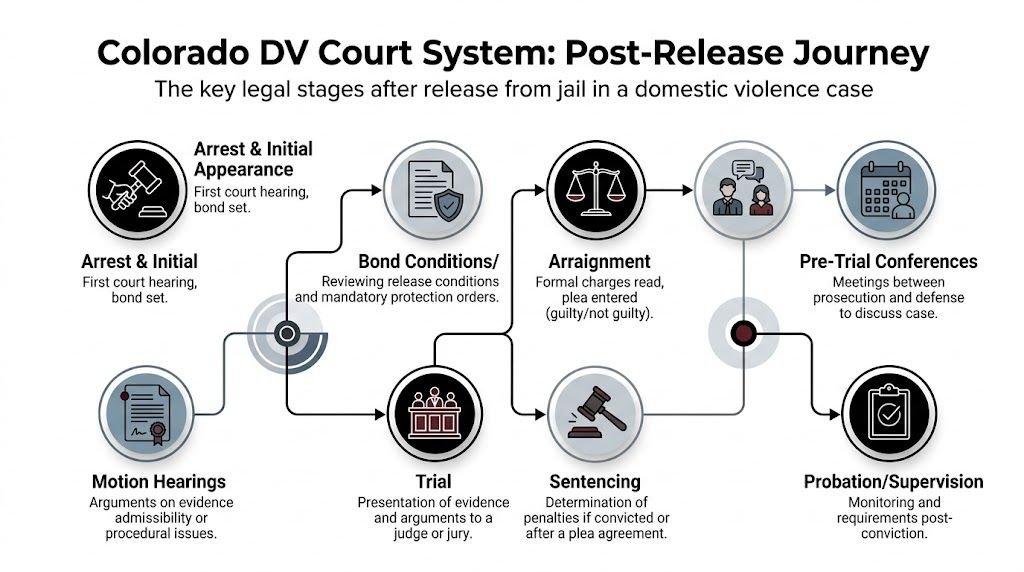
Colorado courts handle a steady volume of these matters. Between fiscal years 2009 and 2014, cases flagged as domestic violence consistently made up 15% of all criminal filings in Colorado, with misdemeanor assault and property offenses among the most common charges, and about a quarter of defendants being female, as shown in the Colorado domestic violence case processing report. That volume is one reason the system feels procedural and fast-moving. Judges and prosecutors see these cases every day.
The usual court path
Most families do better when they stop thinking in terms of one giant case and start thinking in stages.
Initial appearance
The court addresses bond and basic release conditions.
Protection order compliance
The defendant has to live inside the rules set by the court from day one.
Arraignment
Formal charges are addressed and a plea is entered. If you want a practical overview, review what happens at an arraignment hearing.
Pretrial conferences and motions
Lawyers discuss evidence, negotiate, and raise legal issues.
Trial or resolution
The case ends through dismissal, plea, or trial.
The order that causes the most trouble
The Mandatory Protection Order is where good intentions often turn into bad outcomes. A defendant may think, “We live together,” “We share kids,” or “She told me it's okay to call.” The court order controls, not private permission.
Common restrictions can include:
- No direct contact
- No indirect contact through friends or relatives
- No return to a shared home without court permission
- No conduct that looks like intimidation or harassment
- Other case-specific restrictions the judge adds
Even minor contact can create a new arrest risk and also damage the defense. If parenting, housing, or property issues need attention, those problems should be handled through the lawyers and the court.
The safest reading of a protection order is the strict reading. If the order doesn't clearly allow it, don't do it.
How families can actually help after release
Families are useful when they stay practical.
- Track every court date. Missed dates can trigger warrants and bond problems.
- Keep a copy of the bond paperwork and protection order. Don't rely on memory.
- Help with transportation and housing. Many defendants can't return home immediately.
- Push for structure. A released defendant who keeps appointments and follows orders usually avoids making the case worse.
The court process is manageable when the household treats it like a schedule and a compliance problem, not just an emotional crisis.
Common Defenses and Potential Case Outcomes
A domestic violence case isn't decided at booking, and it isn't decided by who was more upset that night. The prosecutor still has to prove the underlying offense and the domestic violence designation. That proof can be stronger in some cases and thin in others.
The defense side usually begins with one question: what can the prosecution prove with admissible evidence? In real cases, that may involve 911 audio, body camera footage, witness statements, injury photos, text messages, medical records, prior statements, or the lack of those things.
Why recantation doesn't end the case
Families often believe the case disappears if the alleged victim says they don't want to press charges. That's one of the most common misunderstandings in domestic violence cases.
According to this Colorado defense discussion of DV case outcomes, prosecutors, not victims, decide whether to dismiss a domestic violence case, and they often treat recantations with suspicion. The same source states that dismissals occur in approximately 20% to 30% of misdemeanor domestic violence cases, especially where the accused is a first-time offender and the evidence is weak.
That doesn't mean recantation never matters. It does matter. It just isn't a magic switch.
Defense themes that often matter
Different cases call for different defense work, but these issues come up often:
False or exaggerated allegations
Emotions run high in breakups, co-parenting disputes, and chaotic household situations.
Self-defense
If the accused was protecting themselves or another person, the facts need to be documented quickly.
Weak physical evidence
Some cases lean heavily on one statement and very little corroboration.
Inconsistent accounts
If the timeline shifts or key details don't line up, credibility becomes a major issue.
Lack of intent
Some underlying charges depend on what the person intended to do, not just what happened during a loud argument.
Release on bond matters because a defendant outside jail can help gather texts, identify witnesses, preserve video, and assist counsel in real time.
What often helps and what often hurts
Helpful moves usually include saving messages, identifying neutral witnesses, following the protection order exactly, and getting counsel involved early.
Bad moves include calling the alleged victim to “straighten it out,” posting about the case online, discussing facts on jail calls, and assuming the truth will somehow reveal itself without organized defense work.
A case can resolve through dismissal, plea negotiations, deferred outcomes where available, or trial. Which path makes sense depends on the evidence, the criminal history, the relationship facts, and whether the defendant can stay disciplined while the case is pending.
The Lasting Impact Collateral Consequences of a DV Conviction
A domestic violence conviction can keep affecting someone's life long after the court date that caused all the panic.

Most families focus on jail first, which makes sense. But once the person is released, the bigger risk often becomes the long tail of consequences that follow a conviction. Housing applications, employment screenings, professional reputation, and parenting disputes can all get harder at the same time.
The problems that don't stay in court
Some consequences hit immediately. Others show up months later.
Firearm restrictions
Domestic violence cases can affect gun possession rights in serious ways.
Custody and parenting issues
Family court judges pay attention to violence allegations and protection orders.
Work and licensing trouble
Employers and licensing boards may react to the record, even when the criminal case feels “minor” to the defendant.
Public record concerns
A domestic violence record can follow someone in ways many first-time defendants don't expect.
One missed hearing can also make everything worse. A missed court date can trigger a warrant, threaten the bond, and undercut every argument that the defendant is taking the case seriously. If that risk is on your mind, read what happens if you miss court.
A short explanation of the broader stakes can help families understand why strict compliance matters:
Why early discipline matters
A lot of damage in these cases comes from panic, not just from the original accusation. People violate orders because they think one text won't matter. They skip court because work was busy. They assume a low-level charge won't affect a background check. Those assumptions cost people.
The better approach is dull and effective. Follow every court order, keep every date, don't freelance communication, and take the case seriously from the beginning. That's how defendants avoid turning one bad night into a much larger legal problem.
Frequently Asked Questions for Families and Defendants
Can a family member arrange release from another state
Yes, remote help is often possible when the bond type allows a surety bond and the paperwork can be completed electronically. Out-of-state relatives should be ready with identification, payment method, and any cosigner information the bond company requests.
Can the defendant contact the alleged victim after release
Not unless the court order clearly allows it. In most DV cases, families should assume contact is prohibited until a judge changes the order.
Is the bond premium refundable if the case is dismissed
No. The premium for a surety bond is the fee for the service of posting the bond. It isn't a deposit held by the court.
Does service cover only Denver
No. Express Bail Bonds serves detention facilities statewide from Denver and handles many releases electronically.
What if the alleged victim wants the case dropped
That request may matter, but it doesn't control the prosecution. The state decides whether to continue the case.
If you need help fast, call or text 720-984-2245 any time. If Express Bail Bonds has helped your family before, you can also leave feedback on their first Google review page or their second Google review page.
If your family is dealing with domestic violence charges in colorado and needs clear release guidance right now, contact Express Bail Bonds. They provide 24/7 statewide Colorado bail bond service, electronic processing for families and cosigners, and practical help when a loved one is stuck on a post-arrest hold and waiting for bond.