
That phone call usually comes at the worst time. Late at night, early in the morning, right in the middle of dinner. A son, daughter, spouse, brother, or friend says they’ve been arrested, and the only question you can think of is, “How do I get them out?”
In that moment, legal words start flying around fast. Bond. Bail. Hearing. Hold. Bailable. Non-bailable. Most families don’t need a lecture. They need calm, clear help and a practical next step.
The meaning of bailable is simpler than it sounds. If a charge is bailable, the law allows a path to release before trial. That doesn’t erase the case, and it doesn’t mean the arrest was minor. It means there is a legal way to seek release while the case moves forward.
Your Guide to the Meaning of Bailable in Colorado
A worried family member usually starts in the same place. They know someone has been booked into jail, but they don’t know where the person is, what the charge means, or whether release is even possible. Panic fills in the blanks.
If that’s where you are right now, take a breath. You do not need to understand the whole criminal justice system tonight. You only need to understand the next decision.

When people search for the meaning of bailable, they’re usually asking a much more urgent question. “Can my loved one come home while this case is pending?” In many Colorado cases, the answer is yes, but there are still steps, paperwork, and court rules involved.
What families usually feel first
The first few hours after an arrest are confusing because everything feels personal and mechanical at the same time. Your loved one may be scared. You may be upset or angry. Meanwhile, the jail is focused on booking, classification, and procedure.
That gap creates a lot of misunderstanding, especially for first-time families.
- You may think bail means innocence. It doesn’t. Bail only deals with release before trial.
- You may think “bailable” means automatic release. It doesn’t always work that way.
- You may think you need all the cash in hand right now. In many situations, families use a surety bond instead of paying the full amount themselves.
The fastest path through this is not guessing. It’s getting the charge, the jail location, and the bond information confirmed.
Once you know those basics, the situation usually starts to feel more manageable. The legal system may be complicated, but the first steps are not.
What a Bailable Offense Really Means for Your Loved One
At 11 p.m., your phone rings. A family member has been arrested, and the first question out of your mouth is usually simple. Can they come home tonight?
If the charge is bailable, the answer may be yes. In plain English, a bailable offense is a charge that allows release before trial if the court’s bond requirements are met. Bail acts as a security promise to the court. The court allows release now, and in return it expects the person to come back for every required hearing.
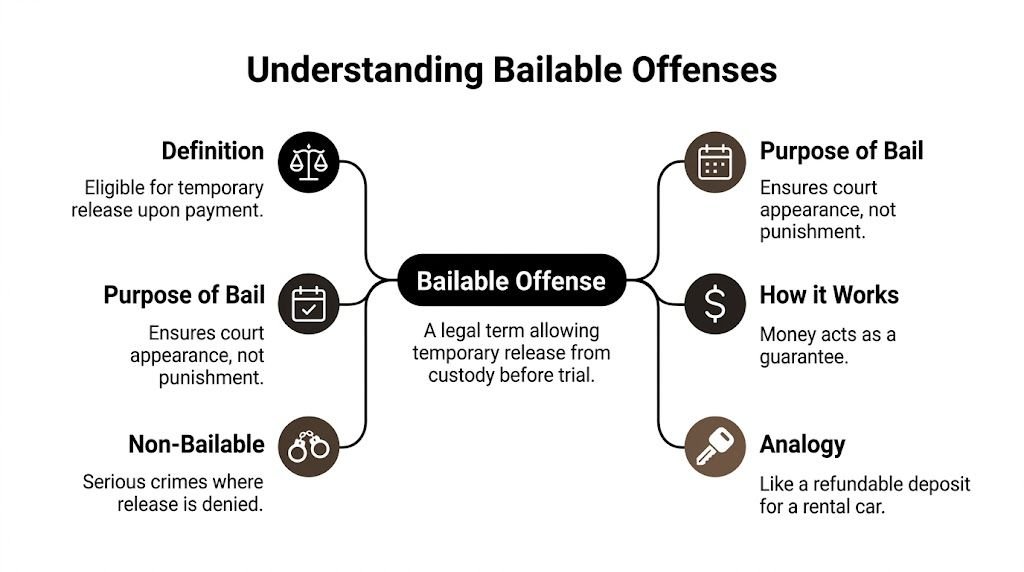
That matters because families often hear the word "bailable" and assume release is automatic. It is not automatic. It means there is a legal path to release, and your job is to move quickly through that path with the right information.
A useful comparison is a rental deposit. The deposit is there to give assurance that the rules will be followed. Bail works in a similar way, except the court is looking for assurance that your loved one will return to court, follow conditions, and stay in contact if required.
Here is the practical version families need:
- Bailable means release is allowed under the law.
- The court may require cash bail, a surety bond, or other release conditions.
- The criminal case keeps going after release.
This process is rooted in the U.S. Eighth Amendment’s protection against excessive bail. In Colorado, our agency’s standard premium is 15%, and we can often secure 10% for bonds over $5,000 in qualifying situations.
The biggest point to remember is emotional as much as legal. "Bailable" does not mean the charge is minor. It does not mean the person has been cleared. It means the system gives your family a way to work on release while the case is pending.
That is why the first call matters so much.
If you learn the case may involve a hold or restriction on release, it helps to understand the difference by reviewing the meaning of a non-bailable warrant in Colorado. That can quickly tell you whether you are dealing with a release problem, a warrant problem, or both.
For a worried family, this is the takeaway. A bailable offense means there is something concrete you can do right now. Get the bond amount, confirm the jail, and start the release process.
Bailable vs Non-Bailable Offenses in Colorado
Your phone rings late at night. A loved one has been arrested, and the first question is simple: “Can they get out?” In Colorado, that answer often starts with whether the case is bailable or non-bailable.
Under C.R.S. § 16-4-101, Colorado generally allows bail in most criminal cases. The biggest exceptions are capital offenses and Class 1 felonies in limited situations where the proof is evident or the presumption is great. For families, the practical meaning is straightforward. Many charges allow a path to release. A smaller group of very serious cases may not.
Common Bailable vs Non-Bailable Offenses in Colorado
| Offense Type | Examples | Typical Bail Status |
|---|---|---|
| Lower-level offenses | Petty theft, simple assault, minor drug-related charges, many misdemeanors | Often bailable |
| Mid-level offenses | Some felony theft cases, some assault cases, DUI-related cases | Often bailable, but amount and conditions vary |
| Most non-capital offenses | A broad range of charges that are not capital crimes or Class 1 felonies | Presumptively bailable in Colorado |
| Most serious offenses | Capital crimes or Class 1 felonies with strong evidence | May be non-bailable |
That table gives you a starting point, not a final answer.
A charge can sound serious and still be bailable. Families hear the word “felony” and often fear release is off the table. In many Colorado cases, it is still possible. The court may allow release, but with a higher bond amount, stricter conditions, or both.
The opposite confusion happens too. A case may look bailable on paper, but the person still does not come home right away. Jail processing takes time. A separate hold, warrant, or probation issue can also stop release even when the underlying charge would usually allow bail.
If you need help sorting out one of those roadblocks, this guide on the meaning of a non-bailable warrant in Colorado explains why a person may stay in custody even after a bond amount appears in the case.
A practical way to tell the difference
Families usually do better with a plain-English test than with courtroom language:
- Bailable offense: The court can release the person before trial if the bond and conditions are met.
- Non-bailable offense: The law or the court blocks release before trial in that case.
- Mixed situation: The charge may be bailable, but another legal issue keeps the person in custody.
A hotel room key works as a useful comparison here. Being told a room is available does not mean you are already inside the room. You still have to check in, show identification, and get the key. Bail works much the same way. A bailable case means release is legally available. The bond still has to be posted, and the jail still has to complete the release process.
From our experience, once a surety bond is posted and there are no extra holds, release can often happen within a few hours. The exact timing depends on the jail, staffing, and whether any other restrictions appear in the booking record.
The offense name is only one part of the answer. The jail record, warrant status, and judge’s release conditions matter just as much.
That is why families should verify the booking status, the bond amount, and any holds before assuming the person can walk out right away. Rumors from friends or social media often leave out the one detail that changes everything.
How Colorado Courts Determine Bail Amounts
Once a family learns a case is bailable, the next question comes fast. “How much is it going to be?” That number matters because it determines what kind of release option is realistic.
Judges don’t pull bail amounts out of thin air. They look at the charge, the person’s background, and the risk of non-appearance or safety concerns. In some jurisdictions, bond schedules may guide the starting point, but the court still has discretion.
What the judge is looking at
Most families expect bail to be based only on the charge. In reality, courts often look at a wider picture.
- The alleged offense matters because courts treat some accusations as higher risk than others.
- Prior record can affect how much reassurance the judge needs.
- Ties to the community matter. A stable address, family support, and employment can help show the person is likely to return.
- Flight risk and safety concerns often drive the decision more than emotion does.
That last point is the one families often miss. Bail is not designed to punish. It’s designed to manage risk while a case is pending.
Why one case can look different from another
Two people can face similar charges and still receive different bond terms. One may have strong community ties and no prior failures to appear. Another may have a record that makes the judge more cautious.
If you want a better sense of what happens in court before bail is set, this explanation of what happens at a bail hearing gives a useful overview.
Bring the court facts, not just feelings. Judges respond to details that reduce uncertainty.
That’s why it helps to gather accurate information quickly instead of guessing what the amount “should” be.
The Critical First Steps to Take After an Arrest
This is the part families can act on right away. When emotions are high, a short checklist works better than broad legal advice.
Step 1
Start by collecting identifying details. Get the person’s full legal name, date of birth, and where the arrest happened if you know it. Small mistakes here can slow everything down.
If the caller was rushed or upset, write down exactly what they said instead of relying on memory. Even a partial charge description can help when you call the jail.
Step 2
Contact the detention facility and confirm the booking. Ask whether the person has been fully processed, what the listed charge is, and whether a bond amount has already been set.
If you’re new to this process, this guide on what happens after you get arrested can help you understand why booking and release don’t happen instantly.
Step 3
Find out what type of bond applies. Some families assume every case can be handled the same way. That’s not true.
You may be dealing with:
- A cash bond that requires payment directly to the court or jail
- A surety bond that involves a licensed bail bond company
- A hold or restriction that delays release even when the charge sounds bailable
Step 4
Decide who will handle the paperwork and who will cosign, if needed. Don’t make this a group project with five different relatives calling five different places. Pick one calm point person.
That person should keep a short written list of names, phone numbers, court dates, and payment discussions. Good notes prevent expensive confusion.
Step 5
Use local help when location matters. If the case is in that area, the Jefferson County bail bond page can help with location-specific guidance. For cases farther south, the Centennial bail bond page is another local resource.
The first win is not solving the whole case. The first win is getting accurate information and choosing the right release path.
Once you know the bond type and amount, the next decision becomes much easier.
Why a Bail Bonds Agent Is Your Fastest Path to Release
The phone rings late at night. Your loved one is in jail, the charge is bailable, and then you hear the bond amount. For many Colorado families, that is the moment panic sets in. The problem is not caring enough to help. The problem is coming up with the full cash amount fast enough to get them home.

A surety bond gives families another path. Instead of paying the entire bond to the court, a licensed bail bonds agent posts the bond on the defendant’s behalf. At Express Bail Bonds, our standard premium is 15%, and we can often secure a 10% rate for bonds over $5,000 in qualifying cases with a cosigner. That can make release possible hours sooner because the family is working with a smaller, more realistic amount.
Speed matters, but so does clarity. Families under stress often lose time because they are trying to decode forms, jail instructions, and payment rules all at once. An experienced agent handles this every day and can explain the process in plain English.
Why families choose this route
A good bail agent does more than provide the bond amount.
They help with:
- Faster action once the bond is set, because the paperwork and approval steps are familiar
- Clear explanations of the agreement, so the cosigner understands the responsibility before signing
- Remote help for relatives outside Colorado, which is often the difference between waiting and getting started right away
If you want a clearer picture of the role, this guide on what a bail bond agent does explains it in simple terms.
Many families also want to confirm they are dealing with a real Colorado company before sharing information or signing anything. You can review the main Express Bail Bonds website to learn how the process works and what help is available.
This short video gives a quick visual overview before you call.
The practical advantage
A bail bonds agent works a lot like a guide at the busiest part of the process. The court sets the rules. The jail controls release timing. The family is trying to keep up while worried, tired, and pressed for time. A good agent helps keep those pieces organized so the release process keeps moving.
That practical help is often what families remember most. Fewer wrong turns. Fewer repeated phone calls. Fewer surprises at the jail lobby.
When your loved one is eligible for release, the fastest path is usually the one with the fewest delays and the clearest next step.
Common Questions About Bailable Offenses in Colorado
The hardest part of an arrest is often the waiting. A family hears that a case is "bailable" and assumes release will happen right away, then hours pass and nothing changes. These are the questions that usually come up in that moment, when you need plain answers more than legal jargon.
Can bail be denied even if the offense is bailable
Sometimes, yes.
In Colorado, many charges allow for bail, but that does not mean release is automatic in every case. A judge still looks at the person, not just the charge. That includes things like prior failures to appear, current holds, threats to a specific person, or facts that suggest the person may not return to court. Public safety is a key factor in that decision.
For families, the practical takeaway is simple. "Bailable" means the law allows release under the right conditions. It does not promise that the court will approve release in every situation.
What happens to the premium paid on a surety bond
The premium is the fee for the bond service. It is separate from the bond amount the court sets.
A good way to understand it is to compare it to using a service instead of paying the full amount yourself. If the court sets a cash bond, paying that amount directly to the court is one option in some cases. A surety bond works differently. You pay the premium to the bond company so the bond can be posted on the defendant's behalf.
That fee is generally not returned just because the case ends. Families often expect it to work like a court deposit, and that is where confusion starts.
What if I live in another state and need to help
You can usually still help quickly.
Out-of-state parents, spouses, and siblings are often the ones making calls, gathering information, and signing paperwork. In many cases, documents can be sent and reviewed electronically, which saves time when every hour feels long.
If you are helping from outside Colorado, focus on three things first. Confirm where your loved one is being held, find out whether a bond has been set, and ask what paperwork or identification will be needed from you.
Does bailable mean the person will get out right away
No. It means release may be possible once the remaining steps are finished.
Jail release works a lot like an airport departure. Having a ticket does not put you on the plane that second. Booking must be complete. Any other holds must be cleared. The bond has to be posted correctly. The jail still has to process the release.
That delay is frustrating, but it is common. A person can be eligible for release and still remain in custody while the system catches up.
Where can I learn about the different kinds of bail
If the terms are starting to blur together, this guide to different types of bail in Colorado can help you sort out what applies to your case.
Some families also want reassurance from real experiences during a stressful release process. These Centennial reviews can give you a sense of what communication and support may look like while you are trying to get someone home.
If you feel overwhelmed, narrow the situation to three questions. Where are they, what is the bond, and what is blocking release right now?
That keeps your next step clear. And in the first hours after an arrest, clarity matters more than anything.