
You pull up the jail roster, type in your loved one’s name, and see two words that make your stomach drop: NO BAIL.
Most families read that and assume the worst. Sometimes they’re right. Sometimes they’re not.
That’s the hard part about the no bail meaning in Colorado. It can point to two very different situations. In one, the person may not need to pay money to get out. In the other, the court has decided the person stays in custody for now. Those are opposite outcomes, but online jail systems and rushed phone calls often make them sound the same.
If you’re dealing with this in real time, slow it down. Read the roster carefully. Confirm the charge and court status. If you’re still trying to locate someone first, this guide on finding an arrested person in Colorado can help: https://expressbailbonds.com/how-to-find-someone-arrested/
There’s another practical concern many families face right away. Even before the release question is sorted out, online arrest photos can spread fast. If that’s become part of the stress, this professional guide on how to get mugshots off Google Images is worth keeping handy.
The Moment of Panic What 'No Bail' Means on a Jail Roster
A jail roster doesn’t explain itself. It gives you labels, abbreviations, and booking lines. Families are left to decode them while they’re scared and sleep deprived.
That’s why no bail meaning causes so much confusion. In Colorado, people often use the phrase loosely. Some use it to mean release without paying money. Others use it to mean held without bond.
Why the phrase confuses people
A lot of online information blends “no bail” with “no cash bail” reforms, even though they aren’t the same thing. In some legal contexts, “no bail” means the court has denied release because of safety or flight concerns, while “no cash bail” refers to release without requiring money for lower-risk cases. That confusion leaves families unsure whether they should be calling a lawyer, a bondsman, or waiting for court.
When you see “NO BAIL” online, don’t assume you know which version it is. The roster may be shorthand, not the final legal answer.
A roster entry also may not tell you whether the person is waiting for first advisement, has a hold from another case, or has already had a judge review release conditions. The wording can lag behind the courtroom reality.
The first question to ask
Ask this exact question when you call the jail or clerk: “Does ‘no bail’ mean release on recognizance, or does it mean bail was denied?”
That question cuts through a lot of confusion.
If the answer is that the person is being released without posting money, that’s one path. If the answer is that a judge denied bond, that’s a different path and usually a more urgent legal problem.
For now, don’t read too much into a roster line by itself. The roster is a clue. It isn’t the whole story.
The Two Paths of No Bail Release vs Detention
The cleanest way to understand no bail meaning is to think of it as two doors.
One door opens outward. The person gets released without posting money.
The other door stays closed. The judge has denied bail, and the person remains in custody unless the court changes that decision.
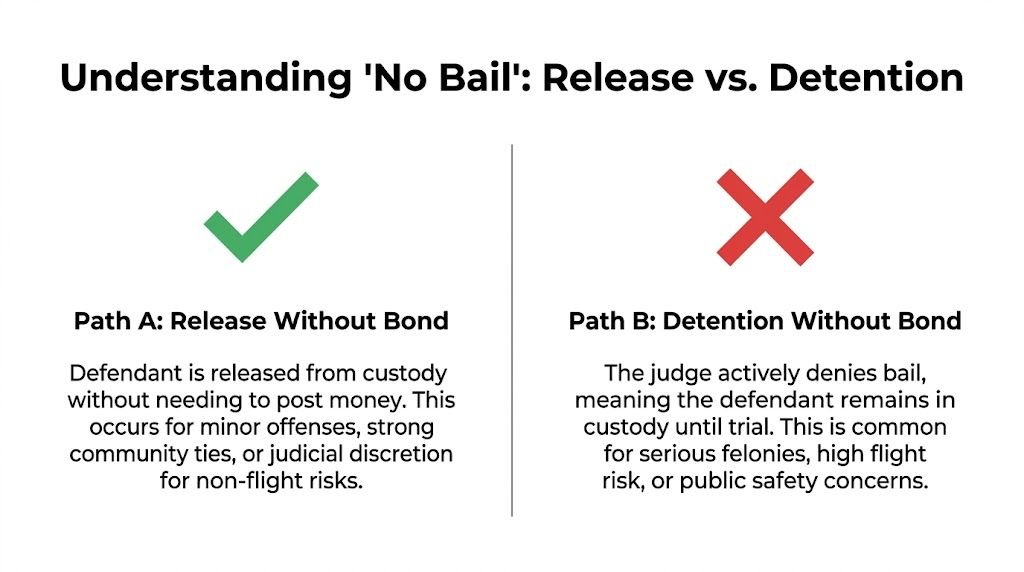
Path A means released without monetary bail
This is the better reading of the phrase.
It usually means the court has allowed release without requiring the person to post cash or a surety bond first. You may hear terms like personal recognizance, PR bond, or release on conditions. The person still has to follow court rules. They just don’t have to put up money to walk out.
That approach matters because many people sit in jail before trial for financial reasons rather than because they’ve been convicted. In the United States, about 731,000 people are in local jails each day, and nearly two-thirds are pretrial detainees, which costs taxpayers about $38 million daily, according to Civil Rights Corps.
Path B means detained because bail was denied
This is the more serious reading.
Here, no bail doesn’t mean “free.” It means the judge has decided there won’t be a bond amount to post at this stage. The person stays in custody pending further court action.
That usually happens when the court believes release would create a serious public safety issue, a major flight concern, or the charge falls into a category where detention gets stricter review.
If you want a plain-English comparison of release terms and bond mechanics, this overview of how bail and bond work gives useful background, even though procedures differ by state.
Two meanings of 'No Bail' at a glance
| Aspect | Path A: Released (No Monetary Bail) | Path B: Detained (Bail Denied) |
|---|---|---|
| What it means | Release is allowed without paying money up front | Release is not allowed at that point |
| Typical result | The person leaves custody after processing | The person stays in jail |
| Money required | None for release | No bond amount exists to post |
| Common court idea | Low enough risk for non-monetary release | Safety or flight concerns control |
| Family’s next move | Confirm conditions and release timing | Contact defense counsel and confirm next hearing |
| Can a bail bond agency help right then | No, because no surety bond is needed | No, because there is no bond to post |
The practical rule
Practical rule: If there is no dollar amount attached, ask whether that means “no payment required” or “no release allowed.”
That single question saves families hours of confusion.
If you want to understand the broader pretrial side of the system before making calls, this explainer on pretrial release is useful: https://expressbailbonds.com/what-is-pretrial-release/
How to Read Colorado Jail Rosters and Confirm Status
Colorado jail rosters can help, but they don’t always speak plain English. A booking page may show a charge, a court date, and a bond field without telling you whether a judge has acted yet.
That’s why families should treat the roster as a starting point, not the final answer.
What the roster may be telling you
Different Colorado counties format records differently. One county may display a bond amount clearly. Another may use a status field that says no bond, bond denied, PR, ROR, or just leave the bond line blank until court.
Common possibilities include:
- Bond not set yet. The person has been booked, but the court hasn’t assigned release conditions.
- No bond allowed at booking stage. There may be a hold, warrant issue, or pending advisement.
- Personal recognizance release. No payment is needed, but paperwork or processing still has to happen.
- Bond denied. The court has decided the person remains in custody.
Why the charge category matters
In many systems, the offense category shapes what happens next. Some frameworks treat certain serious offenses much differently from low-level cases. As explained in this overview of no-bail detention categories, capital crimes and violent felonies are typically the kinds of charges associated with absolute no-bail provisions.
Colorado families don’t need to become lawyers overnight, but they do need to know this: the charge level and the hearing status matter more than the words on the roster by themselves.
What to verify before you panic
When you call the detention facility, clerk, or court, ask for these basics:
- Current custody status. Is the person still in the jail, in transport, or awaiting court?
- Bond type. Was a PR bond granted, a surety bond set, or bond denied?
- Next hearing. Is there an advisement, bond review, or first appearance scheduled?
- Other holds. Is another county, warrant, or probation matter blocking release?
A roster can be updated after booking but before court, or after court but before release processing. That lag creates a lot of false alarms.
If you need a practical overview of booking and release timing across Colorado facilities, this page is a helpful reference: https://expressbailbonds.com/24-hour-booking-and-release/
Families near Golden may also need county-specific details because local procedure affects how fast status updates appear. Jefferson County cases often move on their own schedule, and Arapahoe-area families run into similar confusion around Centennial facilities. That’s why local jail and court pages matter more than generic advice.
Your Action Plan When Bail Is Denied in Colorado
If you’ve confirmed that no bail means the court denied release, the next steps are different. This is no longer about paying money. It’s about legal strategy.
Start with calm, concrete action.
Step one is confirm why the judge denied release
You need the actual reason, not a guess from the roster.
Under no-bail policies, judges use a risk-based evaluation rather than looking at the person’s ability to pay. The focus is on danger to the community and flight risk, and judges are expected to articulate specific safety concerns rather than use money as a stand-in for risk, as described in this explanation of risk assessment in no-cash-bail systems.
That means the family should find out:
- Was the concern public safety
- Was the concern failure to appear
- Did the judge rely on the current charge, prior history, or both
- Was there another hold involved
Get the minute order, hearing information, or attorney notes if possible.
Step two is get defense counsel involved fast
This is the point where a bail bond company can’t solve the immediate problem. If bail has been denied, there is nothing to post.
A defense attorney can review the court’s reasoning, the charging documents, criminal history issues, and whether there’s a basis to ask for reconsideration. Families often lose time by calling ten different places for a bond quote when the primary need is legal advocacy.
If bail is denied, the key question isn’t “How much is it?” It’s “What has to change before the court will consider release?”
If you’re trying to understand the hearing process itself, this page gives a useful overview of what happens at a bail hearing: https://expressbailbonds.com/what-happens-at-a-bail-hearing/
Step three is prepare for a bond review or reconsideration request
A denial isn’t always the final word. Courts can revisit release conditions in some cases.
The attorney may argue things like:
- Stronger community ties. Stable residence, family support, and local roots can matter.
- Work and caregiving responsibilities. Judges often want to know the person has daily anchors.
- Weaknesses in the prosecution’s detention argument. Sometimes the original picture is incomplete.
- Alternative conditions. Monitoring, reporting, or other restrictions may address concerns short of detention.
Those arguments need records, names, and specifics. Families can help by gathering documents, employment contacts, treatment information if relevant, and reliable people who can appear or write letters.
Here’s a short visual explanation of post-arrest procedure that many families find helpful before speaking with counsel:
Step four is watch timing and communication
Courts move on their own schedule, and detention decisions can turn on small details.
Keep one written log with:
- Court dates and times
- Case number
- Current charges
- Who you spoke with
- What the judge ordered
That prevents crossed wires between family members.
What not to do
Don’t assume an online update is the same as a signed court order.
Don’t promise the defendant that money alone will fix it.
Don’t miss the first meaningful hearing because everyone was waiting for the roster to change.
When a No Bail Status Can Change to a Set Bond
A no bail status can feel final, but it often isn’t. Courts can change release conditions when the legal picture changes.
That’s important for families because hope should be realistic, not vague. The question is not whether every no-bail ruling will change. The question is whether there is a legal path that could change it.
What can shift the court’s decision
Sometimes the judge gets more complete information later than they had at the first appearance.
That can include stronger evidence of community ties, corrected criminal history information, a better explanation of the facts, or a defense request for conditions that address the court’s concerns without requiring continued detention.
In other cases, the prosecution’s filing changes the situation. Charges may be amended. A hold from another case may be cleared. A warrant issue may be resolved. Any of those developments can move the case from detained without bond to bond set.
What families should be ready for
If the court does set a bond later, the change can happen quickly. Families who spent days focused only on the denial sometimes get caught flat-footed when the judge suddenly sets a surety amount.
Have these basics ready in advance:
- A current phone number for all decision-makers
- Identification and contact details for any cosigner
- Basic employment and address information
- A plan for transportation after release
- A clear understanding of court conditions
Courts can move from “not today” to “bond is set” with very little warning. Preparation matters.
The mindset that helps most
Don’t treat the first ruling as meaningless. It matters.
Also don’t treat it as untouchable. Courts revisit release issues when lawyers present better facts, legal arguments, or changed circumstances. Families do best when they stop guessing and start preparing for both possibilities.
If the judge denies bail, the immediate lane is legal work. If the judge later sets a bond, the lane changes fast to logistics and release.
How Express Bail Bonds Delivers When Bail Is Set
Once a judge sets a surety bond, the problem changes. It’s no longer “Can this person be released at all?” It becomes “How do we get this posted correctly and fast?”
That’s where practical service matters.

A common gap in public explanations is what families should do after the court shifts from denial to an actual bond amount. This R Street discussion notes that many explanations stop at denial, even though agencies can handle 24/7 remote applications for statewide facilities, helping families avoid unnecessary jail visits once bail is set, as described in this policy study on post-ruling guidance and remote processing.
What that looks like in the real world
For Colorado families, speed usually depends on paperwork, signatures, jail procedure, and whether everyone can act quickly from different locations.
Express Bail Bonds serves statewide and offers electronic processing through its main website. That matters if the cosigner lives out of town or the defendant is booked far from where the family lives.
The company also provides county-specific help for places families search most often, including Jefferson County and Golden and Centennial and the surrounding Arapahoe area.
What families usually need next
Once bond is set, families typically need answers to a few immediate questions:
- How is payment handled
- What documents need signatures
- Can an out-of-state cosigner complete everything remotely
- How long does the jail take after bond is posted
For payment expectations and mechanics, this guide on how to pay a bail bondsman helps answer the basic money questions before you commit.
If you want to check public feedback before making the call, these review profiles are also worth looking at: Google reviews for Express Bail Bonds and another customer review profile.
Take Your First Step Toward Clarity Today
Seeing NO BAIL next to someone you care about is jarring. But that phrase doesn’t always mean one thing, and the right next step depends on which version you’re dealing with.
If it means release without money, confirm the conditions and timing. If it means bail was denied, focus on counsel and the next hearing. If the court later sets a surety bond, move quickly and get the paperwork started without delay.
If you need straight answers right now, contact Express Bail Bonds. They serve Colorado statewide, help families understand whether a bond is set or denied, and can move fast when a surety bond becomes available.