
The phone usually comes late.
A spouse wakes up to an unknown number. A parent hears, “I got arrested for DUI.” A brother gets a short call from a county jail and has no idea what to do next. In that moment, everything feels urgent and blurry at the same time.
If that is where you are right now, take a breath. A DUI arrest is upsetting, but it is also common enough that there is a clear process. In 2024, law enforcement made approximately 804,926 DUI arrests in the U.S., with Colorado alone recording 15,827 according to SafeHome’s DUI statistics. Families across Colorado get pulled into this situation every day.
What matters first is understanding what bail for dui means, how Colorado courts may approach it, and what you can do from home, from work, or even from another state. You do not need to know the legal system to take the next step. You just need a calm roadmap.
The Late-Night Call A Guide Through Your First Steps
A typical call sounds like this: your loved one says they were stopped, arrested, booked, and now they are waiting. They may not know the exact charge wording. They may not know the bond amount yet. They may only know the name of the jail.
That uncertainty is what rattles families most. People often think they need to solve everything in the first ten minutes. They do not. The first goal is simpler. Find out where the person is, whether bail has been set, and what kind of release may be available.
A DUI arrest can trigger panic because people immediately jump ahead to jobs, cars, court dates, insurance, and criminal consequences. Those issues matter, but the first few hours are about custody and release. If you focus on that piece first, the rest becomes easier to manage.
Tip: Write down details as you get them. Full name, date of birth, arresting county, and the jail location will save time and prevent mistakes.
If you are still trying to understand the immediate chain of events after booking, this overview of what happens after you get arrested can help you place each step in order.
Families also get confused because “DUI” can cover very different fact patterns. One person may be facing a first-time misdemeanor allegation with no crash. Another may be dealing with a repeat case, an injury allegation, or a refusal issue. Those differences can affect whether bail is low, high, waived, or subject to added conditions.
The good news is that bail for dui is not random. Courts use patterns, schedules, and risk factors. Once you know what they are looking at, the process starts to feel less mysterious and more manageable.
What Exactly Is Bail for a DUI
Bail for a DUI is the court’s way of allowing someone to leave custody while the case is still pending. The money attached to bail is meant to secure the person’s return to court and encourage compliance with any release rules the judge sets.
That distinction matters for families. Paying bail does not resolve the case, erase the arrest, or decide guilt. It changes where the person waits. Instead of sitting in jail, they wait for court at home if release is approved.
A simple way to understand it is to picture a hold placed on the court’s trust. The judge is asking, “Can this person be released and still be counted on to come back?” Bail is one of the tools the court uses to answer that question.
The two main ways bail gets posted
In Colorado DUI cases, families usually hear about two release payment options first.
A cash bond means paying the full bail amount directly to the court or jail. If the person follows the court’s rules and appears as required, that money may be returned later, subject to court procedures and any applicable fees.
A surety bond works differently. A licensed bail bond company posts the full bond amount on the person’s behalf, and the family pays the bond company a premium for that service. For many households, that is the more realistic path because it avoids coming up with the full amount all at once.
If you are also trying to understand how DUI allegations themselves can vary, this overview of DUI charges gives useful background on how these cases are commonly categorized.
Why this matters so much after a Colorado DUI arrest
The first hours after booking are often a blur. A spouse may be trying to arrange childcare. A parent may be worried about a missed work shift. Someone may also be trying to locate the car, medications, or a phone that was taken during booking.
That is why the form of bail matters as much as the amount.
If a family can post a cash bond quickly, that may be the simplest route. If pulling together the full amount would empty savings or delay release until the next day, a surety bond often solves the immediate problem faster. Many Colorado families now handle much of that process remotely by phone, text, and secure online paperwork, which can be a relief when nobody is in a position to drive across town in the middle of the night.
A practical example
Suppose bail is set at a level the family cannot comfortably pay in cash before morning. Waiting to gather the full amount can keep the person in custody longer, and those extra hours can affect work, school pickups, medical needs, and the ability to speak with counsel in a calm setting.
A surety bond changes the question. Instead of asking, “How do we raise the whole bond tonight,” the family asks, “Can we qualify for the bond service and complete the paperwork quickly?” That is often a much more manageable problem.
For a broader explanation of release options, including cash and surety bonds, this guide to different types of bail breaks down how each one works.
Key takeaway: Bail for dui is about release while the case is pending. For families, the practical question is usually which option gets their loved one home safely, quickly, and with the least financial strain.
How Colorado Courts Determine DUI Bail Amounts
The number attached to a DUI bond can feel arbitrary when a family first hears it. It usually is not. Courts look at the charge itself, the surrounding facts, and the person’s history before settling on a release amount.
Early in the process, one of the biggest mistakes families make is comparing one DUI arrest to another and assuming the bail should be similar. Two people can be arrested for “DUI,” but one may be facing added risk factors that change the bond dramatically.

The starting point and the add-ons
Courts often begin with a baseline approach for a standard DUI allegation, then increase bail when certain facts make the case look more serious.
A useful example comes from the enhancement model described by Justice Bail Bonds. Colorado courts often use a system where a baseline DUI bail may be increased by $10,000 if the defendant refused a chemical test or had a BAC over 0.15%. That is one reason two cases that sound similar in conversation can produce very different bond amounts.
If more than one aggravating factor appears, the increase can be even steeper. In practice, families often learn that the arrest report details matter more than the shorthand label of “just a DUI.”
Factors judges commonly care about
A judge or magistrate may focus on several questions at once:
- Prior history: A repeat DUI often receives a tougher response than a first allegation.
- Testing issues: Refusal or a very high BAC can push the amount upward.
- Crash allegations: A collision, especially one involving injury, changes how the case is viewed.
- Failure-to-appear history: If the person has missed court before, the court may see greater risk.
- Community ties: Steady employment, family support, and a stable address can help show reliability.
That last point often surprises families. Bail is not based only on the charge. It is also tied to whether the court believes the person will come back and comply.
Misdemeanor and felony cases do not move the same way
Many DUI arrests are handled as misdemeanor matters, but not all are.
If the case involves more serious allegations, prior convictions, injury, or death, the court may treat the matter at a much higher level. That does not mean release is impossible. It means the judge may use a different lens and a much larger bond.
For readers who want a better sense of what occurs when the court first addresses release, this guide to what happens at a bail hearing is helpful.
Practical note: If a family member says, “But this is their first DUI,” do not assume the bond will stay low. A first DUI with aggravating facts can be treated very differently from a first DUI with none.
Why families get confused
People hear “first offense” and think that ends the inquiry. It does not.
The court may still look at the BAC level, whether a test was refused, whether there was a crash, whether anyone was hurt, whether the person has a stable residence, and whether there are any warrants or missed court dates in the background. When you know that, the bond amount starts to make more sense, even when it is not the number you hoped for.
The Step-by-Step Process to Post a DUI Bail Bond
Once bail has been set and a surety bond is the chosen path, families need a clean sequence of steps. The process then becomes less emotional and more practical.
The process is usually faster when you gather information before making the first call or sending the first text.
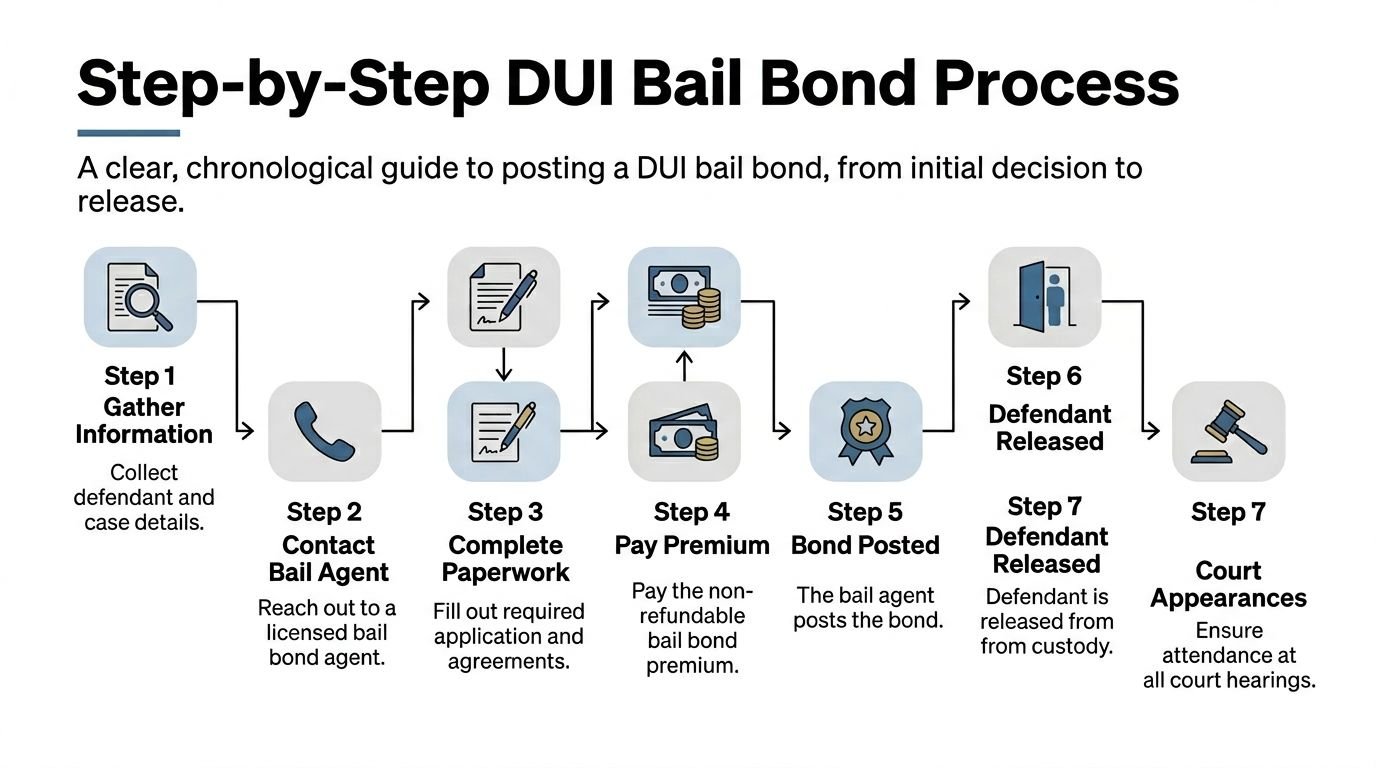
Step 1 Gather the key details
Start with what you know. Even partial information can help.
Try to collect:
- Full legal name: Nicknames can slow the search.
- Date of birth: This helps confirm identity.
- Where the person is being held: County and facility matter.
- Booking number if available: Helpful, but not required in every case.
- Possible charge information: Even rough wording can help narrow things down.
If the arrested person sounded confused or upset, that is normal. Many families only have a name and a jail at first. A licensed agent can often help from there.
Step 2 Make contact and ask direct questions
When you speak with a bail agent, keep your questions simple.
Ask whether bail has already been set, whether the bond is surety-eligible, what paperwork is needed, and whether a cosigner is required. If you are out of state, ask whether the whole process can be handled electronically.
That last question matters more than many people realize. Remote processing can save hours, especially if you are trying to help from another city or while managing work and children at home.
Step 3 Complete the paperwork
The paperwork usually includes an application, indemnitor or cosigner agreement, and release-related documents.
A lot of families worry this means driving to a detention center and sitting in a waiting area with a stack of forms. That is not always necessary now. Modern bail bond services often use electronic documents and remote signatures so the process can move without an in-person visit.
This is especially helpful when:
- A spouse is home with children
- A parent lives in another state
- A friend is helping late at night
- A family member cannot leave work quickly
For a plain-language overview of the mechanics, this guide on how to post bail for someone breaks down the sequence clearly.
Step 4 Understand the cosigner’s role
A cosigner is not just the person making a payment. The cosigner is taking responsibility connected to the bond agreement.
That means the cosigner should understand the defendant’s duties after release, including appearing in court and following all conditions. Families sometimes rush through this part because they are focused on getting someone home. That is understandable, but it is better to be clear up front.
A cosigner should ask:
- Can this person be trusted to attend every court date?
- Will they stay in touch after release?
- Are there any known issues that make compliance harder?
If the answer to those questions is uncertain, slow down and get clarity first.
Step 5 Pay the premium
With a surety bond, the premium is the fee paid for the bond service. It is not the full bail amount.
The exact cost depends on the bond amount and the applicable premium rate. This fee is generally non-refundable, because it pays for the service and risk involved in posting the bond.
Step 6 The agent posts the bond
Once the paperwork is completed and the premium is handled, the bail agent posts the bond at the facility.
At that point, the jail still controls the release timeline. Some facilities move quickly. Others take longer because of internal processing, release queues, or shift changes. Families often think something has gone wrong when there is a delay after bond posting. Often, it is just jail procedure.
Tip: “Bond posted” does not always mean “walking out immediately.” Ask for a realistic release expectation, then prepare for some waiting.
Step 7 Bring the person home and organize the next day
The emotional trap is thinking the hard part is over the moment release happens. In reality, the next few hours matter a lot.
The person released from custody may be exhausted, embarrassed, confused, or still trying to piece together instructions. Keep things simple. Get them home safely. Gather the paperwork. Put every court date and reporting obligation in one place.
For families in different parts of the metro area, local resources can also help with logistics. If the case is tied to that part of the Front Range, the Jefferson County Golden bail bonds page and the Centennial bail bonds page can help you identify local detention and court information more quickly.
Calculating the Cost of a DUI Bail Bond with Examples
For many families, the hardest part of the call is not hearing that a loved one was arrested. It is hearing a dollar amount and not knowing what it means.
The first number you hear is usually the bail amount set by the court or jail. The second number, if you use a bail bond company, is the premium, which is the fee paid to the bail agent for posting the bond. Those two numbers are related, but they are not the same. That distinction is what helps many Colorado families breathe again and make a plan.
Why the bail amount and your out-of-pocket cost are different
A cash bond works like paying the full sticker price up front. If bail is set at $5,000, the family would need to come up with the full $5,000 to post it directly with the court or jail.
A surety bond works differently. Instead of paying the full bail amount, the family pays a percentage of that amount to the bail bond company, and the company posts the bond. In Colorado, that premium is typically a percentage of the total bail amount, and in some situations there may be lower-rate options on larger bonds with an approved cosigner. Approval depends on the details of the case and the financial strength of the signer.
That is why a family may hear, “Bail is $10,000,” but the immediate cost to get someone released through a bail bond could be much lower than $10,000.
Sample DUI bail bond cost calculations
These examples show the math in plain terms:
| Total Bail Amount | Applicable Premium Rate | Your Cost (Non-Refundable Fee) |
|---|---|---|
| $5,000 | 15% | $750 |
| $10,000 | 15% | $1,500 |
| $10,000 | 10% | $1,000 |
| $20,000 | 15% | $3,000 |
| $20,000 | 10% | $2,000 |
| $25,000 | 10% | $2,500 |
Here is the simple formula: bail amount × premium rate = bond cost.
If your son, spouse, or friend has a $5,000 DUI bond and the premium is 15%, the cost to post the bond is $750. If bail is $20,000 and a 10% rate is approved, the cost is $2,000. Families often find this easier to follow once they stop treating the bail amount and the bond fee as the same bill.
What affects the final price
The bond amount is the biggest factor, but it is not the only one.
The premium rate can vary based on the size of the bond, whether there is a qualified cosigner, and how much risk the bond company is taking on. A person with strong local ties, clear contact information, and a dependable cosigner often presents a different risk picture than someone with prior failures to appear or unstable housing.
Collateral may also come up in some cases. That does not always mean a family must hand over cash. It can mean the company needs added security before posting a larger bond.
What the premium pays for
Families ask this every day, and it is a fair question.
With a surety bond, the premium is generally non-refundable. You are paying for the bond company’s service, the financial guarantee it provides to the court, and the risk it accepts by posting the bond. A cash bond is different. If the case is handled properly and court requirements are met, the court may return that money at the end of the case.
That choice often comes down to liquidity. Some families can pay the full bond and wait for the case to end. Others would rather keep savings available for towing fees, attorney costs, treatment, ignition interlock expenses, or missed work after a Colorado DUI arrest.
If you want a clearer picture of how bond sizes and pricing relate, this guide to Colorado DUI bail amount ranges and bond costs can help.
Before choosing a provider, some families also look at client experience and responsiveness. These review pages can help with that: Google reviews page one and Google reviews page two.
Key takeaway: In bail for dui cases, the number set by the court is not usually the same as the amount a family pays to a bail bond company. Knowing that difference helps you judge what is possible, ask better questions, and make a calmer decision in the middle of a stressful night.
Are There Alternatives to Using a Bail Bond
A trustworthy answer is yes. A bail bond is common, but it is not the only possible path.
Families appreciate straight advice here because they do not want to feel pushed into paying for something they may not need. In some DUI cases, the better question is not “Which bond company should I call?” but “Does this case require a bond at all?”
Release on recognizance
Release on recognizance, often shortened to OR, means the court releases the person based on a promise to appear rather than requiring a monetary bond.
For first-time DUI offenders with no aggravating factors, OR is a common outcome, according to Chicago DUI Lawyers. Judges are more likely to grant OR or waive bail when the defendant has stable employment, a clean record, and strong community ties.
That does not guarantee OR in Colorado, but it does highlight an important principle. A first-time case with no crash, no injury, and no major aggravating facts may be treated far differently from a more complicated arrest.
Cash bond
A cash bond is the simplest option on paper. You pay the full amount directly.
The tradeoff is obvious. The money can be tied up while the case moves through court. For some families, that is acceptable. For others, it creates too much financial strain.
Citation and release or other non-bond outcomes
In some low-level situations, an officer may issue a citation and release the person without a full custodial process. That is not the standard outcome people think of in a DUI arrest, but it is one reason not every case follows the exact same pattern.
There can also be situations where a defense attorney seeks a reduction or waiver after the initial setting. If your loved one may be a good OR candidate, that issue is worth raising quickly.
The practical way to think about it
If the court is likely to release the person without money, a bond may be unnecessary.
If the court has already set a bond and time matters, a surety bond may be the fastest realistic route. The right answer depends on the person’s history, the facts of the arrest, and what the court has already ordered.
After Release Your Responsibilities and Next Steps
Getting home is a relief. It is not the end of the obligation.
The period after release is where families can protect the bond or put it at risk. Many people think the only rule is “show up to court.” That is important, but it is not always the only condition attached to release.

Common conditions after a DUI release
Beyond appearing in court, DUI bond conditions can include mandatory reporting to a supervision officer, maintaining employment, and avoiding further legal trouble, according to Simms Showers. Violating those conditions can lead to bond revocation and a return to jail, even if the defendant has not missed a court date.
That last part catches people off guard. They think compliance starts and ends with the hearing schedule. It does not.
A practical checklist for the first day home
Use a written checklist. Do not rely on memory.
- Save every document: Booking papers, release paperwork, and court notices all matter.
- Confirm the next date: If there is any uncertainty, verify it quickly.
- Follow every condition precisely: Do not assume a condition is optional because it seems minor.
- Stay reachable: Missed calls from the court, attorney, or bond office create avoidable problems.
- Avoid new trouble: Even a small new issue can trigger review of the bond.
The cosigner’s role after release
Cosigners often believe their role ended when the paperwork was signed.
In reality, the cosigner should remain involved enough to make sure the defendant understands the next obligations. That does not mean acting like a jailer. It means helping with calendars, transportation, reminders, and communication when stress is high.
Practical note: The safest approach is to treat every release condition as strict, even if the defendant thinks the court “probably won’t care.”
When the case concludes and the court releases the bond obligation, the bond is exonerated. That is the point where the surety’s obligation ends. Until then, compliance matters every day.
If you need statewide help at any point in that process, the main Express Bail Bonds site is available as a central resource.
Frequently Asked Questions About DUI Bail
How long does it take to get someone out after a DUI bond is posted
There is no single release time for every jail.
The bond can be posted quickly, but the jail still controls the release process. Staffing, shift changes, internal checks, and how busy the facility is can all affect timing. If you are waiting, that delay does not automatically mean there is a problem.
Can I arrange bail for dui if I live outside Colorado
Yes, in many cases.
Remote processing is one of the biggest improvements in the bail industry. Electronic applications, signatures, and payment options can allow an out-of-state spouse, parent, or sibling to help without traveling to the jail in person.
Does paying bail mean the DUI case is over
No.
Bail only addresses release from custody while the case is pending. The criminal case, court dates, and any separate license-related issues still need attention. If someone in your family is trying to understand the broader ripple effects, this guide to the consequences of a DUI gives a useful general overview.
What if the person has a first-time DUI
A first-time allegation may be treated more favorably than a repeat case, but it does not guarantee the same result in every situation.
Details matter. A first case with no aggravating facts can look very different from a first case involving a high BAC allegation, a refusal, or a crash.
Can bail be reduced after it is set
Sometimes.
That usually depends on the court, the facts, and whether the defense can present reasons for a lower amount or a different release condition. Families should ask the defense attorney whether a review or reconsideration is realistic in that specific case.
What happens if the defendant misses court
Missing court can create serious trouble.
The court can issue a warrant, and the bond can be placed in jeopardy. If there is any confusion about a hearing date, confirm it early rather than guessing.
Is the premium refundable
A surety bond premium is generally a service fee and is typically non-refundable.
That is one of the biggest differences between paying a premium for a surety bond and depositing the full amount as a cash bond.
Should the family choose cash bond or surety bond
That depends on your priorities.
If you can afford to tie up the full amount and want to avoid paying a premium, a cash bond may be worth discussing. If the full amount would create financial strain or delay release, a surety bond is often the more workable choice.
If you need fast, clear help with a DUI release anywhere in Colorado, Express Bail Bonds is available 24/7 with remote applications, electronic paperwork, and statewide service. Whether your loved one is in Denver, Jefferson County, Arapahoe County, Centennial, or another Colorado facility, their team can walk you through the next step calmly and clearly.