
The call usually comes late.
A son got stopped after leaving a party. A spouse was booked after a DUI arrest. A college student says, “I thought it was legal because I was at a friend’s house.” In that moment, nobody cares about legal theory. You want to know what the charge means, whether your loved one can get out, and what to do next.
Colorado alcohol laws confuse people because they mix old rules, newer reforms, and a few exceptions that sound broader than they really are. The result is panic, bad assumptions, and delays at the worst possible time. This guide walks through drinking laws in colorado in plain language, with the bail process in mind from the start.
Your Guide to Navigating Colorado Drinking Laws
Colorado has a long, uneven history with alcohol law. The state was an early prohibition state, banning alcohol in 1916, which was four years before the national amendment, as noted by the Denver Center’s history of Prohibition in Colorado. That early ban, followed by later repeal and decades of changing rules, helps explain why Colorado law can feel inconsistent today.
If your family is dealing with an arrest now, history matters for one reason. It shows that Colorado has never treated alcohol violations as minor background issues. Enforcement has changed over time, but alcohol-related arrests still move quickly from a traffic stop or party call into booking, bond, and court dates.
A lot of families freeze because they do not know the sequence. Arrest comes first. Release comes next, if bond is allowed. Legal defenses come after that. If you need a simple overview of how release decisions work, this explanation of pretrial release in Colorado helps put the process in order.
Key takeaway: The fastest way to lower stress is to separate the problem into parts. First release. Then defense. Then long-term consequences.
People also get tripped up by words that sound familiar but mean different things in court. “Underage drinking exception” does not mean “police cannot arrest.” “Below .08” does not always mean “safe from a charge.” “Allowed at home” does not always mean “free from liability.”
That is where most mistakes happen. The rest of this guide breaks those points down one by one.
The Fundamental Rules for Adults
For adults, the baseline rule is simple. You must be 21 to legally drink in Colorado. That feels obvious now, but Colorado did not always work that way. After repeal of national Prohibition, Colorado had no minimum legal drinking age for a period and only adopted the 21-year-old minimum in 1987 under federal pressure, according to this review of Colorado’s drinking age history.
What the legal drinking age means
If you are 21 or older, you may legally possess and consume alcohol, subject to other laws.
If you are under that age, the issue is not just drinking. Trouble can start earlier, with possession, purchase attempts, or using someone else’s ID. Families often focus on whether the person was “drunk.” That is not the only question police look at.
Open containers and vehicles
Think of a vehicle like a locked office with a public front desk. The area where people sit is the front desk. Law enforcement pays the most attention there.
If an alcoholic drink is open and reachable in the passenger area, that creates risk. People often assume the driver is the only one who matters. In reality, the location of the container matters a lot, especially if it is within easy reach.
A simple mental check helps:
- Driver seat or cup holder: High-risk location.
- Back seat floor within reach: Still risky.
- Trunk or a separate storage area: Safer than the passenger area.
The point is not perfection. The point is that an open container in the seating area gives police another issue to add to the stop.
Public intoxication is not just “being drunk outside”
Colorado families often ask whether it is illegal to be drunk in public. The better question is this: did the person’s condition lead to conduct that drew police attention or created a safety problem?
Someone walking out of a concert after drinking is one thing. Someone yelling, stumbling into traffic, refusing commands, or causing a disturbance is another. Alcohol often turns a minor contact into a booking because officers tie the behavior to safety, disorder, or another offense.
If an arrest follows a traffic stop, this guide to typical DUI bond amounts in Colorado can help you understand what families often face next.
Practical tip: Most adult alcohol arrests do not start with a legal debate. They start with behavior that gives police a reason to act.
Underage Drinking MIP and Social Host Liability
A parent gets a late-night call. Their teenager is at a house party, police are there, and someone says, “We thought it was allowed because an adult was home.”
That is where a lot of families get blindsided. In Colorado, a claimed exception for underage drinking may help in court later, but it does not automatically stop an arrest, a trip to juvenile intake, or a charge for minor in possession.

Why MIP cases confuse families so often
Colorado law has limited exceptions for underage drinking, including some situations on private property with parental consent. The key problem is that these are affirmative defenses, not automatic protection from arrest, as explained in this discussion of underage drinking defenses in Colorado.
A simple way to understand that difference is to picture a receipt after a store dispute. The receipt may prove your side, but it does not stop security from detaining you while they sort things out. An affirmative defense works in a similar way. It may help later, but it does not guarantee the night ends at the curb.
That is why the first problem for a family is often practical, not theoretical. Where is the child being held? Will they be released to a parent? If the case is being handled in juvenile court, this guide to juvenile bail bonds in Colorado can help families understand what release may look like.
Situations that commonly trigger underage alcohol charges
Police do not need a dramatic scene to start an MIP case. These situations create trouble again and again:
- Alcohol at a party: Visible possession, a cup in hand, or signs of recent drinking may be enough.
- Fake ID use: The alcohol issue can quickly turn into an identification or fraud-related issue too.
- An adult supplied the alcohol: Attention can shift from the minor to the older friend, sibling, host, or parent.
- A gathering inside a private home: Families often assume a house makes the situation safe from charges. It does not.
A house rule is not the same as a legal shield
Parents often say, “It happened in my home, so I thought it was fine.” That sentence makes sense emotionally. It does not settle the legal problem.
Once officers show up, they are usually looking at the full chain of events. Who provided the alcohol? Were other minors present? Did anyone leave and drive? Was there a fight, an overdose scare, property damage, or an injury? A quiet family decision can turn into a much larger investigation in minutes.
That is also why these cases can affect more than the teenager. The underage drinking allegation may be only the first layer.
Social host liability can hit the adults in the house
Social host liability is the part many parents never see coming. A parent may believe they were keeping things controlled by allowing drinking at home, but that choice can still create legal exposure if the situation leads to harm.
Colorado families should pay close attention to the civil side of the case. Reported exposure in these situations can reach significant amounts. Even without a criminal filing against the parent, the financial fallout can be serious.
| Situation | What a family may assume | What often happens next |
|---|---|---|
| Teen drinks at home with a parent present | The parent’s permission ends the issue | Police may still detain, cite, or investigate, and the defense gets argued later |
| Teen drinks at a friend’s house | The hosting parent takes all responsibility | Several minors and several adults may come under scrutiny |
| Teen is injured after drinking | Only the minor faces consequences | Adults may face civil claims tied to the event |
What parents should remember: A narrow exception can help in court. It does not promise protection from arrest, release problems, or civil liability.
Decoding DUI vs DWAI Charges
A family often hears "DWAI" at the jail window and assumes it is the lesser problem. That assumption can slow down the right response.
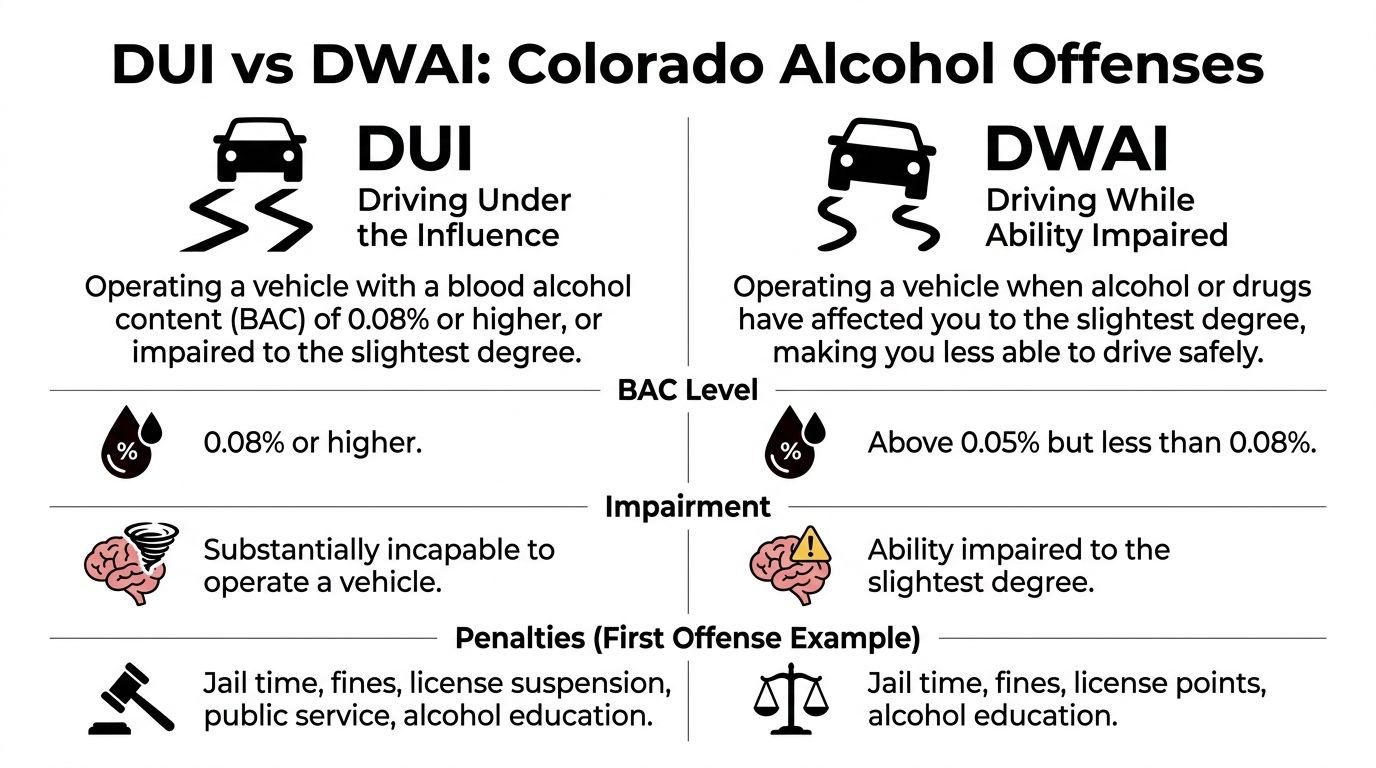
In Colorado, the line between DUI and DWAI works more like a thermostat than an on-off switch. The state does not need a DUI-level result to accuse someone of impaired driving. If alcohol or drugs reduced safe driving ability, even to a lesser degree, a DWAI charge can still follow.
The BAC line that changes the charge
Under Colorado law, a BAC of 0.08 or higher is DUI. A BAC of 0.05 to 0.079 can support a DWAI charge, according to the Colorado rule document on impaired driving standards and consequences.
That catches many drivers off guard. They focus on .08 as if it is the only number that matters. Colorado allows prosecutors to work with a lower range when the allegation is DWAI.
How the two charges differ
DUI means the state claims the driver was under the influence to a stronger degree.
DWAI means the state claims alcohol or drugs affected the driver enough to make safe driving less reliable.
The wording looks close on paper. The practical effect can still be serious in both cases, especially in the first day or two after an arrest, when the family is trying to secure release, protect a job, and figure out what happens to the license.
Colorado DUI vs. DWAI Penalties (First Offense)
| Penalty | DWAI (Driving While Ability Impaired) | DUI (Driving Under the Influence) |
|---|---|---|
| BAC range tied to charge | 0.05 to 0.079 | 0.08 or higher |
| Jail | Some jail time or community service | More significant jail time |
| Fines | Fines ranging hundreds of dollars | Fines ranging hundreds to thousands of dollars |
| License consequence | License revocation for a period of months | Longer license revocation period |
| Community service | Some community service hours | More significant community service hours |
The immediate impact of the charge after booking
The charge does more than label the case. It affects how the family should respond in the first hours after arrest.
A DUI charge usually creates instant panic because people recognize the term and expect license trouble, missed work, and public embarrassment. A DWAI charge often creates the opposite problem. Families hear a term that sounds smaller, then wait too long to arrange release or speak with counsel.
That delay matters. The first goal is getting the person out so they can start dealing with court dates, the DMV side of the case, and the practical fallout at home and at work.
Here is the simplest way to separate the two from a family standpoint:
- DUI cases usually trigger faster concern about harsher penalties and longer license problems.
- DWAI cases often sound minor enough to ignore for a day or two, even though they still bring criminal exposure and possible jail time.
- Both charges call for quick action after booking, because release is the starting point, not the finish line.
What police usually look at besides BAC
BAC matters, but it is only one part of the file. Officers also write down the facts they believe show impairment, including:
- Driving behavior: Swerving, drifting, speeding, braking late, or stopping in an unusual way
- Physical signs: Odor of alcohol, red or watery eyes, slurred speech, or balance problems
- Statements: Comments about drinking, where the person came from, or when the last drink happened
- Field observations: How the person followed instructions and performed roadside tasks
That is why someone can say, "I felt fine," and still face a charge. The officer is building a record from several pieces at once, much like stacking blocks into a wall.
Bail is not the same as guilt
Families often connect bond with conviction. They are different issues.
Bond is about getting the person released while the case moves through court. Release gives the defendant a fair chance to meet with a lawyer, gather documents, protect employment, and prepare for what comes next. If your family is dealing with an impaired-driving arrest, this guide to getting a bond for DUI in Colorado explains the release process in plain language.
Important: A DWAI is not a harmless version of DUI. It is still an impaired-driving charge that can affect freedom, finances, and the defense strategy from day one.
What Implied Consent Means for You
A Colorado driver agrees to certain rules before any traffic stop happens. One of those rules is implied consent.
In plain language, if police have lawful grounds to believe you were driving while impaired, Colorado treats driving as consent to a chemical test, usually breath or blood. It is not a roadside negotiation. It is part of the condition of driving.
Why refusal does not make the problem disappear
Many people think refusing a test keeps the state from proving the case. Sometimes they are focused only on the criminal charge and forget the license side.
Refusal can create its own serious consequences. Even when a person hopes refusal will help, it often adds another layer of trouble. The state may still rely on driving behavior, officer observations, statements, and other evidence.
The easiest way to think about implied consent
Consider the rules on a ski lift ticket. You do not wait until halfway up the mountain to decide whether those rules apply. You agreed when you used the privilege.
Driving works in a similar way. Once you operate a vehicle in Colorado, you have already stepped into that legal framework.
What families should focus on after a refusal issue
The immediate problem is rarely solved at the roadside. It shifts to damage control.
- Protect the timeline: Keep track of booking details, paperwork, and hearing deadlines.
- Separate the issues: Criminal court and driving consequences can move on different tracks.
- Do not guess: A refusal case can look simple and still create fast-moving problems.
Calm approach: Whether the person tested or refused, the next useful step is the same. Get them released, gather documents, and speak with counsel quickly.
What to Do Immediately After an Arrest
The call often comes late. A son says he was stopped after leaving a party. A spouse says she is at a jail but does not know how long she will be there. By the time family hears about it, the officer has already made the arrest and the booking process has usually started.
At that point, the goal is simple. Get clear information, get the release process started, and avoid mistakes that slow everything down.

Start with the facts the jail will use
Begin with three details. Get the person’s full legal name, the jail or detention facility, and the charge if anyone has given it to you.
That sounds basic, but it saves time. Colorado alcohol arrests do not always end up in the city where the stop happened. A person arrested after a DUI, DWAI, MIP, or party-related incident may be transported to a county facility tied to the arresting agency. If you are unsure what to do first, this guide on what to do when someone gets arrested lays out the release steps in the order families usually need them.
What booking means
Booking is the jail’s intake process. The jail confirms identity, enters the charge, takes fingerprints and photos, and decides whether the person is waiting for a bond amount, a review, or a hold to clear.
Families often get stuck here because they treat the jail like a pickup counter. It works more like an airport security line. Even if your ride is waiting outside, you do not skip the checkpoints. Until booking is complete and bond conditions are satisfied, release usually does not happen.
What helps in the first few hours
Use a simple checklist and stick to it.
- Answer calls, even from unknown numbers. Jail staff, a lawyer, or a bond agent may call from a number you do not recognize.
- Write down times, names, and what each person tells you. If information changes, your notes help you sort out what is current.
- Ask whether bond has been set yet. That answer affects what can happen next.
- Keep the person focused on release, not explanations over the phone. Jail calls are for basic communication, not for arguing the case.
A calm record beats a rushed memory every time.
Why alcohol arrests can create more than one problem at once
Some families hear "drinking charge" and assume the issue is small. That can be a costly mistake. An arrest tied to alcohol may involve the criminal case, the bond process, and separate fallout for the household.
For example, underage drinking situations and house-party arrests can pull in parents, hosts, older friends, or anyone accused of allowing the event to happen. As noted earlier, Colorado social host rules can create civil exposure in some situations. So the family may be dealing with release from jail while also trying to understand who else could face legal or financial risk.
This short video gives another useful overview of the release process families often face after an arrest.
Keep your attention on the next decision
After an arrest, people want answers to everything at once. That is normal. It also slows families down.
Handle it in order. Confirm where the person is. Find out whether booking is complete. Ask if bond has been set. Then make arrangements for release as quickly as possible.
Best next move: Get accurate jail information, confirm bond status, and act on verified facts. Time in custody often gets longer when families rely on guesses instead of the jail’s actual process.
Your Next Step to Freedom and Peace of Mind
Colorado alcohol laws can look simple until an arrest turns them into a real problem. A parent hears “private property” and assumes no charge will follow. A driver hears “under .08” and assumes no impaired-driving case exists. A family hears “affirmative defense” and assumes release will be automatic.
That is not how these cases usually unfold.
The useful path is steady and practical. Find the jail. Confirm the charge. Learn whether bond has been set. Get the person released. Then deal with the legal defense with a clear head. Fast action protects jobs, school, family responsibilities, and the ability to prepare for court.
If you need in-person directions or local confirmation, you can also view the Denver location on Google Maps and the Centennial area location on Google Maps.
When a family is under pressure, clarity matters more than anything else. One calm conversation can replace hours of confusion.
If you need fast help with release anywhere in Colorado, contact Express Bail Bonds. They serve Colorado statewide, offer electronic processing, and are available 24/7 by call or text at 720-984-2245 to help families move from panic to a clear plan.