That late-night phone call is a jolt. A loved one has been arrested, and your mind is racing with one question: "What do I do now?" The first step toward getting them home is usually contacting a bail bond agency and paying a simple, non-refundable fee known as a premium.
Let’s walk through exactly what to expect. If you need immediate help, contact Express Bail Bonds right now.
Making the First Call: What to Expect When You Contact a Bail Bondsman

That initial phone call is all about turning panic into a clear plan. When you reach out to a professional bail bond agent at Express Bail Bonds, our job is to guide you through the process calmly and efficiently, no matter the time of day or night.
You don’t need a mountain of paperwork to get things moving. To start, we just need a few key pieces of information:
- The full name of the person in custody (the defendant).
- The city and county jail where they’re being held.
- The total bail amount, if you happen to know it.
Don't stress if you're missing some details. An experienced agent can almost always locate the necessary information with just a name and the jail’s location. From there, we'll explain the next steps, starting with the immediate cost.
The Bail Bond Premium Explained
The primary cost you'll discuss is the bail bond premium. This is the non-refundable fee you pay the bondsman for posting the full bail amount for you. It’s the cost of the service, plain and simple, and it isn't returned, regardless of how the criminal case ends.
In Colorado, the law sets the standard premium at 15% of the total bail amount. However, for larger bonds—often those over $5,000—we can frequently get that rate reduced to just 10% with a qualified cosigner. It's a significant saving, and it's something a good agent should always bring up. Our team in Jefferson County is always ready to explain your options. For a deeper dive, check out our guide on what a bail bond agent does.
To give you a clearer picture, here’s a quick breakdown of how bail bond premiums work in Colorado.
Bail Bond Premium Payment at a Glance
| Bail Amount | Standard Premium (15%) | Potential Premium with Cosigner (10%) | Common Payment Methods Accepted |
|---|---|---|---|
| $2,500 | $375 | N/A (typically for bonds over $5k) | Credit/Debit Card, Cash, Zelle |
| $10,000 | $1,500 | $1,000 | Credit/Debit Card, Cash, Zelle |
| $50,000 | $7,500 | $5,000 | Credit/Debit Card, Cash, Zelle |
These are just examples, but they show how having a cosigner can make a real financial difference, especially with higher bail amounts.
The bail bond industry plays a crucial role in the pretrial system. With over 20,800 businesses in the U.S., the industry is projected to reach $3.5 billion in revenue by 2026. This shows just how many families depend on bail bonds to secure release from custody. You can explore more on these trends in this detailed industry report.
You Can Start the Process Immediately
Arrests don't stick to a 9-to-5 schedule, and neither do we. Reputable bail bond agencies operate 24/7/365 for this very reason. Whether you're calling from home, work, or even from another state, we can start the process right away. An agent in Centennial can get the paperwork started electronically, meaning you can handle everything from your phone or computer.
This first conversation is your chance to ask every question you have and get comfortable with the person helping you. A trustworthy agent will be patient, provide clear answers, and stay focused on the main goal: getting your loved one home as fast as possible. We’re proud of the support we provide, which is reflected in the positive feedback and testimonials from families we’ve helped. For fast, reliable service, call Express Bail Bonds today.
From Online Payments to Cash: How to Pay a Bail Bondsman

Thankfully, the days of scrambling to find a bag of cash to meet a bondsman at a jail are mostly behind us. Figuring out how to pay for a bail bond is much more straightforward now, giving you secure, flexible options that let you act fast, no matter where you are.
At Express Bail Bonds, we've adapted our process to fit real-life situations. The fastest and most common way people pay the bond premium is with a credit or debit card. It’s immediate, which is exactly what you need when someone is waiting in a cell. Our secure online payment system lets you handle everything right from your phone or computer, so you don't have to go anywhere near the jail.
The Advantage of Paying from a Distance
Here's a situation we see all the time: a parent in California gets a call that their son was arrested in Golden, Colorado. The thought of dropping everything to fly across the country just to post bail is a logistical and financial nightmare. This is where remote payments make all the difference.
We can get it all done from afar.
- You'd call our agent who covers the Jefferson County jail.
- We then email you a secure link to the bail agreement and payment form.
- You fill it out and pay the premium online with your card.
- As soon as the payment is confirmed, our local agent is on their way to the jail to post the bond.
That’s it. The whole thing can be wrapped up quickly without you ever having to buy a plane ticket. It saves a ton of money and, more importantly, shaves critical hours or even days off the release process. Our clients often mention in their Google reviews how much they appreciated the speed and convenience of handling it all electronically.
When Traditional Payments Make More Sense
While we love the speed of digital, we know it’s not for everyone. Traditional payment methods are still very much an option, especially if you prefer to meet an agent in person to handle things.
If you're paying face-to-face, you can use:
- Cash: Simple and direct.
- Cashier's Check: This is a great choice if you don't want to carry a large amount of cash. Since it’s backed by the bank, it’s just as good as cash to us.
- Money Order: Similar to a cashier’s check, it's prepaid and provides a reliable paper trail for your payment.
No matter which route you take, getting the proper paperwork is non-negotiable.
Always Get a Receipt and a Copy of the Contract. This is incredibly important. Whichever way you choose to pay, make sure you walk away with two documents: a detailed receipt showing your payment and a signed copy of the bail bond agreement. This is your proof of payment and your legal contract, protecting both you and the person in jail.
Other Ways to Pay
Beyond credit cards, other digital payment apps are gaining traction. Services like Zelle, Venmo, or PayPal can be convenient, and many agencies are starting to accept them. At Express Bail Bonds, our main goal is to reduce your stress, so we try to be as flexible as possible. If you have a different payment method in mind, just ask us.
Whether you're dealing with a situation in Centennial or anywhere else in Colorado, we’re set up to handle your payment securely and get things moving. You can explore all the ways to pay on our bail bond payment options page.
Ultimately, the best method really depends on your location, your comfort level with technology, and how quickly you need to act. By working with a professional team like Express Bail Bonds, you can choose the path that works for you and feel confident that everything is being handled correctly. We’re proud of the feedback we get, and we encourage you to read what our past clients have to say about their experience with us.
Understanding the True Cost: The Premium, Collateral, and Fees
When you get that call, one of the first questions racing through your mind is always, "How much is this going to cost?" It's a stressful situation, and the financial part can feel overwhelming. Let’s walk through exactly what you can expect to pay, so there are no surprises.
The main cost you’ll encounter is the premium. Think of it as our service fee for posting the entire bail amount with the court, allowing your loved one to come home. This fee is non-refundable because it's earned the moment we post the bond and secure that release.
Breaking Down the Premium
Here in Colorado, the premium is actually regulated by state law. The standard rate is 15% of the total bail amount. So, if bail is set at $10,000, the premium you pay the bondsman is $1,500.
But here’s where working with an experienced agent really pays off. For any bond over $5,000, we can almost always get that rate down to just 10% if you have a qualified cosigner. On that same $10,000 bond, that simple step drops your cost from $1,500 to a much more manageable $1,000. That’s a $500 savings, and when things are tight, every dollar matters. This isn't a special, one-time deal; it's a standard practice we offer at Express Bail Bonds to help families.
In Colorado, the statutory rate is precisely 15% for most bonds, but with an approved cosigner, agencies like Express Bail Bonds can often secure it at 10% for bonds over $5,000.
This discount is exactly why you want an agent who knows the system inside and out. Our job isn't just to post the bond but to find you the most affordable path forward. Contact our team in Centennial for a free consultation.
Are There Other Fees Involved?
While the premium is the big one, a couple of minor fees can pop up. These aren't our fees; they are administrative costs passed on from the jail itself. We're always upfront about them.
You might see:
- Jail Processing or Filing Fees: Some jails charge a small fee—usually just a few dollars—to file the bond paperwork. This goes directly to the detention center, not us.
- Administrative Fees: On rare occasions, there might be a small fee to cover things like extensive travel or electronic processing.
We don't believe in hidden charges. When one of our agents gives you a quote, that’s the total price, all-inclusive. You'll know the exact number before you sign anything.
The Role of Collateral
You’ve probably heard the term collateral, but for most of our clients, it never even comes up. Collateral is simply an asset—like a deed to a property or a car title—that you pledge to guarantee the full bond amount.
It's really only necessary in a few specific situations:
- Extremely large bonds (think $100,000 or more).
- When the defendant is considered a high flight risk.
- If you don't have a financially stable cosigner.
Honestly, a qualified cosigner is all we need for the vast majority of cases. At Express Bail Bonds, we’ll exhaust every option to get the bond done without collateral.
The bail bond agreement itself is the contract that lays all of this out. While our agents will explain every line, you can use tools like a Free AI Contract Generator to get familiar with standard contract terms ahead of time.
Our goal is always to make this process as affordable and straightforward as possible. For a deeper dive into how the final numbers add up, you can learn more about how much a bail bond costs in our complete guide. We’re here to help you get through this.
From Payment to Release: A Practical Timeline
After you've sorted out payment and signed the paperwork, the only question that matters is, "How soon will they be out?" It's the one we hear most often, and for good reason. Understanding the real-world timeline is key to managing your own stress during this waiting period.
The moment your payment clears and the agreement is signed, the clock starts for us. At Express Bail Bonds, we handle as much as possible electronically to get things moving instantly. Our first and only priority is getting an agent on the road to the jail to post the bond.
The Bondsman's Job After You Pay
Once we have the green light from you, one of our licensed agents physically takes the official bond paperwork to the detention center. We know the ins and outs of every facility, from the large Denver Detention Center to the smaller county jails. That local knowledge is crucial—every jail has its own way of doing things, and knowing who to talk to and where to go saves precious time.
Honestly, our part of the process is fast. With our experienced team, we can usually get a bond posted within an hour of you finalizing everything on your end. We pride ourselves on making sure there are absolutely no delays on our side. But once we hand that paperwork to the jail staff, the timeline is out of our control and in theirs.
This simple flowchart shows the pieces you'll handle with us before the release process can even begin: the premium payment, any small fees, and collateral (which is rarely needed).
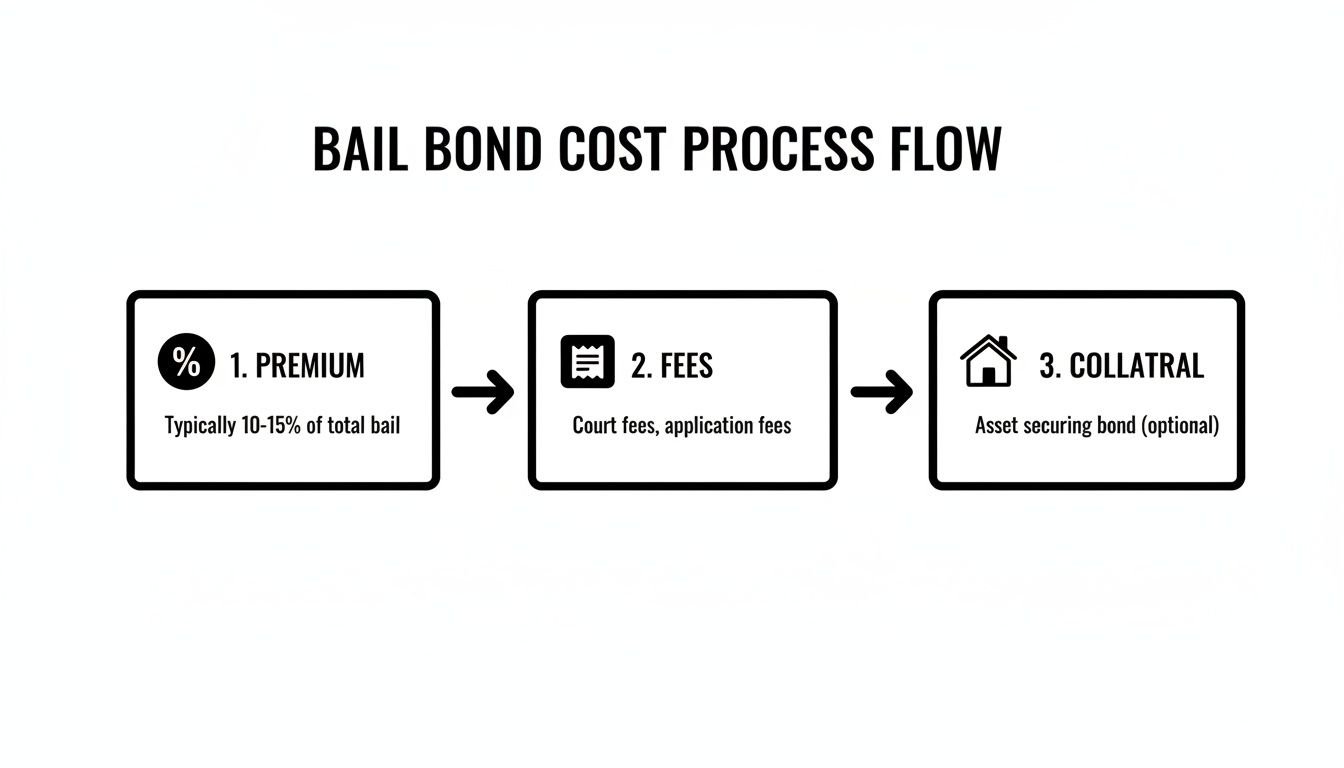
As you can see, the main step is the premium. Once that's settled, we can get to work posting the bond.
The Jail's Release Process: The Waiting Game
This is where patience becomes so important. After the bond is officially posted, the jail starts its own internal "out-processing" procedure. This entire stage is handled by the detention staff and can take anywhere from two to eight hours, sometimes longer.
Several things can affect how long it takes:
- Staffing Levels: A shift change can bring everything to a temporary halt. If the bond is posted right before a new shift comes on, you can expect a delay.
- How Busy the Jail Is: Major facilities near Centennial or Denver are constantly booking people in and out. Your loved one is in a queue, and it just takes time for the staff to work through it.
- Time of Day or Night: Posting a bond at 3 AM might mean fewer officers are available to process the release paperwork.
Expert Insight: The actual release is never immediate. Once we post the bond, the fastest you can expect someone to be released is a couple of hours. It's critical to prepare yourself for this wait. This is standard procedure for every jail, and no bail agent can make it go faster.
A Real-World Example in Jefferson County
Let's walk through a common scenario. Say your friend gets arrested and taken to the Jefferson County jail in Golden. You call us at 8:00 PM. By 8:30 PM, you've handled the digital forms and paid the premium online. Our agent is immediately on their way and posts the bond at the jail by 9:30 PM.
From there, it’s up to the Jeffco jail staff. On a quiet night, your friend might walk out around 11:30 PM. But if it's a busy Friday, it could easily be 4:00 AM or 5:00 AM before they are released. Our job is to get that process started for the jail as quickly as humanly possible.
That efficiency is something our clients often mention in our Google reviews. They appreciate knowing we did our part in record time, and you can see more testimonials here.
Your Responsibilities After the Bond Is Paid
Getting the bail bond premium paid is a huge relief, but it’s important to understand that this is where your responsibilities as a cosigner really begin. Once we post the bond and your loved one is released, you step into a crucial role. Think of it as a partnership between you, the defendant, and us.
Your most important job is simple but non-negotiable: making sure the defendant shows up for every single court date. That's the core promise of the entire bail bond agreement.
What Happens If a Court Date Is Missed
We're always upfront about this part because it’s serious. If the defendant doesn't appear in court—often called a "Failure to Appear" or FTA—the judge will immediately issue a warrant for their arrest.
For you, the cosigner, this is where the financial risk becomes real. The court forfeits the bond, which means our agency is suddenly responsible for paying the entire bail amount. Since you guaranteed the bond, that liability falls to you. It's a scary thought, but our team at Express Bail Bonds works with you from day one, sending reminders and staying in touch to prevent this from ever becoming an issue.
The good news? This is not a common scenario. A bond is typically only forfeited when a defendant deliberately flees, which happens in less than 5% of cases nationwide. The vast majority of people see their case through to the end. You can explore some of the numbers on this industry data report.
How to Be an Effective Cosigner
As the person who cosigned, you are our main point of contact. Your involvement is the best way to protect yourself and help the defendant navigate the court process successfully.
Here are a few things we’ve seen make all the difference over the years:
- Keep the Lines of Communication Open: Stay in touch with the defendant and your bail agent. If your phone number or the defendant's address changes, let us know immediately.
- Become the Calendar Keeper: Don't just assume the defendant is keeping track of court dates. Put them in your own calendar, set phone alerts, and check in a few days before a hearing.
- Provide Practical Help: Sometimes, the biggest hurdle to getting to court is a simple logistical one. Offering a ride, especially to a busy courthouse like the one in Jefferson County, or helping arrange childcare can remove a major point of stress.
This role involves a lot, and we've put together a complete guide to help. We strongly recommend you read our detailed guide on being a bail bond cosigner to understand all your rights and responsibilities. Having a supportive agency on your side makes a world of difference, something our clients often mention in their positive reviews.
The Finish Line: When Your Responsibility Ends
Your financial obligation doesn't last forever. It ends the moment the court "exonerates" the bond, which is the legal term for closing it out. This happens once the defendant has attended all their court dates and the judge has officially resolved the case.
A case can be resolved in a few different ways, all of which lead to exoneration:
- The charges are dropped.
- A "not guilty" verdict is returned.
- The defendant agrees to a plea bargain.
- The defendant is sentenced following a guilty verdict.
Once the bond is exonerated, you're off the hook. Your liability for the full bail amount is gone, and any collateral you provided is returned. This is the goal everyone is working toward, and the support of a professional team—highlighted in our Google testimonials—can help you get there smoothly.
Common Questions About Paying for a Bail Bond
When you get that call, the stress is overwhelming enough without having to navigate a confusing process. We get it. After decades in this business at Express Bail Bonds, we've heard just about every question imaginable.
Let's clear up some of the most common concerns we hear from families every single day.
Can I Get a Payment Plan for the Bail Bond Premium?
Absolutely. In fact, most people need one. It's rare for a family to have the full bail bond premium sitting in a bank account, ready to go. That’s why we offer flexible payment plans at Express Bail Bonds.
We look at every situation individually to figure out a payment schedule that actually works for your budget. Things like the total bond amount, the cosigner's stability, and the details of the case all play a role. The fastest way to see what's possible is to just give us a call. Our agents can quickly walk you through the options to get your loved one home without creating a new financial crisis.
What Happens If I Can't Afford the Bail Bond Premium at All?
If even a payment plan feels out of reach, don't give up. You still have a couple of options, though they tend to be slower and less of a sure thing. Some families have success with crowdfunding sites to raise the premium from friends and extended family.
Another route is to have the defense attorney file a motion for a bail reduction hearing. The major downside here is that it takes time to get on a judge's calendar, and there’s no guarantee they’ll agree to lower the bail. This is why calling a bondsman first is so often the best first step—you’ll know the exact cost and can explore every immediate path to getting someone out of jail.
It’s hard to imagine now, but when Express Bail Bonds first opened in the 1980s, the process was incredibly rigid. Payments were almost always cash-only, and you had to drive it down to the jail yourself. The shift to 24/7 digital payments has been a complete game-changer, with efficient agencies now posting up to 85% of bonds within just a few hours. You can read more on these bail industry service trends to see how far we've come.
Does My Credit Score Affect Getting a Bail Bond?
Your credit score is part of the equation, but it’s almost never the only thing that matters. A good credit history definitely helps, as it shows financial responsibility and can make it easier to get a payment plan or secure a very large bond without putting up collateral.
But a low score doesn't automatically mean "no." At Express Bail Bonds, we always look at the bigger picture. We consider your employment history, how long you've lived in the area, and your ties to the community. We work with people from all walks of life—many of whom have less-than-perfect credit. Our positive Google reviews often highlight our willingness to find a solution. The only way to know for sure is to apply.
You can also learn more in our guide about whether you can pay for bail with a credit card, which gets into some related details. And if you're worried about how other financial issues might affect you, it's helpful to know your rights and understand if you can you go to jail for debt.
How Quickly Is Someone Released After I Pay?
There are two stages to this. The first part—our part—is very fast. Once you've signed the e-docs and paid the premium, an Express Bail Bonds agent is immediately on their way to the jail to post the bond. That leg of the journey typically takes about an hour.
The second stage is the "out-processing," which is handled entirely by the jail staff. This is the part we can't control. Depending on how busy the jail is, their staffing levels, and the time of day, this can take anywhere from 2 to 8 hours. While we can't make the jail staff move faster, we pride ourselves on getting our side done with maximum urgency. Our clients’ testimonials frequently mention how much they appreciate that speed.
If you have more questions or need help right now, the team at Express Bail Bonds is standing by 24/7. Whether you're in Jefferson County or need assistance in Centennial, our agents are ready to give you the clear, fast support you deserve.