
When most people hear the term "bounty hunter," they picture something straight out of an old Western. The reality is a bit different. At its core, a bounty hunter—more accurately called a fugitive recovery agent—is a private citizen hired by a bail bond agency to do one specific job: find and return a defendant who skipped their court date.
They aren't cops. Their role comes from a private financial agreement, not public law. Think of them as recovery specialists for people, not property, working to protect a bail bond company’s investment. If you ever need professional guidance on the bail process, our team at Express Bail Bonds is here to help.
The Modern Bounty Hunter's Role Explained
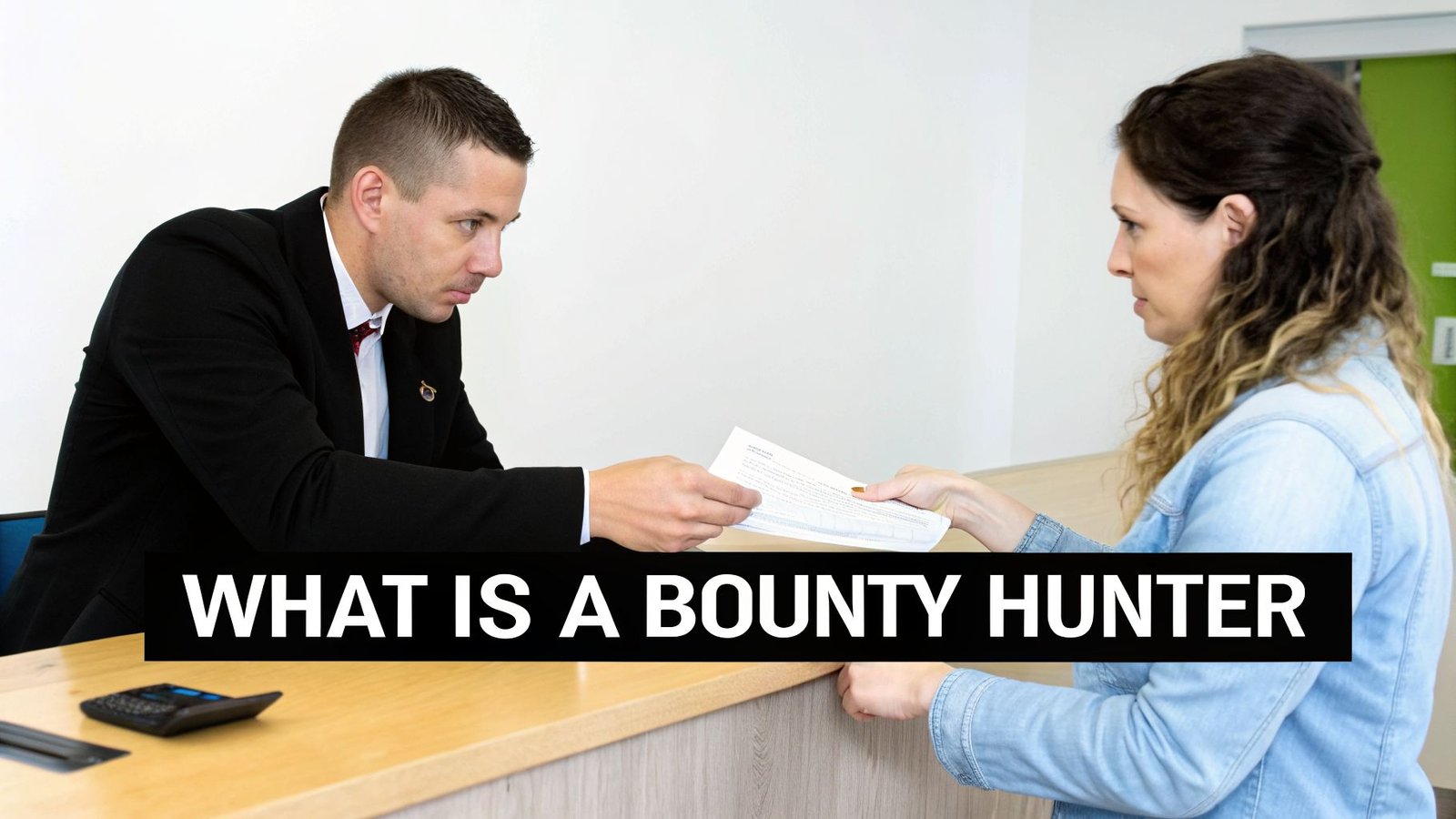
Here’s how it works: when someone skips bail, the bondsman who posted their bond is on the hook for the entire amount. To avoid that massive financial hit, the agency brings in a bounty hunter to track the defendant down and get them back into custody.
A bounty hunter's power doesn't come from a badge, but from the bail bond contract the defendant signed. That paperwork legally allows the bail bondsman—and any agent they hire—to take the person back into custody. It's a job that blends investigation, surveillance, and apprehension, all driven by that initial contract.
Bounty Hunter vs Bail Bondsman vs Police Officer
It’s easy to get these roles mixed up, but their jobs, legal authority, and motivations are worlds apart. Knowing the difference is key to understanding how the justice system works.
Let's break down exactly who does what.
| Role | Bounty Hunter | Bail Bondsman | Police Officer |
|---|---|---|---|
| Primary Function | To locate and apprehend a defendant who has skipped bail for a bail bond agency. | To provide a financial guarantee (a bond) to the court, allowing a defendant to be released from jail pre-trial. | To enforce laws, investigate crimes, and maintain public order as a government employee. |
| Source of Authority | The bail bond contract signed by the defendant and the bail bondsman. | State licensure and the ability to post bonds with the court system. | State and federal law, giving them public authority to arrest and investigate. |
| Main Goal | To protect the bail bond company’s financial investment by returning the fugitive to custody. | To manage financial risk and ensure clients appear for all court dates. | To uphold the law and ensure public safety. |
As you can see, each person plays a very distinct part. The police officer serves the public, the bail bondsman serves the court and their client, and the bounty hunter serves the bail bondsman.
The Skills and Reality of Fugitive Recovery
Forget kicking down doors. A modern bounty hunter’s most valuable tools are research and digital savvy. Their work often begins online, figuring out how to find a person on social media to piece together clues about their location and habits.
This focused, professional approach gets results. While bounty hunting is only legal in the U.S. and the Philippines, fugitive recovery agents have an incredibly high success rate—some estimates claim they bring back over 90% of all bail fugitives.
Of course, if a bounty hunter gets involved, it means something has already gone wrong. The best way to avoid that entire high-stress scenario is to work with a trustworthy bail bond agency from the very beginning. A good bondsman does more than get you out of jail; they make sure you know exactly what’s expected of you. For a deeper look, check out our guide on the role of a bail bond agent. For immediate assistance with bail in Jefferson County, Golden Colorado or Centennial, contact us today.
The History Behind Modern Bounty Hunter Powers
To really grasp what is a bounty hunter, you have to look past the Wild West myths. Their unique authority doesn't come from a dusty movie set but from legal principles stretching back centuries to medieval England.
It all started with English "common law" and a concept called surety. A surety was someone who put their own money and reputation on the line, guaranteeing that an accused person would show up for court. If the defendant decided to run, the surety had the right to physically track them down and drag them back.
Think of it as a form of "private jail." The surety essentially became the defendant's keeper, armed with broad powers to make sure they didn't skip out on their legal obligations.
From English Law to American Justice
When the United States was building its legal system, it borrowed heavily from English common law, and that included the bail and surety system. It was just a practical way to keep the justice system moving without having to lock everyone up before trial.
The core principle was simple: if someone was willing to risk their own money on a defendant, they should also have the power to protect that investment. That’s the very foundation the entire modern bail bond industry is built on.
A bounty hunter's power doesn't come from a government-issued badge. It comes from a private contract, and that contract's authority was cemented by a landmark 1873 Supreme Court decision that gave them the right to chase fugitives across state lines.
This bit of history is so important because it draws a clear line between bounty hunters and police. A bounty hunter's authority isn't granted by the state; it's derived from the private agreement between a defendant and their bail bondsman—a system upheld by the highest court in the land.
The Supreme Court Case That Defined Everything
If you had to point to one event that shaped American bounty hunting, it would be the 1873 Supreme Court case, Taylor v. Taintor. This single ruling is responsible for the sweeping powers that bail bondsmen and their recovery agents still use today.
The court was incredibly direct. It clarified that when someone is out on bail, they are technically in the "custody" of their bail bondsman. In the court's own famous words, the bondsman could:
- Pursue the fugitive into another state.
- Arrest them on a Sunday.
- Enter their house to apprehend them.
This landmark decision effectively gave private citizens—bail agents and the bounty hunters they hire—powers that can sometimes go beyond those of police officers, who usually need a warrant to cross state lines or enter a home. It's because of this historical precedent that a fugitive recovery agent in Jefferson County, Golden Colorado, can legally chase a defendant who has skipped town and fled to another state.
This legal framework is what allows modern bail bond agencies to operate. Having skilled recovery agents on call lets companies like Express Bail Bonds manage their financial risk and ensure defendants make it to court, which is a critical part of the justice system. Whether you're in Centennial or anywhere else in the state, this history directly impacts how bail works. If you ever have questions, our team is here to help. You can easily find our Denver location or our Golden location for assistance.
What Bounty Hunters Can and Cannot Legally Do
It’s easy to get the wrong idea about bounty hunters, thanks to movies and TV. The most important thing to understand is this: their power doesn't come from a police badge. It comes from a private contract.
When someone signs a bail bond agreement, they are essentially giving the bail agent permission to track them down and arrest them if they skip court. This contractual right, established long ago by the Supreme Court in Taylor v. Taintor, is what gives a recovery agent authority that even police don't have without a warrant. But this power isn't a blank check; it's balanced by very strict rules.

What a Bounty Hunter Can Legally Do
Because the bail contract transfers custodial rights to the bondsman, a bounty hunter working for them has some surprisingly broad powers to bring a fugitive back.
Here’s what they are generally allowed to do:
- Enter the Defendant’s Home: This is the big one. Unlike police, who need a separate warrant, a bounty hunter can enter the defendant's primary residence to make an arrest. The bail agreement is treated as a form of pre-consent to entry.
- Arrest the Defendant: They have the full legal right to take the fugitive into custody. This is a private arrest, not a state action, but it's just as real.
- Cross State Lines: If a defendant flees Colorado, a bounty hunter can legally pursue them into other states to make the arrest and return them to the original court's jurisdiction.
- Use Reasonable Force: If a fugitive resists arrest, the agent can use the amount of force necessary to safely detain them. That word "reasonable" is the key, and its interpretation is watched very closely.
Think of it this way: if a defendant out on bond in Jefferson County, Golden Colorado misses their court date, the recovery agent can show up at their listed apartment and go inside to find them. This is exactly why keeping your address current with your bail agent at Express Bail Bonds is a non-negotiable part of the deal. Missing a court date is what triggers a bench warrant, kicking this whole process into gear.
What a Bounty Hunter Cannot Legally Do
A bounty hunter’s authority is powerful, but it's also narrowly defined. Crossing these lines can land them in serious trouble, facing both civil lawsuits and criminal charges. Knowing these limits is your best defense.
Crucial Takeaway: A bounty hunter's special right of entry applies only to the defendant's home. They have no legal right to enter the home of a third party—a friend, parent, or partner—without getting permission from the person who lives there.
These are the hard-and-fast rules they must follow:
- No Impersonating Police: This is illegal, period. They can't wear a uniform that looks like a cop's, flash a police-style badge, or do anything else to make you think they are law enforcement. They have to identify themselves as a fugitive recovery agent or bail enforcement agent.
- No Forcing Entry into Third-Party Homes: If a bounty hunter comes to your home looking for a friend or relative, you do not have to let them in. They need your consent to enter.
- No Excessive Force: While "reasonable force" is allowed, anything beyond what's necessary to control a resisting person is assault. They can't beat someone up who is already compliant or cause unnecessary injury. They are personally liable for any damages or injuries they cause.
- Cannot Ignore a Reinstated Bond: If the missed court date is fixed by getting the bond reinstated, the bounty hunter’s job is over. This is why the very first call you should make is always to your bail agent.
Knowing the rules gives you power. If you’re in Centennial and an agent knocks on your door looking for someone else, you can confidently and legally tell them they cannot come in. If you ever find yourself in this situation, clear communication is the key. You can always get in touch with our team through our Denver location or Golden location for guidance.
How Bounty Hunting Laws Differ Across the US
Think bounty hunting is the same everywhere? Think again. The rules for a bounty hunter, or fugitive recovery agent, can change drastically the moment you cross a state line. It's a confusing legal patchwork that can leave families wondering what is—and isn’t—allowed.
This isn't just a legal technicality. The term "bounty hunter" means something entirely different depending on where you are. In some states, it's a highly regulated profession. In others, it’s a free-for-all with almost no oversight. A few have banned it completely.
The Spectrum of State Regulations
When it comes to fugitive recovery, states generally fall into one of three camps. This directly impacts your safety and the agent's accountability. If a defendant skips bail, the local laws determine whether you're dealing with a trained professional or someone with far fewer rules to follow.
The "Wild West" gunslinger image is mostly Hollywood fiction. Some states, like Illinois, Kentucky, and Wisconsin, have outlawed commercial bail bonds entirely, so there’s no bounty hunting to speak of. In contrast, 22 states—including Florida and Arizona—require licenses as of 2026. Then you have places like Kansas and Idaho with minimal rules, where notifying local police might be the only requirement. If you're curious about the real history, you can read additional details about bounty hunting on MentalFloss.com.
Colorado: A Model for Professional Standards
Thankfully, Colorado is one of the states that takes fugitive recovery seriously. Our state has put strict rules in place, treating it as a profession that demands real training, licensing, and accountability. This provides a crucial layer of protection for the public.
To legally work as a fugitive recovery agent in Colorado, a person must:
- Be at least 18 years old.
- Complete pre-certification training in firearms and arrest control tactics.
- Pass a full criminal background check.
- Get a license directly from the Colorado Division of Insurance.
This regulated system means that when an agency like Express Bail Bonds needs to find a defendant who has missed court, we work only with trained, vetted professionals who know the law inside and out. It minimizes the risk for everyone. For families in places like Jefferson County, Golden, Colorado, it provides peace of mind knowing any recovery is handled by a legally compliant agent.
In Colorado, fugitive recovery isn't a free-for-all. It's a carefully managed process where agents are held to a high professional standard. That’s a world of difference from states with little to no oversight.
This patchwork of laws across the country can be confusing. To simplify it, here's a quick look at how different states handle the practice of bounty hunting.
State Regulations on Bounty Hunting: A Comparison
| State Category | Example States | Regulatory Approach |
|---|---|---|
| Banned | Illinois, Kentucky, Wisconsin | Commercial bail bonds are illegal, so there is no legal bounty hunting. |
| Highly Regulated | Colorado, Arizona, Nevada | Requires licensing, extensive training, and background checks for all agents. |
| Minimally Regulated | Kansas, Idaho, Montana | Few or no statewide laws. Some may require notifying local police before an arrest. |
As you can see, the state you're in makes a huge difference. In a well-regulated state like Colorado, working with a professional bail bond agency in Centennial ensures every part of the process—including potential fugitive recovery—is handled responsibly and legally.
If you have questions about your specific situation, our expert team is here to help. You can find us at our Denver location or our Golden location.
Your Rights if a Bounty Hunter Contacts You
Having a fugitive recovery agent show up at your door is, to put it mildly, an unnerving experience. It's stressful, it's frightening, and it’s easy to feel powerless. But the single most important thing you can do is understand your rights. When you know the rules they have to play by, you can stay in control and keep a tense situation from escalating.
The first step, always, is to take a deep breath and find out exactly who you're dealing with. A legitimate agent won't have any issue proving who they are.
Verify Their Identity and Authority
Before another word is spoken, you need to confirm they are who they claim to be. You have every right to ask for and carefully inspect their credentials.
Make sure you see these specific items:
- Their Bail Enforcement Agent License: In a regulated state like Colorado, this is non-negotiable. They must have one.
- Photo ID: A driver's license or another government-issued ID is crucial to confirm the person standing in front of you is the same person on the license.
- The Name of the Bail Bond Agency: Ask them which company they work for, like Express Bail Bonds. This is a vital piece of the puzzle for your next step.
While you should never lie or physically block a legitimate agent—that can land you in serious legal trouble—you are absolutely within your rights to verify them before cooperating.
Here's a critical point to remember: a bounty hunter's power of entry is extremely limited. They cannot legally enter the home of a third party—a friend, a relative, even a neighbor—without that person's direct permission. If they are at your door looking for someone else, you can refuse them entry.
Know the Limits of Their Power
Once you've confirmed their identity, it's just as important to understand the legal boundaries they operate within. A bounty hunter's authority doesn't come from a government badge; it comes from a private contract, and that contract comes with strict limitations.
The legal landscape for bounty hunting varies wildly from one state to another, as this map shows.
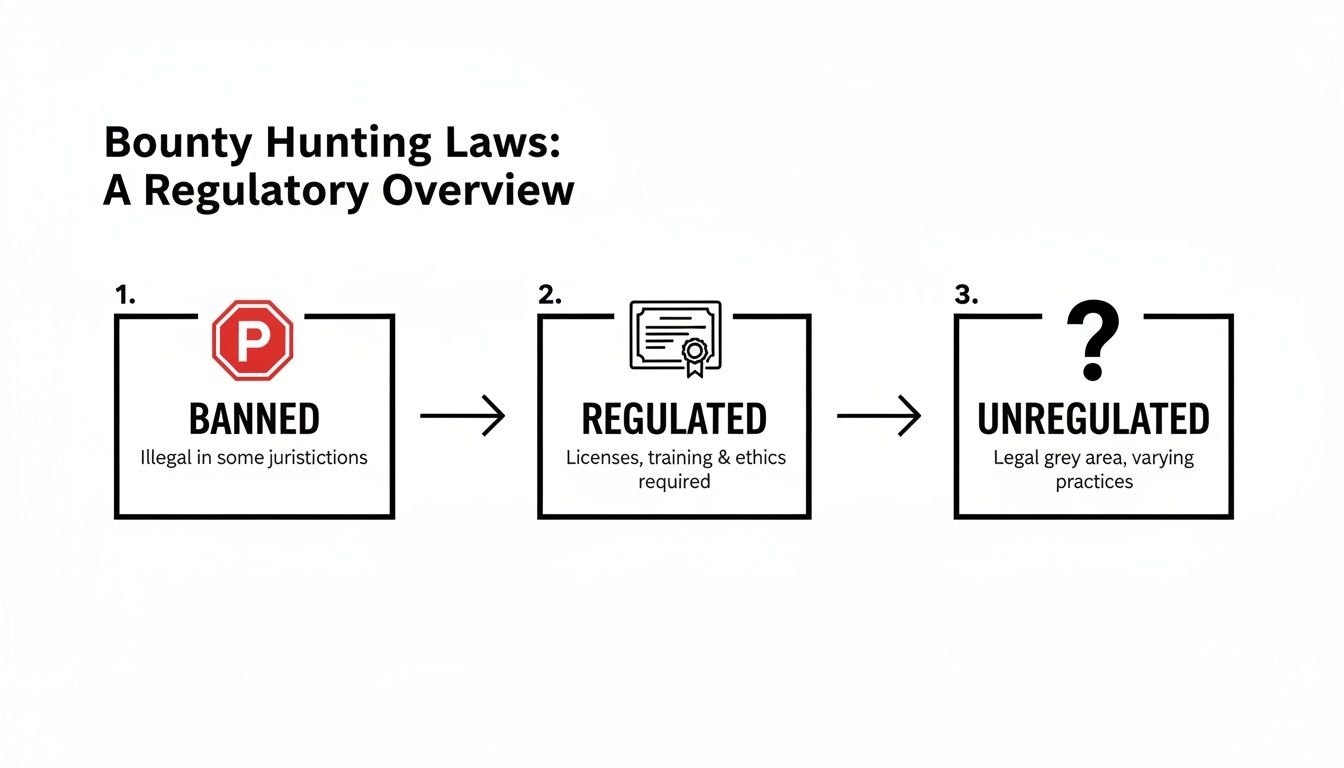
As you can see, some states have banned the practice altogether. States like Colorado, however, have chosen to regulate it, which provides a level of accountability you won't find in unregulated states.
Your Most Important Call
If a bounty hunter contacts you or a family member, the very first call you make should be to your bail bondsman. We can't stress this enough. Contacting a professional at your agency can resolve the entire situation quickly and, most importantly, peacefully.
An experienced agent can get to the root of the problem—often a simple misunderstanding or a missed court date—work to fix the issue with the court, and call off the recovery agent. Sometimes, it’s all a mistake. Our guide on the process of turning yourself in is a great resource if things have progressed to an active warrant.
By getting in touch with your bondsman in Jefferson County, Golden, Colorado or Centennial, you put a professional advocate back on your side. If you need help, our team is always on call at our Denver location or Golden location.
How a Professional Bail Bondsman Prevents Problems
Honestly, the best way to deal with a bounty hunter is to make sure you never have to. A recovery agent's job is to fix a problem after it's already happened. A good bail bondsman, on the other hand, works to stop that problem from ever starting in the first place. Their job is much more than just posting bail—they become your guide through the often-confusing legal system.
When you work with an experienced agent from a reputable firm like Express Bail Bonds, you’re not just buying a bond; you’re getting a support system. They'll send court date reminders, clearly explain your responsibilities, and keep the lines of communication open. The whole point is to prevent a "Failure to Appear" warrant from ever being issued.
Your Proactive Partner in the Legal Process
Think of it this way: instead of trying to figure out the court system on your own, you have an expert on your side whose success is tied to yours. They are there to make sure you meet every single one of your obligations.
A professional team provides some real, practical benefits:
- Always on Call: Got a question at a weird hour? Need to double-check something? Help is always available 24/7 by phone or text. This stops small worries from turning into big problems.
- Simple Online System: Modern bail agencies let cosigners handle applications and payments right from their computer or phone. It’s fast, efficient, and gets things moving without forcing you to drive to an office.
- Constant Communication: You'll get regular reminders and updates so a court date never slips your mind. This is your best defense against the kind of mix-up that leads to a warrant and a visit from a recovery agent.
By partnering with an agency that serves communities like Jefferson County, Golden, Colorado, you’re taking the single most effective step to avoid the anxiety and danger of a fugitive recovery situation.
Choosing the right bail bond agency isn't just about getting out of jail—it's about staying out of trouble. A proactive bondsman is your first line of defense against the circumstances that lead to needing a bounty hunter.
For families in places like Centennial and all over the state, this kind of partnership is what provides real peace of mind. When every box is checked and every court date is met, the need for a bounty hunter simply disappears. That small fee you pay for the bond also covers all this crucial guidance. If you're curious about the cost breakdown, you can learn more about how bail bondsmen get paid right here.
You don't have to navigate this complicated process alone. For immediate, professional help, you can always reach our team at our Denver location or our Golden location.
Frequently Asked Questions About Bounty Hunting
When you’re trying to navigate the bail system, the idea of a bounty hunter can bring up a lot of concerns. Getting a handle on what they do and what their limits are is the best way to feel prepared. Let's walk through some of the questions we hear most often from families.
Can a Bounty Hunter Use Force During an Arrest?
Yes, but it's a very different situation than with a police officer. Bounty hunters are allowed to use what the law calls "reasonable force" to take a fugitive into custody if they resist. The key word there is reasonable.
Unlike law enforcement, a bounty hunter has zero immunity. They are 100% personally responsible for their actions. If they damage property, injure a bystander, or use force that a court later deems excessive, they can be sued and face serious legal consequences. It makes them highly accountable for every move they make.
What Happens to My Premium if the Defendant Runs?
This is one of the most common—and important—questions we get. The premium you pay, usually 10-15% of the total bail, is non-refundable. It’s the fee you pay the bondsman for their service of guaranteeing the full bail amount to the court and securing the release.
If the defendant skips bail, you don't get that premium back. Even more critically, as the cosigner, you are now on the hook for the entire bail amount. This is the exact reason a bounty hunter is brought in—to find the defendant and return them to jail so you don't have to pay that massive sum.
Key Insight: A bounty hunter's primary job is to protect the cosigner from a devastating financial blow. Their success means the terms of the bail contract are met, and your money and assets are safe.
How Are Bounty Hunters Paid?
You won't find many bounty hunters drawing a regular salary. The vast majority work as independent contractors on a high-risk, high-reward basis.
Their payment is a percentage of the bail bond they are recovering, typically somewhere between 10% and 20%. Here’s the catch: they only get paid after the fugitive is successfully located and returned to custody. If they search for weeks and come up empty, they get paid nothing for all their time, effort, and expenses. This model ensures they are incredibly motivated to close the case.
Is It Better to Pay Cash Bail Instead of Using a Bondsman?
Paying the full bail amount in cash might seem like a straightforward option, but it comes with some serious downsides. You have to hand over the entire amount directly to the court, which can tie up thousands, or even tens of thousands, of your dollars. That money is then completely locked up for months or even years until the case is fully resolved.
Working with a bail bondsman lets you secure a person's freedom for a much smaller, more manageable fee. Plus, a good bondsman acts as a guide, sending court date reminders and helping ensure the defendant meets all their legal obligations. It’s a supportive and financially smarter way to handle a tough situation. For a deeper dive, check out our page on frequently asked questions about bail bonds.
When you're facing a stressful situation, you need a partner you can trust. Express Bail Bonds is available 24/7 across Colorado to give you the clear guidance and professional support you deserve. Whether you have questions about the process in Jefferson County, Golden Colorado, need immediate help with bail bonds in Centennial, or are located anywhere else in the state, our experienced team is ready. We provide fast, reliable service and straight answers. You can find our Denver location and Golden location or start the process online right now with Express Bail Bonds.