
When a defendant skips a court date, the term ‘bounty hunter’ usually conjures up images of wild, dramatic takedowns from movies. But here in Colorado, the reality is far more structured and regulated.
In our state, what people call bounty hunters are legally known as ‘bail enforcement agents’. They can't just operate on their own; they must be employed by a licensed bail bonding agency. If you need help understanding the bail process, don't hesitate to contact the experts at Express Bail Bonds.
Understanding Colorado’s Bail Enforcement Rules
The world of fugitive recovery is a lot more complex than what you see on TV, and it’s all governed by a web of state-specific laws. When someone gets out of jail using a bail bond, they’re signing a contract—not just with the court, but with the bail agency that posted the money.
If that person then fails to show up for court, the bail agency is on the hook for the full bond amount. This is where a bail enforcement agent's job begins. Their purpose is simple: find the defendant and return them to custody to resolve the agency’s financial liability.
How Bail Enforcement Agents Get Their Authority
The power of a bail enforcement agent comes directly from the bail bond agreement itself. It’s a civil contract. By signing it, a defendant agrees to give the bail agency—and its designated agents—the authority to take them back into custody if they violate the terms of their release. This power is completely separate from the authority held by police officers.
Think of it this way: The bail agency acts like an insurance company guaranteeing the defendant's court appearance. When the defendant skips, the bail enforcement agent is the specialized professional sent to manage the risk and recover the "asset" (the defendant) to prevent a massive financial loss.
It's a common myth that these agents are rogue vigilantes. The opposite is true in Colorado. The state has put strict bounty hunter regulations in place to ensure every action is professional, accountable, and safe for the public. They aren't freelancers; they are an extension of a licensed, regulated bail bond company.
This legal framework is designed to prevent the "Wild West" scenarios people imagine. It professionalizes the industry by linking enforcement agents directly to licensed bail bond agencies, creating a clear chain of command and legal oversight. If you want to dive deeper into the roles and responsibilities involved, you can learn more about what a bail bond agent does.
For a quick reference, here’s a summary of what bail enforcement agents can and can’t do in Colorado.
Bail Enforcement Agent Authority In Colorado
This table provides a quick overview of the key powers and limitations for bail enforcement agents operating within the state.
| Action | Is It Legal In Colorado? | Key Requirement or Limitation |
|---|---|---|
| Apprehend a Fugitive | Yes | Must be employed by a licensed bail bonding agency. |
| Forcible Entry Into a Home | Yes (with limitations) | Can enter the defendant's own residence (listed on the bond agreement) if there is reasonable cause to believe they are inside. |
| Enter a Third-Party Home | No (without consent) | Cannot forcibly enter the home of a friend or family member without their permission or a separate warrant. |
| Carry a Firearm | Yes (with a permit) | Must comply with all state and federal firearm laws, including having a valid concealed carry permit if applicable. |
| Detain a Non-Fugitive | No | Cannot detain, search, or arrest individuals who are not the specific defendant named in the bail contract. |
Understanding these rules is crucial, as they are designed to protect everyone involved—the public, the defendant, and the agents themselves. For guidance specific to your situation in areas like Jefferson County, Golden Colorado or Centennial, call us today.
A Patchwork of Laws Across the Country
It’s really important to realize that these rules are not universal. Bounty hunter regulations vary dramatically from state to state, creating a complicated legal landscape.
For example, as of 2026, only three states—Illinois, Kentucky, and Oregon—have completely outlawed the practice. In those states, any bail enforcement activity is illegal and can lead to serious criminal charges. Colorado, on the other hand, is one of the states that permits fugitive recovery but keeps it on a tight leash, requiring agents to be part of a licensed agency and pass background checks. This patchwork of laws makes cross-state recovery a highly specialized field.
The Bail Enforcement Agent's Role In The Justice System
So, why do we even have bail enforcement agents, or bounty hunters as they're often called on TV? Their job, while often misunderstood, is a crucial part of how our justice system works. It all boils down to financial risk and making sure a promise to the court is kept.
When a bail bond agency like Express Bail Bonds posts a bond, they're putting a lot of money on the line. They are guaranteeing the court that the defendant will show up for every single hearing. If that person skips town—what’s known as a "failure to appear" or FTA—the agency is on the hook for the entire bond amount. That could be tens or even hundreds of thousands of dollars.
A Civil Matter, Not a Police Priority
This is where the bail enforcement agent steps in. They are hired by the bail agency to manage that financial risk by finding the defendant and returning them to jail. Many people think this should be the police's job, but it’s actually a civil issue between the defendant and the company that posted their bond.
Frankly, local police departments have their hands full with more urgent public safety issues. Handing fugitive recovery over to the private sector—through licensed bail enforcement agents—saves a tremendous amount of taxpayer money and frees up law enforcement to focus on what matters most. These agents are private contractors, not police officers, working to fulfill a specific agreement.
At its core, the job of a bail enforcement agent is all about risk management. They aren't public servants; they're specialists hired to ensure the bail agreement is honored. This protects the financial system that allows pretrial release to exist in the first place.
For families in places like Jefferson County or Centennial, knowing this distinction is key. It explains why a professional recovery agent gets involved if a court date is missed. If you're worried about this happening, it’s important to understand the full consequences, which we detail in our guide on what happens after a failure to appear.
The Numbers Behind Fugitive Recovery
Bail enforcement agents are the backbone of the U.S. bail system's accountability. They're tasked with finding the estimated 15-20% of defendants who jump bail after being released. Their work is essential for recovering the bail agency's funds and preventing massive bond forfeitures.
Their authority isn’t magic; it comes directly from the bail bond agreement the defendant signs. In that contract, the defendant waives certain rights, like extradition, and gives the agent legal permission to find them, enter their property, and use reasonable force to make an arrest. These are powers a regular citizen simply does not have. You can read more about the legal framework for bounty hunters in the U.S. to understand the specifics.
And it works. The data shows that professional bail enforcement agents successfully track down and return about 90% of fugitives—all without needing police involvement. That high success rate is what keeps the entire pretrial release process running.
Of course, the best-case scenario is avoiding this situation entirely. That starts with choosing a reputable bail bondsman who communicates clearly and helps you stay on track. We're proud of our record, and you can see what our customers say about Express Bail Bonds or check out our business profile and location to learn more.
A Bail Enforcement Agent's Legal Powers And Limits
This is where we get to the heart of the matter—the questions that keep families up at night. Can a bounty hunter kick down your door? Can they arrest you on the spot? The answers aren't as simple as a yes or no. Instead, they’re found within the bail bond contract itself, which acts as a key unlocking a very specific set of legal powers.
When someone signs a bail agreement to get out of jail, they aren't just paying for freedom. They're entering into a serious civil contract. That document explicitly gives the bail agency, and by extension its enforcement agents, the authority to act if the defendant skips court. It’s a powerful piece of paper with very clear boundaries.
The Power Granted By The Bail Contract
The authority a bail enforcement agent wields is much greater than that of an ordinary citizen, but it isn't a blank check. Those powers come directly from the waivers the defendant signed. In Colorado, this contract typically grants the right to apprehend the defendant and surrender them back to the custody of the court.
This contractual power is precisely why an agent can do things that would otherwise land anyone else in jail. But—and this is a big but—every action must be performed within the strict confines of the law. This is exactly why working with a professional, licensed agency like Express Bail Bonds is so crucial; it ensures the entire process stays legal and above board.
This flowchart breaks down how a bail agent's authority works once a contract is in place.
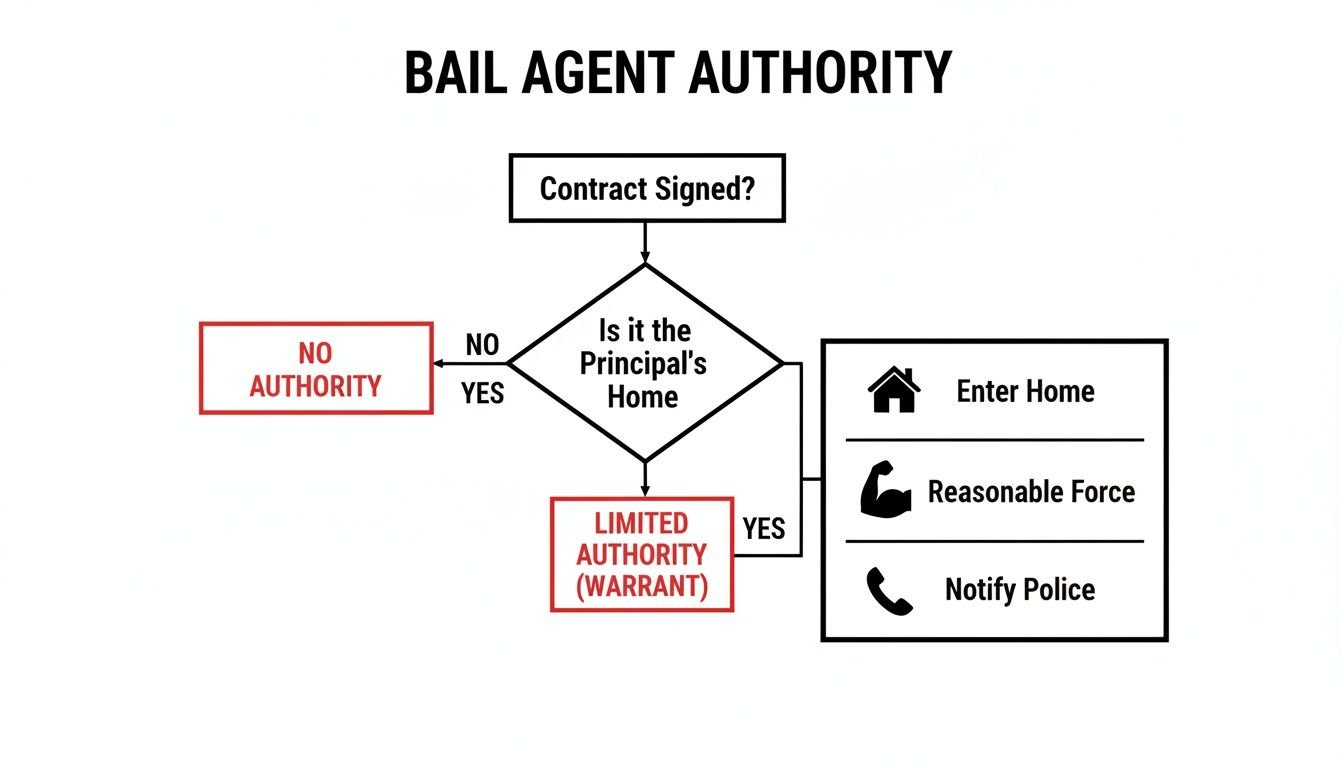
As you can see, the signed bail agreement is the foundation. It's what gives an agent the legal standing to do their job, from entering a home to making an arrest.
Understanding Reasonable Force And Entry
One of the most common and intense points of confusion is an agent's right to enter a property. Here’s how it works: based on the contract, an agent generally has the right to enter the defendant's own residence to make an apprehension. They do not have a right to force their way into a third-party’s home, like a friend's apartment or a relative's house, without permission.
Agents are also permitted to use "reasonable force" to take a defendant into custody. While that term sounds subjective, it legally means the minimum level of force needed to safely detain the person. It is absolutely not a license for excessive violence or causing unnecessary injury.
Crucial Takeaway: An agent’s power is tied directly to the defendant. They have zero authority over innocent third parties. Their actions must be focused solely on apprehending the individual who has jumped bail.
Firm Legal Limits And Accountability
Even with their contractual powers, bail enforcement agents operate under strict legal guardrails meant to protect everyone's safety.
- Positive Identification: Before they do anything, agents must be 100% certain they have the right person. A case of mistaken identity can result in severe civil and criminal consequences for the agent.
- Notification of Law Enforcement: True professionals will almost always notify local police before they attempt a fugitive recovery. This isn't just a courtesy; it promotes transparency and officer safety.
- No Harm to Third Parties: Their authority stops with the defendant. They cannot legally harm, detain, or threaten anyone else.
These rules create a system of accountability. An agent who ignores these boundaries isn't just bending the rules—they're breaking the law. The difference between a lawful apprehension and illegal overreach often comes down to the agent's professionalism and training, which is a direct reflection of the bail agency that hired them. To operate effectively, agents need a solid grasp of complex legal statutes, often requiring them to get up to speed through resources like guides on Mastering Westlaw legal research.
Ultimately, these regulations exist to resolve a bond forfeiture while minimizing risk. The process is best managed by professionals who know and respect the legal lines in Jefferson County, Golden Colorado, and across the state. If you find yourself in this situation, clear communication with a reliable bail agency in areas like Centennial can make all the difference. You can also view our business location or see what our clients have to say about our professional and lawful approach.
Here's a rewritten version of the section, crafted to sound human-written, natural, and expert-driven.
How Colorado's Regulations Protect You
The world of fugitive recovery—what most people call "bounty hunting"—changes dramatically the moment you cross a state line. It's a confusing patchwork of laws that can create a lot of risk. But here in Colorado, our system is built very differently, with a strong focus on safety and accountability that protects defendants, their families, and the general public.
Understanding these protections is crucial, especially if you're a co-signer putting your trust and finances on the line. The regulated approach in our state ensures that if someone needs to be brought back to court, the job is handled by accountable professionals, not unpredictable freelancers. This is exactly why working with a licensed, experienced agency isn't just a good idea—it's essential for a safe and legal outcome.
The Spectrum of Bounty Hunter Regulations
Think of fugitive recovery laws in the U.S. as a spectrum. There’s no single federal rule, so each state makes its own, creating three very different environments. Colorado sits squarely in the most responsible and protective middle ground.
The "Wild West" States: In some places, there’s virtually no oversight. Just about anyone can call themselves a bounty hunter, with no regard for their background, training, or stability. This lack of standards is a recipe for disaster, leading to property damage, cases of mistaken identity, and dangerously excessive force.
The "No-Go" States: On the other end, states like Illinois, Kentucky, and Oregon have banned commercial bail and bounty hunting altogether. While that eliminates rogue agents, it puts the entire burden of finding fugitives on already-strained law enforcement, which can seriously slow down the wheels of justice.
Regulated States Like Colorado: Colorado found a smart balance. We permit bail enforcement, but only under strict rules. Here, a so-called "bounty hunter" must legally be a bail enforcement agent who is a direct employee of a licensed bail bond company, like Express Bail Bonds.
This single requirement is the cornerstone of public safety. It ensures every agent is vetted, trained, and accountable to a licensed business with a massive stake in getting it right.
Why Colorado's Model Prioritizes Safety
Requiring bail enforcement agents to work for a licensed bondsman isn't just red tape; it’s a powerful way to enforce accountability. It creates a clear chain of responsibility that protects everyone.
At the end of the day, the system is designed so that the actions of a bail enforcement agent directly reflect on the bail agency that hired them. If an agency tolerates unprofessional or illegal behavior, it puts its own state license—and its entire business—on the line. That financial and legal pressure is a huge incentive to do things by the book.
This structure delivers real-world benefits. A professional agency makes sure its agents are trained in Colorado law, de-escalation tactics, and the legal use of force. They know the critical difference between a lawful arrest in Jefferson County, Golden Colorado, and what would be considered assault or breaking and entering.
Accountability in Action
Let’s put this into a real-world context. Imagine you live out-of-state and co-signed a bond for a loved one in Centennial. If that person panics and skips court, you need to know the situation will be handled professionally.
- In an unregulated state, you’d have no idea who is searching for your loved one or what dangerous methods they might be using.
- Here in Colorado, you can rest assured that the agency you hired is responsible for the entire process, from start to finish. The recovery will be managed by vetted agents who answer directly to our licensed company.
This is exactly why choosing a reputable partner is so important. A professional agency always prioritizes a safe, voluntary surrender over a dramatic, high-risk confrontation. We work within the legal system, not outside of it. For families going through this stressful time, knowing you have a responsible partner managing things provides enormous peace of mind.
To see our commitment to professional standards, you can view our business location or read reviews from our satisfied clients. If you need help in the Centennial area, our team is ready to step in with a lawful and safe approach.
What To Do If A Bail Enforcement Agent Contacts You

It’s a situation nobody wants to be in. A knock on the door or a phone call from a bail enforcement agent can send a jolt of anxiety through anyone. Whether it’s you they’re looking for, a family member, or someone you co-signed for, how you react in those first few moments can change everything. Knowing the right way to handle it is your best tool for keeping a bad situation from getting worse.
The absolute first thing to do is remain calm and cooperative. A bail agent's job is to find a defendant who missed court, and they are operating with legal authority. Getting confrontational, trying to lie, or being argumentative won't help—it will only escalate things and could land you in legal trouble for hindering their work.
Your goal is simple: figure out who they are and why they're there. A professional agent expects you to have questions. They are required to operate within specific bounty hunter regulations and should conduct themselves accordingly.
Initial Steps During Contact
When an agent shows up or calls, your first move is to verify their credentials. You have every right to confirm who you are dealing with before saying another word. Any legitimate agent is prepared for this.
Ask to see these three key documents:
- Official Identification: This includes their state-issued ID and any professional credentials identifying them as a bail enforcement agent.
- The Bail Bond Paperwork: They must have a copy of the original bail agreement. This document is the source of their legal power to apprehend the defendant.
- The Arrest Warrant: They should also have a copy of the bench warrant issued by the court when the defendant failed to appear.
Do not let anyone into your home if they can't produce this proof. If they refuse or get evasive, that's a massive red flag. Politely close the door, lock it, and immediately call both the local police and your bail bond agency to report what happened.
Crucial Advice: Never give false information or try to hide the defendant's whereabouts. Hindering a fugitive apprehension is a serious crime. Cooperation is always the safest and smartest path forward for everyone involved.
The Most Important Call You Can Make
After you've verified the agent is legitimate, the single most important action you can take is to call your bail bondsman immediately. Do not try to navigate this alone. The team at Express Bail Bonds is your best resource and advocate in this exact scenario.
Making that phone call does a few things right away. We can instantly confirm the agent's identity and that they are working on our behalf, which should give you some peace of mind. More importantly, we can step in and manage the conversation to work toward the best possible outcome: a safe, voluntary surrender.
A peaceful surrender is always better than a forcible arrest. It's safer for the defendant, far less stressful for the family, and avoids the risk of property damage or injury. Our agents are experienced in negotiating these arrangements.
Letting your bondsman take the lead de-escalates the tension and ensures the entire process is handled correctly and in line with Colorado law. If you or someone you know is facing this, you can learn more about how to safely navigate turning yourself in with our guidance.
Choosing A Licensed Bail Agent For A Lawful Process
When a loved one misses a court date, things can get stressful fast. But the best way to handle a fugitive recovery situation is to prevent it from spiraling out of control in the first place. That process begins the moment you choose a bail bond agency.
Working with a licensed, reputable bail agent who truly understands Colorado’s strict bounty hunter regulations is your first and best line of defense. A professional company doesn't just post the bond; they manage the entire process lawfully, from the initial paperwork to any potential recovery down the road.
When you partner with an established agency like Express Bail Bonds, you're not just buying a service. You're investing in an accountable, safe process. We ensure that if a defendant fails to appear in court, any recovery effort is handled exclusively by our own trained, vetted, and directly employed bail enforcement agents. That's a critical difference that protects everyone involved from unnecessary risk.
The Value of Professional Management
What separates a professional, managed recovery from a chaotic and dangerous one? It really comes down to experience and accountability. A licensed agency has every incentive to get things right—our business, our insurance, and our reputation are on the line.
This means we always prioritize de-escalation and clear communication. Our goal is to arrange a safe, voluntary surrender whenever possible, rather than resorting to a high-risk confrontation.
Working with a professional bail bond company is your best protection against the risks of an improperly handled fugitive recovery. You ensure the process is managed by trained experts who operate in full compliance with Colorado law, safeguarding both the defendant and your own legal and financial standing.
Our team’s statewide expertise is also a massive asset in a crisis. We know the specific procedures and have relationships in every jurisdiction, from the courts in Jefferson County, Golden Colorado to the system in Centennial. That local knowledge ensures every step is handled correctly and efficiently.
A difficult situation doesn't have to become a disaster. With the right team, the entire process can be managed with safety and respect for the law.
Your Partner in a Crisis
Our 24/7 availability means you'll never be left to navigate the uncertainty alone. You have a direct line to an expert who can answer your questions, verify information, and guide you toward a resolution. This is especially vital when dealing with the complex, high-stakes world of bail enforcement.
Hiring the right bail agency is the single most important decision you can make. It sets the tone for the entire journey and provides peace of mind that everything is being handled by the book. Some people even find this field compelling; if you're curious, you can learn more about the high standards required by reading our guide on how to become a bail bondsman.
When you need immediate, professional help, don't leave it to chance. You can see what our many satisfied clients have to say about our lawful approach. For prompt assistance from a partner who respects the law, contact Express Bail Bonds today.
Frequently Asked Questions About Bounty Hunter Regulations
When you're dealing with bail bonds and the possibility of a fugitive recovery, a lot of questions can come up. The rules around bounty hunter regulations can feel complicated, but they exist to keep everyone safe. Here are some straightforward answers to the questions we hear most often from families.
Can A Bail Agent Arrest Someone Besides The Defendant?
Absolutely not. A bail enforcement agent's authority is laser-focused and comes from one place only: the bail bond contract the defendant signed. They have zero legal power to arrest, hold, or use force against anyone else. This includes friends, family members, or even a co-signer on the bond.
Any attempt to do so would be a serious crime, opening that agent up to charges like kidnapping, false imprisonment, and assault. If an agent contacts you, their only legal purpose is to ask for information to help locate the defendant—they cannot, and should not, threaten you with arrest.
What Happens If The Defendant Is In A State Where Bounty Hunting Is Illegal?
This is where things get serious, as state lines create hard legal boundaries. A bail agent from Colorado simply cannot cross into a state where bounty hunting is outlawed (like Illinois or Massachusetts) and try to physically apprehend someone. That agent would be breaking the law and could be arrested on the spot.
In a situation like this, a professional agency like Express Bail Bonds has a strict process to follow. We coordinate directly with local law enforcement in that state to handle the arrest legally. Once they have the defendant in custody, we begin the formal extradition process to bring them back to Colorado to face their charges.
Is The Bail Premium Refunded After The Defendant Is Returned To Custody?
No, the bail premium is never refunded. It’s best to think of it as the earned fee for our service and for taking on the financial risk of posting the entire bond amount on your behalf.
This one-time payment covers all our operational costs, from the initial paperwork to, if necessary, the expense of a fugitive recovery. The premium is considered fully earned the second the defendant is released from jail, no matter how the case turns out later.
What Is The Difference Between A Bounty Hunter And A Private Investigator?
The biggest difference comes down to legal authority. A bail enforcement agent (what people often call a "bounty hunter") is given unique powers directly from the bail contract, but only to apprehend that specific defendant. A private investigator, on the other hand, is hired to gather information. They have no more power to make an arrest than any other private citizen.
Another key distinction in Colorado is their employment status. A bail enforcement agent must be a direct employee of a licensed bail bond agency. Private investigators work independently and aren't tied to the bail industry, which means their legal powers and responsibilities are completely different.
When you're in a tough spot with the legal system, having an expert on your side makes all the difference. Express Bail Bonds is committed to making sure every step is handled professionally and completely within the bounds of Colorado law. Our teams in Jefferson County, Golden Colorado and Centennial are here for you 24/7. Find out what our satisfied clients say, take a look at our business profile, and call us whenever you need immediate, reliable help.