When you’re trying to get a loved one out of jail, one of the first questions that comes to mind is, "How does the bail bondsman get paid for this?" It's a fair question, and the answer is straightforward.
Bail bond agents are paid through a non-refundable fee called a premium. This is our service fee for posting the full bail amount with the court on your behalf. Instead of you needing to come up with a massive sum of cash, you pay a small, legally regulated percentage to us. We then take on the financial risk, ensuring your loved one's release.
This premium is our earned income for the service, regardless of how the criminal case turns out. If you need immediate assistance in areas like Jefferson County or Centennial, contact Express Bail Bonds for a free consultation.
The Bail Bond Premium Explained
When a judge sets bail, that amount serves as a financial promise that the defendant will show up for all their court dates. But let's be realistic—these amounts can be incredibly high, often far more than most families have on hand. This is where a professional bail bond agency bridges the gap.
The premium is the core of how we're able to help. It's a one-time fee calculated as a percentage of the total bail amount. In Colorado, the standard is typically 10-15%.
For example, if bail is set at $10,000, a 15% premium would be $1,500. You pay that $1,500 to us, and we post a surety bond for the full $10,000 with the court, securing the release. This structure makes getting out of jail financially possible for many people.
How the Premium Works
So, what exactly does that premium cover? It’s not just for the money we post. It covers the entire professional service we provide from start to finish.
- Assuming Financial Risk: This is the big one. We are guaranteeing the full bail amount to the court. If the defendant doesn't appear for their court date, our agency is suddenly responsible for paying the entire $10,000. The premium is our compensation for taking on that massive risk.
- Navigating the System: The jail and court systems are complex and confusing. Our experienced agents handle all the necessary paperwork and work directly with the authorities to speed up the release process.
- Providing Accessibility: A bail bond service means you don't have to liquidate your assets, empty your savings, or take out a high-interest loan just to get a family member out of jail.
The bail bond industry is a significant part of the justice system for this very reason. It's estimated that $14 billion in bail bonds are written each year in the U.S. by roughly 25,000 agencies. This generates between $1.4 billion and $2.4 billion in revenue for the agents and their insurance underwriters who back the bonds.
To better illustrate how this works, let's break down the numbers in a typical scenario.
Bail Bond Premium At a Glance
| Scenario | Court-Set Bail Amount | Bail Bond Premium (15%) | Your Upfront Cost | Is This Refundable? |
|---|---|---|---|---|
| Defendant is arrested, and bail is set. | $20,000 | $3,000 | $3,000 | No, this is the non-refundable fee for the bail bond service. |
As you can see, the premium is the non-refundable payment you make directly to the bail bond agency for their service and for taking on the court's financial risk.
This system provides an essential service to families across Colorado. Whether you're in Jefferson County or need help in the Centennial area, a professional bondsman makes an overwhelming situation manageable. We're proud of the trust our clients place in us, and their feedback on Google speaks volumes about our commitment to professionalism and transparency.
If you'd like a more detailed breakdown of all the factors that go into the final price, you can read our detailed guide on bail bond costs for more information.
Following the Money: The Agent and the Underwriter
When you pay a bail bond premium, you might naturally wonder where that money goes. It’s not just a simple payment to one person. That fee is actually divided between the local bail bond agent you’re working with and a large insurance company, known in our world as a surety or underwriter.
This partnership is what makes the entire bail bond system work.
Think of your agent at Express Bail Bonds as the person on the ground. We’re the ones handling all the legwork—navigating the complex court paperwork, answering your phone call in the middle of the night, and working directly with the jail to get your loved one released. That local know-how is crucial for getting things done fast.
The Agent and Underwriter Partnership
So, what about the big insurance companies? While we keep a portion of the premium for our hands-on work, we partner with an underwriter to guarantee the full, often massive, bail amount to the court. These underwriters are the financial powerhouses that provide the backing for the bond.
This relationship allows a local agent to post a bond of almost any size, whether it's for a small misdemeanor in Jefferson County or a serious felony with a six-figure bail. The underwriter carries the ultimate financial risk, while we manage the client relationship and the on-the-ground logistics. Our deep-rooted relationships, going back to 1988, ensure this whole process runs like a well-oiled machine for families across Colorado.
This simple diagram shows how your premium payment unlocks the entire process, leading directly to a release.
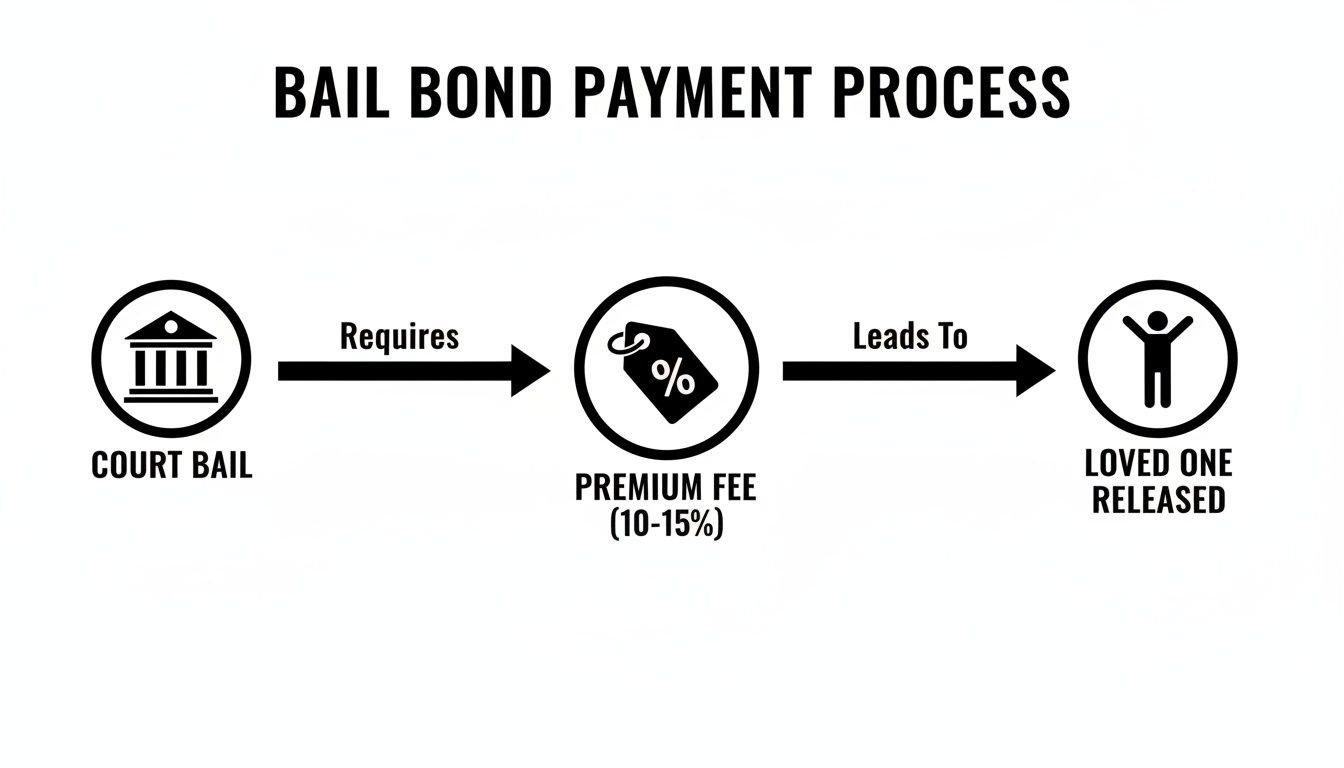
As you can see, the premium you pay is the key. It bridges the gap between what the court demands and securing your loved one’s freedom.
The Premium Split in Practice
The bail industry is surprisingly concentrated. Fewer than 10 major insurers are behind nearly all $14 billion in bail bonds issued across the U.S. each year.
Here’s a practical example:
- Let’s say bail is set at $50,000.
- You pay a $7,500 premium to your bail agent.
- The local agent then pays a portion of that fee (often around 10%, which would be $750 in this case) to the underwriter.
That $750 is the underwriter's fee for guaranteeing the full $50,000 bond to the court.
The bail bond agent is your direct point of contact and guide through the legal maze. Their role is to make the complex process of securing release as clear and fast as possible, providing both expertise and peace of mind during a stressful time.
This partnership structure makes sure that no matter how high the bail is, there's a financial path forward. If you have questions about how this works or need immediate help in areas like Centennial, our team is here for you 24/7. To get a better sense of everything an agent handles, you can learn more about what a bail bond agent does in our detailed guide.
How Collateral and Cosigners Secure a Bond
Sometimes, the premium alone doesn't cover the full picture of how bail agents get paid or, more accurately, how they protect their business. For especially large or high-risk bail amounts, a bondsman needs more than just the fee—they need a safety net. This is where collateral and cosigners become essential.
Think of it this way: the premium is the fee for the service, but the cosigner and collateral are the guarantee that the service won't result in a massive loss.

The Role of a Cosigner
A cosigner, also known as an indemnitor, is typically a responsible friend or family member who co-signs the bail agreement. By signing, they are making a firm promise to the bail agent: they are taking on full financial responsibility for the defendant showing up to court.
To back up that promise, the cosigner may also need to provide collateral.
What Exactly Is Collateral?
Collateral isn't a payment. It’s best understood as a security deposit. You're pledging a tangible asset to the bail bond company, which they hold onto while the case is active. As long as the defendant makes every single court appearance, your collateral is safe and will be returned to you once the case is officially closed.
Some of the most common forms of collateral include:
- Real Estate: A house or land with enough equity is often used for the largest bond amounts.
- Vehicles: Cars, trucks, or motorcycles with a clean title can be pledged against the bond.
- Valuables: Items like jewelry, firearms, or other high-value personal property can also work.
The whole point is to give the bondsman financial security. If the defendant skips a court date and the judge forfeits the bond, the bail agent is suddenly on the hook for the entire bail amount. The collateral is what they would use to cover that loss.
A cosigner's promise is the first line of defense; collateral is the backstop. Together, they give a bondsman the confidence to post a high-risk bond, making release possible when it otherwise wouldn't be.
At Express Bail Bonds, we work hard to make this part of the process as clear as possible. Our secure electronic system means that even family members who live out-of-state can cosign and complete all the necessary paperwork without having to travel. We believe in total transparency and are always here for a confidential consultation to explain your responsibilities.
For a deeper dive into this role, you can learn more about the responsibilities of a bail bond cosigner in our detailed guide.
Beyond the Premium: What Other Costs Could Come Up?
A good bail bondsman will be upfront about every single dollar. While the premium is the main, non-refundable fee for our service, it's smart to know what other costs could pop up in certain situations. We want you to have the full picture, with no financial surprises later on.
For example, if you set up a payment plan for the premium, your agreement might include small, clearly defined financing fees. The more serious costs, however, only ever come into play if a defendant doesn't show up for court. This is often called "skipping bail."
When Recovery Costs Become a Factor
If a defendant misses their court date, the responsibility to cover the costs of finding them and bringing them back to jail falls on the cosigner. These are known as recovery costs. It’s a serious situation, but at Express Bail Bonds, we spell out every potential expense in our contract right from the start.
Our clients count on us during stressful times because they know we are professional and completely transparent. This review shows just how much that clarity and support means to people.
That kind of feedback is what we strive for. It shows our commitment to being there for our clients with genuine care, whether they're in Jefferson County or anywhere else in Colorado. Trust is built on honesty, and we believe you deserve to see the whole financial picture from day one. You can read more about what our clients have to say on our Google review page.
We make absolutely sure you understand your financial responsibilities before you sign a single thing. Our goal is to prevent surprises and give you peace of mind through total transparency—a principle that has guided us since 1988.
Getting a handle on how different legal services work can also provide helpful context. For instance, you can see how our straightforward fee structure compares to other professional services, like the typical accident lawyer fees in Colorado.
At the end of the day, our mission is to secure a release from jail as quickly and affordably as possible. We’re known for our compassionate service, as you can see from reviews by clients we've helped in places like Centennial and across the Front Range. Being honest about how bail bondsmen get paid isn't just a policy; it's the foundation of our entire business.
How You Can Pay for a Bail Bond in Colorado
When you get that call saying a loved one is in jail, figuring out how to pay shouldn't add to your stress. At Express Bail Bonds, we’ve worked hard to make the payment process straightforward and fast, so you can focus on what really matters—bringing your family member home.
We accept all standard payment methods, including credit cards, debit cards, cash, and electronic transfers. But where we really make a difference is with our completely remote process. You can fill out the application, sign the agreement, and make the payment right from your phone or computer, no matter where you are.

This simple, secure payment system is a lifeline, especially for families and cosigners who live out of state and can't just drive to our office. You can handle everything from hundreds of miles away in just a few minutes.
Modern Payments for a Faster Release
This electronic process isn't just about convenience; it’s about speed. By eliminating the need to drive to an office or the jail, we can start working on the release the second you complete the paperwork. It cuts out hours of travel and waiting time.
Our agents are able to post bonds 24/7, and our digital system means we get the green light to act immediately. This drastically reduces the amount of time your loved one has to spend behind bars, whether they're in Centennial or need our help in Jefferson County. The entire system is built for one purpose: getting your loved one out of jail and back home as quickly as possible.
The ability to pay and sign for a bail bond remotely transforms the entire experience. It turns a lengthy, in-person ordeal into a quick, secure process that can be handled from any phone or computer, accelerating your loved one's release.
This client experience, shared on Google, is something we hear all the time. Our goal is to remove financial friction so you can concentrate on your family.
If you’d like to explore the different ways you can cover the cost, our detailed guide on bail bond payment options is a great resource. For immediate, 24/7 help, call or text us at 720-984-2245. As our clients confirm in their reviews, our team is always ready to answer your questions and guide you through every step.
What Happens to Your Money When the Case Is Over
When the judge’s gavel falls for the last time and the case is officially closed, a huge weight lifts. But then comes the practical question: what happens to all the money and property involved in the bail process? Let's walk through it.
First, let's talk about the premium—the fee you paid to us. It's important to understand that this fee is non-refundable. Think of it as our earned fee for the service we provided. We took on the full financial risk of the bond for the court and worked to secure your loved one's release, and that premium covers the work and risk involved.
For a more detailed explanation on this, our guide on is bail refundable? breaks it all down.
The Court's Final Step: Bond Exoneration
Once the case is resolved and the defendant has made all their required appearances, the court issues a bond exoneration. This is a crucial legal step.
Essentially, it's the court's official declaration that the terms of the bail have been met. It formally releases everyone—the defendant, the cosigner, and our agency—from the financial obligation of the original bail amount. Think of it as the final green light that closes the loop on the bond.
Getting Your Collateral Back
As soon as we receive that bond exoneration from the court, our team at Express Bail Bonds gets to work. Our top priority is returning any collateral you pledged to secure the bond.
Whether it was a vehicle title, property deed, or other valuables, we start the process of returning it to you right away. No delays, no hassle. This is the final step that brings real closure, ending the financial side of a stressful chapter.
We pride ourselves on being a steady partner for families from that first urgent phone call to the final return of their assets. It’s a commitment we’ve upheld for clients from Jefferson County to Centennial and all across Colorado.
This review shows the kind of supportive experience we always aim to provide:
We believe in supporting families through the entire journey, not just the initial release. You can see more stories from people we've helped over on our Google reviews page.
Upon bond exoneration, the return of your collateral is our top priority. This final action concludes our agreement and returns your assets, ensuring you can move forward without any lingering financial ties.
Answering Your Questions About Bail Bond Payments
When you're trying to get a loved one out of jail, the last thing you need is confusion about money. We get it. Over the years, we've heard just about every question there is when it comes to paying for a bail bond. Here are straight answers to the ones we hear most often.
If the Charges Get Dropped, Do I Get My Premium Back?
That's a common question, but the answer is no. The premium you pay is a non-refundable fee for our service.
Think of it this way: the moment we post the bond and your loved one walks out of jail, our job has been done and our fee is earned. We’ve put our own money on the line with the court and taken on the full financial risk. What happens in court afterward—whether the case is dismissed or goes to trial—is a separate matter.
It’s always a good idea to keep a copy of your payment receipt for your records. If you ever misplace one for any kind of transaction, knowing the process for getting copies of receipt can be a lifesaver.
Can We Set Up a Payment Plan for the Premium?
Yes, absolutely. We know that coming up with the full premium amount on the spot is a huge burden for most families. That's why at Express Bail Bonds, we’ve always offered flexible payment plans.
We'll sit down with you—or talk over the phone—to figure out a payment schedule that actually works for your budget. Our goal is to get your loved one home without putting you in a financial bind. The first step is a free, no-pressure chat to review your situation, whether you need help in Jefferson County or over in Centennial.
Is It Better to Use a Bondsman or Just Pay the Full Bail in Cash?
For the vast majority of people, working with a bondsman is the much smarter financial move. If you pay the full bail amount directly to the court in cash, that money is completely tied up. You can't touch it. It could be months, or even years, before the case is resolved and you get it back.
By using a bondsman, you only have to pay a small fraction of the total bail (the premium). This frees up the rest of your cash for what really matters, like household bills and hiring a good attorney.
A bail bond agent lets you use a small, manageable fee to secure a release, keeping your own savings available for other urgent needs. It's a financial tool that makes freedom possible without having to drain your bank account.
Plus, a professional bondsman knows the system inside and out. We can navigate the paperwork and procedures far more quickly, saving you a ton of time and stress.
I'm Cosigning for Someone. What Happens if They Don't Show Up for Court?
When you cosign a bond, you are making a serious promise to the bondsman: you financially guarantee that the defendant will appear at all their court dates.
If they miss a date, our first call is to you. We'll work together to find out what happened and get them back in touch with the court. Our clients know we do everything we can to resolve these situations without things escalating, which is something you'll see mentioned in our Google reviews.
However, if the defendant disappears and we can't bring them back to court, the bond is forfeited. At that point, the cosigner legally owes the bondsman the full bail amount. This is why it is absolutely critical to only cosign for someone you trust completely. Our upfront, honest approach is a big reason clients have left us such positive Google feedback.
When you need fast, reliable service from a team that has served Colorado with integrity since 1988, we're here to help. For immediate 24/7 assistance and clear answers to all your questions, contact Express Bail Bonds today.
Visit us online at https://expressbailbonds.com/ or call/text 720-984-2245.