
So, you're out on bond and need to leave Colorado. The big question is, can you? The short answer is yes, it's possible, but it's not as simple as just packing a bag. You absolutely must get explicit permission from the court first.
Think of your bond conditions as the rules of the road for your freedom while your case is ongoing. Leaving the state without a judge's green light is a serious violation of those rules. It's a privilege, not a right, and it has to be earned through a formal legal process. If you need assistance navigating this complex process, don't hesitate to contact Express Bail Bonds for expert guidance.
Your Guide To Traveling Out Of State While On Bond

When a judge agrees to release you on bond, you're essentially making a promise to the court. You're promising to show up for every single hearing and to follow a specific set of rules until your case is resolved. One of the most common and non-negotiable rules is a restriction on out-of-state travel.
Ignoring this rule—even for a quick weekend trip—is a huge mistake. The consequences can be severe, from having your bond revoked and forfeited (meaning the bondsman loses their money) to a new warrant being issued for your arrest.
To avoid that nightmare scenario, you have to follow the proper legal steps. This guide will walk you through exactly what you need to do, who you need to talk to, and what to expect along the way. For immediate help, especially in areas like Jefferson County or Centennial, our team is ready to assist.
The Key Players and Steps Involved
Getting permission to travel isn't overly complicated, but you can't skip a single step. Every part of the process is mandatory. Think of it as a three-way agreement between you, the court, and your bondsman.
Here’s a quick look at the essentials:
- Talk to Your Attorney First: This is non-negotiable. Your lawyer is the one who will officially ask the court for permission on your behalf.
- Get Your Bondsman's Approval: The bail bond company is financially on the hook for you. They have to agree to the travel plans before anything else happens.
- File a Formal Motion: Your lawyer will draft and file a "Motion for Leave to Travel," which is a formal written request to the judge.
- Wait for the Judge's Order: You cannot go anywhere until a judge signs an order officially granting you permission. A verbal "okay" isn't enough.
The single most important takeaway from all of this is simple: Always, always get permission first. We know how overwhelming the legal system can be, and partners like Express Bail Bonds are here to help you stay on the right track.
Whether you have a family emergency, a critical work trip, or another valid reason, there is a proper channel for making the request. Our team has deep local expertise in Jefferson County, and we also offer dedicated support for clients managing bond conditions in the Centennial area.
Clear communication and following the rules are what will protect your freedom while your case is pending. For directions to our office, you can find us on Google Maps or check out our other location here.
Understanding Your Bond Conditions And Travel Restrictions
When you post bail, the stack of papers you sign is more than just a formality. It’s a serious, legally binding contract. Think of it as the "terms and conditions" for your freedom while you await trial, and it lays out the exact rules you need to follow.
One of the most common and critical rules you'll find is a restriction on travel. This isn't meant to be a punishment. From the court's perspective, it's a practical way to manage "flight risk" and ensure you show up for all your required court dates. Limiting travel is simply the default setting for most bond agreements in Colorado.
Your bond paperwork will have specific clauses spelling this out. You'll want to look for phrases like "must remain within the state of Colorado unless permitted by the court." Finding and truly understanding this language is your first and most important step.
Court-Imposed Rules Versus Bail Company Agreements
This is where things can get a little tricky. You're actually juggling two separate agreements at the same time, and you have to follow both of them perfectly.
- Court-Imposed Conditions: These are the direct orders from the judge. They are the law, plain and simple, and are enforced by the police. The judge has the final say on whether you can leave the state.
- Bail Bond Company Contractual Obligations: This is the private contract you signed with your bondsman. Because the bail company put up a lot of money to get you out, they have their own set of rules to protect their investment. This always includes keeping them in the loop about your location.
Getting permission from the judge is absolutely mandatory, but it's not the only green light you need. You also have to get approval from your bail bondsman. Having one without the other isn't good enough. The entire bail bond system is built on this kind of personal communication between defendants and their agents. To get a better feel for the fundamentals, you can learn more about how bail bonds work in our detailed guide.
Your bond agreement is a dual-layered promise. You promise the court you will appear for all your dates, and you promise your bondsman you won't put their financial investment at risk. You have to keep both promises.
If you're having trouble finding the travel clauses in your paperwork or just aren't sure what they mean, don't guess. The team at Express Bail Bonds can walk you through your documents so you know exactly what’s expected of you. For those in the Golden area dealing with the local courts, we offer specialized support. You can find more details on our services for Jefferson County here.
Why Direct Communication Is Non-Negotiable
I can't stress this enough: clear, consistent communication is everything. The bail bond industry has grown because people need help navigating the financial side of the justice system, and the whole process hinges on trust and direct contact between the agent and the client. This is exactly why staying in touch is so vital. You can read more about the bail bond services industry's dynamics on ibisworld.com.
It can even be helpful to see how legal pros approach client communication best practices to understand why it’s taken so seriously. Don't leave your freedom to chance—always ask questions and get straight answers before you even think about making travel plans. For fast, reliable help in Centennial, reach out to our dedicated team for bail bonds in Centennial.
How to Formally Request Travel Permission From the Court
If you need to leave Colorado while you're out on bond, you can't just pick up the phone and ask. This is a formal legal process, and you have to follow the steps precisely. The court needs an official, structured request before it will even consider letting you travel. Think of it as your chance to show the judge that you're responsible, transparent, and absolutely not a flight risk.
This is where your defense attorney comes in. They are your sole representative in this process and the only person who can formally communicate with the court for you. The key tool they'll use is a legal document called a "Motion for Leave to Travel." This motion is basically a written argument to the judge, laying out a clear, compelling case for why you need to go and why you should be allowed to. You can't just write a letter or call the clerk's office; the motion is non-negotiable.
Crafting a Compelling Motion for Leave to Travel
The fate of your travel request really hinges on the quality and detail of this motion. Vague plans get denied. It's that simple. You'll need to work with your attorney to put together a complete package of information that leaves no room for doubt or suspicion in the judge's mind. A strong motion builds a powerful case for your trustworthiness.
It’s a bit like applying for a loan—the more organized and detailed your application, the more confidence the lender has in you. The same principle applies here.
Your motion must include these specifics:
- Precise Travel Dates: The exact date you plan to leave and the exact date you will return. No "around the 15th."
- Specific Destination Address: The full street address where you will be staying. "A hotel in Phoenix" won't cut it.
- Clear Purpose for the Trip: What is the reason for this travel? Is it a mandatory work conference, a close family member's wedding or funeral, or another unavoidable event?
- A Complete Itinerary: Lay out your plans. This means including flight numbers, hotel reservations, and a basic schedule of your activities while you're gone.
Before you can even think about filing a motion, you first need to be crystal clear on what your existing bond conditions are. The infographic below walks you through those foundational steps.
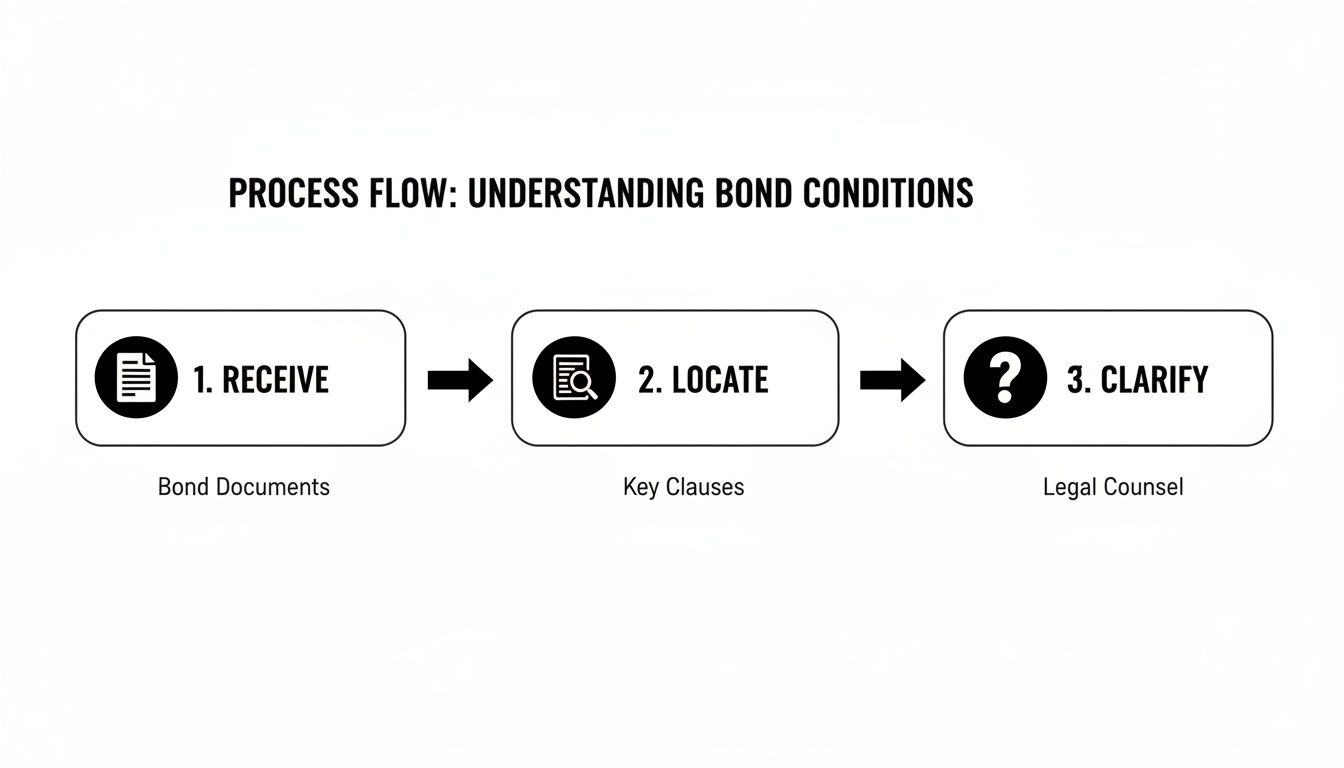
This visual guide hits on the essential first steps: get your bond paperwork, find the specific clauses about travel, and talk to your lawyer to clear up any confusion before you ask the court for anything.
The Timeline and What Happens Next
When it comes to the question "can you leave the state on bond," timing is everything. Don't wait until the week before your trip to ask. You need to get this request filed well in advance, ideally several weeks ahead of time. This gives the court system enough runway to process the motion and allows all the parties involved to respond. A last-minute request just looks like poor planning and can easily annoy a judge.
Once your attorney files the motion, a copy goes to the District Attorney's (DA) office for review. The prosecutor has the right to object to your travel. They might argue that your trip makes you a flight risk or that your reason isn't important enough, especially if the charges you're facing are serious.
Crucial Takeaway: Just filing the motion means nothing. Do not book non-refundable flights or make any concrete plans. You cannot leave the state until you have a signed order from the judge physically in your hands.
If the DA doesn't object, the judge might just sign the order without a hearing. But if the DA does object, or if the judge has their own concerns, you'll likely be scheduled for a court hearing. At that hearing, your attorney will argue your case, and the judge will make the final call. These procedures can be confusing, so having an experienced team on your side is a huge advantage. If you need help or have questions in Jefferson County, the folks at Express Bail Bonds are a solid resource. You can easily find our office on Google Maps.
Your Bail Bondsman's Role In Out-Of-State Travel

Getting a judge's sign-off for travel is a huge step, but it’s only half the journey. Before you even file that motion with the court, there's another conversation you absolutely have to have: you need to talk to your bail bondsman. This isn't just a courtesy—it’s a non-negotiable part of the contract you signed.
Your bondsman isn't just a service you hired; they are your financial guarantor. They put a significant amount of their own money on the line with the court, promising you’ll show up for every hearing. Because they are shouldering 100% of the financial risk, they have a direct, vested interest in making sure you follow every rule to the letter.
Think of it this way: the bail bond company has essentially co-signed a massive, high-stakes loan for you. Just like any lender, they have the right to set conditions to protect their investment. This gives them the authority to approve or deny your travel plans, completely independent of whatever the judge decides.
Why Your Bondsman Must Approve Your Travel
When you ask, "can you leave the state on bond," you have to see it from the bondsman's point of view. Their approval comes down to one thing: managing risk. If you travel and miss a court date, they are on the hook for the entire bail amount, which could easily be tens or even hundreds of thousands of dollars.
For that reason, your contract clearly states you must inform them before making any travel plans. A bondsman has every right to say no, even if a judge has already said yes. If you ignore this and leave anyway, you are in direct breach of your contract, and they can have your bond revoked immediately.
Here’s a look at what your bondsman is weighing:
- Your Track Record: Have you been reliable with check-ins and followed all the other conditions?
- The Reason for the Trip: Is it a verifiable family emergency or a required work trip? A request for a vacation is always a tougher sell.
- Your Destination: A day trip to a neighboring state is viewed very differently than an international flight.
- The Seriousness of the Charges: More severe charges automatically mean you're considered a higher flight risk.
The bail bond industry is a global business, and this system of financial accountability is recognized worldwide. In fact, the global bail bond services market was valued at $5.7 billion as of August 2025, which shows just how standardized these financial guarantees have become. Knowing this helps explain why your Colorado bondsman sticks to such strict protocols.
How to Present Your Request for the Best Outcome
A good, transparent relationship with your bondsman is your best asset. When you approach them about traveling, be prepared, be professional, and above all, be honest. Giving them the same detailed information you give your attorney goes a long way in building trust.
You aren't just asking for a favor; you're showing them you're still committed to seeing your case through. A well-organized request demonstrates that you respect the process and their critical role in it.
To give your request the best chance of being approved, bring the following:
- A Detailed Itinerary: This means flight numbers, hotel confirmations, and the full address of where you'll be.
- Solid Contact Information: Provide a phone number where they can reliably reach you at any time while you're away.
- Proof of Purpose: Back up your request with documents, like a formal letter from your employer, a wedding invitation, or a note from a doctor about a family emergency.
In some situations, a bondsman might approve your travel but add a few extra conditions to reduce their risk. This could mean more frequent check-ins by phone, text, or an app, or they might require temporary GPS monitoring, which you would have to pay for.
Proactive, clear communication is everything. For more insight into what your agent does behind the scenes, you can learn more about what a bail bondsman does in our detailed guide. Always treat your bondsman as a partner in the process—it makes everything smoother for everyone involved. For directions to our office, you can find us here.
The Severe Consequences of Leaving Without Permission

Thinking about just skipping the formal process and leaving the state without getting the okay first? Let me be blunt: that's a catastrophic mistake. Traveling without permission from both the court and your bondsman isn't a minor slip-up. It's a direct violation that instantly sets off a chain reaction of serious legal and financial consequences.
Ignoring the rules starts a domino effect. The very first thing that happens is the judge will issue a bench warrant for your arrest. This isn't just a local problem—that warrant gets plugged into state and national law enforcement databases, effectively making you a fugitive.
At that exact moment, you've also broken your contract with the bail bond company. This gives them the legal authority to track you down, apprehend you, and bring you back to jail so they can get their money back from the court.
The Financial Nightmare of Bond Forfeiture
One of the worst financial hits you can take for violating your bond is something called bail forfeiture. This is the formal court process where, because you failed to follow the rules, your bond is declared void. The second that happens, the court demands the full bail amount be paid by your bail bond company.
This instantly creates a massive debt that you and your cosigner are now legally obligated to repay to the bondsman. If your bail was set at $50,000, that's the amount you're on the hook for—not just the small percentage you paid upfront.
When you leave without permission, you turn a manageable premium payment into a life-altering debt. The court will not hesitate to forfeit the bond, and the bail bond company is legally obligated to use every available means to collect that full amount from you and your cosigner.
This can quickly escalate to having your wages garnished, liens placed on your property, and dealing with aggressive collection agencies. To really grasp how serious this is, you can learn more by reading our detailed guide that answers the question, "What is bail forfeiture?"
New Criminal Charges and Extradition
On top of the immediate arrest warrant and financial disaster, leaving the state without permission stacks on brand-new legal problems. The judge will hit you with a new charge, usually called "Failure to Comply" or "Failure to Appear," which is a completely separate crime from what you were originally arrested for. That new charge brings its own penalties, including more potential jail time and fines.
This is also where extradition enters the picture. Extradition is the official process where law enforcement in another state arrests you and forcibly returns you to Colorado to face the music.
Here’s how that typically plays out:
- Arrest: You get picked up in another state because of the outstanding Colorado warrant.
- Detention: You'll sit in a local jail in that state, often for weeks, while the two states sort out the legal paperwork.
- Forcible Return: Law enforcement officers will then transport you all the way back to the original county in Colorado.
- Facing a Judge: You'll end up back in front of the original judge, now facing not only your initial charges but also the new failure to comply charge. Your chances of getting out on bail again are next to zero.
The risks are just too high. The only smart, safe path forward is to follow the rules. The team at Express Bail Bonds is here to help you avoid these devastating outcomes by guiding you through the proper channels.
What to Do If Your Travel Request Is Denied
It’s easy to feel deflated when the court denies your request to travel, but a ‘no’ isn't always the final answer. It’s important to remember that the judge’s decision isn't personal; it's based on a risk assessment. The key is to figure out why they said no, because that’s your road map to a potential yes.
The court’s number one job is making sure you show up for your future court dates. A denial usually boils down to a few common concerns. Maybe the charges are serious, or perhaps your request was too vague and left the judge with too many unanswered questions.
Common Reasons for a Travel Denial
Judges are trained to look for red flags when someone on bond asks to leave the state. Here are some of the most common reasons they pump the brakes:
- Severity of Charges: The more serious the alleged crime, especially if it's a high-level felony, the warier the court will be.
- Vague Itinerary: A motion that just says "visiting family in Texas for a week" is much weaker than one with flight confirmations and a specific address.
- Prior History: If you’ve ever missed a court date or violated bond conditions in the past, that history will almost certainly lead to a denial.
- Prosecutor's Objection: The District Attorney can object to your travel. If they stand up and argue you’re a flight risk, the judge will take that very seriously.
Think of a denial not as a closed door, but as feedback. It's the court telling you what specific concerns you and your attorney need to address. This is your chance to go back, strengthen your request, and try again.
Actionable Next Steps to Take
Your first phone call should be to your lawyer. They are the only ones who can communicate directly with the court or the prosecutor to find out the specific reason for the denial. Once you know the 'why,' you can build a new strategy.
For instance, if the itinerary was the problem, your attorney might file a new motion. This time, you'd include flight receipts, hotel bookings, and maybe even a letter from an employer or family member at your destination to verify the trip's purpose. Sometimes, you can overcome a judge's hesitation by volunteering for stricter conditions, like wearing a GPS monitor or agreeing to daily phone check-ins.
It is absolutely critical to keep your bail bondsman in the loop. Let them know the court said no and what your lawyer plans to do next. Their support matters, and they may have insights that could help get a revised request approved. Understanding the stakes of compliance is crucial, which is why our guide on what happens if you miss court is a must-read.
The bail bond industry is a significant part of the justice system, helping secure pretrial release for countless individuals. In fact, the U.S. market is expected to hit $3.5 billion by 2025, growing by 1.2% in that year alone, which highlights just how many people rely on these services. You can learn more about the growth of the bail bond market on ibisworld.com. For any questions about your specific situation, visit our main site at https://expressbailbonds.com/.
Your Top Questions About Traveling On Bond, Answered
When you're out on bail, life doesn't just stop. Questions about travel are bound to come up, and navigating the rules can feel like walking a tightrope. Getting the right answers is the key to protecting your freedom and avoiding a costly mistake.
Here are some of the most common questions we get from clients and their families.
Can I Go On Vacation While I'm On Bond?
This is a tough one, and honestly, it’s a long shot. While it's not technically impossible, getting a judge to sign off on a vacation is much harder than getting approval for essential travel, like for work or a family emergency. From the court's perspective, a vacation is often seen as a luxury that creates an unnecessary flight risk.
If you're going to try, your request needs to be airtight. You can't just ask for a week off. You'll need to provide a rock-solid, detailed itinerary and a very compelling reason why this trip is important. Vague plans are a guaranteed "no."
What if There's a Last-Minute Family Emergency?
When you get that dreaded call—a sudden death in the family or a serious medical crisis—your first instinct is to drop everything and go. Do not do this. As hard as it sounds, leaving without permission, even in an emergency, is a serious violation of your bond.
Your first move should be to call your attorney and your bail bondsman. Immediately. They know how to handle these situations and can file an emergency motion with the court, explaining the critical nature of your request. No matter how dire things seem, never leave without getting explicit, documented approval first.
A core principle of being on bond is that communication is your lifeline. In an emergency, your first move isn't to travel—it's to communicate with your legal and financial support team. They are equipped to handle these urgent requests through the proper legal channels.
Do I Really Need Permission for a Quick Day Trip to a Neighboring State?
Yes, you absolutely do. This trips up a lot of people, but the rules are incredibly strict. Any time you cross state lines—whether it's for a few hours to see family or a few days for a work meeting—you are violating your standard bond conditions unless you have prior authorization from the court.
There are no loopholes for short trips. Thinking "it's just for the afternoon" is a dangerous assumption. When you're figuring out if you can leave the state on bond, the only safe answer is to assume you need permission for any out-of-state travel. It's the only way to avoid an accidental violation that could land you right back in jail.
As a Cosigner, Am I on the Hook if the Defendant Leaves the State?
Yes, you are 100% liable. When you cosigned that bond, you signed a legally binding contract. That contract makes you financially responsible if the defendant doesn't follow the rules. If they leave without permission, miss court, and the bond is forfeited, you are obligated to pay the entire bail amount to the bond company.
This is the biggest risk of cosigning a bond, and it’s why trust and open communication are so important. Your financial security is directly tied to the defendant’s ability to comply with every single rule. For more answers, you can check out our guide covering frequently asked questions about bail bonds.