Whether you get your bail money back hinges entirely on one crucial decision: how you paid it in the first place.
If you posted the full bail amount in cash directly to the court, that money is yours to reclaim once the case is over, minus some court fees. But if you went through a bail bondsman, the money you paid them was a non-refundable fee for their service. You don't get it back.
Cash Bail vs. A Bail Bond: What Actually Comes Back
This is where a lot of confusion comes in. Many people don't realize that paying cash to the court and paying a premium to a bondsman are two completely different financial paths. Grasping this distinction upfront is key to knowing what to expect financially down the road.
This decision tree breaks it down clearly, showing the two routes for posting bail and what happens to your money in each scenario.
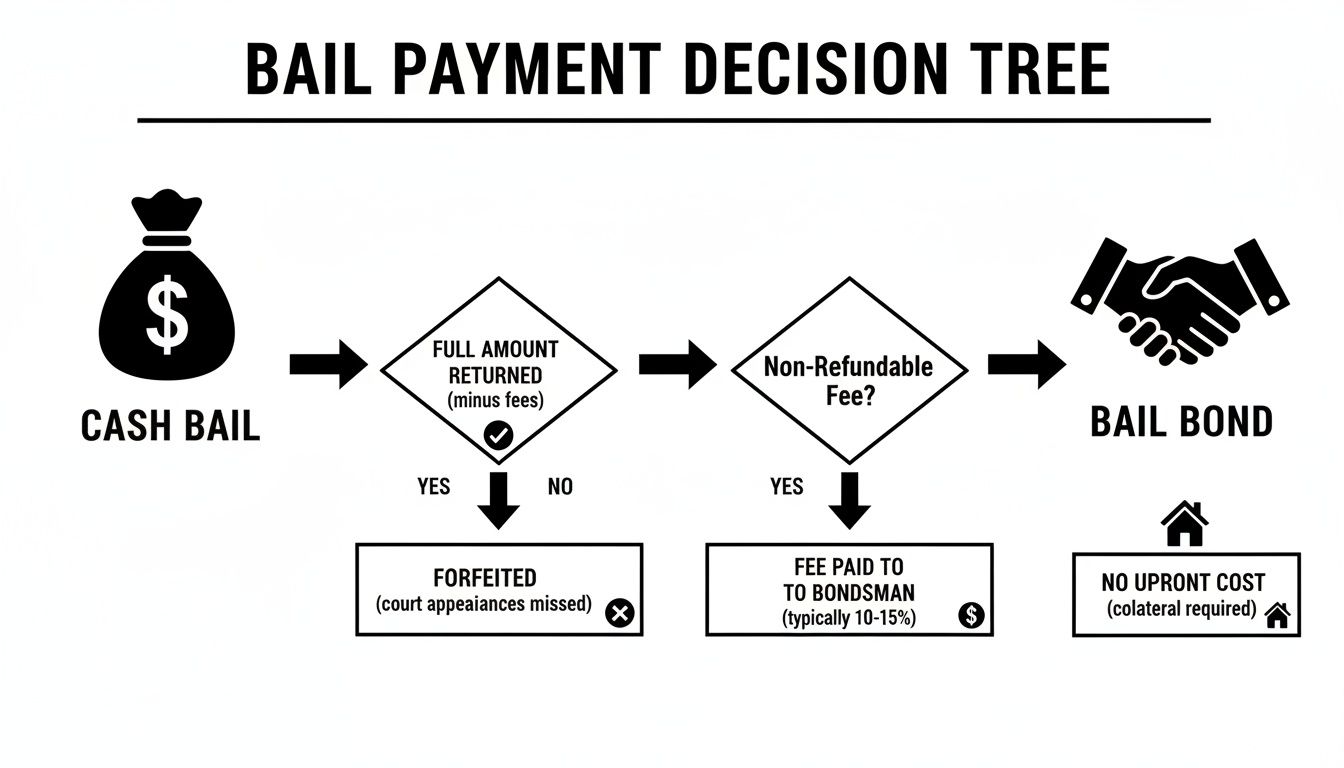
As you can see, the path you choose directly impacts whether you're making a refundable deposit or paying a permanent fee. It’s a choice with major financial consequences.
Let's break down the financial reality of each option. The table below gives you a quick, at-a-glance comparison.
Cash Bail Refund vs. Bail Bond Premium: What You Get Back
| Factor | Cash Bail (Paid to Court) | Bail Bond (Paid to Bondsman) |
|---|---|---|
| Initial Payment | 100% of the full bail amount | A percentage of the bail amount (typically 15% in Colorado) |
| Is it Refundable? | Yes, most of it. | No, this is a non-refundable service fee. |
| What You Get Back | The full amount minus court costs, administrative fees, and any fines. | $0. The premium is the bondsman's payment for their service. |
| Who Returns It? | The court clerk's office. | N/A |
Ultimately, paying cash bail means a bigger upfront cost but the potential for a significant refund. A bail bond costs less initially, but that payment is gone for good. If you're facing this decision, Express Bail Bonds can help you understand your options.
The Cash Bail Refund Path
When you pay cash bail, you're essentially handing the court a security deposit. You give them the full bail amount as a guarantee that the defendant will show up for every single court date.
As long as the defendant holds up their end of the bargain and the case is officially closed—whether it’s dismissed, they’re acquitted, or they’re sentenced—the court is required to return your money.
But hold on, it's rarely the full amount. The court will almost always deduct things like:
- Administrative processing fees
- Any outstanding court costs
- Fines or victim restitution the judge ordered as part of the sentence
And don't expect it overnight. After a judge exonerates the bond (the official term for releasing it), it can still take weeks, sometimes even a couple of months, for the court clerk's office to process the paperwork and mail you a check.
The Bail Bond Service Path
Going through a bondsman works very differently. Instead of paying the court, say, a $10,000 bond, you pay the bondsman a smaller, non-refundable premium. Here in Colorado, that fee is typically 15% of the total bail. So for that same $10,000 bond, you’d pay the bondsman a $1,500 fee.
That fee is their payment for taking on the full financial risk and posting the entire $10,000 with the court on your behalf. Since it's a fee for a service they've already provided, you don't get that premium back, no matter how the case turns out.
As you dig into the differences between a surety bond vs cash bond, you'll see they serve very different needs. It's a system that has become incredibly common; from 1990 to 2009, the use of commercial bonds by felony defendants in the U.S. more than doubled, jumping from 24% to 49%. It shows just how many people rely on this service when cash bail is out of reach. For expert guidance in Jefferson County or Centennial, our team is ready to assist.
Getting Your Cash Bail Back: A Step-by-Step Guide
If you paid the full bail amount directly to the court in cash, think of it as a security deposit. This section breaks down exactly how to get that money back. The entire process hinges on one simple, yet crucial, rule: the defendant must show up for every single court date.
Miss one appearance, and you risk losing the entire amount. The refund process can only kick off once the case is completely resolved—meaning it's been dismissed, the person was found not guilty, or a sentence has been handed down.
What Happens After the Case Ends
When the case wraps up, a judge will issue an order to "exonerate" the bond. That’s just the legal term for releasing the funds. But don't mistake that for an instant payout. You can't just head over to the clerk's office and expect to walk out with your cash.
This order is the starting pistol, not the finish line. From the judge, the paperwork travels to the court clerk's office for processing. And this is where things can get a little complicated.
Be prepared: The check you receive will almost always be less than the amount you originally posted. Courts are legally allowed to deduct a variety of fees directly from your bail money before sending you the remainder.
This is a point of frustration for a lot of people, but it's standard procedure. Before they cut that check, the clerk will subtract:
- Administrative Fees: Most courts take a slice for the paperwork and handling involved.
- Court Costs: These are standard operational fees tied to the case.
- Fines or Restitution: If the defendant owes fines or has to pay victim restitution as part of their sentence, the court will take that money directly from the bail you posted.
Knowing about these potential deductions upfront can save you a lot of headaches and help you set realistic expectations.
How Long Does It Actually Take?
Once the judge has exonerated the bond and the clerk has tallied up all the deductions, a check is finally mailed. It goes to the person who is officially listed as paying the bail—the name on the original receipt.
So, the big question: how long is the wait? Here in Colorado, the timing can swing pretty widely from one county to the next. As a general rule, you can expect to wait anywhere from four to eight weeks after the case officially closes. If the court is particularly busy or facing a backlog, it can stretch even longer.
This delay and the guaranteed deductions are precisely why so many people choose to work with a bondsman instead. It's often more predictable. Missing a court date has serious consequences, and you can learn more about what bail forfeiture really means and how to avoid it.
Ultimately, posting cash bail means tying up a significant amount of your own money for months on end, only to get a smaller amount back after a lengthy wait. For a faster, more predictable process, contact Express Bail Bonds today.
Getting Your Collateral Back from a Bondsman
When you put up collateral for a bail bond—whether it's a car title, property deed, or other valuables—your top priority is getting it back safely once the case is resolved. Remember, unlike the non-refundable premium you paid the bondsman, your collateral is your property. The clock on getting it back starts ticking the second the judge closes the case.
The magic word here is exonerated. When a judge exonerates the bond, it's legal-speak for "the defendant did their part." They showed up to all their court dates, so the bondsman's financial risk to the court is officially over. This is the green light your bondsman needs to start the process of returning your property.
Kicking Off the Collateral Return Process
A reputable bondsman should move on this quickly. Once they get the official word from the court that the bond has been exonerated, they have what they need to release your assets.
That said, don't just sit back and wait. Be proactive. It's smart to call your bondsman as soon as you get confirmation the case is over. They will almost certainly need a copy of the official court paperwork showing the bond exoneration.
This single document is your proof that all legal obligations are complete. Having your original bond agreement and payment receipts on hand will also help everything go smoothly. To get a better feel for the bondsman's role in this, you can learn more about what a bail bondsman is and what their responsibilities are.
Timelines and What to Expect
How long it takes to get your collateral back really depends on what you put up.
- Physical Valuables: If you handed over jewelry or important documents, you can usually pick them up directly from the bondsman’s office within a few business days after they have the exoneration notice.
- Car Titles: For a vehicle, the bondsman has to formally release the lien they placed on the title. This is a bit more involved and typically takes about 7 to 14 business days.
- Real Estate: This is the most complex scenario. Releasing a lien on property requires the bondsman to file a Deed of Reconveyance with the county recorder's office. It's a formal legal process that can take several weeks to be officially recorded and finalized.
From day one, a solid written agreement is your best friend. It should spell out exactly what happens and how long it takes to get your collateral back. This level of transparency is what you should expect from a trusted agency.
Client Experience: We pride ourselves on making this process as clear and professional as possible. As one of our clients in Jefferson County, Colorado, shared, "They were professional… I used my truck for collateral and got the title back promptly." You can see for yourself what clients are saying.
One final, critical point: any outstanding balance on your premium must be paid in full before your collateral can be returned. Make sure your account is completely settled to prevent any hold-ups. If you have any questions, our team at Express Bail Bonds is here 24/7 to walk you through it. Our job isn't done until your assets are safely back in your hands.
Common Pitfalls That Put Your Money at Risk
When you're dealing with the bail process, a few seemingly small mistakes can end up costing you big time, putting your cash or collateral in serious jeopardy. The single biggest, most devastating error is also the simplest: the defendant doesn't show up for their court date. That one misstep sets off a chain reaction of bad news that's incredibly difficult to undo.

The moment a defendant misses court, the judge issues a bench warrant and declares the bail forfeited. If you posted cash bail directly, the court keeps it all. Every last cent. If you worked with a bail bondsman and put up collateral, that bondsman is now responsible for paying the full bail amount to the court, and you can bet they'll start the process of seizing your collateral to cover their loss.
It’s a high-stakes game where communication and reliability are everything. We've seen it happen too many times, which is why we put together a detailed guide on what happens if you miss a court date to explain the consequences.
The Nightmare of Bail Forfeiture
Bail forfeiture isn't just some abstract risk; it's the number one reason people lose their money in this system. Once the court declares the bail forfeited, trying to get those funds back is a massive uphill climb. It often means hiring an attorney just to petition the court, and even then, there's absolutely no guarantee you'll see a dime.
And it's not always because someone is trying to flee. Forfeiture can happen for mundane, everyday reasons:
- Honest Mix-Ups: A defendant simply misreads the date or time on their court paperwork. It happens.
- Life Intervenes: A car breaks down on the way to the courthouse, or the bus runs late.
- Family Emergencies: A sudden illness or a crisis at home can make a court appearance impossible.
Unfortunately, the reason often doesn't matter—the financial result is the same. This is why staying in constant contact with the court and your bail bondsman is so critical. A good bondsman will help the defendant keep track of their court dates to avoid these costly mistakes.
Hidden Fees and Unpaid Balances
Beyond the disaster of a missed court appearance, other, more subtle issues can chip away at your refund.
If you paid cash bail, the court has the right to deduct any unpaid fines, fees, or court-ordered restitution directly from your bail money before sending it back. You might be expecting a $5,000 check in the mail, only to open it and find it's for $4,200 because of various costs you weren't tracking.
When you use a bail bond, the common pitfall is falling behind on a premium payment plan. If you've arranged to pay the bondsman's fee in installments and miss payments, they can—and will—hold onto your collateral until your balance is paid in full. It’s all in the contract you sign.
It's worth remembering that the cash bail system itself creates enormous financial strain. Nationwide, over 60% of people in local jails are there not because they've been convicted, but because they simply can't afford to post bail. This highlights the pressure it puts on families long before a case is ever decided.
Whether you're in Centennial or Jefferson County, staying on top of these financial details is non-negotiable. Make sure your payment plan is current and that you have a clear understanding of any potential court deductions. A reputable bondsman will always provide a clear breakdown of costs and obligations. We pride ourselves on clear communication, which our clients appreciate in their reviews.
Why a Professional Bondsman Is Your Best Bet
After wading through the murky waters of cash bail refunds and the real risk of losing your collateral, you start to see why there’s a much simpler, more predictable path. Instead of tying up thousands of your own dollars and then fighting with court bureaucracy for a partial refund, working with a professional bondsman is an investment in certainty.
It’s a different way of thinking. This approach isn't about getting bail money back—it's about not having to risk your life savings in the first place.
When you work with a service like Express Bail Bonds, you pay a non-refundable premium for our service. In Colorado, that fee is typically 15% of the total bail amount. In exchange, we shoulder the full financial risk with the court. You get your loved one released quickly without draining your bank account or starting that long, uncertain countdown for a check from the court.
The Value of Expertise and Speed
Let's be honest, the legal system is intimidating, especially when you're already stressed out. A good bondsman is your guide through that maze. We handle all the paperwork, deal directly with the jail, and post the bond efficiently to get things moving.
Our experience in places like Jefferson County and Centennial means we know the local quirks and procedures inside and out.
This know-how gets rid of the guesswork and prevents costly mistakes. You're not trying to figure it all out on your own; you have a partner whose entire job is to make the process smooth. And with our 24/7 online service, help is there the moment you need it. As one of our clients put it, our process is "professional" from start to finish. You can see what others have said about their experiences in our reviews.
Predictability in an Unpredictable Time
One of the single biggest advantages of using a bondsman is financial clarity. You know the exact cost upfront: the non-refundable premium. That’s it.
There are no surprise court fees sliced off your refund weeks later and no wondering if your check got lost in the mail. This predictability lets you budget and focus your resources on what really matters—the legal case ahead. For a deeper dive into this, check out our guide on how bail bonds work.
By paying a set fee, you transfer the entire financial risk of the full bail amount from your shoulders to ours. We guarantee the defendant's appearance to the court, providing security for everyone involved.
This arrangement provides an incredible sense of relief. You aren’t just paying for a release from jail; you’re paying for a service that simplifies a complex situation, reduces financial strain, and brings a little calm to a chaotic time. It’s about protecting your assets and your peace of mind. As another client shared, our goal is a "smooth and professional resolution," and you can read their story here.
If you need immediate, professional help, our team is ready to go. Call or text us anytime at 720-984-2245, or visit us at Express Bail Bonds.
Your Top Questions About Getting Bail Money Back
The bail process can feel confusing, and once the case is over, the biggest question on everyone's mind is, "How do I get my money or property back?" Let's walk through the most common questions we get from clients here in Colorado so you know exactly what to expect.
How Long Does It Take to Get Cash Bail Back in Colorado?
If you paid the full bail amount in cash directly to the court, the refund process doesn't even start until the judge officially closes the case. Once that happens, you’re typically looking at a wait of four to eight weeks for the court to mail you a check.
Honestly, this timeline can be a bit of a moving target and often depends on the county. The delay comes from the court clerk’s office having to process the "bond exoneration" (the official release of the bond), deduct any court costs or fines from your payment, and then finally cut the check. If they have a backlog, it can sometimes take even longer.
What Happens to My Bail Money if the Charges Are Dropped?
Getting the news that charges have been dropped is a huge relief. It also simplifies your bail situation quite a bit.
If you posted a cash bond with the court, you're set to get a full refund. They might hang on to a small administrative fee, but the vast majority of your money will be returned.
If you went through a bondsman, the bond we posted is now released, and our financial obligation to the court is over. This clears the way for us to return any collateral you put up, like a car title or property deed, based on the agreement you signed. The premium, however, is the fee for our service, so that part is not refundable.
Is the Bail Bond Premium Ever Refundable?
This is a big one we get asked all the time, and the answer is simple: no, the premium you pay a bail bond company is never refundable. It’s best to think of it as a fee you paid for a service that has already been completed.
The moment we post the bond, we take on the full financial risk for the entire bail amount, which is what gets your loved one out of jail. That service is considered finished as soon as they are released. The final outcome of the case—whether it ends in a dismissal, an acquittal, or a conviction—doesn't change the fact that we provided that service upfront.
Your premium is the cost of transferring the financial risk from your shoulders to the bonding agency. It guarantees the defendant's appearance without you having to tie up your personal assets.
What if There Is a Delay in Getting My Money or Collateral Back?
It’s frustrating when you’re expecting money or property back and it's taking longer than you thought. Your first step depends on how you posted bail in the first place.
- For a cash bail refund: The only people who can help you are at the courthouse. Your point of contact is the clerk of the court where you originally paid the money. Give their office a call and ask for a status update on your refund.
- For collateral return: This comes down to the contract you signed with your bondsman. Any reputable agency will have a straightforward, professional process for returning your property as soon as they get official notice from the court that the bond has been exonerated.
Having a trusted partner to guide you through these steps makes all the difference. For any questions about the bail process, from Centennial to Jefferson County, don’t hesitate to contact Express Bail Bonds.
At Express Bail Bonds, our commitment is to make the entire bail process as clear and stress-free as we can. For immediate, professional help anywhere in Colorado, visit Express Bail Bonds. You can also learn about our local services in Jefferson County and Centennial, or read client reviews like this one and this one to see why we're a trusted partner during difficult times.