
The call comes late, from a number you don't recognize, and it's your child on the line, or a friend of theirs, or a deputy reading a name you know. Maybe your son was picked up two hours ago and nobody has told you where he is. Maybe your daughter is in a holding cell in a county you've never driven through. You have a phone, a name, and no idea which call to make first.
An arrest isn't a single event you respond to once. It's a sequence of decisions, and the first ones determine what the later ones cost you. This is a checklist problem before it's a legal problem.
Write the order down: counsel, custody and bond status, a bail agent, money and cosigner terms, childcare, then a written compliance calendar. Families who work in that order stop improvising. Families who skip around lose hearing dates, pay the wrong party, or sign a contract they don't understand at 1 a.m. The next steps are for parents, not for attorneys alone, and the parents who handle them calmly are the ones who read the paperwork out loud to somebody before signing it.
Find Your Family Member and Confirm the Bond Status
The first call most parents make is to the jail, and the person who answers can't tell you much until you ask a specific question. Location first. Status second. Everything else follows from those two answers.
In Colorado the notification isn't a courtesy call. When a young person is taken into custody and not released while charges are pending, the officer must notify the judicial-district screening team, and that team must notify the parent, guardian, or legal custodian "without unnecessary delay," as Colorado's juvenile notification statute sets out. The notice must also explain that if the child is placed in detention or a temporary holding facility, the family has a right to a prompt hearing on whether continued detention is justified. That right is why the hearing time matters more in the first hour than the bond amount does.
What to confirm on day one
| Check | Where to get it | Why it matters |
|---|---|---|
| Custody location and facility | Jail booking desk or county inmate search | Transfers between facilities are common, so confirm it the same day |
| Booking status and charges | Jail staff or court clerk | The bond is tied to a specific offense, and the charge shapes the conditions the court sets |
| Whether bond is set or a hearing is needed | Court clerk or jail | Colorado gives a right to a hearing when the court has not already set bond |
| Bond type and amount | Written court order or jail record | Cash, property and commercial surety bonds work differently and cost different amounts |
| Next court date and hearing time | Court clerk or case docket | A missed hearing can trigger a warrant and revoke release |
| Processing fee at this facility | Jail finance or booking staff | Some jails add a fee on top of the bond, so ask for it in writing |
Two rows get skipped, and both cost money. Families assume the facility they first hear about is the facility where the person stays. Transfers happen, and a bond posted at the wrong jail delays release by hours you don't have. The other skip is the court date. Write the hearing time down before you do anything else, because a missed appearance is the fastest route from a manageable charge to a warrant.
By the end of that first call you should have four things on paper: the facility name, the case or booking number, the bond amount if one has been set, and the next court date with its time and courtroom. If nobody will give you a facility name yet, work backward through the county inmate lookup, such as the statewide inmate search tool, before you start dialing jails one at a time.
Get Counsel Before Anyone Discusses the Case
The order inside the first 24 hours matters more than the speed. Defense counsel goes before the bail agent, and both go before any conversation about what happened.
- Find out who is appointed, today. Call the jail booking desk or the court clerk and ask which public defender office covers that judicial district. If the family intends to hire private counsel, call two or three defense attorneys and ask directly about juvenile experience, caseload, and fee structure before choosing.
- Give one instruction to everyone who will visit or answer the phone. Nobody discusses the alleged offense with police, with the alleged victim's family, with witnesses, or on social media. Case facts go to counsel, and the parent's job is to hold that line, including with relatives who mean well.
- Write the family's account in date order. Put the booking number and facility name at the top of the page. Hand it to your attorney, not to an investigator who calls asking friendly questions.
- Ask counsel which conditions will reach into your household. No-contact orders, travel limits, who may transport or supervise minors, and whether school records or a treatment contact would help at the detention hearing all change how the next week runs.
- Put the first court date and counsel's number in the same place. One note, shared with everyone who might answer your phone, so a docket call doesn't get lost between two people who each thought the other had it.
A single early misstep is not destiny. An OJJDP summary of juvenile justice research covering 161,057 youth referred to juvenile court found that just over 60% did not return to court after their first referral. What narrows the options is talking without advice before counsel has seen the file. Keep your own notes separate from anything your child writes down.
Counsel handles the case. Nobody automatically handles you. If the worry is keeping you from sleeping and making clear calls, getting started with Tampa Bay therapy is a low-effort way to talk to a licensed clinician while the legal process runs. Denver families can also read up on criminal defense representation in Denver before the first attorney call, so the questions are sharper.
How to Contact a Bail Agent Step by Step
A parent often has five facts and no idea what to do with them. Start there. Colorado gives a person in custody a right to a hearing to determine bond and release conditions when a court hasn't already set them, and the statute states plainly that filing a criminal charge is not a prerequisite to bail, per Colorado's 2019 bail statute. That means money alone doesn't produce a release. Bond may not exist yet. Confirm status first, then call an agent.
Securing a bail bond takes three steps: initial contact, completing paperwork with details about the detained person and the charges, and the bondsman posting bail with the court. Express Bail Bonds helps clients with necessary paperwork and guides them through the bail process, including the legal aspects of bail. If this is your first time dealing with a bondsman, how to use a bail bondsman explains what the agent does versus what the court does, a distinction that matters when deadlines are close.
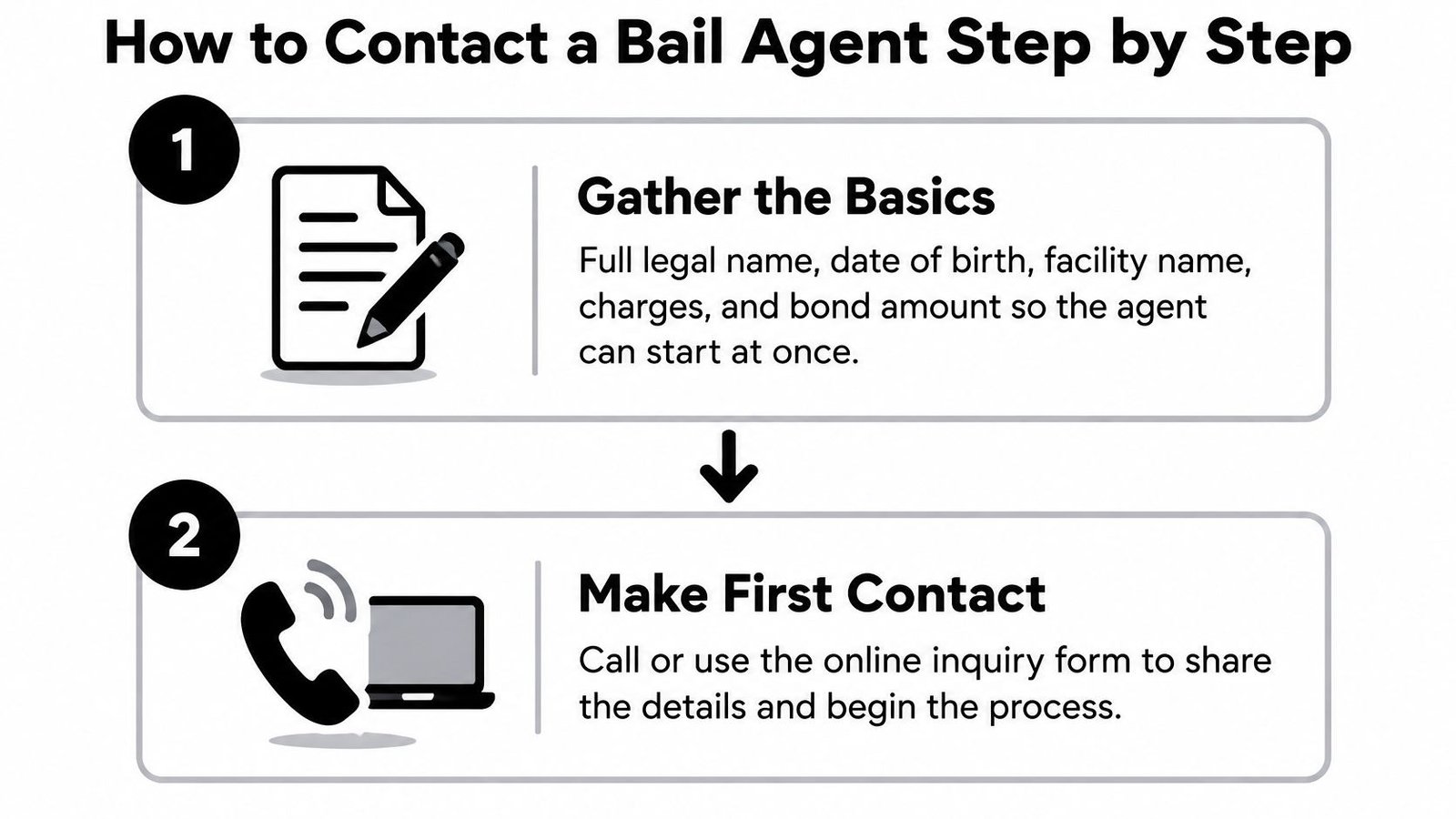
The six steps, and the slip inside each one
- Gather the basics before you dial. Full legal name, date of birth, facility name, charges, and bond amount. An agent can start the moment those five items are in hand. Without them, the first conversation turns into a search exercise.
- Make first contact by phone or the online inquiry form. Use the first call to ask about costs and what being a cosigner means, because those answers shape the rest of your week. The practical slip is leaving a message, waiting for a callback, and letting the hearing pass in the meantime. If you want to begin online, fill out the inquiry form on the Express Bail Bonds website.
- Complete the application with full details on the detained person and the charges. An out-of-state relative can fill it out and submit it securely online, so geography isn't a blocker. Remote signing is available, so a family member does not need to travel to the Golden facility in person.
- Read the contract and ask whether collateral is part of the deal before signing. Express Bail Bonds explains the terms upfront and in plain English. Ask until you know what you are agreeing to, especially if collateral is part of the arrangement.
- Pay the premium and any processing fees in the amount quoted to you in writing. Unclear or partial payment details are a common cause of delay, so confirm the quoted amount before sending money. Keep the written amount with the rest of your release notes.
- Let the agent post the bond. Once paperwork is signed and the premium is paid, a licensed agent goes to the jail and posts the surety bond with the court clerk. The Express Bail Bonds team then follows up to confirm the defendant is out and gives guidance on court date compliance and bond conditions.
For families in the Golden area, the Jefferson County bail bond page walks through the online application, the payment, signing contract documents, and posting at the relevant detention facility. Families outside Colorado can use the same process to help a loved one without flying to the state.
The bond gets signed once. The conditions it creates get tested every week until the case closes. Cosigners should stay in regular contact with the defendant, remind them of upcoming court dates, and tell the agency if the defendant moves or changes their phone number. After release, the defendant must keep in touch with the bail agent, whether through a weekly phone call or a visit to the office. Court and agent conditions, including travel restrictions, no-contact orders, and mandatory classes, are required.
Clients who opt in to SMS may receive appointment reminders and follow-up messages from Express Bail Bonds, including court date reminders, payment reminders, and customer service updates such as courtroom location or hearing status. You can opt in verbally with a representative or by sending a message requesting assistance. If you don't want texts, decline the SMS consent box. If you opt out later, you can text START to re-subscribe.
Costs, Collateral and Cosigner Duties
Start with the category, because the categories are not interchangeable. Colorado's official pretrial reporting framework counts cases posted through a commercial surety bond, cases released on all-cash bonds, and cases involving cash or property bonds as separate groups, as the state's judicial branch pretrial report shows. A surety arrangement runs through a bail-bonding agent. A cash or property requirement may carry different payment, refund, and collateral consequences. Ask which category the court ordered before you send anyone money.
| Item | What to ask | Why it matters |
|---|---|---|
| Premium | Exact percentage, whether it is refundable and when it is due | The premium is usually non-refundable, so confirm it before signing |
| Processing or booking fee | Whether this facility charges a bond-processing fee | Gilpin County's jail guidance lists a $10 bond-processing fee and treats other jail debts separately, so ask which charges actually block release |
| Collateral or lien | Whether property or a lien is required | Collateral can be held until conditions are met |
| Unrelated jail debts | Whether older jail charges must be cleared | In some counties a money bond does not require paying other jail debts |
| Cosigner obligations | Who signs and what promise they make | A cosigner's signature is a binding promise that the defendant attends every hearing |
What a cosigner actually signs
By signing as cosigner, you make a legally binding promise that the defendant will appear at every required hearing. That is not a formality or a character reference. If the person doesn't show, the obligation lands on you, which is why the signature deserves the same scrutiny as a loan. The cosigner responsibilities that follow from that signature are worth reading before you pick up a pen.
Express Bail Bonds explains the terms upfront and in plain English, so you know whether collateral is part of the deal before agreeing to anything. Colorado's standard premium is 15%, and on bonds over $5,000 the agency often secures 10% with an approved cosigner, which is worth asking about if the bond is large.
For anything involving real property or a five-figure amount, have an attorney read the contract before you sign it. Keep the signed contract, every receipt, the agent's direct phone number, and the court clerk's contact details in one folder. When a payment dispute or a missed notice comes up months later, that folder is your defense.
Keep Children and Routines Steady While They Are Away
Say the arrest happens on a Tuesday night and there are two children asleep upstairs, one in second grade and one who just turned three. Wednesday morning still has a school run, a medication schedule, and a bus that comes at 7:40. The legal problem can wait until nine. The children can't.

The first 24 hours of childcare
- Name a temporary caregiver in writing. Write the name, the dates, and what authority that person has for school pickup and medical decisions, then tell the school and the doctor's office.
- Gather medication and school information. Prescriptions, dosing times, the teacher's name, the pickup list, and any IEP or accommodation the child relies on.
- Document the custody arrangement. A court order or parenting plan copy settles most questions at the school office door.
- Set one safe channel for communication. Decide who talks to the children about the absence, and keep it consistent so they aren't hearing three versions.
- Ask counsel which release conditions touch the children. Who may transport or supervise minors is a conditions question, not a preference.
Children from birth to age five are especially sensitive to disruption in attachment and routine, and research summarized in a 2025 report on parental incarceration and children notes that even short jail stays can affect employment, housing, custody of minor children, and other essential parts of family life, with disruption becoming especially evident after roughly three days in detention. Three days is a planning window, not a countdown.
Talk to the children in plain, age-appropriate language: where the adult is, that it isn't the child's fault, who is picking them up today, and when they'll see you. Skip detail they can't use, and skip promises you can't keep.
The trade-off worth naming out loud: a fast release that outruns your childcare, transport, or housing plan isn't a win. It's a set of conditions you can't meet, and that creates new legal risk.
This is general information, not individual legal advice. Defense counsel answers the case questions, child-welfare agencies and the school handle their own, and emergency services handle emergencies. If the pressure is becoming unmanageable, counseling options for overwhelmed parents exist for exactly this kind of week.
Build the Release Plan and Track Every Obligation
Release is the start of the process. The families who get through a case without a new detention are the ones who treat the release order as a job description.
One calendar, three stages
Stage one, confirm the facts. Lock down the child's location, the alleged offense, the assigned caseworker or attorney, and the next hearing. Each one changes who you call next.
Stage two, build the supervision plan. Residence, school attendance, work, transportation, curfew, adult supervision, treatment, and restrictions. Colorado's juvenile court guidance explains that a detention hearing addresses probable cause and appropriate release conditions, and that the court evaluates whether the youth is likely to return for future hearings and weighs the parent's proposed supervision. The court makes the release decision, not the parent and not the attorney. Youth may be released to a parent, guardian, kin, or another responsible adult under a written promise to appear, and home detention generally limits movement to court, school, medical appointments, or professional meetings with a responsible adult present.
Stage three, build the compliance calendar. One document holding every court date, appointment, check-in, and reporting obligation, with the written conditions attached. Conditions set by the court and the bail agent are not optional, including travel restrictions, no-contact orders, and mandatory classes. Defendants check in with their bail agent on a weekly phone call or office visit, and cosigners are expected to keep regular contact and remind the defendant of upcoming dates.
| Obligation | How often | Who tracks it |
|---|---|---|
| Court dates and hearings | Each date set by the court | Parent and attorney |
| Check-ins with the bail agent | Weekly call or office visit | Defendant |
| Travel and movement limits | Ongoing until the case closes | Defendant and cosigner |
| No-contact orders | Ongoing until the court lifts them | Defendant |
| Classes or treatment | Per the court's schedule | Defendant, with written proof of completion |
| Supervision and transport | Daily | Responsible adult |
What the court is weighing: whether this young person comes back for the next hearing, and whether the adult in front of it can actually deliver the supervision being promised.
The most common failure isn't a dramatic violation. It's missing one hearing, breaking a movement rule by a block, or not arranging a ride. Any of those can trigger renewed detention or other court action, which is why backup transport and backup childcare belong in the calendar before you need them.
Remote cosigners need a plan too. If the defendant has no phone, agree on a backup contact and a fixed check-in time before release, because contact gets harder and less consistent once people are transferred between facilities, as a briefing on pretrial detention's effects on children describes. An out-of-state relative can apply, sign, and coordinate remotely, but must report a move or a new phone number to the agency, and should confirm travel and contact rules with counsel rather than assuming.
Keep written proof of completed classes or treatment, and call the agent and the court clerk the same day if someone is moved or released late. The full list of what conditions of bond usually include is worth reading before you sign anything.
Call Your Bail Agent and Confirm the Next Court Date Today
Two calls in the next hour move this forward. One to the facility or court to confirm custody location, bond status, and the next hearing. One to a licensed bail agent, without waiting for a better time.
Express Bail Bonds is a licensed Colorado agency based in Denver, serving every city and county detention facility in the state, and reachable 24/7 by call or text at 720-984-2245. Families can start the process from anywhere through the online inquiry form on the Express Bail Bonds website, and the Centennial bail bonds page covers local posting for families in that part of Arapahoe County. Contacting the agency immediately is how you get real numbers on the upfront costs instead of guessing at them.
Ask your two questions on that first call: what this will cost, and what signing as cosigner commits you to. Then write three things in one place, on paper and in your phone, so nobody has to reconstruct them at midnight: the case or booking number, the agent's direct number, and the next court date with time and courtroom.
You're not expected to know this process. The agent walks through each step in order, and counsel advises on the legal details. What you're responsible for is the order you do things in, and now you have it.
An arrest rearranges a family's week in an hour, and the parents who come through it with the fewest problems are the ones who get professional eyes on the paperwork early. Express Bail Bonds handles surety bonds across every Colorado county, lays out the premium and cosigner terms before anyone signs, and lets an out-of-state relative complete the application and contract online. Call or text 720-984-2245 any hour of the day, or visit Express Bail Bonds to start the inquiry and confirm what release will require of your family.