The call comes with a number: bail is set, relatives are checking what they can send, and the first question is what must be paid before release. Under Colorado's bail-bond premium statute, a bail-bond insurance producer's premium or commission can be no more than the greater of $50 or 15% of the bail furnished.
The schedule separates the court's bond amount, the non-refundable premium based on that total, and each separate fee, then lists who owes each line and when it falls due. It also states which event changes the balance. If the defendant misses court, the cosigner must pay the full bail amount to the bail bond company. Collateral may be required on top of the premium and a qualified cosigner for very high bail or a high flight risk. The written contract should list these fees, dates and responsibilities before anyone signs.
Premium Costs at a Glance
Under Colorado's bail-bond premium statute, a bail-bond insurance producer's premium or commission cannot exceed the greater of $50 or 15% of the bail furnished, which produces the maximum premiums below.
Maximum bail bond premium by bond amount in Colorado
| Bond amount | Maximum premium | What the written schedule must show |
|---|---|---|
| $200 bond | $50, the $50 floor applies | Total premium, amount due at signing, each installment date |
| $1,000 bond | $150 | Total premium, amount due at signing, each installment date |
| $5,000 bond | $750 | Total premium, amount due at signing, each installment date |
| $20,000 bond | $3,000 | Total premium, amount due at signing, each installment date |
These are maximum premiums, not a promise that every agreement will charge the maximum. Some agencies quote lower rates for larger bonds, so get the actual rate and total charge in writing before signing.
The premium is the agency's fee for providing the surety bond. It isn't the amount the judge sets, a payment toward a fine, or money held by the court for later return.
What an installment plan changes
A payment schedule divides the agreed premium into smaller payments. It doesn't shrink the premium, and the agency doesn't recalculate the original premium each month just because the outstanding balance has fallen.
Subject to the statute's specified provisions, a compensated surety earns the premium in its entirety when the defendant is released from custody. That means an installment agreement is generally a commitment to pay the full agreed premium, not a subscription you can cancel once your relative comes home.
Before signing: Find the total premium first. A manageable monthly payment doesn't tell you the full cost.
Read the premium alongside the amount due at signing and the later installments. If the agreement lists financing charges, those should be identifiable rather than hidden inside a larger payment with no explanation.
Check the quote rather than guessing
Our Colorado bail laws guide provides additional context for reviewing the paperwork. Keep the quote, signed agreement, and payment schedule together so everyone helping with the cost is working from the same terms.
For a quote calculated at the legal ceiling, multiply the bail amount by the stated rate and apply the statutory minimum when it produces the higher permitted amount. For a negotiated lower quote, verify the agreed calculation and check that it doesn't exceed the legal maximum.
The final check is simple: the paperwork should explain the total, not merely advertise an affordable installment.
What Your Bail Money Actually Pays For
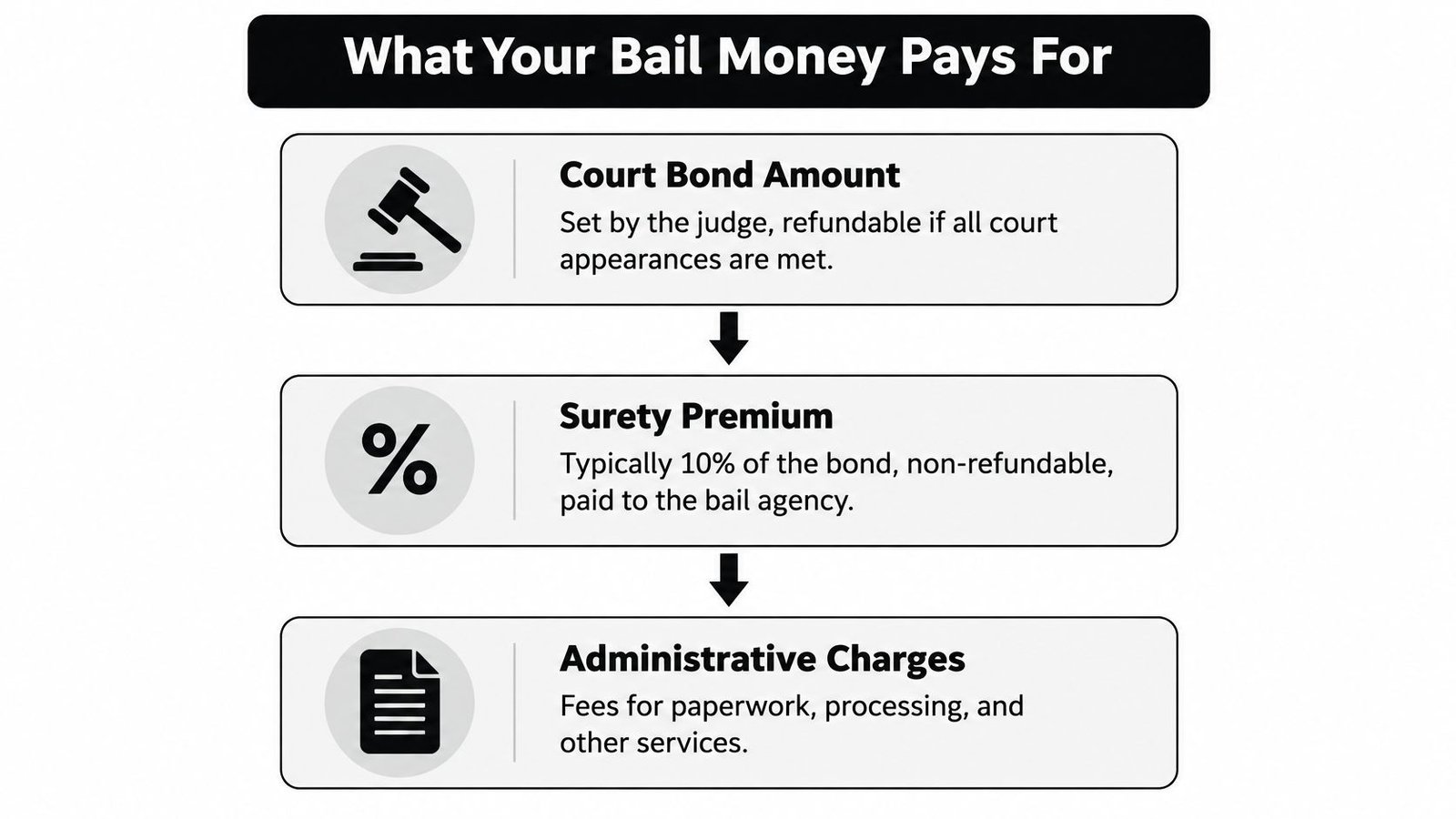
Families often hear a single amount over the phone and assume it covers everything. Separate it into the court bond amount, the surety premium, and administrative charges before deciding how to pay.
The judge sets the bond amount. With a surety bond, the agency guarantees that obligation instead of the family depositing the full amount with the court.
For example, on a hypothetical $5,000 surety bond, the premium goes to the agency while the $5,000 remains the obligation guaranteed to the court. Paying the premium doesn't reduce that guaranteed amount.
The diagram separates the payment categories. Treat any rate depicted in it as illustrative, not as your written quote.
Identify each charge and its recipient
Colorado's official bail-bond guidance helps distinguish the agency's charge from the court obligation; Colorado's applicable fee provisions also distinguish charges not required to secure release on a money bond from a permitted $10 bond fee and a credit-card fee capped at 3.5%, in specified circumstances.
Who gets paid in a bail bond transaction
| Payment | Paid to | Refund or keep |
|---|---|---|
| Court bond amount, cash bond | Court | May be returned after the case ends, minus any deductions; confirm with the clerk |
| Court bond amount, surety bond | Not paid upfront; the agency guarantees it | Not a payment; the cosigner owes it if the defendant forfeits |
| Premium | Bail agency | Earned in full on release; not returned, subject to applicable statutory provisions |
| Bond fee of $10 | Court, in specified circumstances | Confirm whether it applies to your case |
| Credit-card fee | Payment processor, capped at 3.5% in specified cases | Confirm before paying by card |
Don't assume every booking, processing, or jail-related charge must be paid before release. Request an itemized explanation identifying the recipient, the reason for the charge, and whether payment is legally necessary for release.
Payments and appearances are separate obligations
Keeping premium installments current doesn't satisfy the defendant's court obligations. A missed appearance can expose the bond to forfeiture even when every installment has been paid.
Refunds also follow different rules. The premium generally isn't returned, a court-held cash deposit may be returned under the case rules, and collateral should be addressed after exoneration and satisfaction of the applicable agreement.
Our explanation of whether bail is refundable can help you distinguish money paid for the agency's service from money or property held as security.
Worked Examples for Three Bond Sizes
Say family members agree to share the premium, but each person needs to know exactly when to contribute. The schedules below are illustrations, not quotes or guaranteed financing terms, and assume no added financing charges.
For these examples, the first installment is due at signing. Later installments fall on the agreed monthly anniversary, with the actual calendar dates written into the contract before anyone pays.
Installment schedules for three bond sizes
| Bond amount | Maximum premium | Installments | Amount per installment | Balance after final payment |
|---|---|---|---|---|
| $1,000 bond | $150 | 3 monthly | $50 | $0 |
| $5,000 bond | $750 | 3 monthly | $250 | $0 |
| $20,000 bond | $3,000 | 6 monthly | $500 | $0 |
| $5,000 cash bail | None paid to agency | 1 payment to court | $5,000 | Returnable under case rules |
A smaller premium split across monthly payments
For the hypothetical $1,000 bond, the total premium is $150. Paying $50 at signing leaves $100, the next monthly payment leaves $50, and the final monthly payment leaves $0.
The written schedule should identify the signing date and the actual due dates for the remaining payments. “Monthly” alone leaves room for confusion about whether payment is due on the same date each month or another agreed day.
For the hypothetical $5,000 bond, the total premium is $750. A $250 signing payment leaves $500, the next $250 payment leaves $250, and the last clears the balance.
Subtract each credited payment from the previous balance. The final scheduled payment should leave nothing unexplained.
A larger premium needs a longer view
For the hypothetical $20,000 bond, a $3,000 premium is divided into six monthly payments of $500. After the signing payment and each successive payment, the remaining balances are $2,500, $2,000, $1,500, $1,000, $500, and $0.
That schedule is arithmetic, not an agency offer. The amount required at signing and the available repayment period must come from the actual agreement.
If you want to test affordability, AI2Fin's monthly loan payment estimator can help model a proposed balance and repayment period. Use only the charges your agreement includes, and don't treat the calculator's output as approval or a substitute for the contract.
Compare the cash alternative correctly
If the court requires $5,000 cash bail in this hypothetical comparison, the family deposits the full $5,000 with the court, rather than paying an agency premium. That deposit may be returned under the case rules, but the family needs the entire amount upfront.
Our bail schedule guide provides context for understanding the court-set amount. Whatever arrangement you're offered, apply the same balance test and insist on actual due dates.
Cosigner and Collateral Risks Before You Sign
A low installment doesn't limit the cosigner's exposure to that installment. At Express Bail Bonds, the cosigner signs the bail agreement and pays the premium, and the agreement is a contract between the cosigner and our company.
Pause over the responsibility language before signing.

Consider the full obligation
If the defendant misses court, the cosigner must pay the full bail amount to the bail bond company. On a $30,000 bond, a defendant who disappears leaves the cosigner responsible for the entire $30,000, not merely the unpaid premium.
Cosigners may also owe additional costs if the bond's terms aren't met. Read the provisions covering those costs and identify who has signed as an indemnitor, rather than assuming only the person making the payments is responsible.
A relative sending money remotely should distinguish between contributing toward the premium and signing a financial guarantee. Don't sign a document you haven't read because another family member says it's only permission to make a payment.
The accompanying video is another resource to consider before committing.
Understand what collateral secures
If the defendant skips court and the cosigner cannot pay the forfeited amount, we can take possession of pledged collateral to cover the loss. Collateral can include property or valuables, and it may be required in addition to the premium and a qualified cosigner, especially for very high bail or apparent flight risk.
We look for stable employment, established residency, and a decent credit score in a cosigner. Those qualifications don't remove the responsibility created by the signature.
Review the bail bond collateral explanation alongside the specific property description in your agreement.
- Identify the property: Check exactly what is pledged and who owns it.
- Read the release terms: Know what documentation is needed before the security can be returned.
- Protect your records: Keep copies of ownership documents and the signed collateral agreement.
Could I pay the full bail amount tomorrow, and would I accept losing the collateral if I couldn't?
When Bond Conditions Change Your Payments
A change in release conditions doesn't automatically end a payment schedule. Before stopping or reducing payments, get written confirmation of what the change means for the signed agreement.
Cash, surety, and personal bonds don't work the same way. The court holds a cash bond, an agency backs a surety bond, and a personal bond may involve no bail agency at all.
An agency's bond obligation may continue until the court formally ends it. Separately, an earned premium balance may remain payable even after that obligation ends, so ask about both issues rather than assuming they end together.
Match the case event to a financial question
Next financial step when bond conditions change
| Event | Next financial step | Question to ask the agency |
|---|---|---|
| Judge modifies the bond amount | Check whether the premium changes under the written agreement | Does the new amount change the contract, and can I see updated paperwork? |
| Defendant released on a personal bond | Confirm whether any surety premium is still owed | Is any balance still due, and what is the final amount? |
| Case dismissed | Keep scheduled payments until the agreement says otherwise | Can I get a written accounting and a collateral release? |
| Nonfinancial conditions added | Keep the schedule in place and report the conditions to the agency | Do these conditions affect the contract or the payments? |
A judge may change the monetary amount or add nonfinancial requirements, such as check-ins or travel restrictions. Those requirements affect what the defendant must do, but they don't by themselves rewrite a private payment agreement.
Our conditions of bond guide can help you identify the obligations that need attention. When you contact us about an order, send the actual document if available rather than relying only on a family member's description.
Use a precise call script
You don't need legal vocabulary to request an accounting. Give enough identifying information for the person answering to locate the correct agreement.
I'm calling about the defendant named on this agreement and this case number. The bond type is listed on my paperwork, my last payment was recorded on this receipt, and the court has changed the release conditions. Please confirm what remains owed and send any changes to the agreement in writing.
Afterward, record the date of the court change, the new bond amount or conditions, our written response, and the remaining balance. Save any exoneration or collateral-release documents with that record.
If an answer is unclear, request a written breakdown before changing your payment instructions. A dismissal notice, a release order, and a paid-in-full confirmation serve different purposes.
Set Up, Verify and Pay Your Payment Plan
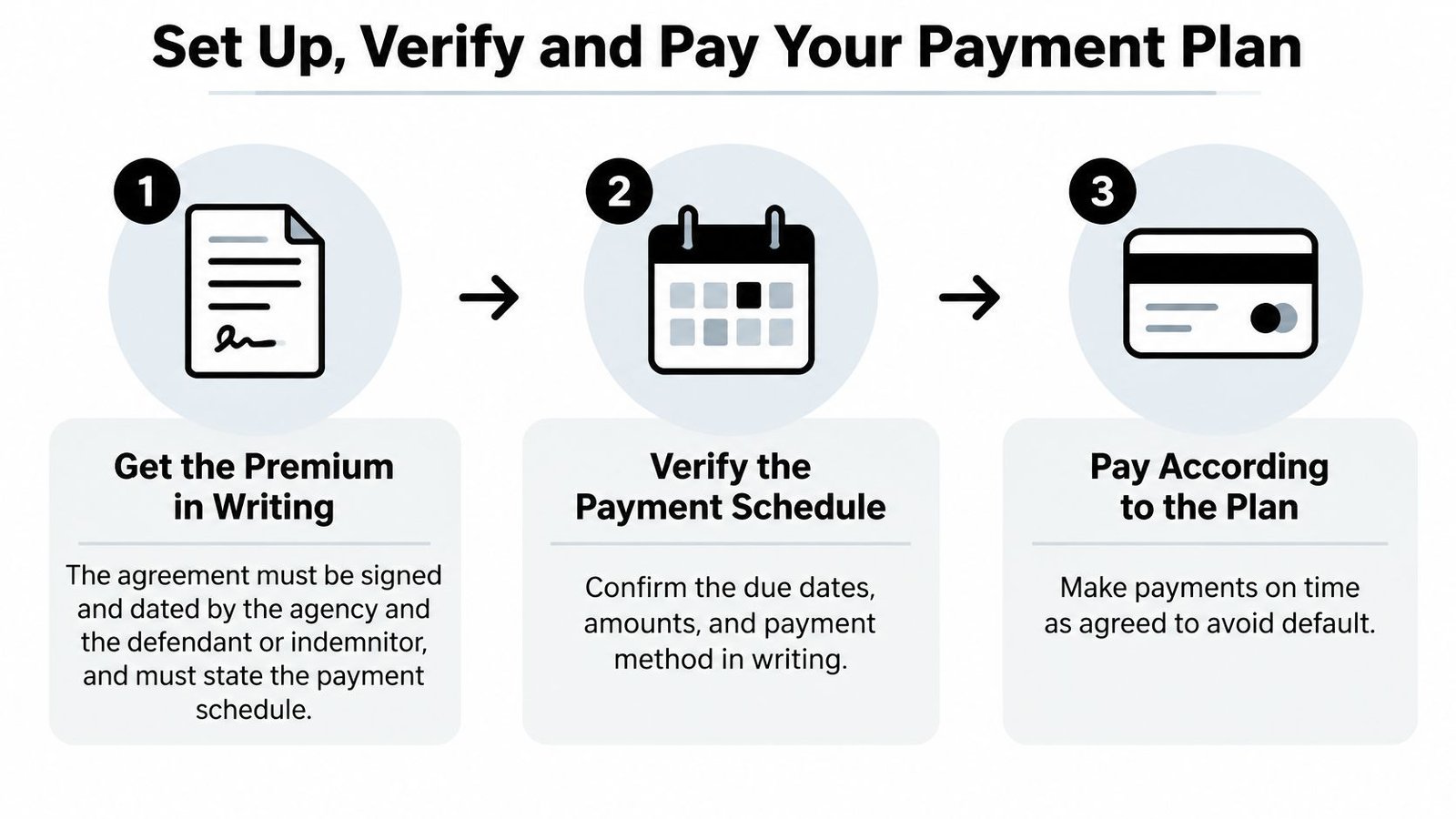
A useful payment plan should let you identify the total obligation, the next due date, and the current balance without reconstructing a phone conversation. Build that record before money changes hands.
Colorado's written-payment-arrangement statute requires the arrangement before the producer accepts consideration, with signatures and dates from the producer and the defendant or indemnitor, and a stated payment schedule. It also requires interest or financial charges on unpaid premium to comply with Colorado's Uniform Consumer Credit Code.
Use this process to organize the agreement and its supporting records.
Verify the agreement before paying
Get the complete agreement. Make sure it's signed and dated, and save your copy. A verbal reassurance won't give you the same record of what everyone accepted.
Check the total premium. Compare it with the applicable legal ceiling, not merely the monthly amount displayed on a payment screen. Keep separate charges separately identified.
Confirm the signing payment and due dates. Add the scheduled premium payments and reconcile them with the stated premium. Have any financing charges explained distinctly.
Read the financing and late-payment terms. Find out whether interest applies, what happens if a payment is late, and whether you'll receive notice before further action. Don't assume an automatic payment failure will resolve itself.
Keep a record you can reconcile
Calendar payments and court dates separately. Use distinct reminder labels so a paid installment can't be mistaken for a completed court obligation. Fintrack's comparison of spreadsheet versus app bill tracking can help you choose a system you'll maintain consistently.
Save receipts and check credits. Colorado's cash-bail and cash-bonding agent receipt statute requires a signed, dated receipt identifying the amount for each premium payment to the covered agents. Compare your receipts with the running balance and raise discrepancies promptly.
Confirm responsibility and security. Identify every cosigner, any pledged collateral, and the process for documenting a case change. We explain terms upfront in plain English, including whether collateral is part of the agreement.
We offer flexible payment options and an online application and payment system. Local readers can also consult our Jefferson County and Golden guide or our Centennial bail bonds page for location-specific information.
Before paying, confirm that the schedule is written, the arithmetic balances, and every cosigner understands the exposure. Keep the contract, receipts, court orders, and correspondence in a shared folder accessible to the people responsible for the account.
Express Bail Bonds offers flexible payment options and explains the premium, payment schedule, and collateral terms in plain English before you agree. Call or text 720-984-2245 at any hour, or visit Express Bail Bonds to start an online application and review the next steps for your family.