
You're usually not sitting in an office when this question hits. You're on the phone from a jail lobby, a detention-center parking lot, or your kitchen table at 2 a.m., trying to figure out why the bond amount is so high and who on earth can sign for it. The mistake families make is treating the cosigner like a favor ask. In Colorado, that signature is an underwriting event, and the wrong person can slow the release, raise the cost, or sink the bond altogether.
A cosigner on a surety bond is not a character reference. The person signing becomes a financially accountable party, and the producer is looking at whether that adult can stand behind the obligation if the defendant misses court or violates conditions. Colorado's fee rules also matter right away, because the premium and allowed charges are limited by statute, so families need to ask the right questions before they hand over documents or collateral (Colorado premium and fee limits). If you want a plain-English starting point, a legal AI assistant can help you organize the questions before you call a bondsman, and the basics of who counts as a cosigner are laid out in this what is a cosigner guide.
Character reference: someone who vouches for you socially.
Indemnitor: someone who signs to accept financial responsibility if the bond goes sideways.
When a Cosigner Becomes Part of the Bond
A family member usually thinks the producer is asking, “Do you trust this person?” That's the wrong question. The question instead is, “Can this adult satisfy underwriting and take on the risk if the defendant doesn't do what the court ordered?” In Colorado bail work, that difference matters immediately, because a cosigner may be required before the bond is even accepted, not after the fact.

A cosigner, in this setting, is an indemnitor. The Consumer Financial Protection Bureau describes a cosigner as someone who adds income and credit history to help another applicant qualify or get better terms, and the FTC explains that the person can be pursued for missed payments, late fees, and collection costs if the borrower doesn't pay (FTC cosigning guidance). On a Colorado surety bond, that risk profile is even more immediate, because the producer is not underwriting a nice gesture, they're underwriting a legal promise.
That's where families get burned. They call around looking for “someone willing,” when they should be looking for someone approvable. A willing relative who has unstable income, shaky residency documentation, or unresolved financial issues may be useless to the bond, even if everyone loves them.
Practical rule: if the person signing can't explain the obligation out loud, they're not ready to sign it in writing.
If you're stuck at the first call, use the legal AI assistant to organize the questions, then hand the producer a clean, direct answer set. That's the fast way to keep the process moving, and it's the approach a serious agency expects, not a vague promise from a stressed-out cousin.
What a Colorado Cosigner Must Qualify For
A Colorado surety-bond producer is looking for an adult who can be verified, not just someone who sounds supportive. Stable income matters because it tells the agency the cosigner can absorb risk if the bond turns into a claim. Verifiable residence matters because the agency needs to know where and how to reach the person. Clean or explainable financial history matters because unexplained problems raise underwriting risk, and legal presence can matter when the agency checks identity and residency documents.
A federal court cosigner checklist shows the kind of questions that can come up, employment, assets, bankruptcies, liens, judgments, warrants checks, and proof of legal U.S. residency may all be relevant (cosigner checklist source). That's the underwriting logic. A cosigner isn't chosen because they're the closest relative, they're chosen because they're the clearest risk.
What underwriters actually want to see
- Stable income: pay stubs, employment proof, or another clear source of ongoing money.
- Verifiable address: a current residential address that matches the paperwork.
- Identity documents: a government photo ID that can be checked without guesswork.
- Explainable credit profile: not perfect, just not riddled with surprises.
- Financial transparency: bankruptcies, liens, or judgments disclosed before the producer finds them.
- Legal presence or residency proof: if the agency asks for it, the cosigner needs to be able to produce it.
For a quick self-screen, ask whether the person can answer yes to all of this without hesitation: they have steady income, a current address, valid ID, and no hidden financial mess that will surface in verification. If the answer is maybe, keep looking.
If you want a separate checklist to compare against, review the cosigner requirements guide and, if you're verifying identities remotely, use a tool that helps you verify identities safely and ethically. That keeps the process grounded in facts instead of family assumptions.
Documents You Need Before Contacting the Bondsman
If you want the call to go smoothly, don't start with the question, “Can someone sign?” Start with the packet. A strong cosigner file usually includes government photo ID, proof of current address, recent income evidence, and, if collateral might be used, the ownership papers that prove what's available to pledge. The cleaner the packet, the less back-and-forth, and the less chance a nervous family member says the wrong thing halfway through verification.
Colorado law also draws a hard line on property collateral. When real property is used, the property must have unencumbered equity equal to 1.5 times the bond amount, and unencumbered equity means the value minus what's owed on it (Colorado property collateral rule). That's not a detail to discover late in the night after someone already promised the house.
Cosigner Document Checklist by Underwriting Path
| Document | Income Only | Property Collateral | Out-of-State Cosigner |
|---|---|---|---|
| Government photo ID | Yes | Yes | Yes |
| Current residential address proof | Yes | Yes | Yes |
| Income proof, pay stubs or tax returns | Yes | Yes | Yes |
| Bank or asset statements | Often | Often | Often |
| Property deed | No | Yes | No |
| Mortgage statement | No | Yes | Sometimes |
| Tax statement | No | Yes | Sometimes |
| Title documents | No | Yes, if relevant | No |
| Remote signature access | Helpful | Helpful | Yes |
“Legible and complete” means every page is readable, names match across documents, and nothing essential is cropped out or hidden. If a person is signing from another state, scan or photograph the originals cleanly and send the full set in one shot, not as a scattered chain of blurry text messages.
Disclose problems up front. If there's a bankruptcy, lien, prior bond issue, or an address change, say it before verification starts. That honesty doesn't scare off a serious producer, it saves time and keeps the application from falling apart halfway through.
For a separate list of paperwork expectations, keep the required documents page open while you assemble the packet.
How Cosigner Liability Differs From a Loan Cosigner
A loan cosigner is risky enough. A Colorado surety-bond indemnitor is a different animal. Colorado's standard appearance-bond form says the principal and surety are jointly and severally bound to the People of Colorado for the bond's penal sum, which means the obligation can attach in full if the defendant doesn't comply (appearance-bond form). That is not a paperwork courtesy. It's a legal commitment.
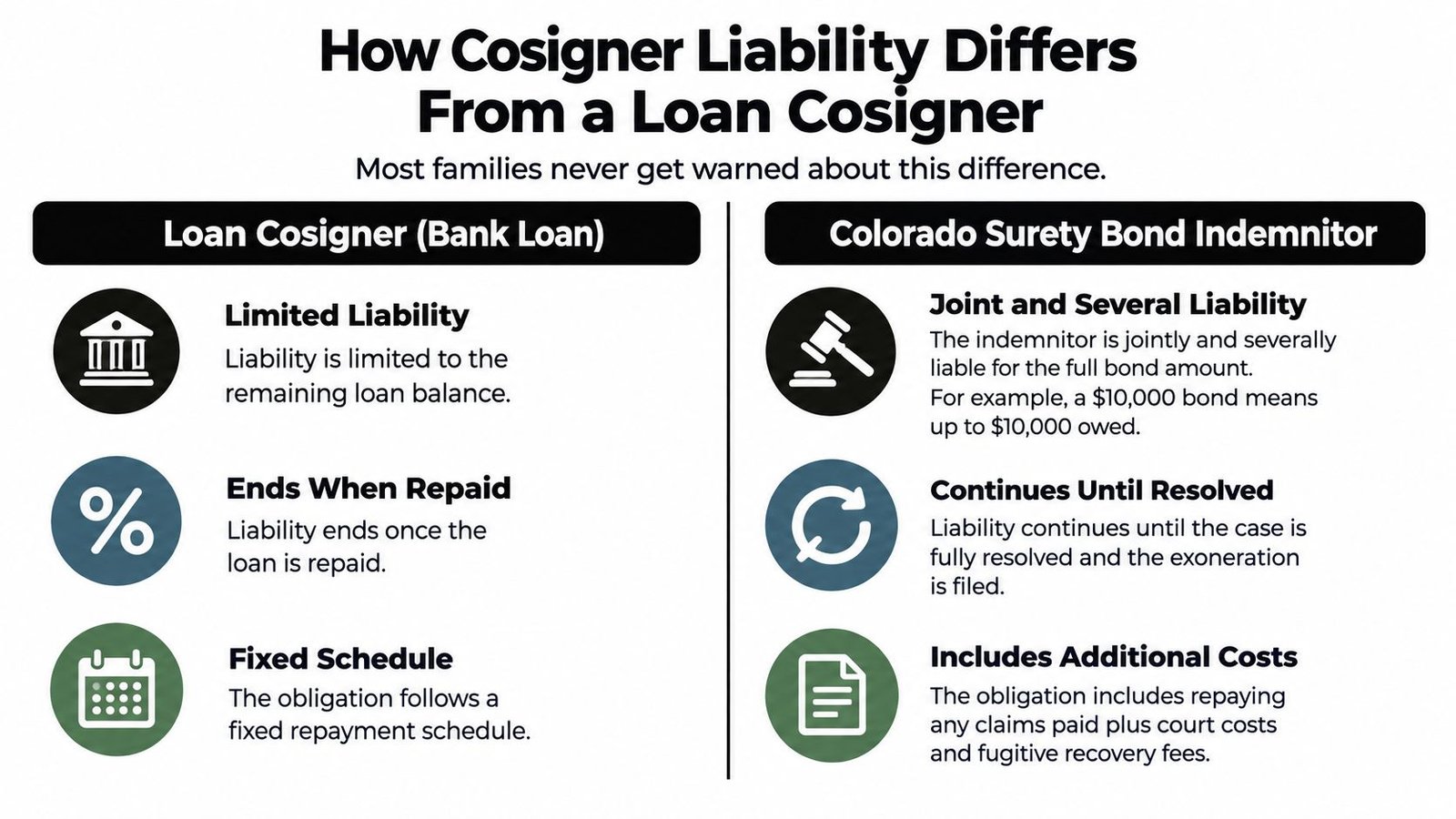
The cleanest way to think about it is this, a bank loan cosigner is tied to a repayment schedule, but a surety-bond indemnitor is tied to the bond's condition. If the defendant misses court or violates the bond, the exposure isn't theoretical. It can turn into the full penal sum, plus whatever written agreement says can be pursued through the bond relationship.
What collateral changes
Colorado's property-bond rule is brutally concrete. If a bond is $20,000, the unencumbered Colorado real-estate equity must be $30,000 because the equity must equal 1.5 times the bond amount (property equity rule). That means equity, not emotional attachment, is the issue. The house has to support the bond on paper.
Before signing, the indemnitor should ask for the written indemnity agreement, the payment schedule, the collateral receipt, and the release rules. They should also ask who pays for filing charges, transport, recovery, and any court-related costs that the bond agreement permits. A signature without those answers is blind trust, and blind trust is a bad financial strategy.
Treat the signature as a contingent financial guarantee, not a favor.
Before a cosigner signs, they need written answers to these questions:
- What is the exact bond amount?
- What premium am I paying, and what fees are allowed?
- What collateral is being held, and how is it released?
- What happens if the defendant misses court or moves?
- Who do I call if the defendant stops answering the phone?
If you need a plain-English explainer of responsibilities, the cosigner responsibilities guide is the right place to start.
Walking the Remote or Out-of-State Cosigner Through It

Out-of-state families overcomplicate this by driving to the wrong place first. Don't do that. First confirm the bond has been set, then contact a Colorado surety-bond producer that can handle electronic documents and remote ID verification. If the bond isn't set yet, you're not solving the problem, you're just moving money around.
The process should feel orderly, not improvised. The cosigner verifies identity, reviews the indemnity agreement, signs electronically, and receives a clear explanation of the premium and any payment arrangement. If collateral is involved, the paperwork has to match the collateral rules before anyone treats the bond as ready to post. For families handling this from another state, the practical guide on whether a cosigner can be out of state is worth reading before anyone starts signing from a phone screen.
Colorado also requires an individualized bond hearing for an in-custody arrestee as soon as practicable and no later than 48 hours after arrival at a jail or holding facility, and once bond is posted the defendant must be released regardless of unpaid fees, costs, or surcharges (Colorado bond hearing rule).
If the jail says the paperwork is “almost done” but the bond hasn't been posted, keep asking for the exact status in writing.
That rule matters because some families get pushed into paying prematurely or accepting excuses that don't line up with the law. If the bond exists and the paperwork is right, the producer can move. If the bond doesn't exist yet, you need to wait on the court process, not force a premature signature.
The goal is simple, clear identity, clear documents, clear payment terms, and a clear court-date handoff. That's how an out-of-state cosigner keeps a chaotic night from turning into a bigger financial mess.
Alternatives When No One Qualifies as a Cosigner
A surety bond is not the only release path, and families waste money when they act like it is. Colorado courts can use release on recognizance, supervised release, treatment or monitoring conditions, or detention decisions instead of a financial bond. Federal pretrial data show how often release happens on conditions other than bail, with 32% of defendants in federal pretrial-services cases released on bail in 2025 and pretrial-services supervision imposed in 86% of conditional releases (federal pretrial-services data).
Start with the paperwork, not the panic. If a bond amount appears in the file, confirm whether it's truly a surety-bond situation or whether a judge can consider recognizance, supervision, or another condition. Families often pay a premium too early because they assumed “bond” always means “hire a bondsman,” and that assumption costs money.
A smarter triage sequence
- Confirm the actual release condition: read the booking or court paperwork, don't guess.
- Ask about non-monetary release: recognizance or supervised release may be on the table.
- Request review if the amount is unworkable: if the bond is excessive for the family, ask whether review is available.
- Move to a surety bond only if needed: if the court does require it, then start the cosigner search.
One more point families miss, especially with larger bonds, a payment plan is often the reason a qualified indemnitor matters. Colorado producers may secure reduced rates with an approved cosigner, which is why the search for a signer and the search for a workable release option should happen together, not one after the other.
Your Cosigner Decision Checklist and Next Steps
Stop asking, “Who's willing?” Ask, “Who's qualified, documented, and ready to sign without confusion?” That shift saves time and usually saves money. A qualified cosigner is an adult with stable income, verifiable identity, a current address, and enough financial clarity to survive underwriting without surprise.
Use this checklist before you call:
- Confirm the release condition: make sure a surety bond is required.
- Pick the right candidate: look for stable income, solid identity, and clean paperwork.
- Assemble the packet first: ID, address proof, income evidence, and collateral papers if needed.
- Disclose the ugly facts early: bankruptcies, liens, address changes, prior bond issues.
- Review the indemnity agreement in writing: no one should sign blind.
- Set up remote signing if needed: out-of-state family shouldn't need to be physically present if the process allows electronic execution.
For families who need statewide help, a Colorado-licensed producer with electronic processing and 24/7 availability can usually walk the cosigner through identity verification, document review, and bond posting without forcing everyone to sit at the jail all night. The key is to have the papers ready before the first call, not after the panic starts. The cosigner guide and document checklist can keep the conversation focused on facts instead of guesswork.
The question isn't, “Who will do me a favor?” It's, “Who can sign responsibly and move fast when the jail, court, or bondsman needs an answer?”
If you're on the phone after midnight and need a real person who can explain the paperwork, coordinate remote signing, and keep the process moving statewide, call or text Express Bail Bonds at 720-984-2245, or visit Express Bail Bonds to get the cosigner process started now.