
When the court sets a bail amount that feels impossibly high, a bail bondsman can be the one person who makes all the difference. In simple terms, a bail bondsman is a licensed professional who posts bail for a defendant so they don't have to stay in jail while their case is ongoing.
Instead of your family having to come up with the entire bail amount in cash—which can often mean draining savings or selling assets—you pay the bondsman a much smaller, non-refundable fee. In return, they guarantee the full bail amount to the court, allowing your loved one to come home. If you're in this situation and need immediate help, contact Express Bail Bonds today for a free consultation.
What Is a Bail Bondsman and Why Are They So Important?
Think of a bail bondsman like a specialized lender for the court system. Let’s say a judge sets bail at $20,000. For most families, coming up with that kind of cash on short notice is out of the question. This is where a bondsman steps in.
They provide the court with something called a surety bond. This is a legally binding promise that if the defendant skips their court dates, the bondsman will pay the full $20,000. This assurance is what gets the jail doors to open.
To give you a clearer picture, let's break down the key terms you'll encounter.
Bail Bondsman at a Glance Key Concepts
This table quickly sums up the core ideas.
| Term | Simple Explanation | Why It Matters |
|---|---|---|
| Bail Bondsman | A licensed agent who posts a bond to secure a defendant's release from jail. | They make it financially possible for someone to get out of jail without paying the full bail amount upfront. |
| Surety Bond | The legal guarantee the bondsman gives the court, promising to pay the full bail if the defendant doesn't show up. | This is the actual "product" you are buying. It's the bondsman's promise that satisfies the court's requirement. |
| Premium | The non-refundable fee you pay the bondsman for their service (usually 10-15% of the bail). | This is your out-of-pocket cost. It's how the bondsman gets paid for taking on the financial risk. |
| Cosigner | The person who signs the contract with the bondsman, taking financial responsibility for the full bail amount if the defendant flees. | This is a serious commitment. The cosigner is legally on the hook for the entire bail amount if things go wrong. |
Understanding these roles and terms is the first step in navigating the process with confidence.

This arrangement is a genuine lifeline for many families. It turns an overwhelming financial burden into a manageable one.
The Bondsman's Role in the Justice System
A bail bondsman does more than just handle the money. They are a key part of the pretrial release system, helping people get back to their jobs, families, and regular lives while they wait for their day in court.
This system is pretty unique. The United States and the Philippines are the only two countries in the world that have a commercial, for-profit bail bond industry. If you're interested, you can learn more about the bail bond services industry to see how it operates on a larger scale.
Because the bondsman is on the hook for the full bail amount, they have a strong incentive to make sure the defendant follows through on their obligations. Their core responsibilities include:
- Providing Financial Guarantees: They post the bond, which satisfies the court and allows the defendant to be released.
- Ensuring Court Appearances: They are legally and financially responsible for making sure the defendant shows up for every single court date.
- Navigating the System: An experienced bondsman knows the ins and outs of local jails and court procedures, guiding families through what can be a very confusing and stressful process.
A bail bondsman acts as a surety, posting bail on behalf of a defendant in exchange for a non-refundable premium, typically 10-15% of the bail amount.
Ultimately, a bail bondsman provides a service that upholds the principle of "innocent until proven guilty" by making pretrial freedom accessible. If you need someone to walk you through this right now, contact Express Bail Bonds today for fast, expert help.
How a Surety Bail Bond Actually Works
The term "surety bond" can sound a little intimidating, but the concept is actually pretty simple. At its core, it’s a three-way agreement that makes getting out of jail before a trial financially possible. Think of it as a formal promise between you (or your cosigner), your bail bondsman, and the court. Each person has a critical part to play.
When a judge sets bail, they’re putting a price tag on the defendant's promise to show up for their future court dates. A surety bond allows a licensed bondsman to cover that cost for you, so you don’t have to drain your savings to pay the full, often staggering, amount in cash.
The Three Parties Involved
To really get how a surety bond works, you have to know who's involved. This isn't just a quick transaction; it's a legal partnership designed to secure someone's freedom while guaranteeing they'll face their charges in court.
- The Principal: This is the defendant—the person who was arrested and needs the bond. Their one big job is to show up for every single court date, no exceptions.
- The Surety (Bail Bondsman): This is the licensed agent, like us here at Express Bail Bonds. We guarantee the full bail amount to the court, which means we’re the ones taking on the financial risk if the defendant disappears.
- The Obligee (The Court): This is the legal entity that requires the financial guarantee. The court holds onto the bond as insurance, making sure the defendant follows all the rules of their release.
This setup shifts the massive financial burden from a family’s shoulders to the bail bond company. If you want an even deeper dive into the entire process, you can learn more about how bail bonds work on our detailed explainer page.
The Financial Mechanics of the Agreement
The whole process kicks off the moment you call a bail bondsman. The first step is paying a non-refundable fee, which is called the premium. This fee is simply a percentage of the total bail amount, and it’s how the bondsman gets paid for taking on such a huge financial risk.
Let's use a real-world example. Say bail is set at $10,000. The premium might be $1,500. You pay that $1,500 to the bondsman, and in return, they post a bond with the court for the entire $10,000. That single action satisfies the court, and the jail begins the release process.
Sometimes, especially with larger bonds or cases that seem a bit riskier, a bondsman might also ask for collateral. This is just an asset with value—like a house, a car, or even jewelry—that you pledge as an extra layer of security for the bond.
A surety bond is a legal instrument where the bail bondsman assumes the court's financial risk, allowing a defendant's release for a fraction of the total bail amount. If the defendant fulfills their court obligations, the bond is dissolved, and any collateral is returned.
Think of collateral as a backup guarantee. If the defendant skips court and the bond is forfeited, the bondsman has to pay the court the full amount. The collateral is used to cover that loss. But as long as the defendant makes all their court appearances, the bond is cleared (or "exonerated") by the court once the case is over, and you get your collateral back. The premium is the only thing you don't get back, as it's the fee for the service. If you have questions about premiums or collateral, don’t hesitate to contact Express Bail Bonds for clear answers.
Understanding the Costs: What You'll Actually Pay
When you get that call from jail, one of the first questions running through your mind is, "How much is this going to cost?" Let's break it down so it's crystal clear.
The main cost you'll face is called the premium. This is a non-refundable fee you pay the bail bondsman for their service. Think of it like this: the bondsman is putting up the full bail amount for you, taking on a massive financial risk with the court. The premium is their fee for providing that service and taking on that risk.
The Standard Rate in Colorado
In Colorado, the bail bond industry has a standard premium rate, which is typically 15% of the total bail amount set by the judge.
So, if your loved one's bail is set at $20,000, the math is straightforward: the standard premium would be $3,000. This is the fee that gets them out of jail and covers all the work we do behind the scenes.
A Way to Lower Your Costs
But here’s some good news—that 15% isn't always set in stone. We know how financially draining this situation can be, which is why we look for ways to help. For bail amounts over $5,000, we can often get that premium down to just 10% if there's a qualified cosigner on the bond.
Let’s look at that $20,000 bail again to see what a huge difference this makes.
To illustrate how this discount works in practice, here are a few examples.
| Total Bail Amount | Standard Premium (15%) | Reduced Premium (10%) |
|---|---|---|
| $10,000 | $1,500 | $1,000 (You save $500) |
| $20,000 | $3,000 | $2,000 (You save $1,000) |
| $50,000 | $7,500 | $5,000 (You save $2,500) |
As you can see, the savings add up quickly. That 5% reduction provides immediate financial relief, putting thousands of dollars back in your pocket during a time when every penny counts.
This is one of the most significant ways an experienced bail bondsman can provide real value. It’s not just about getting someone out of jail; it’s about making the process as affordable as possible.
For a deeper dive into all the factors that influence the final price, be sure to check out our complete guide on how much bail costs.
What About Collateral?
Sometimes, the premium isn't the only financial piece of the puzzle. You might also hear the term collateral.
Collateral is simply an asset of value—like a piece of property, a car title, or jewelry—that is pledged to the bail bond agency as a secondary guarantee. It’s an extra layer of security ensuring the defendant shows up for their court dates.
Don't worry, collateral isn't always necessary. We typically only need it in higher-risk situations, like when the bail amount is extremely high or if a cosigner's financial history isn't very strong. The best part? As long as the defendant makes every single court appearance, the collateral is returned to you in full once the case is over.
Your Step by Step Journey from Arrest to Release
When you get that dreaded call saying a loved one is in a Colorado jail—whether it's in Denver, Arapahoe, or Jefferson County—your first feeling is often a mix of panic and confusion. What do you do next? The path to getting them home can feel overwhelming, but it’s a structured process. Knowing the steps from the moment of arrest to their release can make all the difference.
It all starts the second they are taken into custody. They'll be brought to a local jail for booking. This is just the administrative part: fingerprints, a mugshot, and entering their information into the system. Be patient, as this can take a few hours, especially on a busy night.
After booking, the next major hurdle is the bail hearing. A judge will look at the case and set a specific bail amount. Think of this number as collateral the court holds to make sure the person shows up for their future court dates. Once that amount is set, the timer starts on getting them out.
Contacting Your Bail Bondsman
This is where you can make the biggest impact on how quickly things move. As soon as you know the bail amount, your very first call should be to an experienced bail bondsman. At Express Bail Bonds, we know you're stressed—and maybe even out of state—so we've made this part as simple as possible.
To get the ball rolling, you’ll just need a few key pieces of information:
- Defendant's Full Name: We need their exact legal name for the paperwork.
- Defendant's Date of Birth: This helps us find them in the jail's system and verify their identity.
- The Jail Location: Is it the Denver County Jail or the Jefferson County Detention Facility? Knowing where they are is critical.
- The Bail Amount: This is what we use to calculate the non-refundable fee you'll pay to us.
Once we have that, we can start drafting the legal documents right away.
The Modern, Digital Bail Process
Forget everything you’ve seen in movies. The days of rushing to a dingy office with a bag of cash and then spending hours at a cold, uncomfortable jail are over. Express Bail Bonds handles everything digitally, so you can sort it all out from your own home.
Applications, contracts, and payments are all done electronically. This isn’t just for convenience; it saves precious time. As soon as the paperwork is signed and the fee is paid online, our licensed agent posts the bond directly with the jail. In most cases, you’ll never even have to go near the facility.
The financial side is pretty straightforward, as this graphic shows.
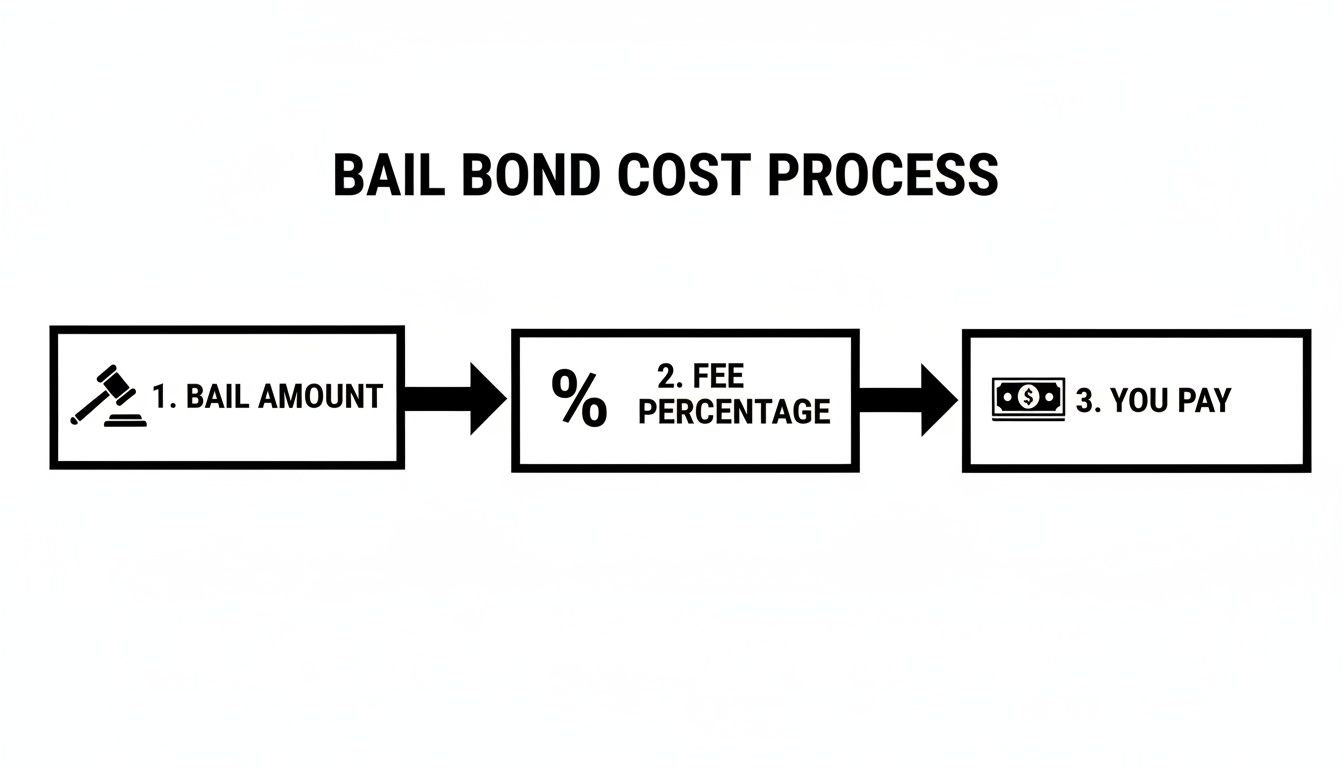
You’re only paying a small, manageable fraction of the total bail the court demanded. We cover the rest.
Release and Post-Release Responsibilities
Once the bond is posted, the jail starts its own release process. This is the one part of the timeline that can be unpredictable. Some jails might get someone out in an hour, while others could take several hours. Our team has been doing this a long time, so we can give you a realistic estimate based on that specific jail’s usual speed.
Getting out of jail is a huge relief, but the journey isn't over. The defendant has to show up for every single court date until the case is fully resolved—that’s the number one rule. It’s also a time to be careful about every little detail, as even knowing how text messages can hold up in court can become surprisingly relevant.
For a complete breakdown, you can read more about how to bail someone out at https://expressbailbonds.com/how-to-bail-someone-out/. If you need help right now, don’t wait. Call or text Express Bail Bonds 24/7 at 720-984-2245 for immediate assistance.
The Responsibilities of a Defendant and Cosigner
Securing a bail bond isn't just a transaction; it's a serious legal agreement. Think of it as a three-way partnership between the defendant, the cosigner, and the bail bondsman. For everything to go smoothly, everyone needs to understand their part of the deal.
This contract is what allows a defendant to get out of jail and return home while their case moves through the system. But that freedom comes with strings attached—responsibilities that absolutely must be met.
The Defendant's Core Duty
For the person who was arrested, the number one job is crystal clear: attend every single court appearance. No exceptions. This is the fundamental promise they make in exchange for their release.
What happens if they miss a court date? The consequences are immediate and severe. A judge will issue a new warrant for their arrest, and the court will demand the full bail amount be paid. This is called a forfeiture, and it puts the bail bondsman—and ultimately, the cosigner—on the hook for the entire sum.
The Cosigner's Financial Guarantee
The cosigner, also known as the indemnitor, is the financial backbone of the agreement. When you cosign a bail bond, you are making a legally binding promise to the bail bond agency. You're guaranteeing two things: that the defendant will show up for court, and if they don't, you will cover the full bail amount.
This is a role with very real financial risk. If the defendant disappears and the bond is forfeited, you become legally responsible for paying the bail agency for the total bond amount. This could mean losing any collateral you put up, whether it's your car, your house, or another valuable asset.
The cosigner’s role is one of immense trust and financial responsibility. You are not just helping someone get out of jail; you are legally vouching for them with your own finances, promising the court they will fulfill their obligations.
Part of the process for both the defendant and cosigner involves filling out paperwork with accurate information. This often starts with efficient client intake forms that we use to get the ball rolling quickly.
At Express Bail Bonds, we believe in total transparency. Our team will walk you through every document and every obligation so you know exactly what you're signing. We want to help you avoid forfeiture and protect your assets.
If you have questions about your responsibilities, call or text us 24/7 at 720-984-2245.
Your Bail Bond Questions, Answered
When you're trying to get a loved one out of jail, a lot of questions pop up, and you need straight answers. Let's walk through some of the most common things people ask us during this incredibly stressful time.
What Is the Difference Between a Cash Bond and a Surety Bond?
The big difference is who pays the court and how much.
For a cash bond, you have to come up with the entire bail amount yourself. If a judge sets bail at $30,000, you or your family must hand over $30,000 in cash directly to the court to secure the release. For most people, that's just not possible.
A surety bond is where we come in. You pay a bail bondsman a much smaller, non-refundable fee (the premium), and we post a bond for the full $30,000 on your behalf. It’s the key that makes getting out of jail financially realistic for almost everyone.
Why Is the Bail Bond Premium Non-Refundable?
Think of it like this: the premium is the fee you pay for a professional service that’s delivered upfront. The moment we post that bond and your loved one walks out of jail, we've done our job.
That fee covers our agent's time, the complex legal paperwork, and—most importantly—the massive financial risk we take on. We are guaranteeing the full bail amount to the court. Even if the case gets dismissed the very next day, the service of securing that release was already completed, which is why the premium isn't refunded.
What Happens If the Charges Are Dropped?
If the prosecutor drops the charges, the case is officially closed. That's fantastic news for everyone involved. The court will then "exonerate" the bond, which is just a formal way of saying the bail bondsman is no longer on the hook for the money.
What does this mean for you? Any collateral you put up—like a car title or property deed—is returned to you. But as we just covered, the premium you paid remains with the bondsman. Their job was to get the person out, and that mission was accomplished.
Can I Get a Bail Bond for a Warrant?
Yes, and it’s a smart way to handle things. If you find out there’s a warrant for your arrest, you can call a bondsman before you turn yourself in. This is often called a "walk-through" or "warrant turn-in."
By arranging the bond in advance, the whole process becomes much less painful. You can walk into the jail with the bondsman, get booked, and get released often in just a couple of hours. It beats getting arrested unexpectedly at home or work and gives you a sense of control over a tough situation. If you need help with a warrant, contact Express Bail Bonds right away.
The role of a bail bondsman has become a fundamental part of how pretrial release works in the U.S. In fact, the use of surety bonds nearly doubled from 24% of cases in 1990 to 49% by 2009. That statistic alone shows just how vital these services have become for families. You can discover more insights about pretrial release trends and see how the industry has evolved over the years.
Trying to figure all this out on your own is overwhelming. You don’t have to. The experienced agents at Express Bail Bonds are here 24/7 to answer your questions and get things moving quickly anywhere in Colorado. For fast, professional help when you need it most, visit us at https://expressbailbonds.com.