
You're at home when the phone rings. A family member missed court because they were hospitalized, misunderstood the date, or never received the reminder. Now someone is mentioning a forfeited bond, a possible warrant, and paperwork that appears to have its own language. A set aside bond request may provide a path to undo the forfeiture, but the result depends on the court record, the reason for the missed appearance, the evidence, and the timing.
Colorado families often use “set aside bond” to describe two related but different requests. One asks a judge to change or remove bond conditions before forfeiture. The other asks the court to undo a bond forfeiture after a defendant fails to appear. Knowing which situation applies is the first step toward filing the right request.
What Set Aside Bond Really Means for Defendants and Cosigners
Suppose a defendant misses a court date after an unexpected hospitalization. The court may record a failure to appear and order the bond forfeited. That order can create problems for everyone involved, including the defendant, the cosigner, and the surety that posted the bond.
A request to set aside the forfeiture asks the judge to restore the parties to the position they occupied before the forfeiture. In practical terms, the court may undo the forfeiture order, prevent a forfeiture judgment from becoming enforceable, and keep the existing bond in place. It doesn't erase the criminal case or excuse every future court obligation.
Two requests use similar language
A motion to set aside bond conditions usually comes before forfeiture. The defendant might ask the court to change travel restrictions, reporting requirements, or another release condition. The court decides whether different conditions still protect the legal process and address the concerns behind the original order.
A motion to set aside bond forfeiture comes after a missed appearance and forfeiture order. The filing must explain why relief is justified and support that explanation with records. The court may also require the defendant to return to custody or appear before the judge before deciding whether to undo the forfeiture.
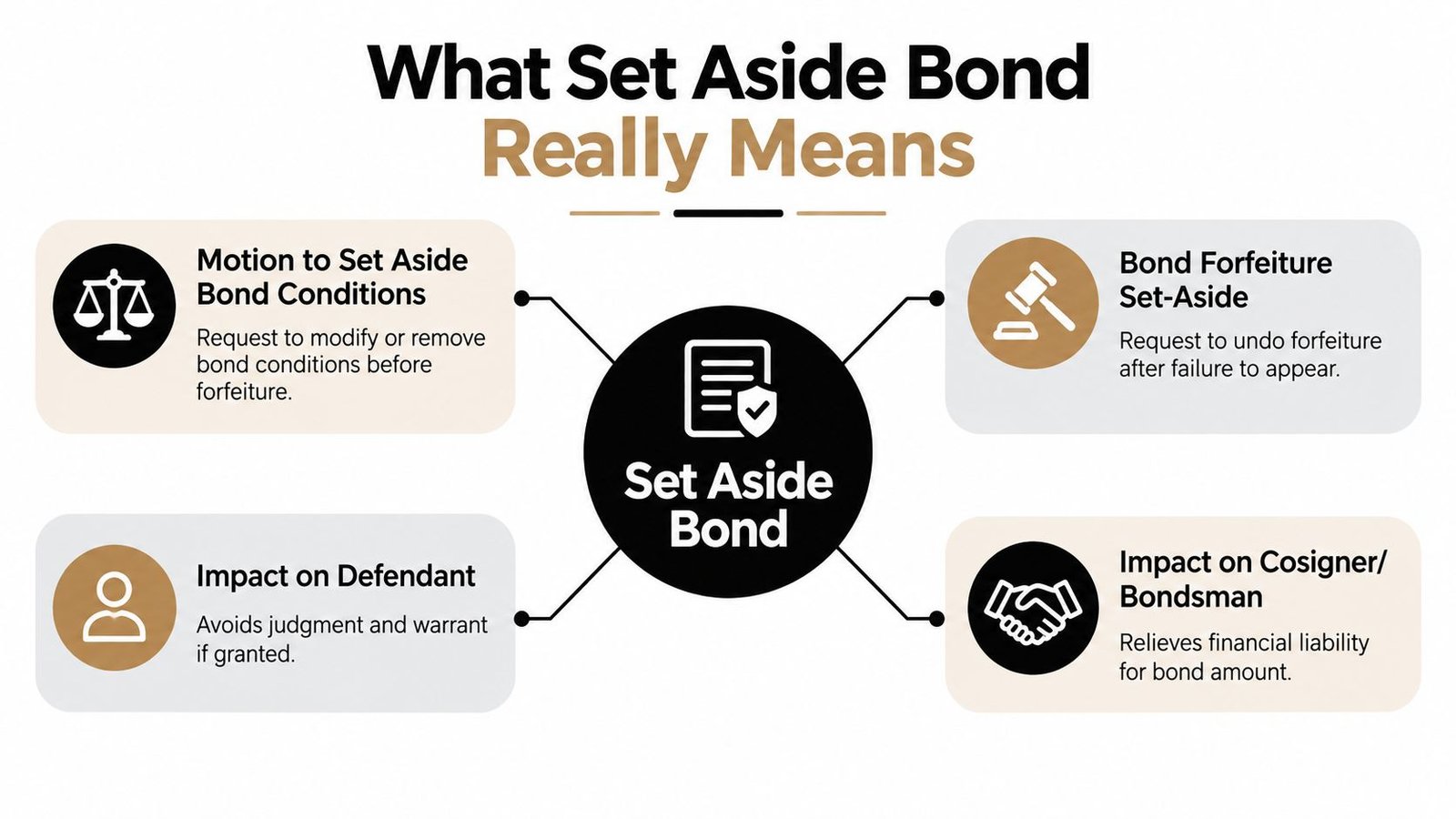
The impact differs by person:
- Defendant: A successful request can help avoid a final forfeiture judgment and may address an arrest warrant connected with the missed appearance.
- Cosigner: Relief can reduce the risk that the cosigner becomes responsible for the bond amount under the indemnity agreement.
- Surety: The bail bonds company may avoid liability on the bond if the court returns the parties to their pre-forfeiture status.
- Court: The judge receives evidence explaining what happened and decides whether the bond can continue securing future appearances.
Practical rule: A medical emergency is important only when the paperwork connects it to the missed court date. Tell the court what happened, when it happened, and how the records prove it.
Cosigners should review their responsibilities and contact the surety quickly. The cosigner responsibilities guide can help clarify why communication, documentation, and court compliance matter.
A set aside request is not automatic. If a notice has arrived, act immediately. The exact deadline may depend on the court order and the applicable Colorado procedure, and waiting can limit the available options.
How Bond Forfeiture and Set Aside Work in Colorado Courts
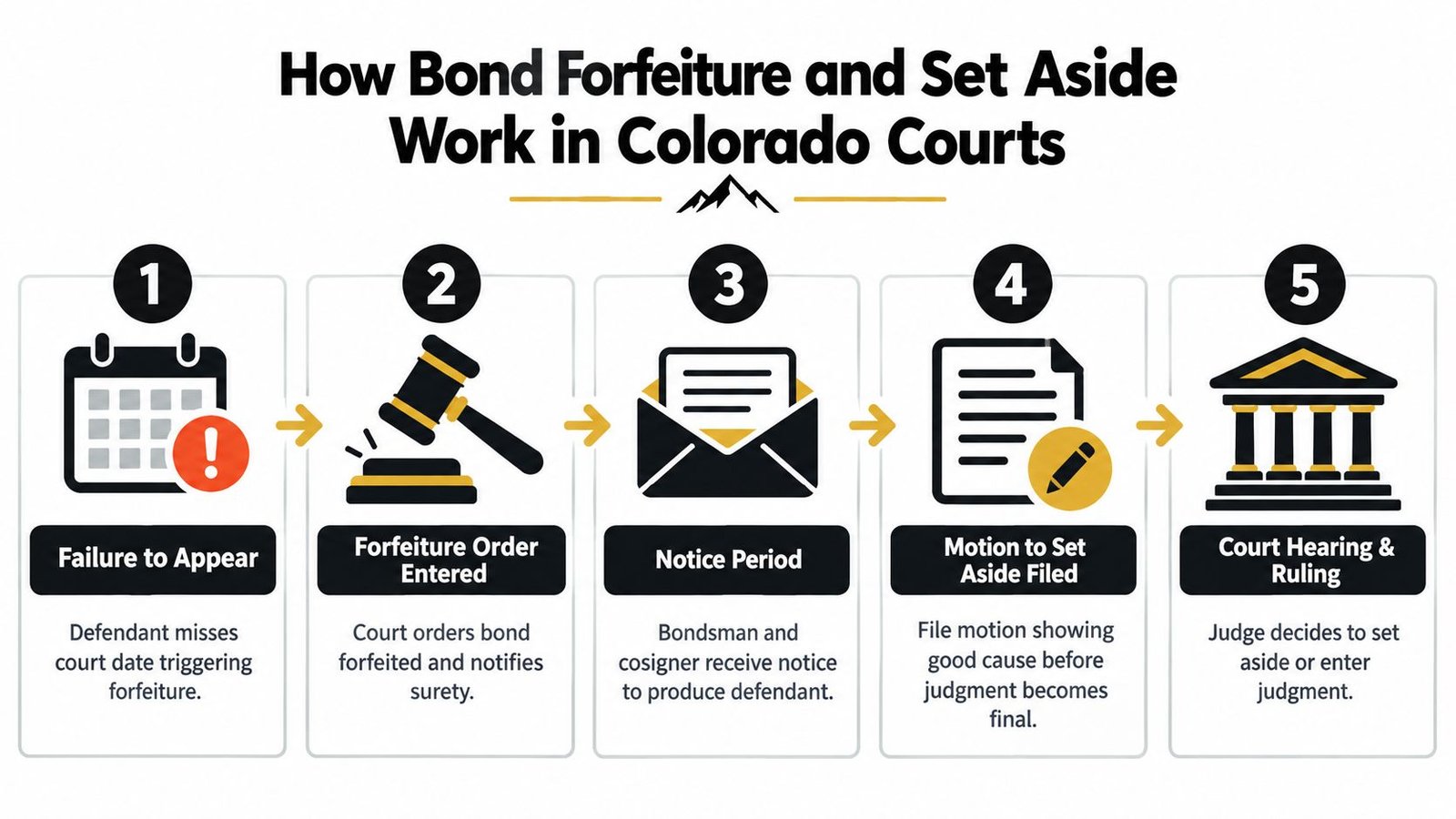
A missed appearance can start a sequence of court actions. The defendant may be marked as failing to appear, the judge may order forfeiture, and the surety may receive notice requiring attention to the bond. The family shouldn't treat the notice as a routine letter because it can identify deadlines, hearing information, and the amount at issue.
The court process follows a defined path
- Failure to appear: The defendant doesn't appear as required, and the court records the absence.
- Forfeiture order: The court orders the bond forfeited and identifies the people or company affected.
- Notice: The defendant, cosigner, and surety may receive information about the forfeiture and the next procedural step.
- Request for relief: The party seeking relief files a motion or petition explaining the legal basis and attaching evidence.
- Ruling: The judge reviews the filing, any response, and the evidence before deciding whether to set aside the forfeiture or allow the judgment to proceed.
Setting aside forfeiture and reinstating a bond aren't always identical. A court may undo the forfeiture but still modify release conditions, require a new appearance, or direct the parties to complete additional paperwork. Ask the clerk or an attorney what the order says before assuming the original bond is fully active.
Colorado's process also sits within a larger national shift in pretrial policy. The federal Bail Reform Act of 1984 moved the federal system further toward detention in some situations. The Bureau of Justice Statistics reported that federal defendants held on pretrial detention increased from less than 2% before the Act to 19% after it, while the broader share held until trial rose from 24% to 29%, as documented in the Bureau of Justice Statistics report on the Bail Reform Act. Those figures don't decide an individual Colorado motion, but they show why courts treat appearance obligations and release decisions seriously.
Reforms that reduce reliance on money bond can change detention exposure. In New Jersey, the average pretrial jail stay fell from 62.4 days in 2014 to 37.2 days in 2017, about a 40% reduction, according to the Harvard Kennedy School publication on bail reform. The same source reports that New York's 2020 reforms made most misdemeanor and nonviolent felony charges ineligible for bail, and one statewide analysis found about 3,000 fewer people held pretrial on any given day, representing roughly 1.1 million fewer jail-days since reform. The lesson for families is practical: the release method and conditions can materially affect how much time someone spends in jail before trial.
For a general explanation of the terminology and consequences in another state, readers may find this overview of how to fight bond forfeiture useful. Texas procedure doesn't control a Colorado case, so use it for background only. Colorado court records and Colorado deadlines govern your motion.
For a plain-language explanation of the first forfeiture steps, review what bond forfeiture means. If the forfeiture isn't set aside, the financial obligation may continue against the surety and cosigner, and the defendant may still need to address any warrant or release violation.
How to Request a Set Aside of Bond Forfeiture in Colorado
Start with the court paperwork, not assumptions. The forfeiture notice, docket, and bond documents should identify the case number, the court, the date of the missed appearance, the forfeiture date, and any hearing or response deadline. A family member who relies on a verbal statement from a jail employee or a bondsman may miss a requirement contained in the actual order.
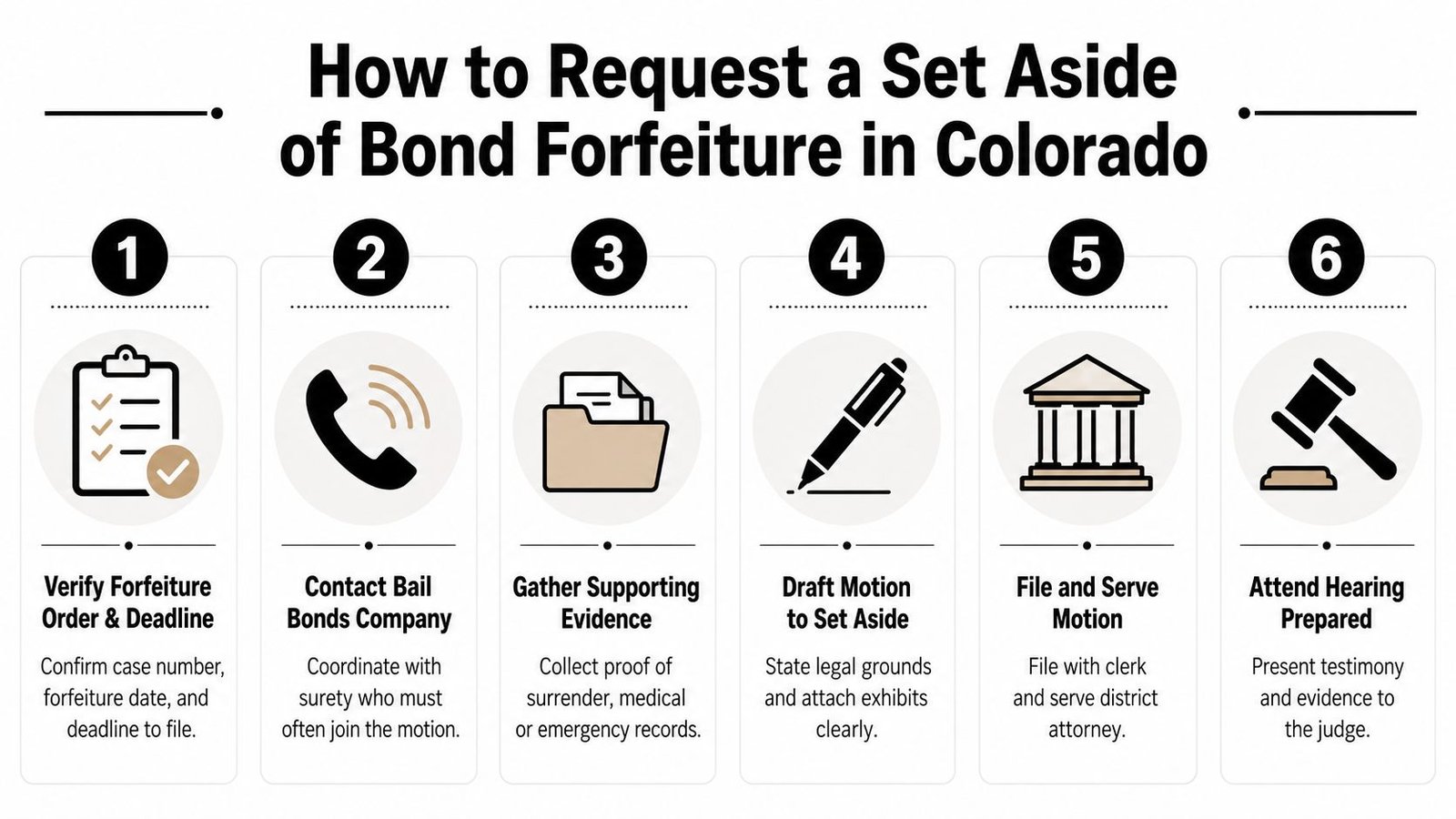
Follow the filing sequence
1. Verify the forfeiture order and deadline. Obtain a copy from the clerk or the court's online docket if available. Compare the order with the bond contract and confirm whether the defendant has an active warrant, a new court date, or a requirement to surrender.
2. Contact the surety immediately. The bail bonds company may need to coordinate surrender, obtain records, communicate with the court, or join the request. Don't assume that filing a motion alone protects the bond or stops every consequence.
3. Gather proof that explains the absence. Strong materials may include hospital or emergency records, court minutes, jail records, sheriff receipts, proof that the defendant appeared later, correspondence showing notice problems, or documents showing that the underlying charges have been resolved. Keep originals safe and label copies by date and purpose.
4. Draft the motion clearly. Identify the defendant, case number, bond, forfeiture order, and relief requested. Explain the reason for the failure to appear in chronological order, state the legal ground supporting relief, and attach exhibits that prove each important point.
5. File with the correct court. Submit the motion through the clerk for the court handling the criminal case. Ask about local filing rules, required copies, filing fees, proposed orders, and hearing procedures. Denver, Jefferson, Arapahoe, and other Colorado courts may use different portals or local forms.
6. Serve the district attorney and other required parties. A motion that reaches only the clerk may not satisfy service requirements. Follow the court's rule for delivering the filing to the prosecuting office, the surety, and any other required participant.
7. Prepare for the hearing. Bring the filed motion, exhibits, identification, and proof of service. The judge may ask why the defendant missed court, whether the defendant has returned to custody, and how future appearances will be secured.
Filing mistakes can weaken an otherwise reasonable request
A motion can fail because it names the wrong case, omits the forfeiture order, lacks supporting records, or asks for relief without stating the legal basis. Another common problem is treating a later appearance as self-proving. The court may need an official record showing exactly when and how the defendant returned.
Before filing: Read the proposed motion beside the docket. Every date, case number, and requested order should match the court's records.
The surety can also help identify practical issues that a defendant or cosigner may not see. Ask whether the company has received notice, whether surrender paperwork is available, and whether the court expects the bond to be reinstated or replaced. If the defendant is represented, defense counsel should review the motion because a forfeiture issue can overlap with a warrant, release condition, or pending criminal hearing.
Don't use a generic form without adapting it to the facts. “I forgot” may not tell the court enough. A concise explanation supported by a hospital record, transportation record, court correction, or official appearance record gives the judge something concrete to evaluate.
Common Grounds That Help a Set Aside Succeed and What Evidence to Bring
Judges need a legally recognized reason and reliable proof. Sympathy can provide context, but the filing should connect the facts to the relief requested. The most useful evidence usually comes from an official source that can establish the date, event, and defendant's identity.

The defendant returned or was surrendered
A defendant who returns to court, is arrested, or is surrendered by the surety may give the court a practical basis for addressing the forfeiture. Attach the court's appearance record, booking record, warrant return, or sheriff's surrender receipt. The document should identify the defendant and show the relevant date.
The surety's role matters here. A bondsman may have records of surrender efforts, communications, or arrangements that support the motion. Those materials don't replace the court record, but they can help explain what happened after the missed appearance.
The failure to appear was corrected
Sometimes the court later vacates the failure to appear, recalls the arrest order, or corrects a scheduling error. In that situation, attach the amended minute order, docket entry, or written order. The motion should explain that the court has already corrected the underlying event and request corresponding relief from the forfeiture.
A resolved criminal case may also affect the forfeiture analysis. Use the final disposition, dismissal, sentencing record, or other official court document. Don't rely on a defendant's statement that the case is “over” when the docket can provide the exact status.
A medical emergency or documented emergency caused the absence
A hospitalization, emergency treatment, or serious event may support relief when records show that it prevented attendance. Submit records that establish the treatment date and the defendant's involvement, while limiting unnecessary private medical details. A short declaration can explain the connection between the emergency and the court date.
Other emergencies require similar proof. A transportation breakdown, incarceration elsewhere, or notice problem is stronger when supported by records from the relevant agency, facility, provider, or court. General stress, work pressure, or family confusion may not persuade a judge without documentation showing why attendance became impossible.
The surety didn't receive proper notice
Notice issues can affect the surety's ability to respond. Preserve envelopes, returned mail, docket entries, and correspondence showing where notice was sent and when it was received. The court will decide whether notice complied with the applicable procedure, so present the facts neutrally rather than overstating the argument.
Evidence principle: Attach the document that proves the event, not only the message that describes it.
The court hearing preparation guide can help organize exhibits, dates, and questions before appearing. Avoid weak arguments that don't address the missed appearance, the forfeiture order, or the requested remedy. A long personal explanation without an official record can distract from the issue the judge must decide.
Working With Your Bail Bonds Company on Fees Premium and Next Steps
The court decides whether to set aside forfeiture, but the surety remains an important business participant. Contact the bail bonds company before filing when possible. The company may need to confirm the bond number, review the forfeiture notice, coordinate with counsel, and determine whether reinstatement or a replacement bond is necessary.
Colorado law caps a commercial bail bond premium at the greater of $50 or 15% of the amount of bail furnished, and the premium is earned when the defendant is released from custody, according to the Colorado premium statute. That rule addresses the premium for the bond furnished. It doesn't answer every question about collateral, court costs, attorney fees, transportation, or additional services, so read the contract and ask for a written explanation.
Some Colorado agencies report a reduced 10% premium on larger bonds when an approved or qualified cosigner is involved, as described in flexible payment terms. Eligibility is agency-specific and should be confirmed before relying on it.
Premium comparison
| Bond Amount | Standard 15% Premium | 10% With Approved Cosigner Over $5000 |
|---|---|---|
| $5,000 | $750 | Not within the stated over-$5,000 tier |
| $10,000 | $1,500 | $1,000 |
| $20,000 | $3,000 | $2,000 |
These examples apply the stated percentages to the bond amount and don't include any other contract terms. The statutory minimum can matter for a small bond because Colorado uses the greater of the minimum dollar amount or the percentage calculation.
A set aside may return the parties to the bond's pre-forfeiture position, but don't assume every obligation disappears. Ask whether the existing bond is reinstated, whether a new signature is required, whether the defendant must appear before the court, and whether the cosigner must update contact or collateral information. How bond pricing works can help families prepare questions about the financial side.
Next Steps After a Set Aside and How to Avoid Future Forfeiture
A judge's order granting relief is the start of the cleanup, not the end. Get a copy of the signed order and confirm whether it sets aside the forfeiture, reinstates the bond, recalls a warrant, changes conditions, or assigns another court date. If the order is unclear, ask the clerk or attorney for clarification before relying on it.
Create one reliable calendar for every appearance. Add text reminders, arrange transportation early, and keep the attorney and bondsman informed about address or phone changes. Review the court's conditions of bond with the defendant so everyone understands what remains required.
If a new emergency develops, contact the attorney, court, and surety as soon as possible. Don't wait until after the hearing date if a problem can be reported in advance. Preserve appointment records, transportation receipts, messages, and any other document that may later explain the situation.
For pricing context, Colorado sources describe 15% as a common standard premium, while some agencies report 10% with an approved or qualified cosigner for larger bonds, as noted earlier. Confirm the actual terms before signing.
Express Bail Bonds provides statewide surety support, electronic applications and payments, and guidance by call or text at 720-984-2245, with assistance available around the clock. Families can seek local information for Jefferson County and Golden or Centennial bail bonds when a local court or detention facility is involved.
If a Colorado bond has been forfeited, contact Express Bail Bonds promptly to review the notice, organize the paperwork, and coordinate the next court step. Visit Express Bail Bonds to begin an electronic application or get guidance on premiums, cosigner requirements, and reinstatement options.