
In Colorado, a sheriff must generally release a defendant within six hours after bond is set and the surety notifies the jail it's ready to post, so “on time” is governed less by the bondsman than by jail-side processing once paperwork is accepted. That six-hour rule applies unless extraordinary circumstances exist, and it doesn't erase delays caused by holds, unfinished booking, or facility queues.
At 2 a.m., that distinction matters. A family member may be sitting at a kitchen table, refreshing a jail roster, calling numbers that go to voicemail, and assuming that paying a premium means the person will walk out immediately. It doesn't. A responsive bondsman can shorten the front end, but the jail controls the final release process.
A 2 A.M. Call and What On Time Really Means
At 2 a.m., a Denver-area father learns that his adult child has been arrested. He paces through the house while the child's mother searches for “on time bail bonds,” looking for someone who answers now, not after breakfast.
The family wants one answer: When will they be home? Paying the premium is only the first step. A bondsman can answer the call, confirm the defendant's location, gather information, complete the contracts, and deliver the bond. The detention facility must then verify the paperwork, check the defendant's status, process the release, return property, and address any holds.
Colorado law gives families a concrete timing reference. Unless extraordinary circumstances exist, a sheriff must release a defendant within six hours after a personal recognizance bond is set. For a cash bond, the period begins after the defendant or surety notifies the jail that the bond is ready to be posted. This rule sets a facility obligation. It does not guarantee that a bondsman can make someone leave immediately. The statute supplies the legal timing mechanic.
Practical rule: “Bond posted” and “defendant released” are separate events. Ask for both timestamps.
The wait has several handoffs. The agent must respond, collect correct information, and submit complete documents. The jail must accept and verify them, then work through its discharge process. A warrant, medical issue, unfinished intake record, or communication failure can extend the wait after the family has supplied everything requested.
Ask the bondsman direct questions before signing: When will you notify the jail? How will you confirm acceptance? Who will update me if the facility finds a problem? A clear answer matters more than an advertisement promising speed.
A serious discussion of on time bail bonds focuses on what controls release after payment. The useful question is not only, “How fast can you post?” Ask, “What happens after posting, and who will track the jail's processing?”
What On Time Bail Bonds Means
On time bail bonds describe a coordinated process, not instant freedom. The core question is what controls release after the bond is posted. The surety handles the bond transaction. The jail controls its own verification and discharge work.
A bondsman should respond promptly, confirm where the defendant is held, verify the bond details, explain the premium and permitted charges, gather accurate indemnitor information, complete the agreement, and notify the facility when the surety is ready to post. Incorrect identifiers or incomplete documents can force the jail to reject or recheck the submission.
The jail must match the bond to the right defendant, confirm its authority and amount, check for warrants or holds, review release conditions, locate the person, retrieve property, and complete discharge procedures. Colorado's six-hour requirement starts at the legal trigger. It sets a deadline for the facility, while the facility's operational steps determine when the defendant reaches the release door.
A courier can deliver the correct package to a loading dock quickly. The receiver still has to scan it, inspect it, enter it into the system, and move it through the outgoing queue. Fast delivery does not control the warehouse.
A posted bond means the surety instrument has been accepted or delivered for processing. A granted release means the defendant has completed the facility's discharge steps and is physically leaving. Paying the premium starts the surety's work. It does not finish the jail's work.
Ask the bondsman what happens after posting, who confirms the jail's acceptance, and who contacts you if the facility finds a problem. For a clearer outline of the paperwork and posting stages, review this guide to 24/7 bail bond services in Colorado. If posting appears stalled, check document accuracy and jail-side processing before assuming payment caused the delay.
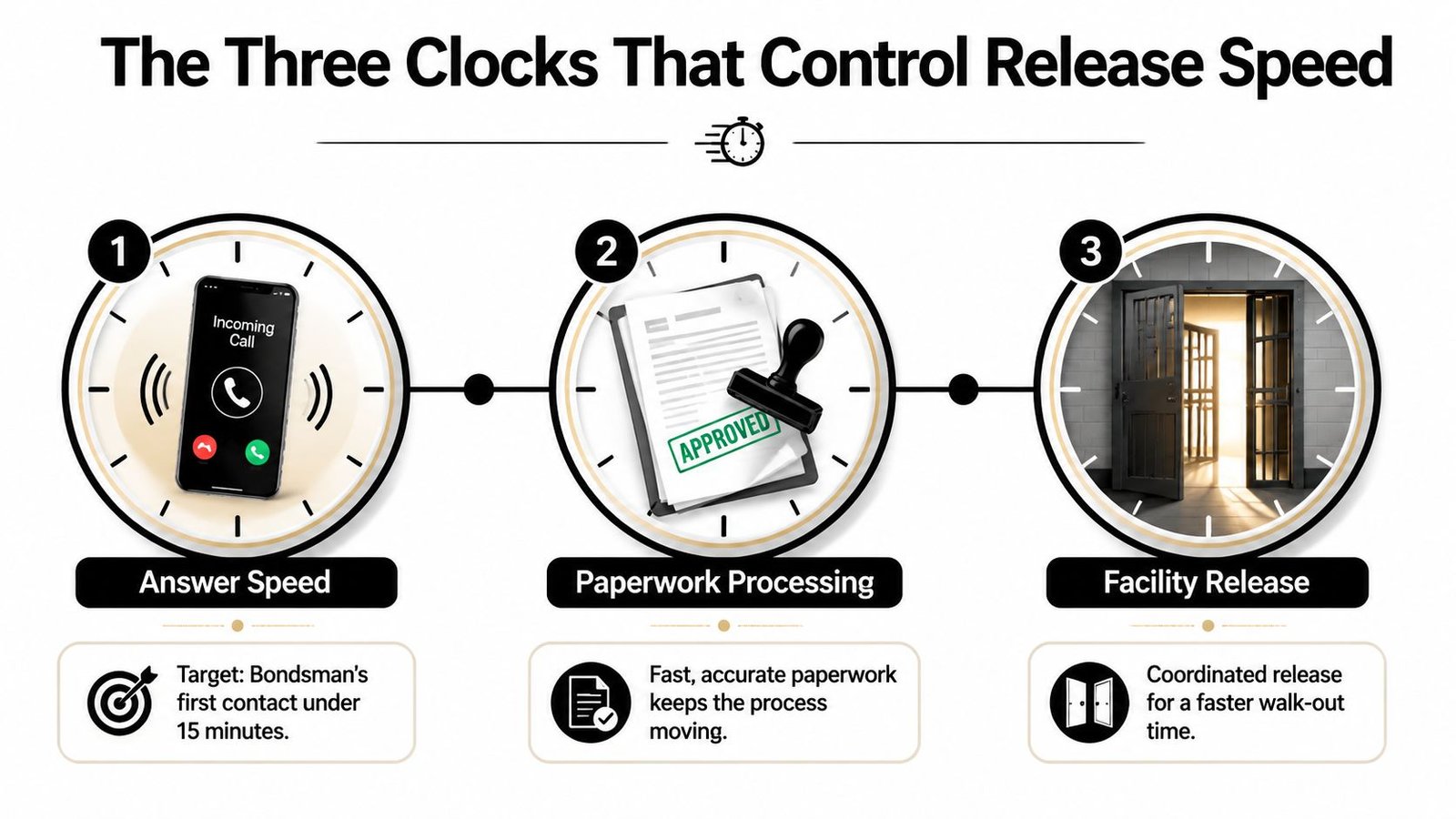
The Three Clocks That Control Release Speed
A family can pay the bond quickly and still wait for the release. Three separate clocks control that outcome. The bond payment is often not the bottleneck. The key question is what happens after the bond is posted.
Clock one is answer speed
The first clock starts with your call. An after-hours operation should put you in contact with a live agent or a clearly staffed response line. An internal target of returning contact in under 15 minutes measures communication, not the jail's release time.
The agent should identify the facility, confirm whether bail has been set, and list the information still missing. Ask who will remain responsible after the first call. If nobody can explain the next action, the process has not started.
Clock two is document speed
This clock covers the application, indemnitor agreement, identity review, any collateral discussion, and premium payment. Have government identification, the defendant's full legal name, date of birth, booking information, address, and a reliable payment method ready.
Electronic signing and delivery can reduce travel and physical handoffs. Accuracy matters just as much. A wrong booking number or mismatch in the legal name can make the agent or facility stop and verify the submission.
Clock three is facility release speed
This clock begins when the surety notifies the jail that the bond is ready to post. Colorado generally requires release processing within six hours, unless extraordinary circumstances exist, under the Colorado bond-release statute. The clock does not promise an immediate exit. Acceptance, staffing, queue position, warrant checks, holds, and court-to-jail communication can control the final wait.
Use this bail processing timeline guide to prepare specific questions. Ask how the bondsman handles each clock, who confirms jail receipt, and who contacts you if the facility finds a hold or paperwork problem. Get those answers before signing.
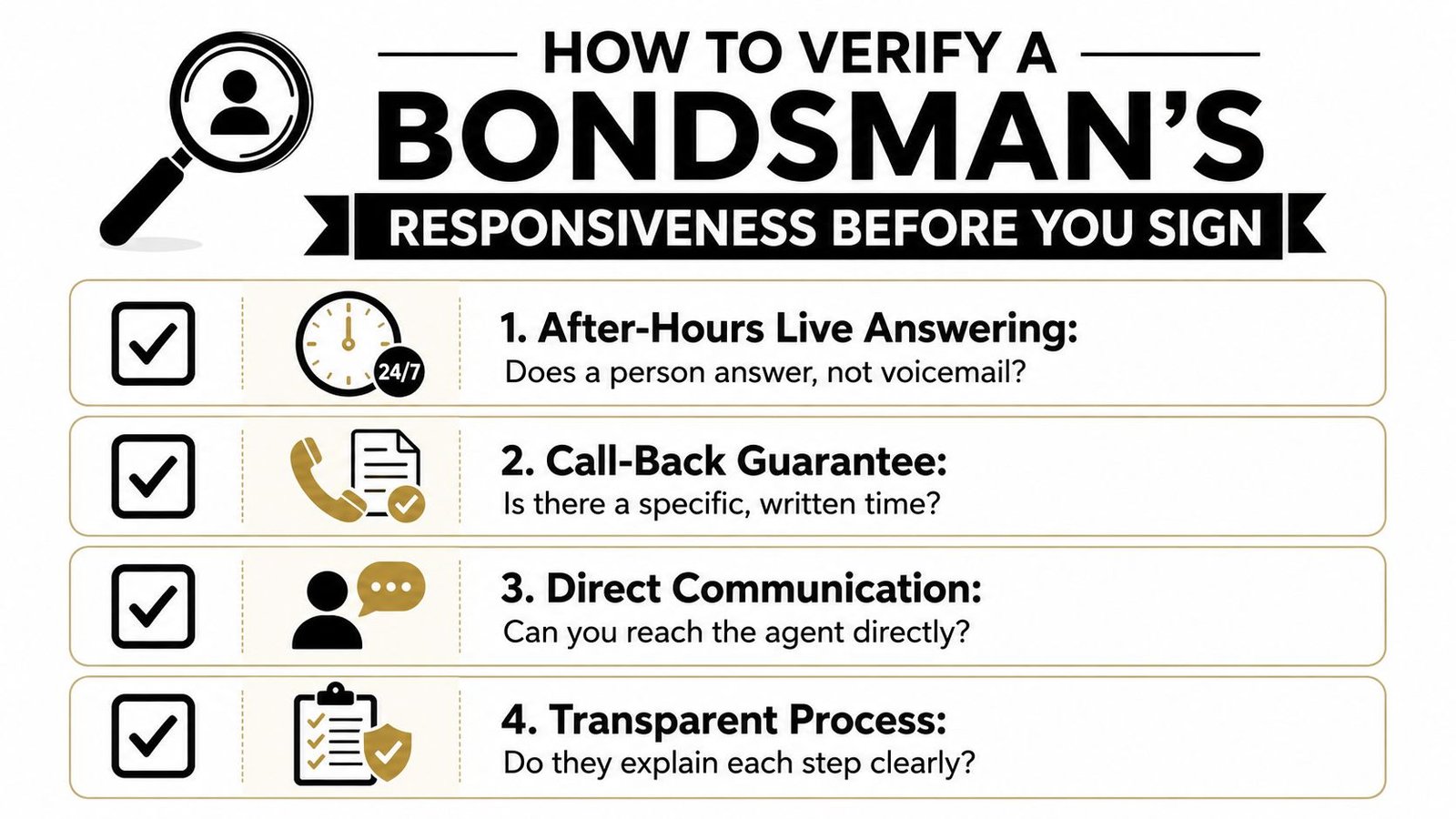
How to Verify a Bondsman's Responsiveness Before You Sign
Don't judge responsiveness by a bold “fast” claim on a website. Test the process during the first call.
Start with after-hours answering. Ask whether a licensed person answers directly or whether the number routes to voicemail. A callback system can work, but the agent should give you a specific expectation and follow through. “Someone will get back to you” isn't a timeline.
Next, ask for the Colorado premium and permitted charges in writing. Colorado caps a commercial bail bond premium at the greater of $50 or 15% of the bail amount, and limits additional charges to specified items, including a court filing fee, actual collateral storage costs, or premium financing. Review the Colorado premium statute before signing.
Ask these questions before signing
- Facility experience: Which county jail did you last post at, and how do you confirm that the facility received the bond?
- Payment process: Can you accept payment and signatures by phone or electronically, and what happens if the payment system fails?
- Written timing: Will you provide written confirmation of when the bond was submitted and when the jail acknowledged receipt?
- Surety identity: Which surety company stands behind the bond, and will you identify it in the contract?
- Charges and collateral: What is the premium, what additional charges may apply, and when is collateral released?
- Release complications: What will you do if the defendant has an outstanding warrant, hold, medical clearance issue, or unfinished booking?
A bondsman who pressures a cosigner before reviewing the charge and release conditions is giving you a reason to slow down. So is an agent who refuses to explain the contract, hides the premium calculation, or promises a guaranteed walkout time.
Before you commit, compare independent bond service reviews and then ask the agent to explain exactly what those reviews mean for the facility holding your family member. Reviews don't replace a license check or a written contract, but they can reveal whether an agency communicates after the bond is posted.
A Colorado Posting Scenario From First Call to Release
Consider a representative Denver-area posting. At 2 a.m., a family member calls after confirming an arrest. The bondsman verifies the defendant's full name, date of birth, facility, booking status, charge information, and bond amount through the jail's available records.
The agent explains the premium, reviews the indemnity agreement, identifies any required collateral, and sends the documents for electronic signature. Once the paperwork and payment are complete, the surety delivers the bond electronically or through the facility's accepted posting process. The agent then confirms that the jail has received the submission.
At this point, the family may think the hard part is over. Often, it is only the beginning of the jail's work. The facility may discover an outstanding warrant from another county, require medical clearance, or still be waiting for arresting officers to finish intake paperwork. None of those problems necessarily means the bondsman failed to post. They mean another release condition remains unresolved.
A bondsman who regularly works with the facility can reduce back-and-forth because the agent knows the accepted forms, submission channel, and contact procedure. That familiarity can improve coordination, but it can't override a hold or force staff to skip required checks.
The six-hour Colorado release clock applies after the statutory trigger, including notification that the surety is ready to post a cash bond under the statute. The actual walkout depends on what the jail finds during verification and how quickly staff move the defendant through discharge.
Watch this overview for a visual explanation of the process:
For families handling the first call, the guide to bailing someone out can help organize the information an agent will need. The factors that compress the timeline are accurate identifiers, complete documents, electronic delivery, and a clear payment path. The factors that stretch it are facility workload, holds, medical review, and incomplete booking.
Why Fast Bond Is Not the Same as Fast Release
The quickest agent doesn't automatically produce the quickest release. Colorado's release options depend heavily on the charge, the court's order, and the county's procedures.
Colorado's HB 23-1228 and earlier Senate Bill 21-062 changed the availability of monetary bond options for many felony levels, with some defendants instead released on personal recognizance or held to a court-set cash-only figure. Those reforms matter because a defendant may not need a surety bond at all. A family that calls only for a commercial bond can waste time if the court has ordered a different release path.
A surety bond involves an underwriter or licensed surety arrangement and jail-side verification. A cash bond requires the family to provide the court or facility with the required funds directly. A cash deposit can move faster in some settings because it doesn't require surety underwriting, but that doesn't make it universally preferable. The facility still controls verification and discharge, and cash-only conditions can eliminate the surety option entirely.
Release conditions can add work after the court authorizes release. Pretrial services reporting, electronic monitoring, GPS requirements, protection orders, and other conditions may require forms, equipment, instructions, or confirmation before discharge. The agent can explain the bond paperwork, but a criminal defense attorney should advise the defendant about legal strategy and conditions.
| Bond Type | Processing Steps | Typical Release Time |
|---|---|---|
| Surety bond | Agent intake, indemnity paperwork, premium payment, surety submission, jail verification, release processing | Controlled by the Colorado six-hour rule after the statutory trigger, subject to extraordinary circumstances and facility delays |
| Cash bond | Payment of the court-set amount, facility verification, hold and warrant checks, discharge paperwork | Can be faster than a surety path in some facilities, but no universal time applies |
| Personal recognizance | Court order, identity and condition review, facility discharge processing | Depends on the court order and jail workflow |
| Cash-only release | Payment of the amount ordered by the court, verification, and discharge processing | Depends on facility operations and whether all release conditions are complete |
The New York experience shows why policy changes can reshape demand. Between 2019 and 2024, statewide rates of setting bail or remanding defendants directly to jail fell from 14% to 4% for misdemeanors, 50% to 26% for nonviolent felonies, and 69% to 50% for violent felonies, according to the five-year reform summary. The lesson for Colorado families is direct: identify the release order before assuming a surety bond is the fastest route.
Putting Colorado's Rules to Work for Your Family
Treat release as a chain of checkpoints. The six-hour rule, the Colorado premium cap, and electronic document handling are useful only when the family, surety, clerk, and jail communicate accurately.
Start before the bond is set if you can. Keep the defendant's full legal name, date of birth, likely booking facility, address, and available booking number together. Have identification and a payment method ready. Keep the agent's direct line accessible rather than relying on a general search result when the arrest happens overnight.
Work backward from the jail's release process
Ask the bondsman:
- Electronic submission: Can the agent transmit the bond electronically to the relevant Colorado facility, or will someone drive paper to a clerk?
- Receipt confirmation: Who confirms that the jail accepted the bond, and how will you receive that confirmation?
- Facility timing: What intake or posting window applies at the jail holding the defendant?
- Problem handling: Who contacts the family if staff find a hold, warrant, medical issue, or incomplete booking record?
- Pricing: Is the premium calculated under Colorado's 15% cap, and are every additional charge and collateral term written into the agreement?
Electronic bail systems are designed to eliminate physical handoffs. Guidance on court-prison digitization calls for bail orders to be uploaded immediately, followed by the release memo and executed bond, with documents sent to the prison without delay. A published account of digital bail in Bangladesh similarly describes electronic bond submission from a lawyer's office or smartphone, with one-time-password confirmation. The digitization guidance supports the operational point, technology speeds transmission, but secure identity checks, interoperability, and jail queue management still control the final release.
Colorado law also defines when surety liability ends, including satisfaction of bond conditions, payment of forfeiture, and certain statutory situations. Another statutory path ends liability after three years if no forfeiture judgment has been entered, while a separate provision addresses a defendant held in a foreign jurisdiction for more than 91 days when Colorado refuses extradition. Review the Colorado exoneration statute and ask how the agency handles exoneration and collateral.
Local procedures can add administrative charges. Gilpin County, for example, publishes a $10 bond-processing fee and repeats the six-hour release requirement in its jail bond instructions. Confirm county-specific charges before signing.
For Colorado-specific guidance on supervision and release conditions, consult information about pretrial services in Colorado. Before any signature or premium payment, confirm electronic filing, ask about the jail's intake process, and request the bondsman's license number so you can verify it with the Colorado Division of Insurance.
Express Bail Bonds provides 24/7 Colorado surety bond assistance, electronic applications and contract signing, and statewide posting support, including service for Jefferson County and Golden and Centennial. If someone you care about has been arrested, visit Express Bail Bonds to start the application, confirm the paperwork, and get a clear explanation of what controls release after the bond is posted.