
Larimer County Jail is at 2405 Midpoint Drive, Fort Collins, CO 80525, and the main line is (970) 498-5200, with fax (970) 407-9034. If you're trying to get there fast, use Midpoint Drive in Fort Collins as your target, because that's the corridor families confuse most when they're in a hurry.
When somebody gets arrested in Larimer County, the first hour is usually chaos. People are calling relatives, checking phones, trying to figure out whether they should drive to the jail, the sheriff's office, or the justice center, and they usually don't want to waste a single trip. The fix is simple, know the exact building, then confirm the inmate's status before you leave.
The Larimer County Jail Address at a Glance
A rushed family often shows up at the wrong door first. The Larimer County Jail address is 2405 Midpoint Drive, Fort Collins, CO 80525, and the published main jail phone number is (970) 498-5200, with fax (970) 407-9034. Use that address for the detention facility itself, not the sheriff's office, not the justice center, and not the residential center.
The confusion starts because all of these county buildings sit in the Midpoint Drive corridor. One wrong assumption sends people to the wrong lobby, and that costs time you do not have during a booking or release situation. Keep the address and phone number on one screen, and the inmate's full legal name on the other.
Practical rule: confirm the inmate's location by phone before you drive, especially if the arrest happened recently or if you're coming in from outside Fort Collins.
For a bail-related overview tied to this facility, families often start with the Larimer County bail bonds page, then verify the jail address and timing with the county's own jail listing. If you are helping an older parent manage documents, the family caregiver legal guide helps you sort out who has authority to act when forms, calls, and release steps start moving fast.
Use this as the simple rule, 2405 Midpoint Drive is the jail. The county's jail listing also explains that cash bonds can be handled at the entrance kiosk or by phone and online through AllPaid, while property bonds are handled elsewhere in town. The fix is straightforward: know the exact building, because the detention facility is separate from the county's other Midpoint buildings.
Getting to the Jail by Car and Where to Park
Driving to 2405 Midpoint Drive is straightforward once you stop guessing at the building names. Follow your GPS to Midpoint Drive in Fort Collins, then look for the detention facility entrance instead of the sheriff's office sign. A lot of first-time visitors pull into the wrong county lot because they're scanning for “Larimer County” and not the specific jail address.
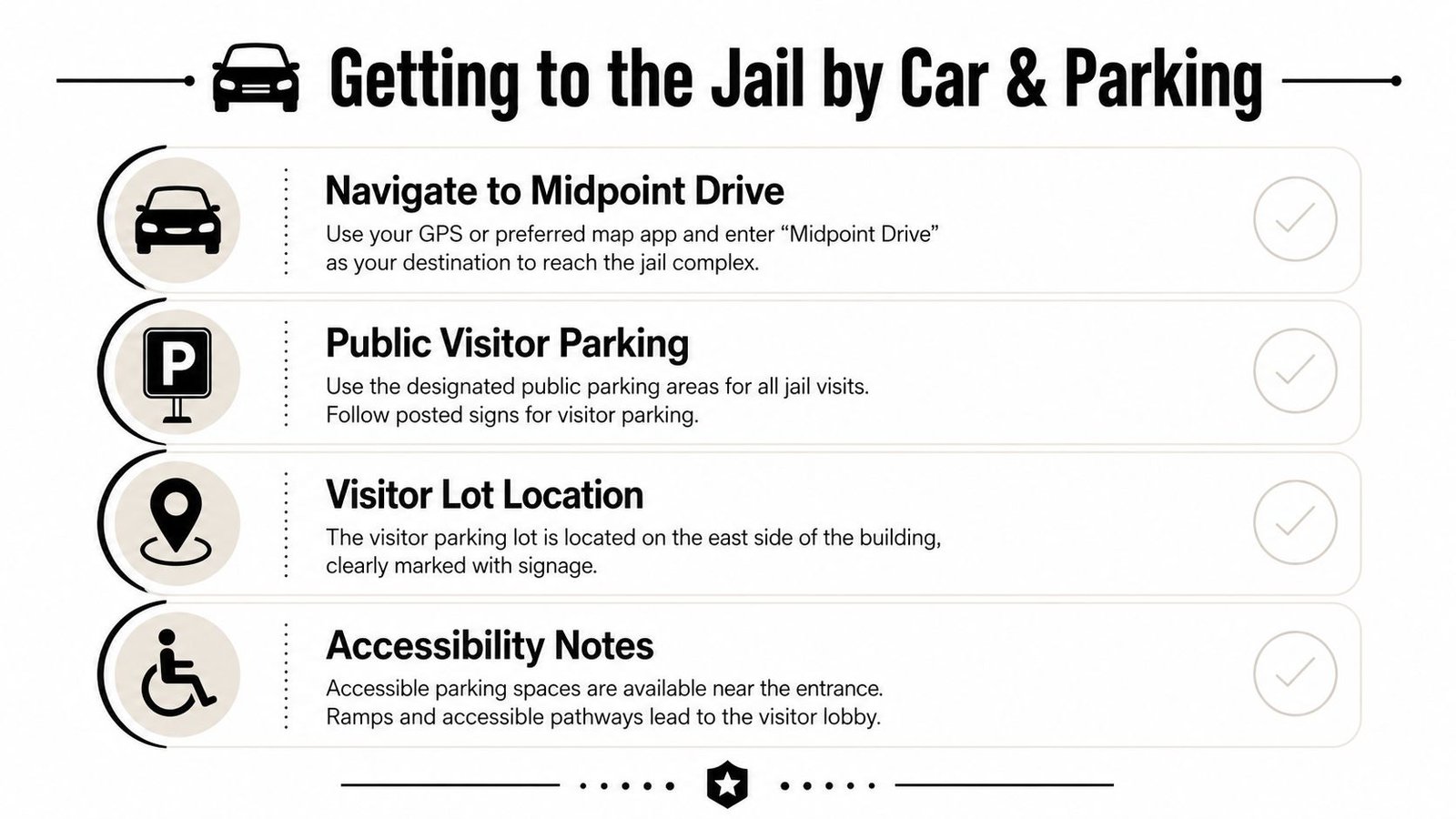
The practical move is to arrive with only what you need. Bring a photo ID, the inmate's full legal name, and anything required for the specific transaction you're doing, like kiosk payment details if you're posting a cash bond. Leave weapons, oversized bags, and extra electronics in the car, because secure facilities don't negotiate on screening.
What visitors miss most often
The lobby is not a place to linger, and the entrance flow can feel tight when multiple families show up at once. If you're there for booking-related business, don't assume the public lobby and the release window are the same line. They aren't, and that mistake costs people time.
Real-world advice: if the jail phone line gave you a specific door, line, or kiosk direction, follow that exact instruction, not the sign you think looks right from the parking lot.
For travelers who are renting a car to get to the facility, the Alamo car rental TPA guide is useful background if your trip started at the airport and you're trying to keep the drive simple. The point is not to make this complicated. Park, bring the right ID, stay out of the wrong line, and confirm you're at the jail entrance before you start asking questions.
Jail, Sheriff's Office, Justice Center, and Residential Center Explained
Midpoint Drive splits into a few different county stops, and families waste time when they treat them like one building. The jail is 2405 Midpoint Drive, the Sheriff's Office is 2501 Midpoint Drive, the Larimer County Residential Center is 2255 Midpoint Drive, and the Larimer County Justice Center is 201 LaPorte Avenue (Larimer County Jail and county facility references, Sheriff's Office location listing).
| Facility | Address | Primary Purpose |
|---|---|---|
| Larimer County Jail | 2405 Midpoint Drive, Fort Collins | Detention, booking, visitation, jail bonding |
| Larimer County Sheriff's Office | 2501 Midpoint Drive, Fort Collins, CO 80525 | Administrative sheriff's office location |
| Larimer County Residential Center | 2255 Midpoint Drive, Fort Collins | Separate correctional center on the same corridor |
| Larimer County Justice Center | 201 LaPorte Avenue, Fort Collins | Court-related business and property bonds |
The reason this matters is clear. Families hear “go to the sheriff's office” and assume that means the jail. Sometimes it doesn't. If the person on the phone meant the detention facility, they should have said jail, not just sheriff's office.
Property bonds create another common mistake. The sheriff's jail page says cash bonds can be posted at the jail entrance kiosk or online or by phone through AllPaid, but property bonds are handled at the Larimer County Justice Center, not at the jail entrance (Larimer County Sheriff's Office jail page). If somebody hands you a scrap of paper with “Midpoint Drive” written on it, confirm whether they mean the jail, the administrative office, or the residential center before you drive across Fort Collins. If you need a plain-English overview of the visit process, this jail visitation guide helps separate the public rules from the day-to-day reality.
How to read the instruction you were given
- If they said “visit”, ask whether they meant the jail visitation schedule.
- If they said “bond”, ask whether it's cash or property.
- If they said “sheriff's office”, ask for the full address so you don't land at the wrong building.
- If they said “court”, that points you to the justice center, not the jail.
The county's separate buildings sit close enough to confuse people, but they do different jobs. That distinction saves families from wasted trips and bad assumptions.
Visitation Hours, ID Rules, and Schedule by Last Name
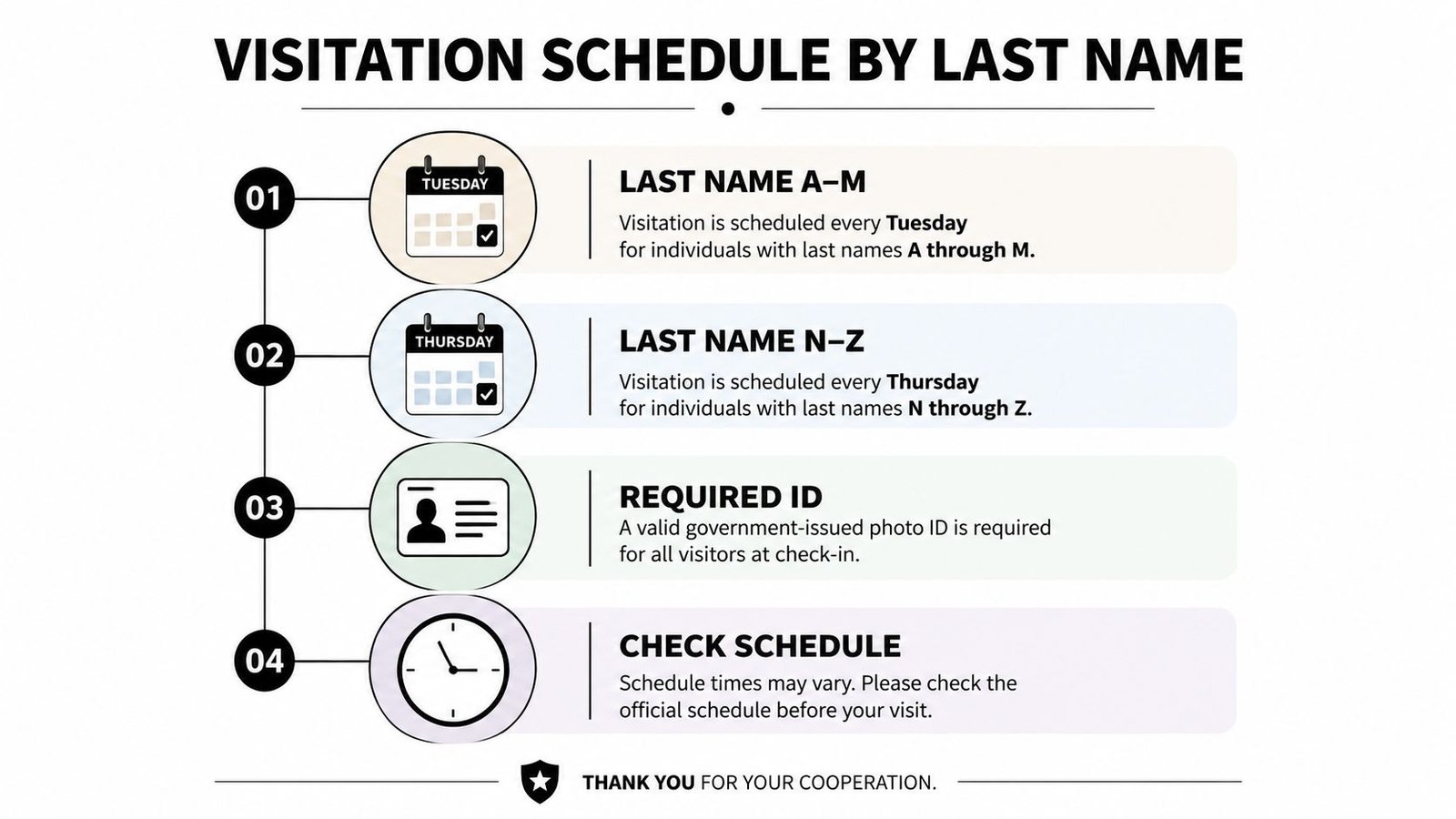
Visitation is tightly controlled, so a random drive over to the jail is a bad plan. The published schedule divides inmates by last name. A through M are scheduled for Tuesday, 6:30 p.m. to 9:00 p.m., and N through Z are scheduled for Wednesday, 6:30 p.m. to 9:00 p.m. (Larimer County Jail visitation guidance). Another source reports visits are allowed only on Tuesday, Wednesday, Thursday, and Saturday, not on Monday, Friday, Sunday, or county holidays, so confirming before you leave is the smart move.
What to verify before you leave home
- Last-name range: check whether the inmate is scheduled on Tuesday or Wednesday evening.
- Day of week: don't assume a holiday weekend changes the rules in your favor.
- Visitor ID: bring a valid photo ID.
- Dress code: keep clothing conservative and avoid anything that could trigger a denial.
- Arrival time: get there early enough to clear screening without rushing.
Do this first: call ahead if you're unsure whether the inmate is still eligible for visits, because a same-day transfer or disciplinary restriction can cancel a trip even when the schedule looks right.
For families who want a broader primer on jail visitation logistics, the can-you-visit-someone-in-jail guide is a practical cross-check. Use it as background, then follow the jail's current day-of-week rules, not assumptions from another county.
The hard truth is that visitation is one of the easiest things to get wrong because people rely on memory instead of the current schedule. If your loved one's last name starts with A through M, think Tuesday evening. If it starts with N through Z, think Wednesday evening. Anything else needs confirmation before you get in the car.
How to Find an Inmate at Larimer County Jail
Start with the inmate's full legal name and date of birth. That's the cleanest way to narrow a search when you're checking whether someone is in Larimer County custody. If the person was just booked, give the system and the jail a little time before you assume something went wrong.
The fastest approach is a three-step check.
- Search first. Use the county's inmate lookup tools or the jail's public information path, then match the name carefully.
- Call the jail. The main line is (970) 498-5200 (Larimer County Sheriff's Office jail page). Ask whether the person is currently housed there.
- Cross-check court information. If the name doesn't appear, compare it with court or booking information before you drive.
Sometimes a name doesn't show because the person was booked recently, moved to another facility, or released on bond. That doesn't mean the arrest didn't happen. It just means you need a second check before making assumptions. If the person may be in immigration custody instead of county custody, the ICE detainee search steps are the right fallback resource to verify the correct system.
Best practice: don't waste a trip on a single unconfirmed search result. A five-minute call can save you an hour of driving and a lot of frustration.
If you still can't confirm the location, use the county jail lookup page as a reference point for how local detention searches are usually organized. Then stop and verify with the actual facility before you go. The goal is simple, make sure the person is really at Larimer County Jail before you show up at 2405 Midpoint Drive.
Booking and Release at the Jail Entrance
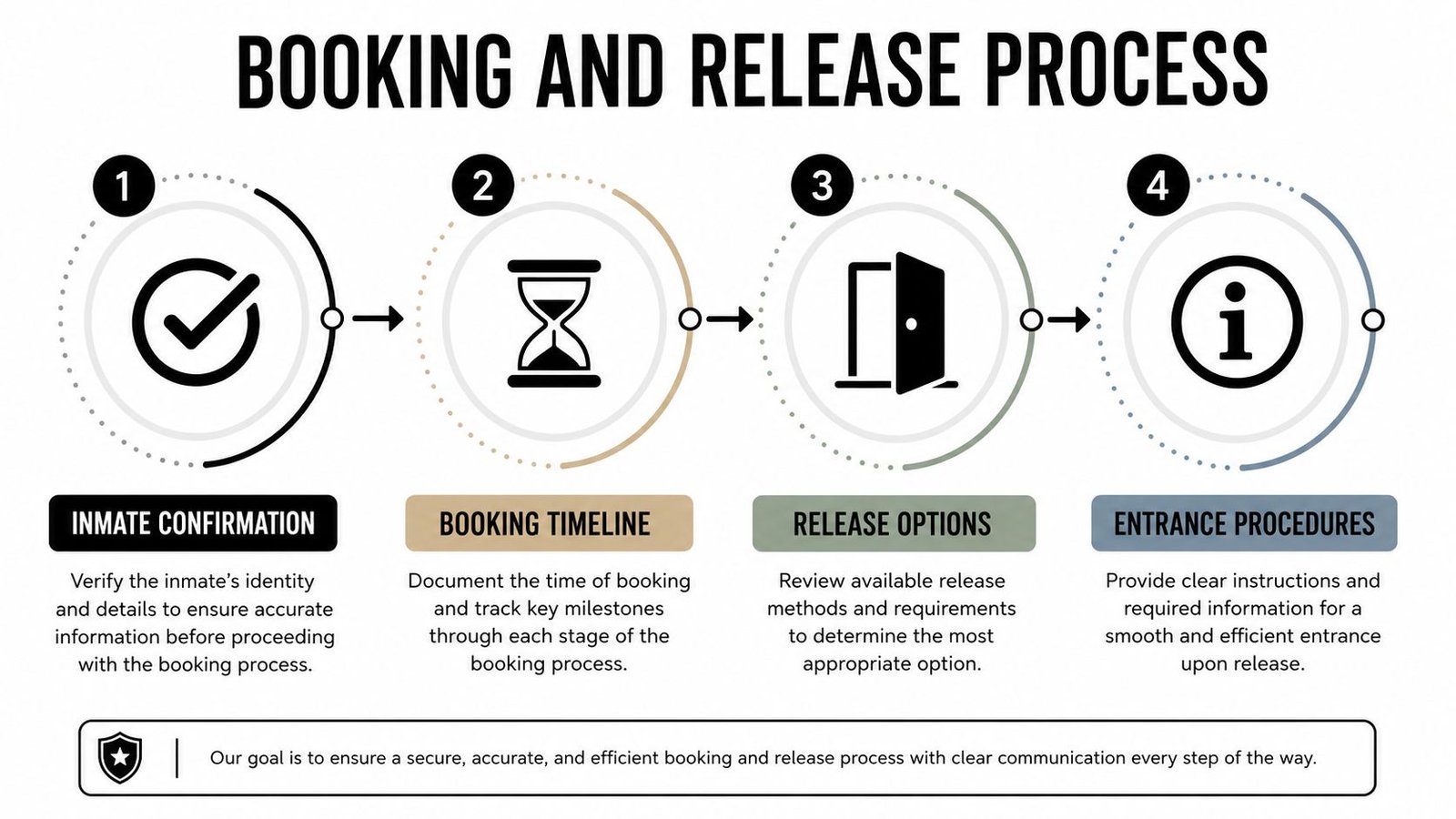
Families usually learn the hard part here. Booking starts at the jail, but release depends on the bond type, who is paying, and whether the jail has finished processing the paperwork. At Larimer County Jail, cash bonds can be posted at the entrance kiosk or handled online or by phone through AllPaid, while property bonds have to be handled at the Larimer County Justice Center, 201 LaPorte Ave, Fort Collins.
Cash bond versus property bond
- Cash bond: paid through the jail kiosk or through the county's online or by phone payment path.
- Property bond: handled separately at the Justice Center, not at the jail entrance.
- Common mistake: families arrive ready to post property at the jail kiosk, then find out they are at the wrong building.
Practical rule: if you do not know which bond type the court allowed, stop and confirm before you pay. The wrong bond type at the wrong building will not speed up release.
For a plain-English look at how booking usually moves, the how long booking takes in jail guide gives useful background. Release happens after the jail receives the correct bond or release authorization, processes it, and then returns property under facility procedure.
I also work with out-of-state families every week, and they often use a remote surety option instead of driving to Fort Collins. A service like out-of-state bail bonds fits when the cosigner cannot get to Colorado quickly and needs the paperwork handled electronically. That does not change the jail's rules, but it does make the family's side of the process easier.
Bail Amounts and Premium Rates in Colorado
At Larimer County, the jail address does not set the bond, the judge does. That is the number families have to work with, and it changes the next step completely. Colorado bond pricing usually starts with a 15% premium, and for bonds over $5,000 an approved cosigner can often qualify for 10% through a licensed agent, according to the publisher's service description.
The math is simple, and families should run it before they make a decision. On a $20,000 bond, a 15% premium means $3,000. At 10%, the premium is $2,000. That payment is for the bond service. It is not refundable cash bail.
People mix up cash bail and a surety bond all the time, and that confusion costs time. Cash bail is money posted directly with the court or jail process where allowed. A surety bond is the premium paid to a bail bond company so it can post the bond on the family's behalf. Once that premium is paid, it does not come back.
What a cosigner has to show before the rate drops
- Colorado residency
- Employment
- Willingness to sign the indemnity agreement
Those three items are the essential checkpoint. If the cosigner cannot show stability, the lower premium usually is not available. If the cosigner can document those basics, the family may keep more cash on hand and still move the case faster.
A good bondsman should tell you the rate in plain numbers. If the answer stays fuzzy, walk away and call someone else. You need to know whether the quote is 15% or 10%, and you need to know what the cosigner must provide before anyone starts paperwork.
Families dealing with a Larimer case from outside Colorado often use out-of-state bail bonds so they can handle the bond without driving to Fort Collins. That does not change the court's requirement or the jail's process. It just gives the family a practical way to get the paperwork done when the cosigner is not local.
Working With a Bondsman Who Posts Bonds Remotely
A family does not need to sit at the jail front desk to get a Larimer case moving. If everyone is spread out, the faster path is to start the bond by phone or text, send the paperwork electronically, and get signatures finished before anyone wastes a drive. Express Bail Bonds handles that intake by phone or text at 720-984-2245, and it works with surety bonds rather than cash-only bonds.
Have the basic facts ready before you call. Give the defendant's full legal name, date of birth, the facility, and the charges if known. That is the information the agent needs to start the file, verify the bond type, and send the contract documents without delay. For relatives outside Colorado, that setup keeps the process moving when they cannot stand at the counter themselves.
Once the file is open, the family's job is simple, but it has to be exact. Send the identity details, current contact information, and any booking or charge information you already have. The agent handles the paperwork, the filing steps, and the coordination tied to the surety bond. If signatures are missing or payment confirmation stalls, expect the process to pause until those pieces are fixed.
What the family does, what the agent handles
- Family provides: identity details, contact information, and any known booking or charge information.
- Agent handles: paperwork, filing steps, and coordination tied to the surety bond.
- Family should expect: quick back-and-forth if signatures or payment confirmation are missing.
If you are comparing Colorado options from another county while handling a Larimer case, use local resources only as reference points. The company also maintains the Jefferson County Golden page and the Centennial bail bonds page, but keep those separate from the Larimer jail details so you do not mix up facilities. Families handling a defendant from outside Colorado can also use out-of-state bail bonds to complete the bond without making an unnecessary trip.
A remote bond does not change jail processing time, and it does not change who can be released. It only removes the need to haul paperwork across Colorado when the family can finish it another way.
Mailing Rules for Inmate Correspondence
Mail errors are common, and the jail does not rescue a bad envelope. The physical detention facility address at 2405 Midpoint Drive is separate from the mailing rules for inmate correspondence. Legal mail goes to the jail street address. Regular inmate mail may go through a postal box in Phoenix, MD if that is what the current mail-processing setup requires (Larimer County inmate mail guidance).
That split matters. Address regular mail to the wrong place and it can sit, get delayed, or come back to you. Legal correspondence should use the jail street address exactly as listed. Standard mail should follow the facility's current screening instructions, because the mailroom controls what enters the jail and where it is routed.
Send only plain correspondence. Do not include stamps, glitter, cash, Polaroids, or Polaroid-sized photos.
Put the inmate's full name on the envelope, and add any booking identifier if the facility requires one. Keep the letter simple, the pages flat, and the envelope free of extras. If you try to dress it up, the mailroom has another reason to stop it.
Mailroom rule: if it can be removed, hidden, or traded, do not put it in the envelope.
Use the correct address, follow the current mail vendor rules, and leave prohibited items out of the package. That is the safest way to get mail accepted.
Common Questions Families Ask After the Visit
Once you leave the jail, the questions get more practical. Families want to know how calls work, where money goes, what happens to property, and whether the person is still there. Keep your answers simple and verify the current rules before you act.
Are calls from the jail collect or prepaid? The facility controls phone access, so expect jail calling rules instead of normal cell-phone use. If the person inside needs to reach you, set up the calling option the jail allows and have the inmate's full name ready when you call for account details.
How do I send money to commissary? Use the payment method the jail or its vendor allows. Do not hand cash across a counter unless staff specifically tell you to do that. Check the jail's current instructions before sending anything, because those rules can change.
What happens if bond is forfeited? The court treats that seriously, and the cosigner can be responsible under the bond agreement. Only sign if you understand the bond amount, the conditions, and the court-date requirements.
How do I get personal property back? Ask the jail about the property release process and bring the exact identification they require. Do not assume a friend can pick up everything without checking first. Property release is usually where families lose time because they guess instead of confirming.
What if the inmate isn't there anymore? Check whether the person was released, transferred, or booked into another facility. At that point, stop guessing and confirm the status through the jail, court records, or the correct county system.
If you need a direct way to handle a Larimer arrest and want someone who posts Colorado surety bonds remotely, contact Express Bail Bonds now and give them the inmate's full legal name, date of birth, facility, and charge information if you have it.