
The phone rings late. A son, partner, sibling, or friend says they've been arrested, and the next words come fast and blurry. Which jail? What charge? How much is bail? Can they get out tonight?
Most families start in the same place. You want a straight answer, and the legal system rarely gives one right away. One possible outcome is release on own recognizance, often shortened to OR or called a personal recognizance bond in Colorado. In plain English, that means the court releases someone without requiring money up front, based on their promise to come back to court and follow the rules the judge sets.
That sounds simple. It isn't always simple in practice. Whether someone gets OR depends on the judge, the charge, the person's history, and the information available at the first hearing. Families who understand that process usually make better decisions and avoid painful surprises.
A Loved One Is Arrested What Happens Now
If you're dealing with an arrest right now, slow the process down into manageable steps. First, confirm where your loved one is being held and what the listed charge is. Then find out when the first appearance or bond hearing will happen, because that's often the first real chance for the court to decide release conditions.
If anyone involved has relevant messages about where the person was, what happened, or who was present, preserve them carefully. Questions sometimes come up later about using text messages as evidence, and it's easier to organize that material early than to reconstruct it later.
A lot of people hear “OR release” and assume it's automatic for minor cases. It's not. It's one possible path, along with a surety bond, a cash bond, or continued detention until the court sets conditions.
The first decisions to make
In the first few hours, families usually need to answer these questions:
- Where is the person booked? County and city facilities follow different routines, and that affects timing.
- What is the next court date? Release decisions usually happen at the first advisement or bond hearing.
- Is there paperwork to gather? Proof of address, work, treatment participation, or family support can matter.
- What should you avoid saying? Don't argue facts of the case over recorded jail calls.
Practical rule: Treat every early step like it may matter later in court. Names, dates, addresses, and documents count.
If you're still trying to get your bearings, this guide on what to do when someone gets arrested gives a helpful starting checklist. The key thing to remember tonight is that release on own recognizance is possible, but it's only one piece of a larger process.
What Release on Own Recognizance Means in Colorado
In Colorado, release on own recognizance means the court lets someone out of custody without requiring money up front. Legally, the term is more precise. Release on own recognizance (OR), legally termed an unsecured personal recognizance bond under Colorado Revised Statutes §16-4-104(b), is a judicial mechanism that permits pretrial release without monetary bail, contingent solely on a written promise to appear and adherence to nonmonetary conditions designed to reasonably ensure court attendance according to Cornell Law School's explanation of own recognizance).
Think of it as a formal promise to the court. Not a casual promise. A legally binding one. The judge is saying, “I believe you can be released without money changing hands right now, but you must return and follow the conditions I order.”
Why lawyers call it an unsecured bond
“Unsecured” confuses people. It doesn't mean the case is informal, and it doesn't mean there are no consequences. It means the person doesn't have to post cash or property before release.
That's different from a secured bond, where someone pays cash or uses a bondsman to guarantee the amount. With OR, the court relies on the defendant's promise and any added nonmonetary conditions.
Here's the practical distinction:
- OR bond means no immediate payment is required for release.
- Secured bond means money or a financial guarantee is required before release.
- Court conditions still apply even when the release is “free” up front.
What the court is really deciding
The court isn't deciding guilt at this stage. It's deciding risk. Will this person come back to court? Do they need conditions to make that happen? Is money necessary, or would a promise and supervision be enough?
That's why OR is often discussed under the broader idea of pretrial release. If you want a quick overview of where OR fits in the bigger process, this page on Colorado pretrial release is useful background.
An OR bond can feel like a break. It's actually a strict agreement with the judge.
For families, the biggest misunderstanding is thinking OR means the case is minor or nearly over. It doesn't. It only means the court chose release without requiring upfront money.
Who Qualifies for a Personal Recognizance Bond
Whether someone qualifies for a personal recognizance bond depends on the court's view of risk and reliability. In Colorado, a Personal Recognizance (PR) bond is generally granted only to defendants deemed to have minimal flight risk and who are charged with non-violent offenses, requiring strong community ties, a limited or no prior criminal record, and a demonstrated history of appearing for court hearings as scheduled as described in this overview of Colorado personal recognizance bonds.
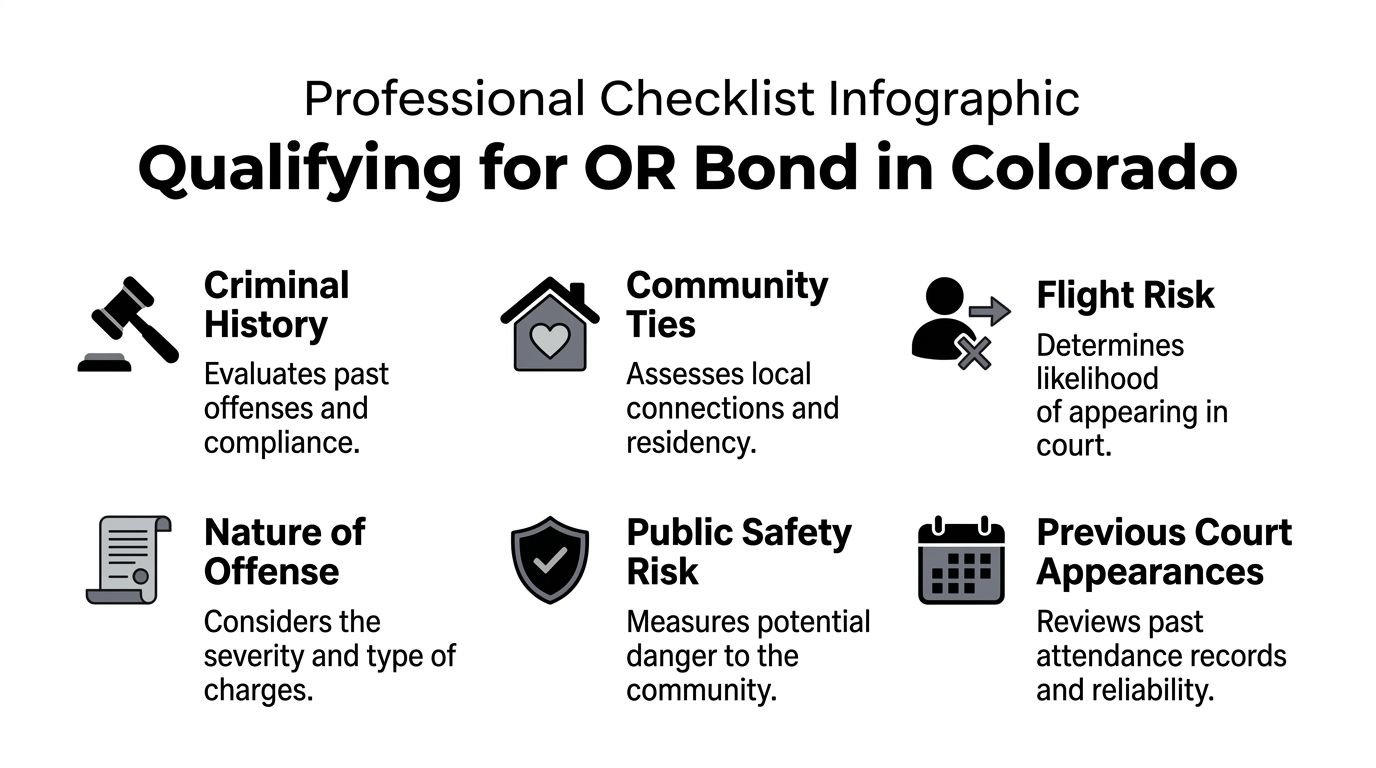
That single sentence contains most of what judges care about. Families often hear broad phrases like “good candidate” or “low risk,” but those phrases usually come down to a short list of concrete facts.
The profile judges usually like to see
A strong OR candidate often looks like this:
- Stable local ties. The person lives in the area, has family nearby, or both.
- Reliable work or school history. Regular responsibilities suggest they're less likely to disappear.
- Little or no criminal history. Especially if there's no pattern of missing court.
- A non-violent charge. Judges usually view these cases differently from violence-related allegations.
- Past court compliance. If the person has shown up before, that matters.
What families can gather before court
You usually can't control the charge, but you can help organize the person's strongest facts. Useful items may include:
- Proof of residence such as a lease, utility bill, or mail showing a local address
- Employment confirmation from a supervisor, schedule, or recent pay documentation
- Family support information showing who can help with transportation and reminders
- Treatment or counseling participation if that helps show stability
- A court-date history if prior appearances were handled properly
Families help most when they bring facts, not speeches.
Colorado also has a category that people often miss. Under Colorado Revised Statutes §16-4-113, a judge must release an accused person on personal recognizance if the charged offense has a maximum penalty of six months' imprisonment or less, unless specific exceptions apply, such as failure to identify oneself, refusal to sign the recognizance, no ties to the jurisdiction, or a prior failure to appear for trial.
That rule matters because it gives some lower-level cases a stronger starting point for OR. But even there, exceptions can change the outcome fast.
If you want to understand how counties and courts evaluate risk before the judge rules, this article on pretrial risk assessment in Colorado helps explain the moving parts. The short version is that OR isn't random. The court is looking for signs that release without upfront money is realistic and responsible.
OR Release vs Bail Bonds and Cash Bonds
Families usually want to know one thing first. If OR doesn't happen, what's the next best option? The answer depends on cost, speed, and who can help complete the release.
An OR bond is often the most affordable option because there's no upfront payment for release. But it's also the option families control the least, because the judge has to approve it. Cash bonds and surety bonds come into play when the court requires financial backing.
Comparing the practical differences
| Feature | Release on Own Recognizance (OR) | Surety Bond (Bail Bondsman) | Cash Bond |
|---|---|---|---|
| Upfront payment | No money required up front | Premium paid to the bail agency | Full cash amount paid to the court |
| Who approves release | Judge | Judge sets bond, agency posts guarantee | Judge sets bond, family pays court |
| Who takes on financial risk | Defendant if they violate conditions or fail to appear | Bail agency and indemnitors under the bond agreement | Person posting cash |
| Best fit | Low-risk defendants with strong facts for release | Families who can't tie up the full cash amount | Families able and willing to pay the full amount directly |
| Common obstacle | Judicial discretion | Need for an approved application and agreement | Large amount of cash may be required at once |
That table explains why OR is attractive but not always realistic. If a judge says no, the issue usually becomes how to secure release without draining a family's finances.
Why OR and bail bonds serve different needs
OR is built around trust and risk. Surety bonds are built around access. A bail bondsman doesn't replace the judge's decision. The judge sets the bond first. The agency then posts a guarantee so the defendant can be released without the family paying the full amount directly to the court.
Cash bonds work differently. The court requires the full cash amount to be posted before release. That can be difficult for families who need money for rent, food, travel, or legal fees.
For a broader overview of each path, this guide to the different types of bail in Colorado breaks down how they compare in real cases.
If OR is denied, the smart next question isn't “Why us?” It's “Which release option can we actually complete today?”
That mindset helps families move faster and make cleaner decisions under pressure.
How to Request Release on Own Recognizance
The request for OR usually happens at the first appearance, advisement, or bond hearing. That's the moment when the judge reviews the charge, hears from the parties, and decides whether release without upfront money is appropriate.
In Colorado, the grant of a Personal Recognizance (PR) bond is a discretionary judicial authority, who must weigh the defendant's financial circumstances under C.R.S. 16-4-103 to ensure bail is not 'excessive'. Unlike secured bonds where a bail agency posts the guarantee, OR bonds bypass the commercial surety market entirely under Colorado Revised Statutes §16-4-104.
What happens in court
Three people usually shape this decision:
- The judge decides the release conditions.
- The prosecutor may argue for stricter conditions or against OR.
- The defense attorney argues for the least restrictive release that still satisfies the court.
If the defendant doesn't have a lawyer yet, the judge may still ask basic questions about ties to the community, work, residence, and history of appearing in court.
What to prepare before the hearing
The strongest OR request is simple, documented, and focused on reliability. Families can help by gathering:
- Address proof that shows the person has a stable local place to live
- Employment details showing a current job, shift schedule, or supervisor contact
- Court compliance facts showing prior appearances, if any
- Support plans such as who can provide rides, reminders, or housing
- Special concerns like medical needs or caregiving duties, if relevant
Avoid turning this into a character parade. Judges usually respond better to specific facts than to broad statements like “he's a great person.”
A practical example of how the request may sound
A defense lawyer might say something like this:
“Your Honor, my client has a stable residence in the county, ongoing employment, family support in the courtroom, and no history of missing court. We're asking for a personal recognizance bond, or in the alternative, the least restrictive conditions the court believes are necessary.”
That request works because it answers the court's real question. Why should this person be trusted to return?
If your loved one might qualify, organize the supporting facts before the hearing starts. Once the judge rules, the window to influence that first decision may close quickly.
The Hidden Risks of an OR Bond
A lot of online explanations make OR sound like the easy answer. It isn't. It may be the cheapest path at the front end, but it can become the most expensive mistake if the defendant treats it casually.
That's the part families often miss. Existing content frames OR as 'free', but rarely addresses the consequences if the defendant violates conditions. When OR is revoked, the court often reimposes a cash bail requirement, sometimes at a higher amount, creating a 'bail trap' where the defendant loses the chance for a lower-cost release according to this discussion of own recognizance release consequences.
The conditions can be stricter than people expect
An OR release may come with rules such as:
- No-contact orders with an alleged victim or witness
- Travel limits that keep the defendant in a county or state
- Sobriety requirements or testing
- Check-ins with pretrial services
- Electronic monitoring in some cases
Colorado practice also recognizes that a judge can grant a Subsection (b) PR bond with added conditions even when a standard PR bond isn't the final choice. That means “released on recognizance” doesn't always mean “released without supervision.”
What happens if someone misses court
Missing court is one of the fastest ways to lose the benefit of OR. The court may issue a warrant, revoke release, and impose new financial conditions that are harder to meet.
If you need a plain-language explanation of that problem, this page on failure to appear in Colorado helps clarify why a missed date can snowball so quickly.
Court dates are not suggestions. OR only works when the defendant treats every condition like an order.
The practical lesson is simple. If someone gets release on own recognizance, write down every date, every rule, every name, and every reporting requirement before they walk out. Families who stay organized protect that release. Families who assume “free release” means “low stakes” often end up back in court under worse conditions.
Colorado OR Bond FAQs and Local Resources
Some questions keep coming up in Colorado cases because families need answers fast, not theory.
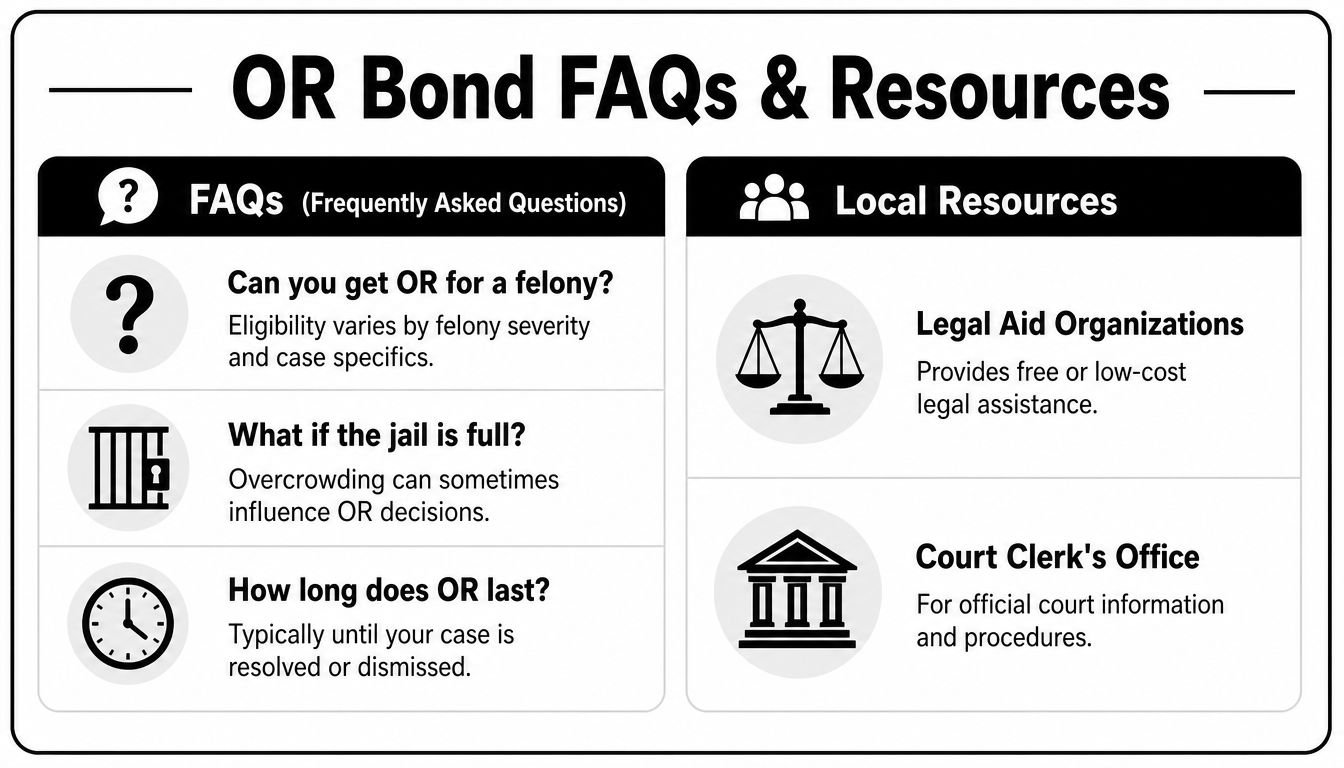
Quick answers families usually need
Can you get OR for a felony?
Sometimes, yes. It depends on the charge, the person's history, community ties, and the court's view of risk. A felony doesn't automatically block OR, but it often makes the argument harder.
What if the charged offense is minor?
That can help. As noted earlier, some lower-level offenses have a stronger path toward personal recognizance release under Colorado law, subject to exceptions.
What if the jail is overcrowded?
This issue matters, but not in the way people expect. In Colorado, crowded jail facilities released only 12% of their cases on personal recognizance, while non-crowded jails released 35% on that basis, according to the Bureau of Justice Statistics description of Colorado pretrial release practices. That shows overcrowding can restrict OR decisions instead of making them easier.
How long does OR last?
Usually until the case ends, the court changes the bond, or the defendant violates a condition.
Useful local next steps
When a loved one is in custody, practical tools matter more than general advice. Start with these:
- Court clerk information for the county handling the case, so you can confirm dates and courtroom details
- County inmate search tools for places like Jefferson County and Arapahoe County
- Defense counsel contact information so documents can be sent quickly
- A written family checklist with housing, work, transportation, and medical facts ready for court
If OR isn't granted, families often need immediate help with the next release option. In that situation, it helps to have a direct line to a Colorado bail agency that handles statewide surety bonds and remote processing.
If release on own recognizance isn't an option, or if you need help right now, contact Express Bail Bonds for fast Colorado surety bond assistance. They serve detention facilities across the state and can help families move quickly after a bond is set. For local support, visit their Jefferson County Golden office page or their Centennial bail bonds page.