
Judicial release is a court-ordered way for an incarcerated person to leave prison before the full sentence is served, and the decision belongs to the original sentencing judge. In Ohio, that can mean filing immediately on a sentence under two years, after 180 days for many 2 to 5 year sentences, or after serving half the term on sentences over ten years.
If you're reading this, there's a good chance someone you care about has already been sentenced, and you're trying to answer the question nobody prepared you for: is there anything that can be done now? Families often leave a courtroom with a sentencing entry in hand, a dozen half-understood legal terms in their head, and no clear idea where hope fits into the picture.
That's where understanding what judicial release is starts to matter. It isn't a do-over of the case. It isn't parole. It isn't a promise. It's a legal process that asks the same judge who imposed the sentence to reconsider whether continued prison time is still necessary.
For Colorado families, the exact phrase may be different, but the underlying idea still matters. One state may call it judicial release. Another may use sentence reconsideration or sentence modification. The labels change. The core question stays the same: can a judge shorten what happens next?
Understanding Your Loved One's Sentence and Options
The hardest moment usually isn't just the sentence itself. It's the ride home after court, when everyone starts asking practical questions and nobody has solid answers. Can they come home early? Does good behavior matter? Is this up to a parole board, or the judge, or the prison?
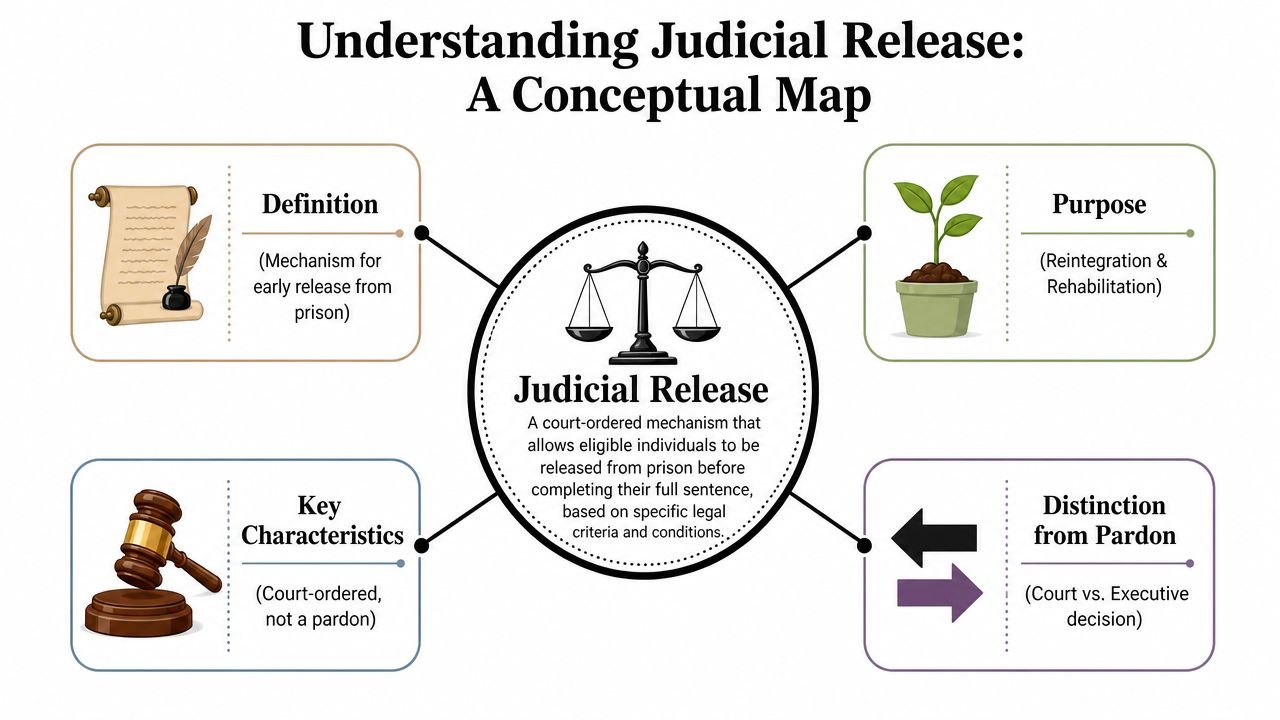
A useful starting point is this. Judicial release is a court-ordered mechanism that permits an incarcerated individual to be released from prison before completing their full sentence, and this decision is made exclusively by the sentencing judge based on eligibility criteria such as good behavior or serving a specific portion of the sentence, as explained by US Legal Forms' overview of judicial release.
That single point clears up a lot of confusion. The decision isn't made by a governor. It isn't a routine administrative action. It's tied to the court that handled the case in the first place.
Why families get confused
People often mix together several stages of the system. Bail happens before trial. Sentencing happens after conviction. Early release options come later still. If your family is still trying to sort out the basics of custody and release, this guide on how to get out of jail can help distinguish pretrial release from what happens after a prison sentence begins.
When a judge sends someone to prison, the sentence feels final. In some cases, the law still leaves a narrow path for the judge to revisit how much of that sentence must actually be served in prison.
Why Ohio makes a good example
Ohio's system is useful because it spells out eligibility in a way families can follow. It shows how the law can create specific waiting periods, filing rules, and judge-driven discretion all inside one structured framework.
Colorado uses different language and different procedures. But if you understand the Ohio example first, the Colorado picture becomes much easier to grasp because you can recognize the same moving parts under different names.
What Exactly Is Judicial Release
Judicial release is easiest to understand if you stop thinking of it as forgiveness and start thinking of it as reassessment.
A good analogy is a professor who gave a final grade, then later reviews strong extra-credit work showing the student has mastered the material. The original grade wasn't illegal. The professor isn't pretending the semester never happened. The professor is deciding whether the result should change because of what happened afterward. Judicial release works in a similar way. The original sentence stands as lawful. The question is whether later facts justify cutting the prison portion short.
What judicial release is not
It's not a pardon. A pardon comes from executive power. Judicial release comes from the court.
It's not an appeal. An appeal argues that the judge or trial court made a legal error. Judicial release accepts the conviction and sentence as valid, then argues that the goals of incarceration may already have been met.
It's also not the same thing as being released on your own promise before trial. If you want to compare that separate concept, this explanation of what released on recognizance means covers a very different stage of the process.
Who the key players are
Three people usually matter most.
- The sentencing judge decides whether release is appropriate.
- The incarcerated person files the request and becomes the petitioner asking for relief.
- The prosecutor can respond, object, or argue that continued incarceration is still warranted.
The prison record also matters, even though the prison itself doesn't make the final decision. Program participation, conduct reports, and reentry planning often become part of the judge's review.
Practical rule: Judicial release is judge-centered. If you approach it like an automatic prison milestone, you'll misunderstand the whole process.
Why judges have this power
Courts and legislatures recognize something simple. People can change after sentencing. Treatment can work. Education can matter. A person may become a lower risk than they were on the day of sentencing. In systems that allow judicial release, the law gives the judge a structured way to respond to that change.
That doesn't mean release is easy. It means the law leaves room for proof. The person seeking release has to show the court more than hope, more than family need, and more than a general promise to do better.
Who Qualifies and How to Apply
Ohio offers one of the clearest roadmaps for understanding how judicial release works in practice.
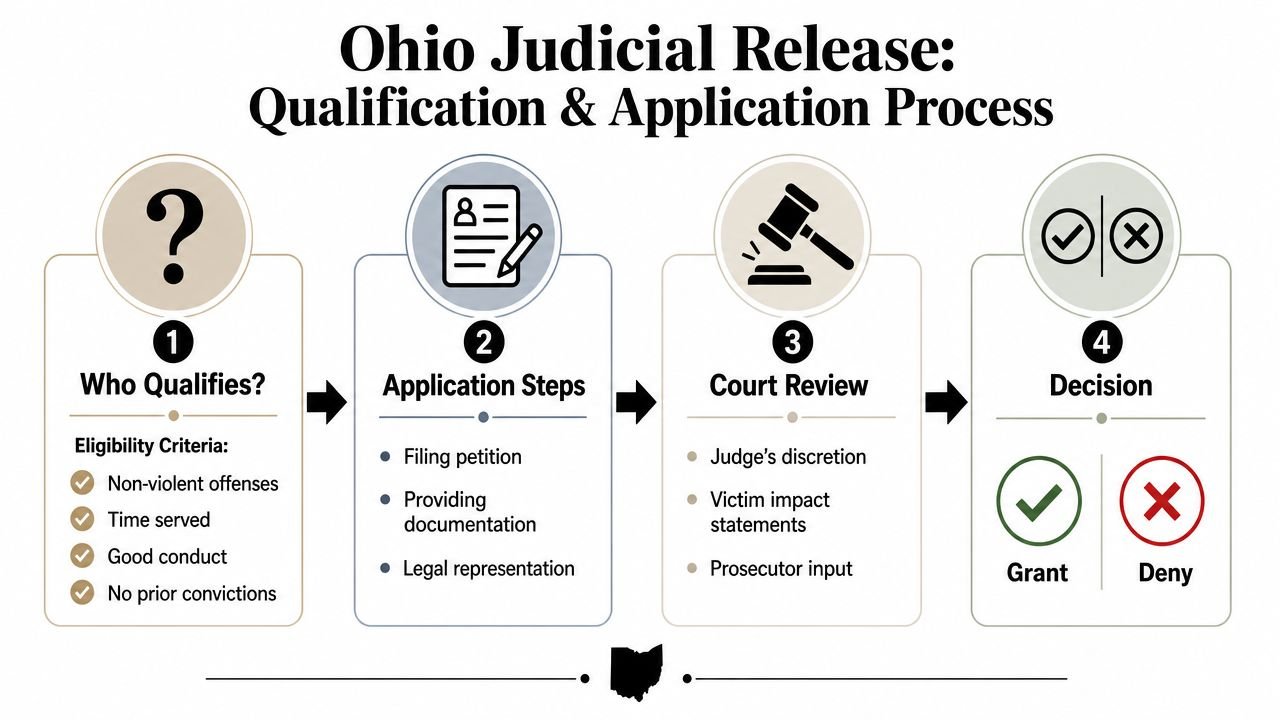
The first lesson is that eligibility is rule-based before it becomes persuasive. A judge can't grant relief if the person isn't legally allowed to file yet. According to Better Call Spall's summary of Ohio judicial release eligibility, offenders with sentences under two years may file immediately, those with 2 to 5 year sentences must serve 180 days, and sentences over ten years require serving half the term. That same source explains that the motion must include a formal filing, evidence of contrition, and behavioral records.
The Ohio filing roadmap
A family usually thinks the process begins with a heartfelt letter. Legally, it begins with timing.
Confirm the sentence structure
Someone must read the sentencing entry carefully and determine whether the person is serving a term that qualifies for filing.Calculate the first filing date
This isn't guesswork. It depends on the sentence length and whether any parts of the sentence are treated differently under the statute.Prepare the motion
The request has to be filed formally with the court. This isn't an informal note to the judge.
Before getting to the later stages of the case, many families also benefit from understanding courtroom preparation generally. This guide on how to prepare for a court hearing gives a practical frame for organizing records, expectations, and presentation.
A short visual overview can also help make the process feel less abstract.
What usually goes into a strong filing
A persuasive motion often pulls together several kinds of proof:
- Behavioral records that show the person hasn't spent the prison term collecting serious disciplinary issues.
- Program completion documents showing classes, treatment, training, or other rehabilitative work.
- A statement of remorse that feels specific and credible, not scripted.
- Family support materials that show where the person will live and who will help keep them stable.
Ohio's framework also shows how sentencing can become surprisingly uneven. A Robina Institute report on Ohio sentencing indeterminacy describes a “crazy quilt” system where a sentence under two years is theoretically 100% indeterminate after admission, a two-year sentence is 75% indeterminate, a four-year sentence is 88% indeterminate, a five-year sentence is 20% indeterminate, and sentences of 10 years or more become uniformly 50% indeterminate. That's a reminder that sentence length alone doesn't always tell a family when meaningful release options begin.
Judicial Release vs Parole vs Sentence Reduction
These terms get blurred together all the time. They shouldn't. If you use the wrong label, you can ask the wrong official for the wrong kind of relief.
Under Ohio law, Harris Law's explanation of judicial release makes two key points. Judicial release is prohibited while the person is serving mandatory prison time, and it is different from parole because parole is administered by a parole board while judicial release is ordered by a judge. That same source also explains that judicial release doesn't attack the legality of the original sentence. It argues that the goals of incarceration have been met.
Release Mechanisms Compared
| Mechanism | Decision-Maker | Basis for Decision | Typical Outcome |
|---|---|---|---|
| Judicial release | Sentencing judge | Eligibility under statute, rehabilitation evidence, post-sentencing conduct | Release from prison under court-ordered supervision, often with conditions |
| Parole | Parole board | Board review under parole rules and supervision standards | Supervised release administered through the parole system |
| Sentence reduction | Usually a judge | A rule or motion allowing the court to revisit sentence length | Shorter sentence or modified sentence structure |
The easiest way to keep them straight
Think in terms of who holds the pen.
If the decision comes from a parole board, you're dealing with parole. If the original sentencing court reconsiders the prison term, you're dealing with something in the judicial-release or sentence-reduction family. If a statute forbids release during a mandatory portion, no amount of strong personal support can get around that legal barrier.
If you're sorting through release terms more generally, this overview of what pretrial release is can help separate pre-conviction release from post-conviction sentence changes.
The phrase “early release” is only a description. It's not a legal mechanism by itself. The real question is which mechanism the law actually allows in that case.
Why this distinction matters in Colorado
Colorado families often use “judicial release” as a generic phrase even when Colorado law uses different terminology. That's understandable, but precision matters. A lawyer can only ask for relief that Colorado recognizes. Using the Ohio concept as a model helps, but the Colorado filing has to be built around Colorado procedure.
What Judges Consider for a Favorable Ruling
Eligibility gets you to the courthouse door. It does not get you through it.
A judge who reviews a release motion wants to know whether prison has done what it was supposed to do. That means the person asking for release must show more than time served. The court will look for signs of rehabilitation, accountability, and a realistic return-to-community plan.
The evidence judges tend to care about
Some proof carries more weight because it answers practical concerns.
- Institutional conduct matters because it shows how the person behaves under rules and supervision.
- Treatment and vocational work matter because they show effort directed at the problems that contributed to the offense.
- Remorse matters when it is concrete. Judges can usually tell the difference between a rehearsed statement and a sincere one.
- Reentry planning matters because a good motion answers where the person will live, how treatment will continue, and what structure will exist after release.
Ohio commentary has also highlighted a newer point that applicants often miss. A VanHo Law discussion of Ohio judicial release requirements notes that revisions to Ohio law emphasize institutional summary reports that cover vocational training and treatment participation. In plain terms, good behavior alone may not be enough if the record doesn't also show active rehabilitation.
Why timing and preparation are high stakes
Some families want to “see what happens” by filing quickly with limited support. That can be a serious mistake.
According to Ohio Legal's discussion of judicial release denials, a motion denied after a hearing is often barred from being filed again, while a motion denied without a hearing may still be refiled. The reasoning is straightforward. Once the judge has fully heard and evaluated the rehabilitation case, the court may treat a second attempt as an abuse of process.
A release motion should be built like a final presentation, not a rough draft.
The human piece judges notice
Judges also look for whether the release plan reduces the chance of collapse. Stable housing, sober support, treatment continuity, and family structure all help. For families dealing with substance use issues, practical recovery planning matters as much as courtroom language. Resources such as lifelong sobriety solutions can help families think through what sustained recovery support should look like after release.
Applying These Concepts in Colorado
A family in Colorado may hear about judicial release in Ohio and assume there must be a Colorado form with the same name. Usually, there is not. The better question is whether Colorado law gives the court any post-sentencing path to revisit the sentence, or whether release decisions now sit with another part of the system.
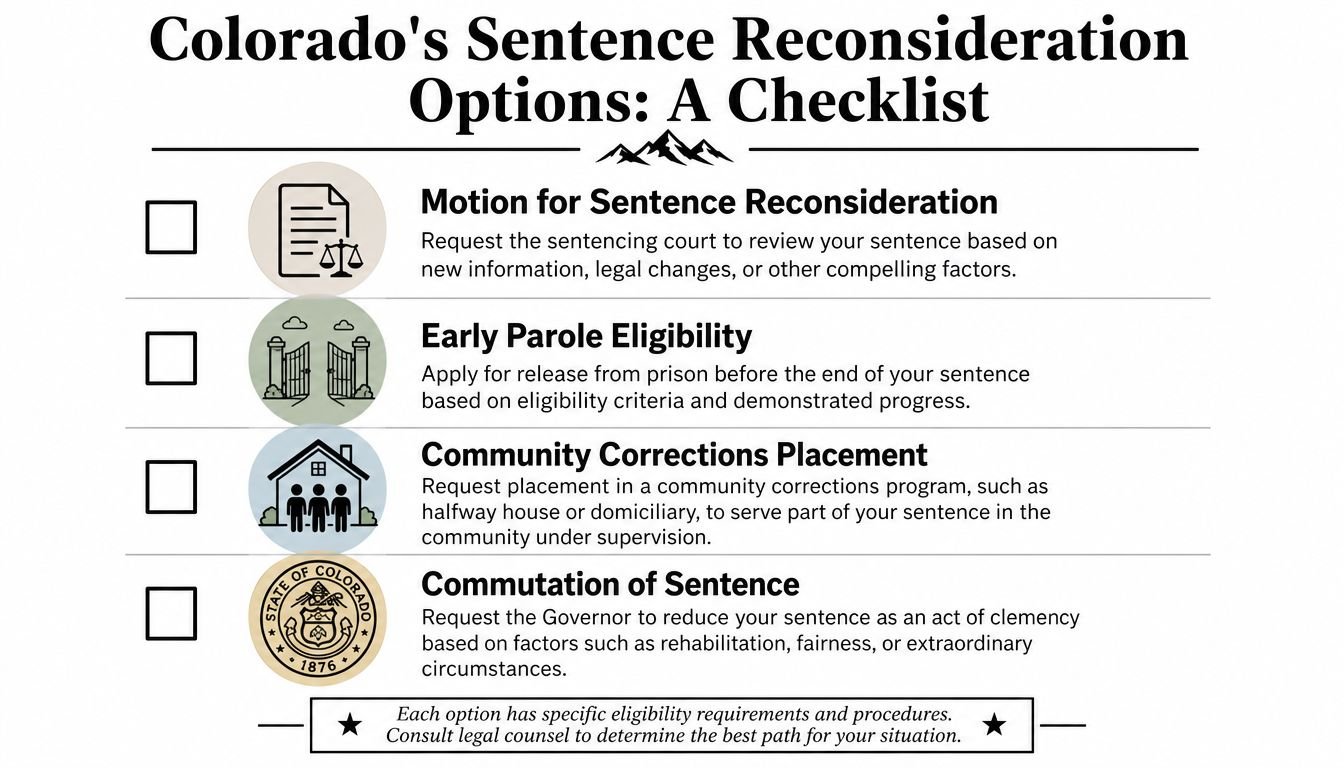
Ohio is a useful teaching model because its rules put the concept in plain view. A judge can reconsider a prison sentence through a defined process called judicial release. Colorado uses different labels, but the underlying question is often similar. Can a judge still change something after sentencing, and if so, what procedure applies?
In Colorado, that conversation often turns to sentence reconsideration, sentence reduction, community corrections, parole, or in rare cases clemency. Those are different tools. They do not come from the same decision-maker, and they do not use the same standards. A wrench and a key both open problems, but they work on different locks. Families get into trouble when they use Ohio terminology as if it were a Colorado filing strategy.
A useful starting point is to separate court-based relief from release decisions handled outside the courtroom. If the sentencing judge still has authority under a specific Colorado procedure, the case may resemble the judge-centered idea people mean when they say judicial release. If the issue is parole eligibility or placement in another program, the process works differently.
That is why the first task is identifying the correct lane. This overview of how to get out of jail after sentencing can help families see the bigger post-conviction picture before they talk with counsel.
How the Colorado translation works
For Colorado families, the safest translation is this: stop searching for the Ohio term and start mapping the decision. Ask who has authority, what deadline controls, and what facts matter now that did not exist at sentencing.
That leads to practical questions:
Is there still a court motion available in this case?
Some post-sentencing remedies are strictly time-limited.Is the judge being asked to reduce or reconsider the sentence, or is another agency deciding release?
That distinction changes the evidence, the procedure, and the odds.What new facts make the request stronger today than it was on sentencing day?
Treatment progress, disciplinary history, programming, housing, and employment planning may all matter.What does Colorado call this remedy in this specific case?
The right legal label helps the lawyer choose the right statute, deadline, and supporting record.
Questions to bring to a Colorado attorney
A productive consultation is often less about telling the whole family story and more about getting clear answers to a few focused questions.
- What is the exact procedural vehicle here?
- Is any filing deadline still open?
- Does the sentencing court still have jurisdiction?
- What documents should we gather before filing anything?
- Would filing now help, or would it waste the best opportunity?
That last question matters more than families expect. A hurried filing can frame the case in its weakest form. A well-prepared filing gives the court a concrete reason to act under Colorado law, using Colorado terminology, with evidence that fits the actual decision-maker.
Your Next Steps and Common Questions
Families often reach this point feeling pulled in two directions at once. One part wants to act immediately. The other worries that one wrong filing could close off a better option later. That tension is normal.
A sentence modification request works a lot like asking a contractor to reopen finished work on a house. You do not succeed by saying, "Please look again." You succeed by showing what has changed, why the request fits the rules, and what the practical plan is if the court says yes. The same idea applies here. Ohio's judicial release system makes that structure easy to see. Colorado may use different labels, but the same practical lesson holds. precision matters.
Careful release planning matters after any early-release request is granted. The Council on Criminal Justice report on recidivism trends found a cumulative five-year rearrest rate of 71% for people exiting prison in a 2012 study, while return-to-prison rates declined over time. That context does not tell a judge what to do in a specific case. It does show why courts and lawyers pay close attention to treatment, supervision, housing, and stability after release.
Common questions families ask
Do we really need an attorney?
In nearly every case, yes. The hard part is not only writing a motion. The hard part is choosing the correct procedure, checking whether the court still has authority to act, and building a record that gives the judge a legal reason to grant relief.
Can a bail bond agent handle a judicial release or sentence reconsideration motion?
No. A bond agent helps with pretrial release and custody logistics. A post-sentencing motion asks a court to change what happens after conviction, which is legal work for an attorney.
What if the motion is denied?
The answer depends on the type of motion, the timing, and the wording of the court's ruling. Some denials mean the request was not strong enough yet. Others can make the next attempt harder. That is why families should treat the first serious filing as a strategic decision, not just paperwork.
What should we gather before meeting with a lawyer?
Start with the judgment of conviction, sentencing order, mittimus if one was issued, and any probation or parole paperwork. Then gather documents that show change since sentencing, such as program completion records, work history, disciplinary records, medical information if relevant, and a release plan with housing and employment details.
A sensible next-step checklist
- Get every sentencing document together so the lawyer can see the exact charge, sentence length, and conditions.
- Write down dates including sentencing, jail credit, transfer dates, and any prior motions.
- Collect proof of progress such as treatment, classes, work assignments, certificates, and conduct records.
- Build a real release plan with an address, transportation, treatment access, and family support.
- Ask the lawyer to name the exact Colorado procedure that fits the case, instead of relying on the general phrase "judicial release."
One final point helps families stay grounded. The strongest request usually does not argue only that a loved one has changed as a person. It shows how that change fits a legal rule and what life will look like in practical terms if release is granted on day one.
If you need help with the Colorado side of custody, release logistics, or understanding what happens before and after court, Express Bail Bonds serves families across the state with practical guidance and fast bail bond support.