Your phone rings after midnight. Your brother's been arrested in a Colorado county hours away, and you're trying to find out where he is, whether a bond has been set, and who can help right now. Several numbers go to voicemail. The uncertainty is hard, but the next steps are manageable once you know which parts of the process a bonding agent can handle and which remain with the jail and court.
A 24-hour bonding company can take an application, explain the paperwork and payment, and prepare or submit a surety bond at any hour. It can't finish booking, clear fingerprints, override a hold, change a court order, or promise when the jail will release someone. This guide covers what to have ready, how the timeline works in practice, how to identify the correct bond type, and what statewide service can and can't mean. If you're also trying to understand what to do immediately after an arrest in another setting, Olson & Sons' Kona arrest guide offers a useful overview.
The Late-Night Call That Starts Everything
The first call is often from a sibling, partner, or friend who has only partial information: a city, an arresting agency, maybe a charge, but no booking number. Start with what you know. Get the arrested person's full name and date of birth, then identify the county or city facility where they're being held. If the person hasn't finished booking, the jail may not yet be able to confirm a bond amount or accept a bond.
That distinction matters at two in the morning. A bonding company can answer, collect information, and prepare its side of the paperwork while a person is still being processed. The jail controls booking and identification checks; the court or authorized detention process controls release eligibility and any conditions. A phone call can get the work moving, but it can't skip those steps.
At the start of the call: Ask whether the person has been fully booked, what bond type the court ordered, and whether the facility is accepting that type of bond.
If you're calling from outside Colorado or coordinating from another town, keep one person as the main contact and write down the names and instructions you receive. Repeating accurate information is more useful than calling several agencies with slightly different versions of the story. Stay available by phone, because the agent may need to confirm details or send documents for signature.
The goal of the first hour isn't to promise a release time. It's to establish where the case stands, find out whether a surety bond is an option, and prepare what can be prepared while the jail completes its work.
What a 24 Hour Bonding Company Actually Does
A round-the-clock agency controls four things: intake, paperwork, payment, and posting. Everything else in the release timeline belongs to the jail and the court, and knowing that split is what keeps a family from misreading a delay at two in the morning.
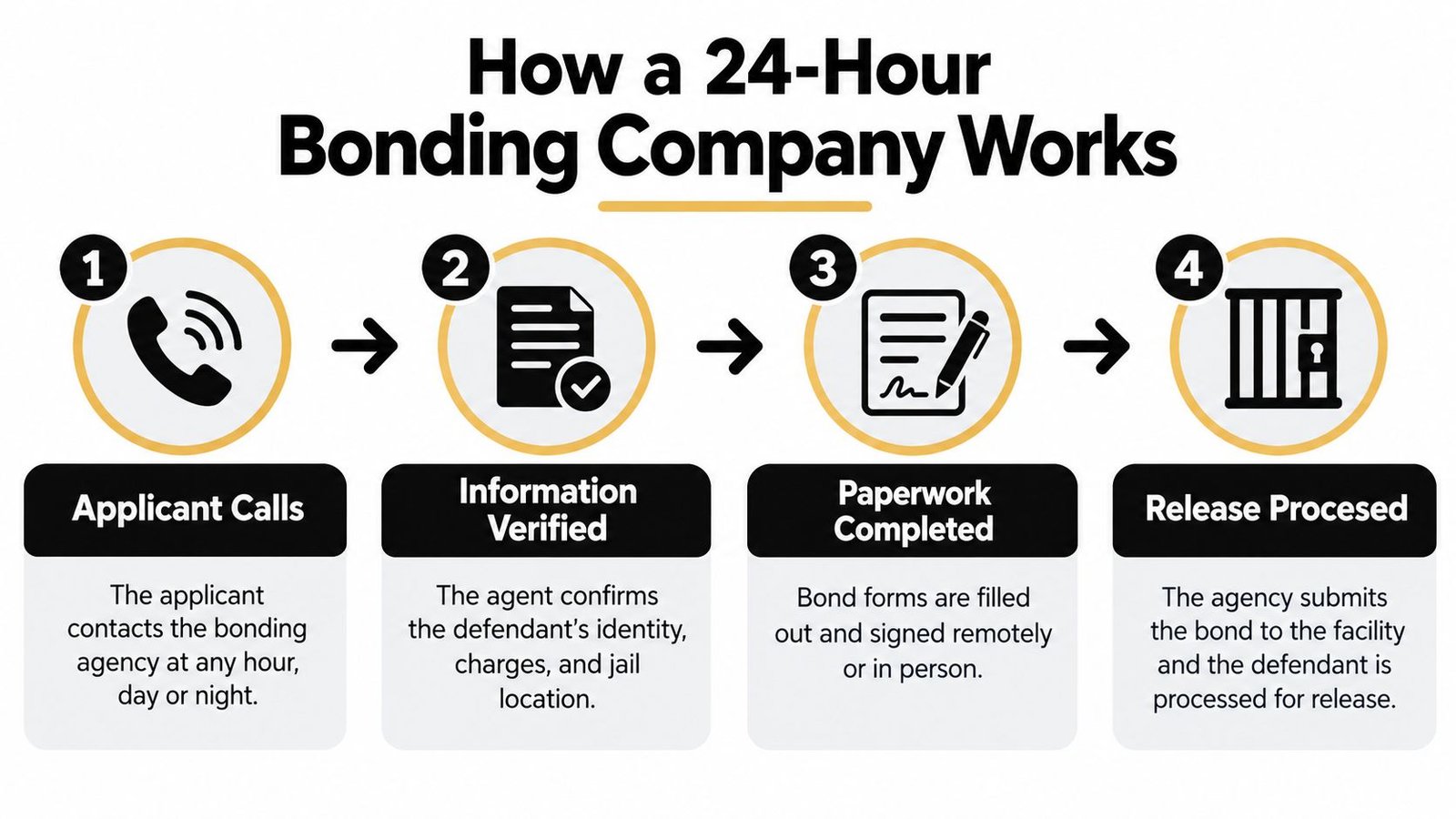
On the agency's side of the fence, the job moves through a fixed set of checkpoints:
- Intake: Record the defendant's identity, location, and whatever booking information exists.
- Verification: Confirm the bond designation and amount through the facility or court record.
- Application and disclosures: Walk the signer through the agreement, premium, payment terms, and any collateral.
- Posting: Deliver the completed surety documents under the facility's own procedure.
Every one of those steps can happen while the defendant is still being processed. An agent can take your call at midnight, verify the bond by one, and hold a signed, paid packet by two. None of that speeds up fingerprinting, identification checks, or the jail's internal release review, because those belong to facility staff. Courts hold a separate lever: they set the bond type, the conditions, and whether a hold from another case or agency blocks release entirely.
The role works like an emergency-room intake coordinator. Registration can be finished in the middle of the night, but the coordinator can't make the clinician arrive faster or the labs come back sooner. An agent finishes the packet; the jail finishes booking. Both have to happen before a door opens.
Pricing sits outside the agency's discretion too. Under Colorado's bail-bond producer statute, a licensed bail-bond insurance producer's premium or commission is capped at the greater of $50 or 15% of the bail amount. The same statute restricts additional bond-posting fees, requires a written, signed, dated payment arrangement before money changes hands, and treats the premium as earned once the defendant is released. Get the numbers in writing before you sign, and ask directly whether collateral or financing is part of the deal.
How a family finds an agent in the first place is a separate question. Firms studying how legal services reach the public can look at AI TV spots for legal teams, though no advertisement replaces a direct, case-specific answer from a licensed agent or attorney.
Information and Documents You Need Before You Call
An agent can begin with incomplete information, but missing details can slow verification and paperwork. Gather what you can without guessing. If you don't know an answer, say so; an accurate “I'm not sure” is better than information that sends the application down the wrong path.
Start with the defendant and facility
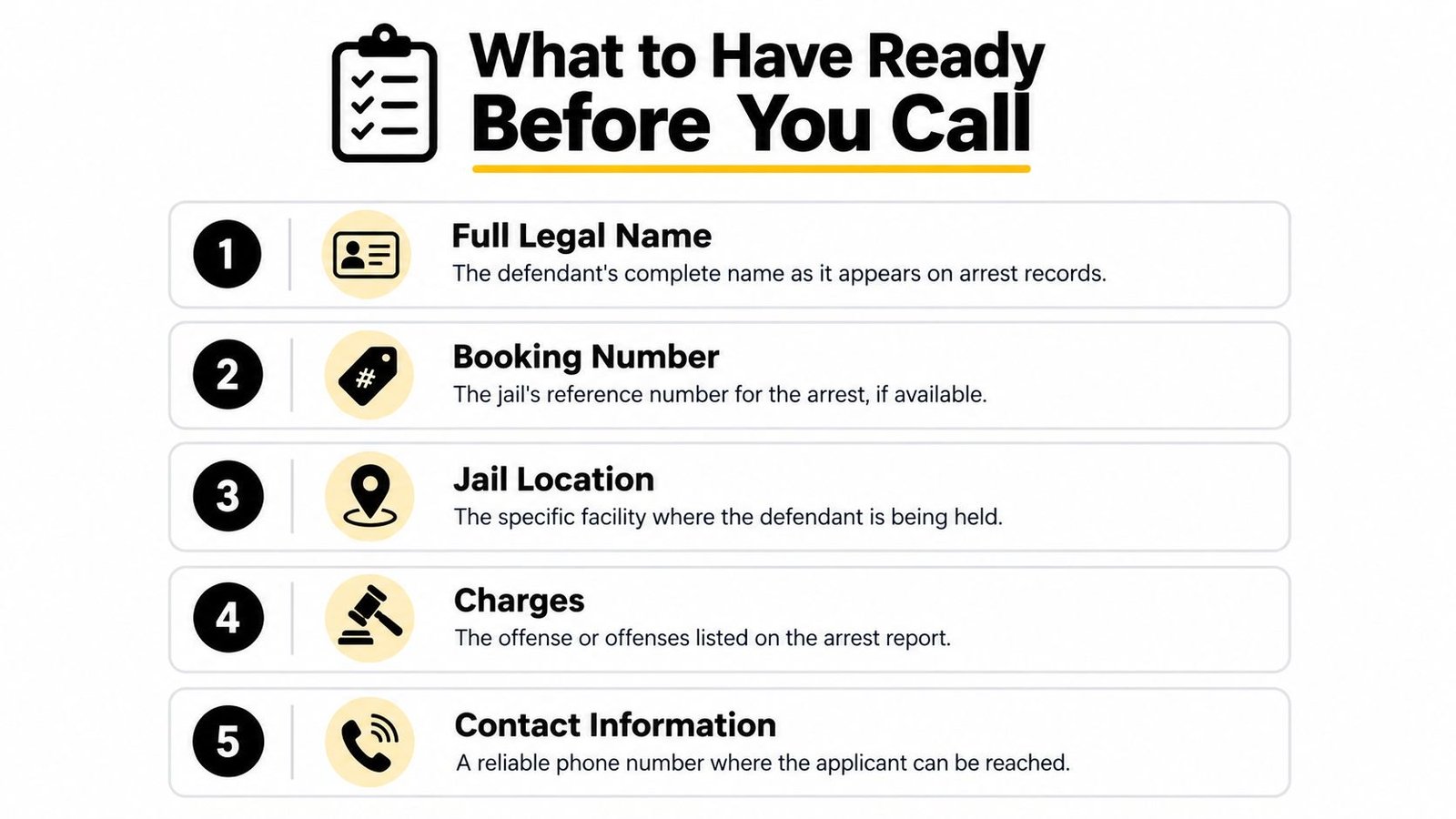
Have these details ready if available:
- Defendant: Full legal name and date of birth.
- Booking: Booking number and listed charges, if known.
- Location: The county or city jail holding the person.
- Court: Next court date, if one has been set, and any known protection orders or release conditions.
- Attorney: Counsel's name and contact information, if the defendant has an attorney.
Prepare the applicant's information
The person signing the contract, often called the indemnitor, should have identification and current contact details available. The agent may ask for an address and, if collateral is involved, supporting financial information. Don't assume collateral is required; ask what applies to the particular bond and get the terms explained before agreeing.
The agency will prepare the premium agreement and indemnity contract, along with any applicable collateral documents. Read the paperwork before signing and keep copies of the completed documents and receipts. Colorado law requires a written, signed, dated premium or payment arrangement before the producer accepts payment, so the agreement should clearly state the terms.
For a more detailed document checklist, see what documents to prepare for a bail bond. Having the defendant's details, facility, signer information, and court information in front of you helps the agent identify what's missing and what can be completed remotely.
Realistic Response Times From First Call to Release
The time an agent can control is not the same as the time the jail controls. An agency may be able to take the call, verify the information, calculate the premium, and prepare documents while the defendant is in custody. The remaining timeline depends on booking status, fingerprint clearance, holds, facility rules, and staff availability.
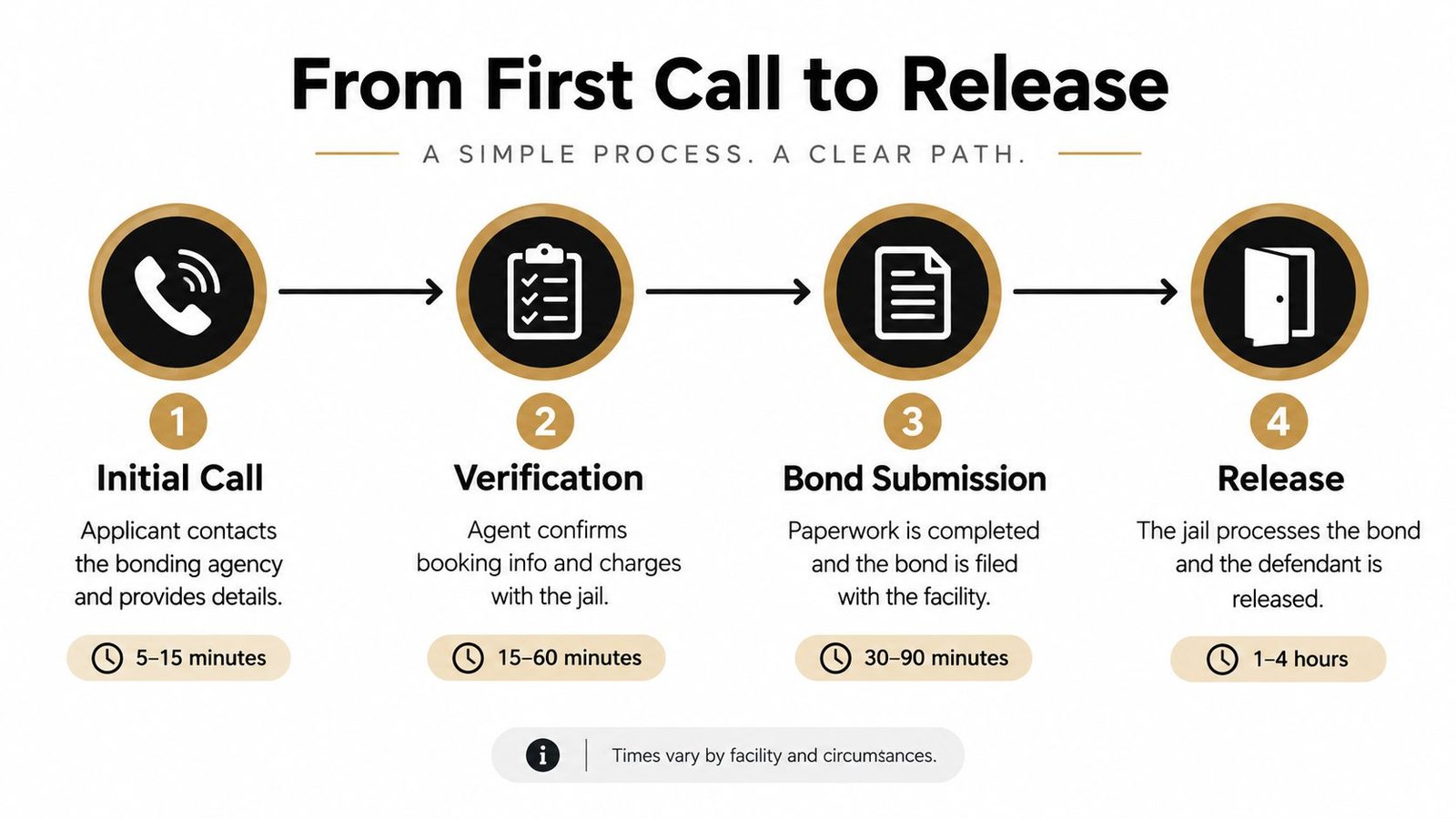
Denver's official Sheriff Department court-services guidance says a person must be fully booked and have fingerprints cleared before a bond can be posted. Denver says intake usually takes two to six hours, and identification checks can take longer because fingerprints are sent to Denver Police, the Colorado Bureau of Investigation, and the FBI. After all parties sign the bond, inmates are generally released within a two-hour window. These are Denver's stated procedures, not a guarantee for other counties or for every individual case.
Where the wait can happen
Denver's county bonding office operates from 7:00 a.m. to 10:30 p.m. daily and is closed overnight, according to the same county guidance. An after-hours agent can help prepare the application and coordinate next steps, but the facility's schedule and release requirements still matter. If fingerprint clearance or another hold is outstanding, completed paperwork alone won't make the person eligible to leave.
For a case-specific explanation of the factors that affect the timeline, use this guide to how long bail takes to process. You can also watch the overview below, then confirm current requirements directly with the relevant facility.
Matching the Court Order to the Right Bond Type
The amount alone doesn't tell you whether a bonding company can help. Colorado courts can use personal-recognizance, cash, surety, or property-secured arrangements, and the court's actual designation determines what the family should do. The Colorado Judicial Branch's bond overview describes the bond categories and conditions.
| Bond Type | Who Pays | Payment Size | Bonding Company Needed | Best Use Case |
|---|---|---|---|---|
| Personal-recognizance | Defendant agrees to appear and follow conditions | No monetary bond amount | No | The court permits release without a financial bond |
| Cash | Defendant or another person pays the court or facility | The full court-ordered amount, using accepted payment methods | No | The order requires cash or direct payment |
| Surety | Applicant arranges a bond through a licensed producer | Premium capped at the greater of $50 or 15% of the bond amount | Yes | The court accepts a surety bond and the family wants to arrange one through an agent |
| Property | Property owner pledges qualifying Colorado real estate equity | Unencumbered equity equal to 1.5 times the bond amount, plus recording-related fees | Not necessarily | The owner can meet the court's property-bond requirements |
A property bond has a different financial threshold from a surety bond. The Colorado Judicial Branch says a $20,000 bond requires at least $30,000 in unencumbered home equity, calculated as property value minus the amount owed; the owner must also handle recording-related fees and later take the release document to the county public trustee to remove the lien (Colorado Judicial Branch property-bond guidance).
A bonding agent can't turn a cash-only order into a surety bond. Domestic-violence cases aren't released under the standard bond schedule in the Colorado Judicial Branch's administrative order; the court must set the bond amount and conditions. The order also requires at least a 16-hour hold, or a longer period until the person is no longer visibly under the influence, for someone taken into custody while under the influence of drugs (Colorado Judicial Branch administrative order.pdf)). Check the court order before paying for a service that can't meet its requirements. For more detail, review the types of bail bonds in Colorado.
Statewide Coverage Across Colorado
A company doesn't need to have an office inside every county to start an application remotely. Electronic signatures and payments can help an agent prepare documents from elsewhere, while posting still has to follow the receiving facility's rules. Depending on the jail, that last step may involve local staff, an agent, or a courier.
Statewide service is practical only when the agency knows how each facility handles bond intake. Counties can differ in where paperwork goes, which payment methods they accept, and when a bonding officer is available. A remote application can reduce travel and get documents ready, but it can't make a county office operate overnight or change a jail's release checklist.
Express Bail Bonds serves detention facilities across Colorado, including Denver, Jefferson, Arapahoe, Douglas, Weld, and El Paso counties, according to its statewide locations directory. Before signing, ask whether the agent has confirmed that the specific facility accepts the court-ordered bond type and how the bond will be submitted.
Families coordinating a release far from home can also narrow their next step by county. The Jefferson County and Golden bail-bond page and the Centennial bail-bond page provide location-specific starting points. Coverage means knowing the local process, not promising that one person can physically reach every jail at once.
When Speed Is Not the Best Outcome
An agent controls intake, paperwork, payment, and posting. The contract sits inside that control, and signing fast to shave minutes off the night can lock a family into terms nobody read. Colorado's Division of Insurance tracks complaints involving overcharging, missing premium or collateral receipts, and fiduciary violations, which is why the paperwork earns a few extra minutes even at 2 a.m.
As explained above, Colorado caps the premium at the greater of $50 or 15% of the bail amount, and the written, signed, dated payment arrangement is required before payment is accepted. Before signing, confirm the bond amount used to calculate the premium, the payment schedule, whether collateral is involved, and what receipt proves the transaction. A premium is earned once the defendant is released, so it does not come back the way a deposit would.
Practical rule: A completed bond starts the release process. It doesn't end the defendant's responsibilities.
Release conditions come from the court order, and no agent can shorten or waive them. The defendant may still have to attend every court date, follow supervision or monitoring requirements, observe travel limits, comply with treatment conditions, and obey protection or no-contact orders. Colorado's statewide pretrial procedure requires anyone released on bond to appear on the specified court date, avoid new law violations, and get court permission before leaving the state (Colorado release-condition statute).
Help the person leaving the jail make a workable plan: confirm the next court date, identify a reliable address and phone number, arrange transportation, secure access to medications, notify counsel, and clarify who receives official notices. Ask about no-contact rules before anyone tries to arrange a reunion. A release plan the defendant understands beats paperwork signed in a hurry.
Your Next Steps and How to Reach a Licensed Agent
Use the first call to establish the facts, not to guess at a release time. Keep the defendant's name and birth date, facility, booking information, signer's identification and contact details, and available court information together. Then ask the agent three direct questions: What bond type did the court order? Does this facility accept that type of surety bond? Are any holds or conditions still preventing release?
Once you have those answers, review the premium and contract terms before signing, and make a plan for the defendant's court obligations. The Colorado bail-bond license information is another place to check while evaluating who will handle the transaction.
If you need help now, contact a licensed agent who can explain the paperwork, payment, facility process, and what remains outside the agency's control. Express Bail Bonds describes its Colorado service as available around the clock by call or text, with electronic application and payment options; ask directly how the specific jail handles posting and release.
If someone you care about is in custody, gather the defendant's details and facility information, then contact Express Bail Bonds to discuss whether a surety bond fits the court order and what paperwork can be completed remotely. Start at Express Bail Bonds for statewide service information and a clear next step.