
That late-night phone call is a jolt to the system. A friend or family member is in jail, and your mind is immediately flooded with a thousand questions. Before you do anything else, take a deep breath. The first step is to stay calm and start gathering the basic facts: their full legal name, their date of birth, and the specific jail where they’re being held.
These details are the key to everything that comes next. If you're feeling lost, don't hesitate to call or text Express Bail Bonds at 720-984-2245. We can guide you from the very first step.
Your First 24 Hours After an Arrest in Colorado

The initial hours after an arrest are almost always chaotic and emotionally draining. Feeling overwhelmed is completely normal, but right now, your ability to focus is your loved one’s greatest asset.
The goals for this first day are simple: locate them, understand their immediate situation, and start the process of getting them out. This isn't about solving the entire case; it's about taking control of the crisis at hand.
First things first, you have to confirm where they are. If the person who called didn't say which jail, you'll need to do some quick detective work. Most major Colorado counties, like Denver, Arapahoe, and Jefferson, have online inmate search tools that can help you verify where they're being held. If you need help, contact Express Bail Bonds and we can assist you.
Gathering Critical Information
Once you know their location, you need to collect a few more pieces of the puzzle. This is the information you'll give to the court, a lawyer, or a bail bonds agent.
- Full Legal Name and Date of Birth: Double-check that you have the exact spelling of their name as it appears on their driver's license or ID.
- Booking Number: Every person arrested gets a unique booking number. If you can get it, it will speed up every single interaction with the jail.
- The Charges: You need to find out the specific charges they are facing. This directly impacts the bail amount and any conditions for their release.
- Bail Amount: This is the most important number you need right now. The jail staff can usually provide this once the booking process is complete.
This checklist gives you the foundation for all your next steps. Without it, you’re just spinning your wheels.
Crucial Reminder: Every single phone call made from a jail is recorded. It is absolutely vital that you and your loved one avoid discussing any details of the alleged crime over the phone. Stick to the basics: confirming they're okay and gathering the information needed for bail.
To help you stay organized during this stressful time, here is a quick checklist of what to do and what information to gather.
Immediate Action Checklist After an Arrest
| Action Item | Why It's Important | Information to Collect |
|---|---|---|
| Locate the Person | You can't help if you don't know where they are. This is your first priority. | County and name of the specific jail or detention center. |
| Gather Personal Details | This information is required by the jail, attorneys, and bail agents to identify them. | Full legal name, date of birth, and booking number (if possible). |
| Identify the Charges | The seriousness of the charges determines the bail amount and legal strategy. | Specific criminal charges (e.g., DUI, assault). |
| Confirm the Bail Amount | This is the financial figure you need to secure their release from custody. | The total bail amount set by the court or jail. |
| Contact a Bail Agent | An experienced agent can verify info, explain the process, and post the bond quickly. | Your loved one's info, charges, and bail amount. |
Having this information ready makes the entire process smoother and faster. When you have these details, call Express Bail Bonds at 720-984-2245 to start the bail process immediately.
What to Avoid in the First 24 Hours
Just as important as what you do is what you don't do. Panic often leads to mistakes that can make a bad situation worse.
Try to avoid promising anything you can't deliver. The legal system has its own timeline, and making guarantees about when they'll be released or what will happen with the case only adds more pressure. Instead, focus on the immediate, actionable goal: arranging bail.
It's also critical to grasp the urgency here. Imagine that frantic call comes in the middle of the night—a loved one is in jail somewhere in Denver. Acting fast is key. Shockingly, about 97% of people in local jails across the U.S. are there awaiting trial, not serving a sentence. They are simply waiting because they haven't posted bail yet.
Your calm, methodical approach in these first hours lays the groundwork for getting them home quickly and efficiently. If you're struggling to locate someone, the team at Express Bail Bonds can help right away. Our experience with local jails means we can often find people and get information faster than you can on your own. For more detailed tips, check out our guide on how to find someone in jail.
For direct, immediate assistance, call or text us 24/7 at 720-984-2245.
Making Sense of Bail and Bonds in Colorado
Once you've found your loved one and have the basic case details, your attention will almost certainly pivot to one thing: the bail amount. Seeing a number like $10,000 or $50,000 can feel like a punch to the gut. It's in this high-stress moment that knowing your options is absolutely crucial.
In Colorado, you've got two main ways to handle this.
The Two Paths: Cash Bond vs. Surety Bond
The first route is a cash bond. This is exactly what it sounds like: you pay the entire bail amount directly to the court or jail, in cash. If bail is set at $10,000, you need to come up with all ten thousand dollars. The good news is you get this money back (minus some court fees) once the case is over. The bad news? Most people don't have that kind of cash just sitting around.
This brings us to the second, and far more common, path: a surety bond. This is where a licensed bail bonds agency, like Express Bail Bonds, steps in. Instead of paying the full bail amount, you pay the agency a smaller, non-refundable fee. Contact us today to learn more about surety bonds.
How a Surety Bond Actually Works
Think of a surety bond as the bail agency's promise to the court. The agency is guaranteeing that the defendant will show up for their court dates. In exchange for taking on that massive financial risk, you pay them a fee called a premium.
Here in Colorado, that premium is typically 15% of the total bond. For very large bonds, that rate can sometimes drop to 10%.
- Let's break it down: Say bail is $10,000. To post a cash bond, you'd need the full $10,000. With a surety bond from a bail agent, you'd only pay a $1,500 premium. It’s a game-changer that makes getting someone out of jail financially possible for most families.
This premium is the cost for the service—it's what allows you to secure a release without wiping out your savings. It isn't refundable, even if the case is dismissed, because it covers the work and risk the agency took on. You can find a deeper dive into this on our page explaining how to bail someone out of jail.
What About Collateral?
Sometimes, especially for very high bond amounts, an agency might also ask for collateral. Don't let the term intimidate you. It's just a way for the agency to protect itself.
Collateral is simply an asset of value—like the title to a car, a deed to a property, or other significant assets—that you pledge to back up the bond. If the defendant skips court and vanishes, the bail agency is on the hook for the full bail amount. They would then use the collateral to cover that loss.
But here’s the important part: as long as the defendant makes every single court date, your collateral is returned to you, untouched, when the case is officially closed. Reach out to Express Bail Bonds to discuss collateral options for your situation.
People often think bail is a form of punishment. It’s not. It’s simply the court’s way of ensuring a person comes back to face their charges. A surety bond is the most realistic way for most families to meet that requirement without destroying their finances.
When you're trying to figure out what to do, this choice matters. Here in Colorado, bail agencies like Express Bail Bonds, which has been in business since 1988, focus exclusively on these surety bonds. It’s what we do. This specialization means a 15% premium (or 10% for those bigger bonds) can make release a reality. Even a staggering $50,000 bond becomes manageable, requiring a premium between $5,000 and $7,500—a serious amount, but a world away from fifty grand in cash. To get a broader perspective on legal systems, you can explore information on global incarceration rates and judicial practices.
The Bail Process Is Now Online and Fast
The days of scrambling to find a bail bonds office in the middle of the night with a bag of cash are over. Thankfully, the best agencies have modernized the entire process to be fast, simple, and far less stressful.
At Express Bail Bonds, we can handle everything electronically.
You start with a phone call or text to one of our agents, who are available 24/7. From there, you can complete the application, sign the paperwork digitally, and even pay securely online—all from your home, on your phone or computer.
This efficient, electronic system means we can get the bond posted at the jail almost instantly, dramatically cutting down the time your loved one has to spend behind bars. It’s a fast, secure, and much more dignified way to navigate a really tough situation. Call us now at 720-984-2245 to get started.
How to Secure a Bail Bond from Anywhere
Let's get one thing straight: the old movie trope of driving to a sketchy, dimly-lit office near the jail in the middle of the night to post bail is mostly a thing of the past. Thank goodness. Today, technology has completely changed the game, making it possible to get someone released quickly and discreetly, often without even leaving your couch.
This is a massive relief, especially when you're dealing with an arrest from another city or even another state. What used to be a logistical nightmare is now a straightforward process you can handle from just about anywhere.
The Modern, Digital Bail Bond Process
It all starts with a simple phone call or text. When you reach out to an experienced agent at Express Bail Bonds, the first thing we'll do is listen. We'll calmly confirm the details you have—like where they're being held and the bail amount—and then explain exactly how our digital process works.
Instead of navigating traffic to fill out a mountain of paperwork, you'll get a secure link sent right to your phone or email. From that point on, everything is handled electronically.
- Fill out the application: You can complete all the required information on your phone, tablet, or computer.
- Sign the documents: We use secure, legally binding e-signature software, so there's no need to print, scan, or fax anything.
- Make the payment: The premium can be paid right online with a credit or debit card, saving you a trip to the bank or an ATM for a large sum of cash.
The entire system is built for speed and simplicity. A process that once ate up hours of driving and waiting in lobbies can now often be wrapped up in less than an hour. Start the fast, online bail process now by calling 720-984-2245.
What You'll Need to Get Started
To make sure things go as quickly as possible, it helps to have a few things handy before you call. While every situation is a bit different, you'll generally need to provide:
- A valid, government-issued photo ID (like a driver's license or passport).
- Proof of your income (recent pay stubs are perfect).
- Your current address and basic employment details.
This is all standard information that helps the bail agent verify who you are and confirm you meet the requirements to be a cosigner. It's a routine step that protects both you and the agency.
The chart below breaks down the two main financial options you face when posting bail.
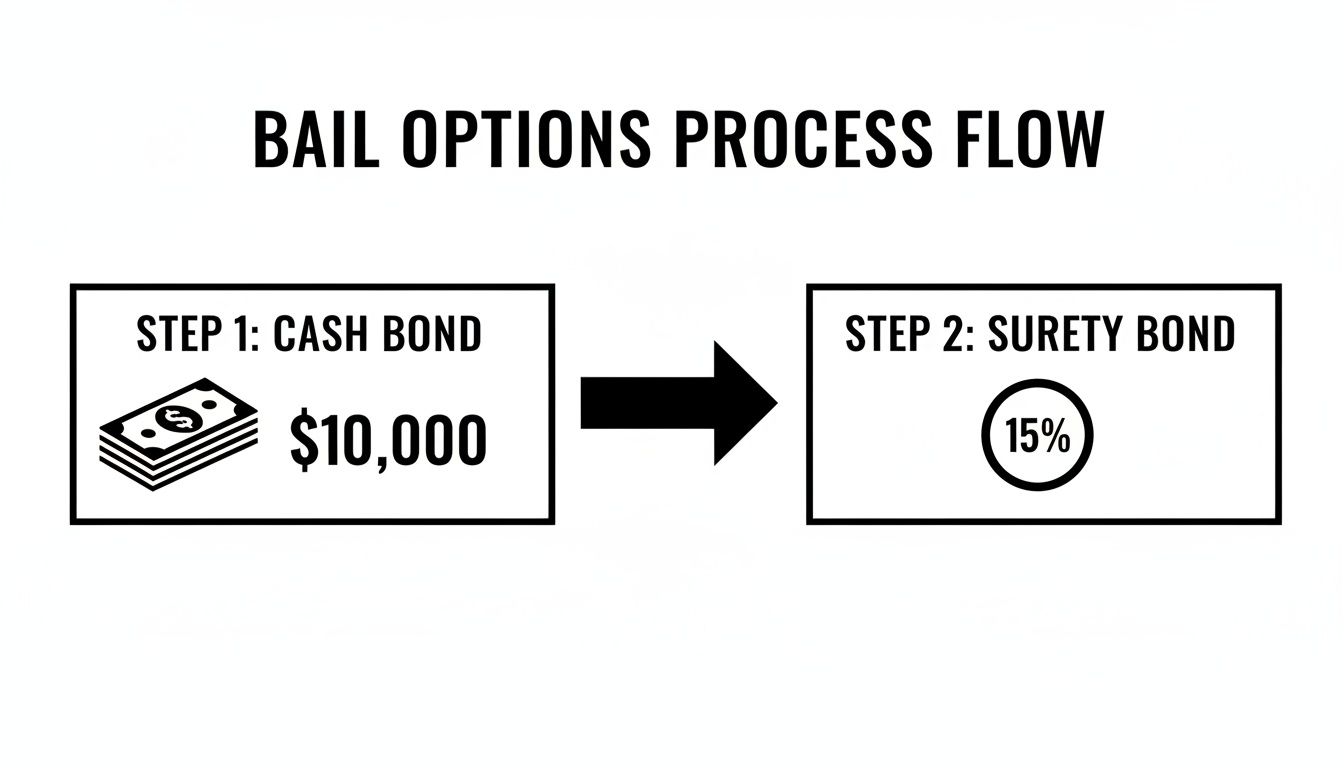
As you can see, the difference in the immediate, out-of-pocket cost between paying the full cash bond and using a surety bond is significant.
One of the most common questions we get is, "Can I get a bail bond if I live out of state?" The answer is a definitive yes. Our entire system is built to handle this exact scenario efficiently and securely.
A Real-World Example: Helping from Out of State
Let’s say you live in Florida and get that dreaded call: your son has been arrested in Denver. The judge sets bail at $20,000. Years ago, this would have triggered a frantic scramble to book a flight to Colorado, find a local bail bondsman, and handle everything in person—all while under incredible stress.
Today, the experience is completely different.
- You call Express Bail Bonds at 720-984-2245.
- The agent texts or emails you a link to our secure online platform.
- Sitting at your kitchen table in Florida, you fill out the forms, upload a quick photo of your driver's license and a recent pay stub, and then digitally sign the agreement.
- Finally, you pay the $3,000 premium (15% of the $20,000 bond) with your credit card online.
The moment your payment goes through, our agent is electronically posting the bond with the Denver jail. Your son's release process starts immediately, and you never had to even think about booking a plane ticket. This is the real-world advantage of a modern, remote system—it removes geography from the equation when you’re trying to figure out what to do when someone gets arrested. It’s a faster, more dignified, and far less stressful solution to an already difficult problem.
Understanding Your Role as a Cosigner
When that phone rings and a loved one is asking for help from jail, your gut reaction is probably to do whatever it takes. But when the words "bail bond cosigner" come up, it's time to take a deep breath. Agreeing to cosign is a massive act of support, but it's also a serious financial and legal commitment you need to walk into with your eyes wide open.
Simply put, when you cosign, you become the financial backbone of the bail bond. You're giving the bail bond agency your legally-binding word that the defendant will show up for every single court date, without fail. That promise is what makes the whole process possible.
The Core Responsibilities and Risks
Your main job as a cosigner isn't just to hope the defendant makes it to court; it's to actively help ensure it happens. This means staying in regular contact, giving them reminders about upcoming dates, and maybe even helping them figure out a ride to the courthouse.
Think of it from the agency's perspective: they're putting up the entire bail amount, which could be thousands of dollars. Your signature on the contract is their guarantee that they won't lose that money. A good cosigner is someone they can count on to take that responsibility seriously.
Here's the most important thing you need to burn into your memory: if the defendant skips a court date, you, the cosigner, are on the hook for paying the entire bail amount back to the agency. This isn't a minor penalty; it’s the central risk you are accepting.
Before you sign anything, it's wise to have a basic grasp of the elements of a valid contract. Understanding what makes an agreement legally enforceable helps you appreciate the seriousness of the paperwork in front of you.
What Makes a Strong Cosigner
Bail bond agencies are looking for stability. They need to know the person guaranteeing the bond is reliable and has roots in the community. While every situation is a bit different, they generally look for a few key things:
- Steady Job: A consistent employment history shows you have a reliable income.
- Stable Residence: Living at the same address for a good while demonstrates that you aren't going anywhere.
- Decent Credit: It’s not always the deciding factor, but a solid credit history shows you're financially responsible.
- Close Relationship: Agencies prefer cosigners who are close friends or family because you're more likely to have some influence over the defendant and can easily stay in touch.
Meeting these criteria makes the approval process go much more quickly. Our team at Express Bail Bonds can walk you through exactly what a bail bondsman looks for in a cosigner during a quick, confidential phone call.
Understanding Collateral and Forfeiture
For larger bond amounts, the agency might ask for collateral to secure the bond. This is a tangible asset—like the title to your car or equity in your home—that acts as insurance. As long as the defendant attends all their court appearances, your collateral is completely safe and will be returned to you when the case is over.
But if they fail to appear and the bond is forfeited by the court, the agency can legally take possession of your collateral to cover their massive loss. This is the worst-case scenario, and it’s precisely why clear, constant communication with the defendant is non-negotiable.
Cosigner Responsibilities and Risks
The table below breaks down exactly what's expected of you and what's at stake.
| Responsibility | Description | Potential Risk if Not Met |
|---|---|---|
| Ensure Court Attendance | Your primary duty is to do everything you can to make sure the defendant appears at all court dates. | If they miss court, you become liable for the full bond amount. |
| Provide Accurate Info | You must be truthful about your identity, employment, and financial situation on the application. | The agreement could be nullified, or you could face legal consequences for fraud. |
| Pay the Premium | You are responsible for paying the non-refundable fee (the premium) for the bail bond service. | The bond won't be posted, and the defendant will stay in jail. |
| Maintain Communication | You need to stay in touch with both the defendant and the bail agency throughout the case. | You could miss critical updates about court dates or other requirements. |
Deciding to cosign is a major decision that has a direct impact on your own financial security. It's a truly powerful way to help someone you care about, but you have to go into it fully understanding what you're signing up for.
For a no-pressure consultation to talk about your specific situation and get straight answers, call or text our team at Express Bail Bonds anytime at 720-984-2245.
Navigating Life After Bail and Preparing for Court
Getting that call that your loved one is out of jail feels like a massive victory. And it is. But it’s important to understand that this isn’t the finish line—it’s just the end of the first lap. The legal marathon is just getting started, and the time between posting bail and that final court date is absolutely critical. Now is the time to shift from crisis mode to proactive preparation.
The very first, most important move you can make is to hire a skilled criminal defense attorney. A bail agent gets someone out of jail; a lawyer is the one who defends the actual case. If you don't know where to begin, ask your bail agent. We’ve worked in the local legal community for years and know which attorneys have the experience and reputation to handle a case effectively.
Staying on Top of Court Appearances
After being released, the defendant is given paperwork that lists their next court date. Forgetting this date or losing the paperwork is simply not an option. Thankfully, most Colorado judicial districts have online portals where you can search for case information and double-check upcoming court dates. You should bookmark that page and get in the habit of checking it often.
Showing up for every single court hearing is non-negotiable. It's the core promise made when the bail bond was secured.
- Plan Your Trip: Know exactly how you’re getting to the courthouse and have a backup plan.
- Get There Early: You should aim to walk through the doors at least 30-45 minutes before your scheduled time. This gives you a buffer for parking, security lines, and finding the right courtroom.
- Dress the Part: You don’t need a suit and tie, but business casual attire shows the judge and prosecutors that you are taking the situation seriously.
This level of preparedness sends a message. It shows you respect the court and the legal process, and that can only help.
A "Failure to Appear" (FTA) is a catastrophic mistake. The judge will immediately issue a new arrest warrant and forfeit the entire bail bond amount. This makes the cosigner financially responsible for the full sum and turns one legal problem into two, much more expensive ones.
The Importance of Open Communication
Through this entire process, clear and consistent communication is key. Your team—the defendant, the attorney, and the bail bond agency—all need to be on the same page about court dates, any changes in contact info, and the overall legal strategy.
If the defendant moves or even just gets a new phone number, you are required to notify your bail agent right away. This isn't just a courtesy; it's a part of the bail agreement. Keeping your agent updated prevents simple misunderstandings that could put the bond at risk.
As you prepare, understanding everything that happens in the courtroom is crucial. One valuable tool for your legal team can be accurate court audio transcription services, which can help in reviewing every detail of a hearing while building a defense strategy.
Building Your Defense Strategy
Your lawyer will take the lead, but you can actively help build a stronger case. The first thing to do is have the defendant write down a detailed, private account of everything that happened while it's still fresh in their mind.
- Start gathering any relevant documents, text messages, or emails.
- Put together a list of potential witnesses and their contact details.
- Be completely honest with your lawyer. They can only build a solid defense if they have all the facts, good and bad.
This period after the arrest is your chance to regain some control. By hiring a great attorney, staying organized with court dates, and keeping everyone in the loop, you shift from a defensive stance to a proactive one. It’s how you prepare for the road ahead and work toward the best possible outcome.
If you have any questions about the defendant's responsibilities while out on bond, our team at Express Bail Bonds is always here to help. Call or text us anytime at 720-984-2245 for guidance.
Answering Your Most Pressing Questions
When you get that dreaded call, your mind starts racing. The entire situation feels confusing, overwhelming, and a hundred questions pop up at once. Drawing from decades of experience helping families navigate this exact moment in Colorado, we’ve put together direct answers to the questions we hear most often.
Getting clear, reliable information is the first step toward regaining a sense of control and making the right decisions. If you have a question not listed here, call us 24/7 at 720-984-2245 for a free consultation.
"How Long Until They're Actually Released?"
This is almost always the first question asked. Once the bond is posted, everyone is watching the clock. While we post bonds electronically to get the ball rolling immediately, the final release time is completely in the hands of the jail staff.
You can generally expect a wait of anywhere from 2 to 12 hours. Why such a big range? It all comes down to what's happening inside the detention center—how busy they are, their staffing levels, and their specific internal procedures. When you call us, we can often give you a better estimate for the specific jail where your loved one is being held.
"What Happens to the Money After the Case Ends?"
Where the bail money goes depends entirely on how you paid it. There are two very different paths.
- Paying Cash Directly to the Court: If you paid the full bail amount in cash, that money is eventually returned to you when the case is officially over. They will, however, deduct any court costs or fines first.
- Using a Bail Bonds Agent: The 10-15% premium you pay us is our non-refundable fee for the service. Think of it like an insurance premium; it covers the risk we take by guaranteeing the full bail amount to the court. This fee is earned for securing the release and is not returned.
Understanding this difference is critical for making a sound financial decision for your family.
The premium you pay a bail agent is the cost of turning a small, manageable amount of money into a guarantee for a much larger one. It’s what makes getting out of jail possible without forcing families to drain their savings or sell assets.
"Can I Post Bail for Someone If I Live in a Different State?"
Absolutely. We handle this situation every single day. You don't need to be in Colorado to get someone out of jail here.
Our entire system is built to handle everything remotely and securely. You can fill out the application, sign all the necessary documents with a legally-binding e-signature, and pay electronically from your own home, wherever that may be. As long as you meet the standard requirements to be a cosigner, your location doesn't have to be a roadblock. Visit our website, ExpressBailBonds.com, to learn more about our remote services.
"I Can't Afford the Full Premium Right Now. What Are My Options?"
We get it. An arrest is an unexpected financial emergency, and most people don't have money sitting around for something like this.
That's precisely why we work with our clients to set up flexible, manageable payment plans. Don't let the total premium discourage you from calling. The best thing you can do is have a confidential, no-pressure chat with one of our agents. We'll go over your specific situation and do everything we can to find a solution that works for your budget. An upfront payment shouldn't be what stops you from helping your loved one.
Navigating the aftermath of an arrest is tough, but you don't have to figure it out alone. For immediate, professional help and clear answers to all your questions, contact Express Bail Bonds. Our experienced team is available 24/7 to guide you through every step of the process. Call or text us anytime at 720-984-2245 or start the process online at https://expressbailbonds.com.