
When someone misses a court date after being bailed out, the court can order a bail forfeiture. In simple terms, this is the court's action to seize the entire bail amount because the defendant didn't hold up their end of the bargain. If you find yourself in this situation, don't panic. Contact Express Bail Bonds immediately for guidance.
Think of it as losing the security deposit on a rental. The defendant’s promise to appear in court is the agreement, and the bail money is the deposit. If they break that promise, the court keeps the money. This creates serious financial problems for everyone involved—not just the defendant, but also the family and friends who helped them get out.
Understanding Bail Forfeiture In Simple Terms
A bail bond is essentially a three-way agreement between the defendant, the court, and a bail bond agency. The defendant makes a promise to show up for all their court dates. To back up that promise, the bail agency posts a financial guarantee—the bond—with the court, allowing the defendant to be released from jail.
As long as the defendant attends all their hearings, everything is fine. The bond is "exonerated" (cleared) once the case is over, and nobody owes the court any more money. But if the defendant misses even one court date, they’ve broken their promise. The court then declares the bail forfeited, and the full bond amount becomes due immediately. If you need help navigating this process, our team is available 24/7.
Key Roles in a Bail Bond Agreement
To really understand what happens during a forfeiture, it helps to see what each person involved has on the line. The table below breaks down the key players and their responsibilities.
| Party Involved | Role in the Process | What's at Stake for Them |
|---|---|---|
| The Defendant | The person arrested and released on bail. | A new arrest warrant, additional criminal charges for "Failure to Appear," and extreme difficulty getting bailed out in the future. |
| The Cosigner | The friend or family member who signed the contract. | They are now legally and financially responsible for paying the entire bail amount to the bail bond agency. |
| The Bail Bond Agency | The company that posted the financial guarantee. | They must pay the full forfeited amount to the court and then try to recover that money from the cosigner and any collateral. |
This system puts a lot of pressure on defendants to return to court. Failure-to-appear rates can be surprisingly high, sometimes reaching 25-30% in certain areas. Even with commercial bail bonds, the rate was around 18% back in 2004, which shows the real financial risk that bail agencies and families take on. If you want a refresher on the basics, our guide on how bail bonds work in Colorado is a great place to start.
A bail forfeiture isn't just a penalty; it's the activation of a legal contract. The court's demand for the full bail amount transforms the situation from a simple promise into a significant financial debt for the cosigner.
When dealing with something as serious as bail forfeiture, you have to understand every official notice you receive. If the documents aren't in English, knowing how to translate legal documents correctly is crucial so you don’t miss a single important detail about your obligations.
The Domino Effect of a Missed Court Date
When someone misses a court date, a swift and serious chain of events kicks into gear. It’s not a maybe—it’s a guarantee. Think of it like a line of dominoes; the moment the defendant's name is called and they aren't there to answer, the first domino falls, setting off a reaction with major legal and financial consequences.
That failure to appear is all it takes. The court doesn't just make a note of it; they formally record the absence, and that single act is what officially starts the bail forfeiture process.
The Court Issues a Bench Warrant
The first thing that happens is the judge issues a bench warrant. This isn't a suggestion; it's a direct order for the defendant's immediate arrest. From that point on, any run-in with law enforcement—even a simple traffic stop—will land them right back in jail.
At the same time, the judge declares the bail forfeited. This is the moment the agreement is officially broken. The full bail amount, whether it’s $5,000 or $500,000, is now a debt owed to the court. The financial guarantee has just been called in.
Once a bench warrant is active, the defendant is considered a fugitive from justice. This not only complicates their current legal case but also adds a new layer of legal trouble, making any future release on bail much more difficult to secure.
Official Notification Is Sent
The court doesn’t waste any time spreading the news. A formal Notice of Forfeiture is mailed out to both the bail bond agency that posted the bond and the cosigner who guaranteed it.
This letter is the official demand for payment. It puts the bail agency on the hook for the full bond amount, which in turn triggers the cosigner's contractual obligation to the agency. For a cosigner, getting this notice is often a gut-wrenching moment when the reality of the situation hits home. A clock has just started ticking, and time is not on your side. We cover the severe consequences of a no-show in our article about what happens if you miss a court date.
Colorado's Crucial Grace Period
Luckily, Colorado law provides a bit of a safety net: a stay of execution. This is a legal grace period that temporarily hits the pause button on the court's demand for payment. This window is the single most important opportunity for everyone involved—the defendant, the cosigner, and the bail agency—to fix the problem.
The length of this stay can vary, but its purpose is straightforward: it gives you a chance to make things right before the forfeiture becomes a final, irreversible financial judgment. During this time, we can work to get the defendant back in front of the judge to explain their absence and try to get the forfeiture thrown out. Understanding what's involved in preparing for trial really drives home why showing up for every court date is so critical to avoiding this mess in the first place.
Acting fast during this grace period is your best, and sometimes only, shot at preventing the full weight of the bond from crashing down on the cosigner. If you've received a Notice of Forfeiture, don't delay. Contact Express Bail Bonds immediately. Our agents know exactly what to do and will guide you through the urgent steps needed to resolve the situation and protect your finances.
The Real-World Consequences of Forfeiture
A bail forfeiture isn’t just some legal paperwork shuffle; it's a serious event that sends shockwaves through the lives of everyone involved. The fallout is immediate and severe, creating a cascade of problems for the defendant, their cosigner, and even the bail bond agency that backed them.
When a defendant misses a court date, they don't just get a slap on the wrist. They’ve broken a promise to the court, and the consequences start piling up fast. For the cosigner, a simple act of helping a loved one can instantly morph into a full-blown financial nightmare. Let's break down exactly what this looks like for each person.
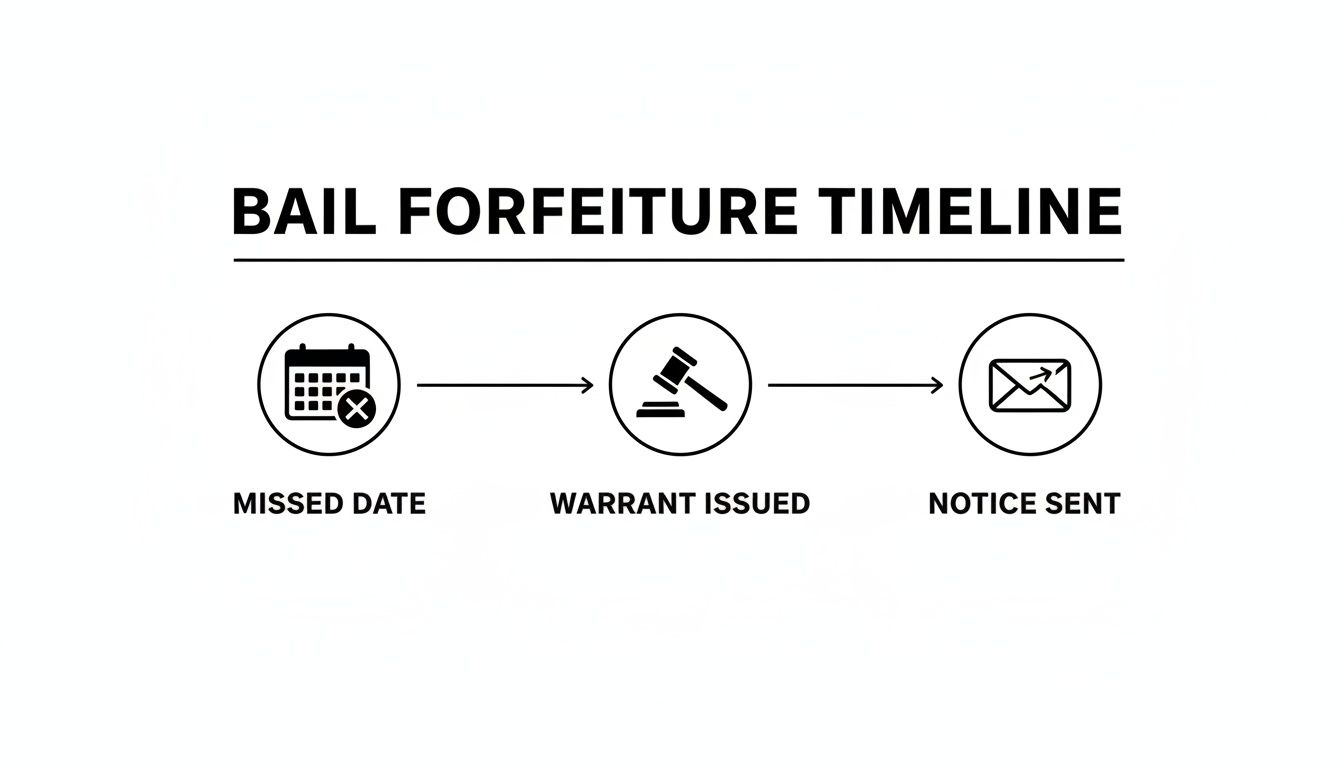
This timeline shows just how quickly things escalate. A missed court appearance triggers an immediate chain reaction, and with each step, the situation gets more serious for everyone.
For the Defendant: New Warrants and Future Hurdles
The moment a defendant skips court, their legal problems multiply. The court almost always issues a new arrest warrant on the spot. This puts them right back at square one—they are now a wanted person, and any encounter with law enforcement will land them back in jail.
It gets worse. Prosecutors often add a brand-new criminal charge for "Failure to Appear," which comes with its own penalties, including more jail time and hefty fines. Their original legal case just got a lot more complicated and expensive.
Perhaps the most damaging long-term consequence is the complete loss of trust with the court. A history of failing to appear makes it incredibly difficult, if not impossible, to get bail on any future charges. Judges will look at their record, label them a flight risk, and either set an astronomically high bail or deny it altogether.
For the Cosigner: Direct Financial Responsibility
For the cosigner, the fallout from a forfeiture is financial, and it's brutal. When you cosign a bail bond, you’re not just vouching for someone’s character—you're signing a legally binding contract. That contract is your personal guarantee that the defendant will show up to court. If they don't, you are now on the hook for paying the full bail amount.
We’re not talking about a small fee. This is a debt for the entire face value of the bond. If bail was set at $50,000, the cosigner is now legally obligated to pay that $50,000 to the bail bond agency.
The agency has every legal right to collect this debt, and they will move quickly to do so. Common collection methods include:
- Seizing Collateral: If you put up a house, car, or another valuable asset as collateral, the agency will start the process of taking ownership to cover the bond.
- Filing a Civil Lawsuit: The agency can sue you to get a court judgment, which then allows them to garnish your wages, levy your bank accounts, or place liens on your property.
This is why it is absolutely critical for cosigners to understand what they are signing. You are making a massive financial commitment, and a forfeiture is the moment that commitment comes due.
For the Bail Bond Agency: A Debt to the Court
Finally, the bail bond agency itself is put under immense pressure. As soon as the judge declares the bond forfeited, the agency owes the court the full amount. That bond instantly transforms from a simple guarantee into a massive, active debt that the agency must pay, often within a strict, court-mandated deadline.
This explains why bail agencies act with such urgency. They aren't just trying to track down a defendant to get their money back; they are legally required to pay the court. This is why they work so hard to make sure defendants get to court and, if they fail to appear, why they put so much effort into locating them. The stakes are incredibly high. National data shows that a staggering 25-33% of defendants fail to appear after being released, triggering forfeitures. This financial strain is a huge issue for the justice system; some jurisdictions, like Dallas County, report facing daily jail costs of over $250,000. If you want to dive deeper into this, you can discover more insights about the impacts of bail forfeiture.
If you’re a cosigner who just received a forfeiture notice, the situation is urgent, but it's not hopeless. The most important thing you can do right now is call your bail bondsman immediately. At Express Bail Bonds, we know how stressful and confusing this is. Call or text us 24/7 at 720-984-2245. Our experienced agents will walk you through your options and help you figure out the best way forward during this critical time.
How a Bail Bond Agency Responds to Forfeiture
When a defendant misses a court date, a flurry of activity kicks off behind the scenes at a bail bond agency. It’s a precise, time-sensitive process designed to get things back on track, protect the cosigner’s finances, and uphold the agency’s promise to the court. This isn't just about a missed appointment; it's a legal trigger that requires immediate action.
The first thing we do? We pick up the phone. A good bondsman knows that life happens. People get sick, cars break down, and sometimes, dates just get mixed up. Our initial goal is always to find a simple, cooperative solution, not to escalate the problem.

The First 24 Hours: Communication and Investigation
As soon as we get a Failure to Appear (FTA) notice from the court, we start reaching out to both the defendant and the cosigner. Think of these first calls as fact-finding, not finger-pointing. We need to understand why the court date was missed.
Our top priority is helping the defendant get back to court on their own terms. It’s the fastest, safest, and cheapest way to convince a judge to cancel the forfeiture and put the bond back in good standing.
If it was a genuine mistake, we can usually resolve it quickly. But if our calls go to voicemail and it starts to look like the defendant is intentionally on the run, our approach has to change. We shift from communication to recovery. A bondsman’s job is much more than just paperwork; you can learn more about all the responsibilities involved in our guide on what a bail bondsman does.
The Recovery Process: Surrendering the Defendant
When a defendant won't cooperate, we have a legal responsibility to find them and return them to custody. This is known as "surrendering the defendant." To do this, we bring in licensed fugitive recovery agents—the professionals you might know as bounty hunters—to locate the individual.
This isn't about being punitive. It’s a critical legal procedure that serves two main purposes:
- Terminating Liability: Bringing the defendant back to jail officially ends our financial responsibility for that bond.
- Protecting the Cosigner: This is the most direct way to stop the forfeiture from becoming a permanent judgment, which would legally obligate the cosigner to pay the entire bail amount.
Fugitive recovery is a serious job handled by trained professionals who work strictly within the law. Their mission is to apprehend the defendant safely and transport them back to the proper jail.
Protecting the Cosigner's Financial Future
Ultimately, every action we take after a forfeiture is to shield the cosigner from a devastating financial blow. We know the cosigner is usually a worried parent, spouse, or friend who put their trust in us and the defendant.
By actively pursuing recovery, we’re taking the only path available to minimize the financial damage. Once the defendant is back in custody, we can go to court and file a motion to vacate (cancel) the forfeiture. If the judge grants our request, the cosigner is no longer on the hook for the full bail amount.
This proactive approach is what separates a reputable agency from the rest. It shows we’re committed not just to the court system, but to the people who’ve put their own financial stability on the line. If you're a cosigner who has just received a notice about what is bail forfeiture, the best thing you can do is work with your bondsman. Call or text Express Bail Bonds now at 720-984-2245 for immediate, expert help.
Your Options for Reversing a Bail Forfeiture
Getting a Notice of Forfeiture can feel like a punch to the gut. It seems final, but here in Colorado, it's not always the end of the road. The law actually provides specific ways to fight the forfeiture and undo the financial damage. The catch? You have an incredibly small window to act.
Taking swift, decisive action is the only way to keep yourself or your cosigner from being on the hook for the entire bail amount. This means calling your bondsman and a criminal defense attorney the second you realize a court date was missed.
Filing a Motion to Set Aside Forfeiture
Your main legal weapon is something called a Motion to Set Aside Forfeiture. Think of it as a formal request to the judge, asking them to hit the "undo" button on the forfeiture order. But for this to work, you can't just say you're sorry. You have to present a rock-solid, legally valid reason why the defendant couldn't make it to court.
Forgetting the date or oversleeping just won't cut it. The court needs to see proof of something that was genuinely out of the defendant's control. An experienced attorney is absolutely critical here; they know how to build the argument and present the kind of evidence a judge will actually listen to.
What Counts as a Good Reason in Court?
A judge has the power to set aside a forfeiture, but they won't do it lightly. You have to bring proof—and lots of it. Just explaining what happened isn't enough; you have to document it.
Here are a few of the most common legitimate excuses:
- Documented Medical Emergency: This means a severe, sudden illness or injury that landed the defendant (or a close family member) in the hospital. You'll need to provide hospital admission forms, a signed doctor's note, or other official medical records.
- Incarceration Elsewhere: If the defendant was arrested and sitting in jail in another city, county, or state, they were physically incapable of appearing. This is easily proven with official jail or prison records.
- Lack of Proper Notification: Sometimes, the court system messes up and fails to send the official notice of the court date. While it can be tough to prove a negative, if you can show a failure in the notification process, it's a valid defense.
The most important thing to remember is that the burden of proof is 100% on you. The court's starting position is that the defendant was supposed to be there and simply didn't show. It's your job to present undeniable evidence that proves otherwise.
Understanding the Concept of Remission
There's another path available in Colorado called remission. Remission doesn't wipe the slate clean, but it can drastically reduce the financial fallout. Essentially, it's when the court agrees to return a portion of the forfeited bail money.
This usually comes into play when the defendant is brought back to court within a certain amount of time after the forfeiture. Even if there was no good excuse for missing court, getting the defendant back into custody quickly can persuade a judge to remit part of the bond. This is a huge reason why our recovery agents work around the clock to locate a defendant—it’s not just about closing a case, it’s about protecting the cosigner's assets.
A bail forfeiture is a serious financial emergency, but it’s one you can fight. If you've received a forfeiture notice, you absolutely cannot afford to wait. The clock started ticking the moment that court date was missed, and every day that goes by makes the problem harder to solve. Your first move should be to call or text Express Bail Bonds immediately at 720-984-2245. We’ll walk you through the next steps and connect you with the resources you need to push back.
How to Avoid Bail Forfeiture in the First Place
The best way to handle bail forfeiture is to make sure it never happens. It’s a stressful, expensive mess that’s almost always preventable. The key is taking a few proactive steps and working with a bail bonds team that has your back.
This is where a good bail agent proves their worth. At Express Bail Bonds, we're not just here to get someone out of jail; we're your partners in seeing this thing through to the end. Our whole system is built around preventing the simple, honest mistakes that cause people to miss a court date.
A Partnership Built on Communication
We don’t just post the bond and disappear. Our agents are with you every step of the way, providing support and clear reminders for every single court appearance. Let's be honest, the Colorado court system can be a maze. That’s why we’re on call 24/7 to answer your questions and keep you on the right track.
Our entire approach is geared toward preventing a forfeiture. Here’s how we do it:
- No Surprises: We give both the defendant and the cosigner a clear, detailed schedule and explain why every court date is so important.
- Constant Reminders: Before a hearing, our agents are on the phone, sending texts, and doing whatever it takes to make sure you don't forget.
- 24/7 Support: Worried about something at 2 AM? We get it. You can call or text us anytime for immediate help and peace of mind.
- Keeping it Simple: We use modern, electronic systems for documents and communication. It cuts down on the paperwork headaches and makes managing everything much easier.
You’d be surprised how often a forfeiture happens just because of a forgotten court date or a simple misunderstanding. A reliable system of reminders and open communication pretty much eliminates that risk.
Ultimately, staying out of trouble comes down to being responsible and having the right support. We know the local court procedures across Colorado inside and out, so you'll always know what's coming next. This partnership is all about helping you successfully navigate the legal system from start to finish.
Don't gamble with your freedom and your money. If you need help with the bail process and want a team that’s truly committed to your success, call or text Express Bail Bonds now at 720-984-2245. We're here to help.
Common Questions About Bail Forfeiture
When you’re dealing with the courts, things can get confusing fast. Here are some straightforward answers to the questions we hear most often about bail forfeiture in Colorado.
What If I Missed Court for a Good Reason?
Life happens. If you miss a court date because of a true, verifiable emergency, the most important thing to do is act immediately. Don't wait.
Call your bondsman and your lawyer right away. You’ll need to provide solid proof of what happened—think hospital admission records, a police report from a serious car accident, or other official documents.
An attorney can use this evidence to file a motion asking the judge to set aside the forfeiture. Judges are human, and they can be reasonable when you have a legitimate, documented reason for your absence. The key is proving the situation was truly out of your control.
Can a Cosigner Go to Jail If the Defendant Skips Bail?
No. A cosigner’s responsibility is strictly financial. You won't be arrested simply because the defendant didn't show up for their court date.
That said, you are still on the hook for the full bail amount. The bail bond agency has the legal right to collect that debt from you through civil actions. This could mean a lawsuit, wage garnishment, or even seizing the collateral you put up. It’s why it is so critical to fully understand what you’re signing as a cosigner.
Forfeiture and exoneration are complete opposites. One means the court keeps the bail money because a promise was broken. The other means the legal process is complete and everyone's financial obligations are released.
How Is Forfeiture Different from Exoneration?
Think of them as two sides of the same coin.
Bail forfeiture is the penalty. It’s what happens when the court seizes the bail money because the defendant failed to make their court appearance.
Bail exoneration, on the other hand, is the goal. It’s the official end of the road, where the court releases the bond and terminates the financial obligation for everyone involved—the defendant, the cosigner, and the bond agency. This usually happens once the case is completely resolved or if a forfeiture is successfully overturned.
Trying to figure out the complexities of bail forfeiture can feel overwhelming, but you're not in this by yourself. The experienced team at Express Bail Bonds is on call 24/7 to give you clear guidance and immediate support. For fast, professional help anywhere in Colorado, visit our website or call/text us anytime.