It's the first question on everyone's mind: "Do you get bail money back?" The answer isn't a simple yes or no—it all comes down to how you post bail in the first place.
Think of it like this: paying the full bail amount in cash is like putting down a security deposit on an apartment. As long as you fulfill your end of the deal (showing up for court), you get that money back. But paying a bail bondsman's fee is more like paying for an insurance policy. That fee is the cost of their service and for them taking on the massive financial risk for you.
Cash Bail vs. Bail Bond Premium
When a loved one is arrested, the top priority is getting them home as quickly as possible. The court sets a bail amount, which acts as a financial promise that the person will show up for all their future court dates. You have two main ways to make that promise, and knowing the difference is critical for your finances.
The Two Paths to Posting Bail
Your first option is to pay a cash bail. This means you, a family member, or a friend pays the entire bail amount directly to the court clerk. If bail is set at $10,000, you have to come up with the full $10,000 in cash or a cashier's check. The court then holds onto this money until the case is completely resolved.
Your second path is to use a bail bond agency for what’s called a surety bond. Instead of trying to find the full bail amount, you pay a non-refundable fee, or premium, to a licensed bail bondsman. Here in Colorado, that premium is usually 10-15% of the total bail.
A bail bond premium is a service fee. It buys you the convenience, speed, and expertise of a professional who handles the entire release process while shouldering the full financial risk on your behalf.
That single difference is what determines if you see your money again.
- Cash Bail: This is a refundable deposit. If the defendant makes it to every single court date, the court returns the funds to whoever paid it, sometimes minus small court fees or fines.
- Bail Bond Premium: This is a non-refundable fee for services rendered. It’s how a bondsman earns their living for guaranteeing the full bail amount to the court and getting your loved one out of jail.
Cash Bail vs. Bail Bond At a Glance
Making this choice under pressure is tough. Here’s a quick table to break down the key differences between paying cash and using a bail bond agency.
| Feature | Paying Cash Bail Directly to Court | Using a Bail Bond Agency (Surety Bond) |
|---|---|---|
| Upfront Cost | 100% of the total bail amount. | A non-refundable premium, typically 10-15% of the total bail amount. |
| Refundability | Yes, the full amount is returned (minus fees/fines) if the defendant appears. | No, the premium is a fee for the service and is never returned. |
| Who Assumes Risk | You. If the defendant misses court, you forfeit the entire cash bail amount. | The Bail Bond Agency. They are responsible for the full bail amount if the defendant fails to appear. |
Ultimately, a bail bond allows you to secure a release for a fraction of the cost, transferring the financial risk from your family to the bonding company.
Navigating this process can be overwhelming, but you don't have to figure it out alone. If you need clarity on your options or immediate help, our experienced agents are on call 24/7. Call or text Express Bail Bonds at 720-984-2245 for fast, professional guidance.
Paying Cash Bail for a Full Refund
When you choose to pay the entire bail amount directly to the court in cash, you’re essentially making a secured promise. This cash serves as collateral, a guarantee that the defendant will show up for all their required court dates. Think of it like a security deposit you'd put down on an apartment; if the defendant holds up their end of the deal, the court gives the money back.
This route is the most direct way to get a potential 100% refund. The court isn't in the business of keeping your money—its main goal is simply to make sure the defendant follows through with the legal process. As long as every condition is met, the funds are intended to be returned to whoever posted them.
Conditions for a Full Refund
Getting a full refund really boils down to one critical thing: the defendant's perfect attendance. The person who was released on cash bail has to appear at every single court date, without exception—from the initial arraignment all the way to the final sentencing.
Any missed appearance, which is known as a "failure to appear" (FTA), puts the entire cash payment in jeopardy. If the defendant skips a hearing, the court can immediately issue a warrant for their arrest and start the process of forfeiting your money. That means you won't get your bail money back.
A cash bail refund is always conditional. The court is just holding your funds in trust, and you'll only see that money again if the defendant strictly follows all court-mandated appearances and release conditions.
Beyond just showing up to court, the defendant also has to comply with any other release conditions the judge sets. This could include things like staying away from certain people or not leaving a specific geographic area. Breaking these rules can also put your refund at risk.
Potential Deductions from Your Refund
Even if the defendant does everything right, you might not get back the exact amount you paid. Courts in Colorado are legally allowed to deduct certain costs from your cash bail before they cut you a check. It’s important to know about these potential deductions so you have realistic expectations.
Common deductions can include:
- Court Costs and Administrative Fees: Most courts will subtract small fees to cover the administrative work of handling the case and processing the bail.
- Fines: If the defendant is found guilty and has to pay a fine, the court will often just take that amount directly from the cash bail on file.
- Restitution: If the court orders the defendant to pay restitution to a victim, this amount can also be taken out of your bail money before it’s returned.
When you post cash bail directly, you generally get most of your money back once the defendant has attended all court dates and the case is closed. This process often takes a few weeks or months after the final disposition. For context, the national median bail for a felony is around $10,000. Families who post this amount directly could get every penny back if all rules are followed. You can find more bail statistics in this comprehensive ACLU report.
In Colorado, the refund process officially starts after the case is completely finished. The court clerk will then process the refund, which is mailed as a check to the person who originally posted the funds. Depending on the county's caseload and procedures, this can take anywhere from a few weeks to a couple of months.
Tying up thousands of dollars in cash can create a huge financial strain for any family. If you need a more affordable and immediate option, call or text Express Bail Bonds at 720-984-2245 for expert help.
Using a Bail Bond: A Non-Refundable Service Fee
This is easily the biggest point of confusion we see. When people ask, “Do you get bail money back?” the answer is simple if you used a bail bond agency: no. The fee you pay a bondsman, called a premium, is non-refundable.
Think of it this way: the premium isn't a deposit. It's a payment for a professional service that's been completed.
It’s a lot like paying for car insurance. You pay that premium every month for protection and for the insurance company to take on the financial risk if you get in an accident. Whether you have a wreck or not, you don't get that premium money back. It was the fee for being covered.
The bail bond premium works the same way. It’s the bondsman's earned fee for taking on a massive financial risk for you and securing a release from jail.
Understanding the Bail Bond Business Model
A bail bond agency’s job is to guarantee the full bail amount to the court so you don't have to. If bail is set at $20,000, you aren’t forced to drain your savings account or sell your car.
Instead, you pay a much more manageable premium—usually 10-15% in Colorado—and the bondsman posts the entire $20,000 on your behalf.
What does that premium actually buy you? Several critical things:
- Immediate Release: It gets your loved one out of jail and back home, fast.
- Financial Leverage: You secure someone's freedom for just a fraction of the total bail cost.
- Risk Transfer: The bail bond agency, not your family, is now on the hook financially if the defendant misses court.
- Professional Expertise: You get an experienced professional to handle all the confusing court procedures and paperwork.
The bail bond premium is a one-time, non-refundable charge for the service of getting someone out of jail and providing a financial guarantee to the court. That service is considered 100% complete the moment the bond is posted and the person walks free.
Choosing a bondsman means that premium isn't coming back, which is what fuels a $2 billion+ industry in the U.S. each year. For a $10,000 bond, the $1,000-$1,500 premium is the agency’s income, even if the charges get dropped the very next day. This model is a big reason why for-profit bail for felony releases jumped from 24% to 49% between 1990 and 2009. You can learn more about the scale of the bail industry from Global Citizen.
A Fee for Service, Not a Deposit
It’s crucial to understand that you're paying for a service that has already been rendered. Grasping how bail bonds agencies operate is the key to understanding why the premium is non-refundable.
Even if the case is dismissed or the defendant is found not guilty, the bondsman already did the job you paid them for—they got the person out of jail. The final outcome of the court case doesn’t change the fact that their service was successfully delivered and they took on all the financial risk.
That fee ensures the defendant can get back to their life, their family, and their job while waiting for their day in court. That's the value you're paying for.
If you’re staring down a high bail amount and need a fast, affordable way forward, a bail bond is almost always the answer. Call or text Express Bail Bonds now at 720-984-2245 to talk through your options with an experienced agent.
What Happens If a Court Date Is Missed
This is the one scenario every cosigner and family member dreads. When a defendant doesn't show up for court, the fallout is immediate and serious. But the consequences you'll face depend entirely on how you posted bail—and understanding this fork in the road is crucial to knowing whether you get your money back or face an even bigger financial loss.
If you paid the full bail amount in cash directly to the court, a missed appearance is a near-guarantee that you will lose every penny. The court will almost certainly initiate what's called bail forfeiture, which means they keep the entire cash amount you posted. That promise you secured with your own money has been broken, and the penalty for that is its total loss.
The Bondsman's Urgent Response
Things get a lot more urgent if you used a bail bond. The moment the defendant fails to appear, the court notifies our agency. Suddenly, the bondsman is on the hook for the entire bail amount—that $10,000 or $20,000 we guaranteed on your behalf.
This reality triggers a rapid-fire series of events designed to prevent that catastrophic loss:
- Locating the Defendant: We immediately get on the phone, trying to reach the defendant and you, the cosigner, to figure out what happened and get them back to court. Sometimes, it's a simple misunderstanding.
- The Grace Period: Colorado courts give bondsmen a "grace period" to find the defendant and return them to custody before the full forfeiture becomes final. The clock is ticking.
- Bail Recovery: If the person can't be reached or won't cooperate, we have to take the next step: hiring a bail recovery agent (what most people call a "bounty hunter") to locate and apprehend them.
The second a defendant misses court, the financial liability lands squarely on the bail bond agency. Our number one priority becomes getting that person back in front of the judge to avoid paying the full bond amount ourselves.
As the cosigner, your agreement makes you financially responsible for any costs we incur during this recovery process, on top of being liable for the full bail amount if the defendant isn't found.
Your Financial Liability as a Cosigner
While a no-show is incredibly stressful, working with an experienced agency gives you a critical layer of support that you just don't have with cash bail. Our expertise and resources can often help resolve the situation and avoid that worst-case scenario. According to the Bureau of Justice Statistics, while about 18% of felony defendants out on bond miss an initial court date, only 3% become long-term fugitives. That tells you most of these situations get worked out, but acting fast is key. You can dig into bail statistics and trends from the Prison Policy Initiative to learn more.
A bondsman's resources are your first line of defense against a total financial loss. If you need help finding court dates and locations, you can use our collection of bail bonds links to jails, courts, and search tools.
If you find yourself in this tough situation or just want to fully understand your responsibilities before you cosign, call Express Bail Bonds at 720-984-2245. We're here to explain the process and give you the straightforward guidance you need.
Your Guide to the Colorado Bail Refund Process
If you paid the full bail amount in cash directly to the court, the short answer to "do you get bail money back?" is yes—but you’ll have to go through a specific administrative process to get it. The refund process only kicks off once the defendant has shown up to every court date and the case is officially closed, whether by dismissal, acquittal, or sentencing.
Getting your money back isn't automatic. You have to follow the court’s procedures to reclaim your funds. While each Colorado county has its own slightly different way of doing things, the core steps are pretty much the same everywhere.
The Step-by-Step Refund Roadmap
Navigating the court system can feel like a maze, but getting your cash bail back is a straightforward, procedural task. Think of it less like a negotiation and more like cashing a check at a bank—you just need the right paperwork and to be at the right "window."
Here’s what that process typically looks like:
- Case Conclusion: The whole thing starts only when the case is fully wrapped up and officially closed by the judge. No refunds are ever issued while a case is still active.
- Obtain Exoneration Order: The court will issue a bail exoneration order. This is the official legal document that formally releases the funds and confirms all the defendant's obligations have been met.
- Contact the Clerk of Court: You’ll need to work with the Clerk of Court's office in the same county where you originally posted the bail. They're the department in charge of processing and mailing out refund checks.
- Verify Your Information: Make absolutely sure the court has the correct name and mailing address for the person who originally posted the bail. The refund check will only be made out to that specific individual.
The flowchart below shows just how different the outcomes are when a court date is missed, depending on whether you paid with cash or used a bail bond.
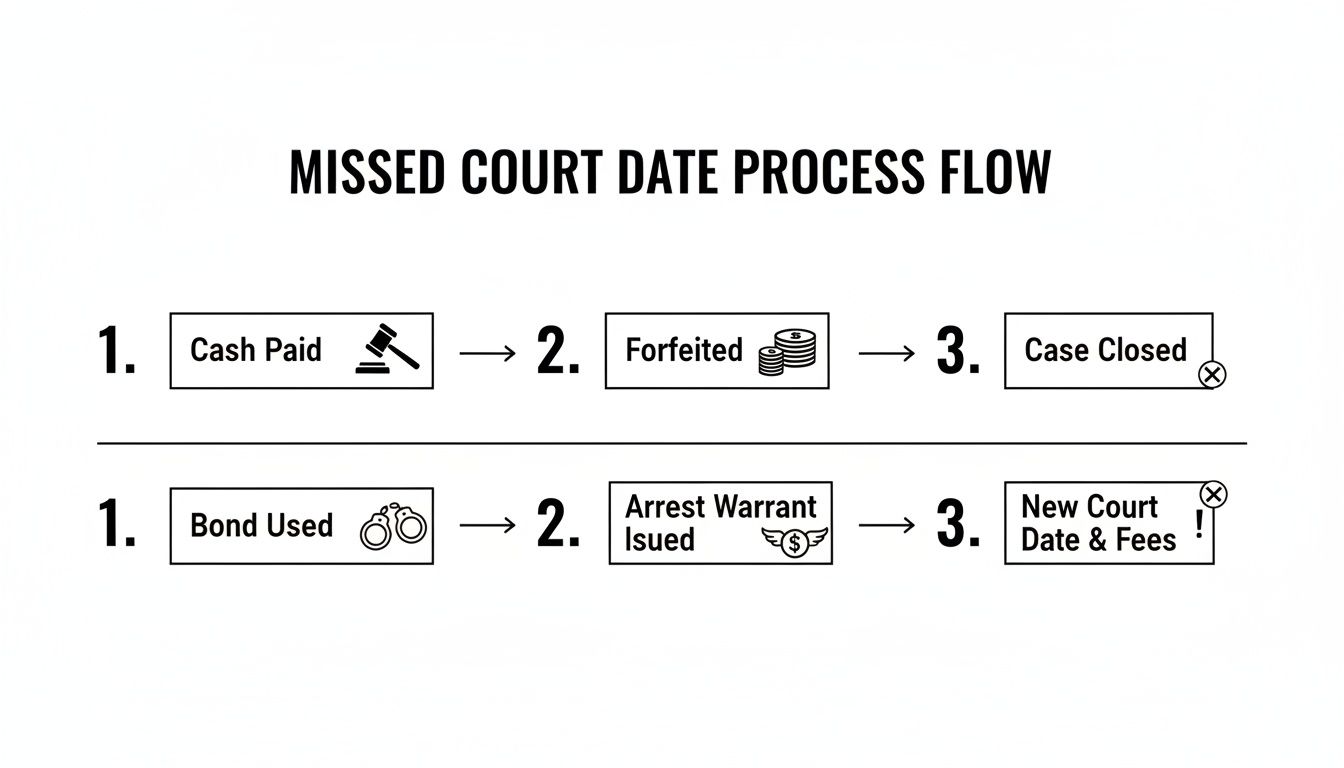
As you can see, posting cash puts your money at immediate risk of forfeiture. Using a bond, on the other hand, transfers that financial risk over to the bonding agency.
Timelines and Troubleshooting
A little patience goes a long way here. Refund timelines can vary quite a bit between counties, mostly depending on their current workload. In the bigger counties like Denver, Arapahoe, or Jefferson, it typically takes four to eight weeks after the case closes to get your check in the mail. If you need help in other areas, our guide to Pueblo County bail bonds offers some great local resources.
What if it's been more than two months? Don't panic. Just give the Clerk of Court's office a call, have the case number handy, and politely ask about the status of your refund.
Dealing with the court system can be slow. If you need immediate help or simply want to avoid tying up your cash in the first place, give Express Bail Bonds a call at 720-984-2245. We’re here to help 24/7.
Secure a Faster Release with Less Financial Risk
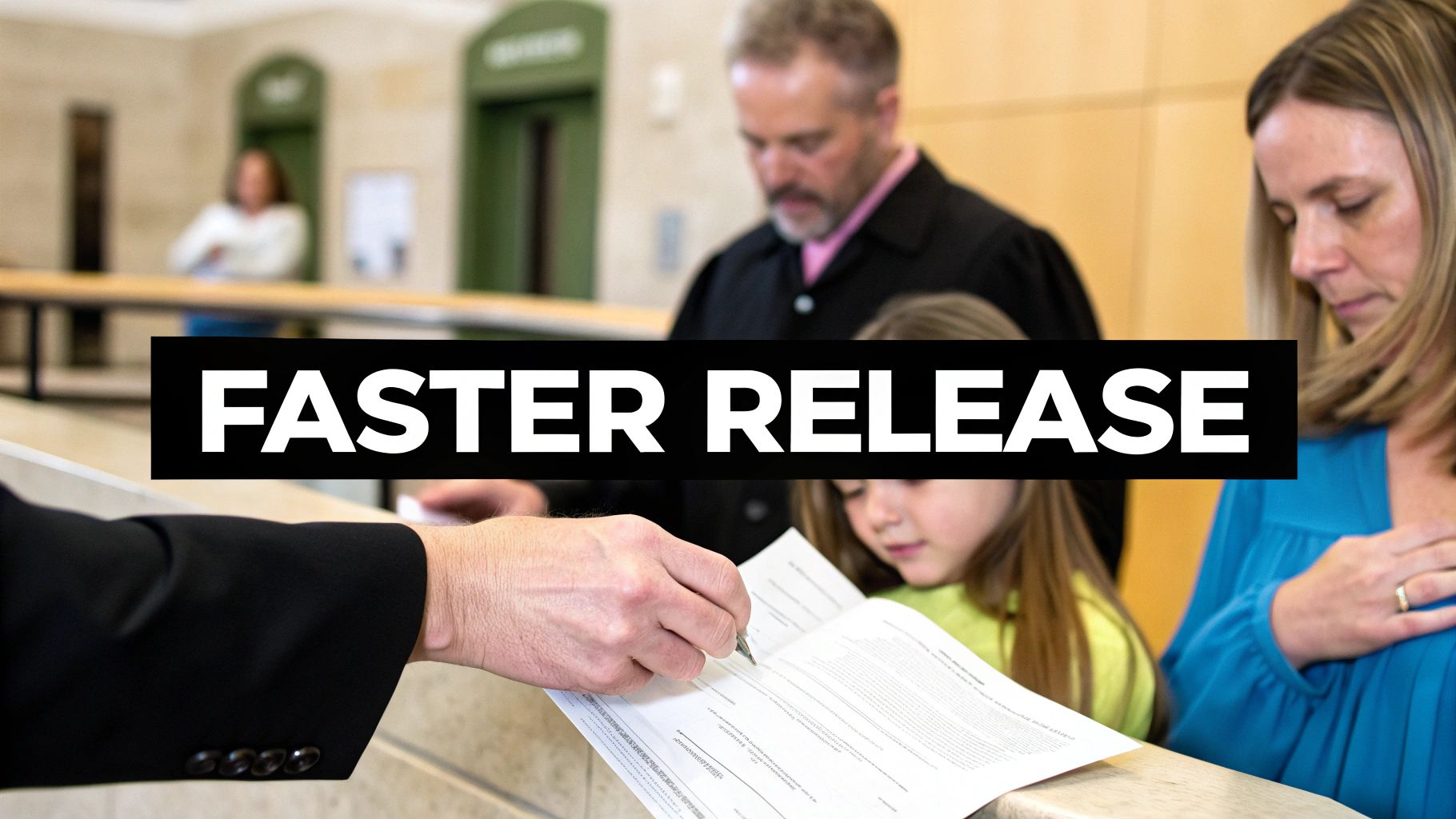
Trying to come up with thousands of dollars for a cash bail payment can throw a family into financial chaos. It’s an immediate, massive burden that freezes your savings or even forces you to sell assets, all while you have no idea how long the court case will take. It's a path filled with unnecessary stress and risk.
There's a much smarter, more secure alternative. Choosing a bail bond gets your loved one home right away without forcing you to drain your life savings for their freedom.
The Value of Peace of Mind
When you work with Express Bail Bonds, you pay a manageable premium, which is just a small percentage of the total bail amount. That one, predictable payment is all it takes to get your loved one home—often within hours—without having to liquidate your financial future.
From there, we handle all the complicated paperwork and take on the full financial risk with the court.
While it’s true that you do not get bail money back when you pay a premium, it’s because that fee is buying something truly invaluable:
- Immediate Freedom: Your loved one is back home, not sitting in a jail cell.
- Financial Stability: Your savings, property, and daily finances are left untouched and secure.
- Expert Guidance: You gain 24/7 access to experienced professionals who can walk you through every step and answer every question.
A non-refundable premium is the fee for a critical service—transferring the entire financial risk from your family to our agency and ensuring a fast, professional release from jail.
A Predictable Path Forward
The uncertainty of a court case is stressful enough. You shouldn't have to add a major financial crisis on top of it.
Using our expert bail bonds services gives your family a clear, controlled path forward. You know the exact cost from the start, which frees you up to focus on what really matters: supporting your family and preparing for the legal process ahead.
Don't let a high cash bail cripple your finances. We offer a faster, safer, and more affordable way to bring your loved one home.
If you need immediate and professional help, call or text Express Bail Bonds at 720-984-2245. We’re available 24/7 to provide the support you need.
Common Questions About Bail Money Refunds
Going through the bail process brings up a lot of questions, especially for the family and friends helping out. In a stressful time, it can feel impossible to get a straight answer.
This section is designed to give you direct, clear-cut answers to the most common concerns we hear from folks all across Colorado. Think of it as your quick guide to understanding your financial role and what happens next, whether you paid the court directly or worked with a bondsman like us.
If Charges Are Dropped, Do I Get My Bail Bond Premium Back?
No. This is probably the single biggest misconception about how bail bonds work. The premium you pay a bondsman is for their service—it's earned the moment they post the bond and get your loved one out of jail.
That fee covers the bondsman's work and the massive financial risk they take on for the full bail amount. Because that service was rendered successfully, the premium is non-refundable, no matter what happens with the case later. This is true whether the charges are dropped, the person is found not guilty, or the case is resolved in any other fashion.
How Long Does a Colorado Court Take to Refund Cash Bail?
If you paid the full bail amount in cash directly to the court, you can expect to wait a bit after the case is officially closed. Colorado courts typically process and mail cash bail refunds within four to eight weeks.
The exact timing can shift depending on how busy that specific county's court is and what their internal process looks like. The refund is always sent as a check, and it's mailed to the person who originally posted the money. It's absolutely critical to make sure the court has your current, correct mailing address to avoid any delays.
Keep in mind, the refund clock doesn't start ticking until the case has reached its final disposition. In other words, the case has to be completely over. No refunds are ever issued while a case is still open.
What Happens to the Collateral I Used for a Bail Bond?
Any collateral you put up for the bond, like a car title or a deed to your property, is returned to you once the case is completely finished. The final step happens when the court officially "exonerates" the bond, which is just the legal term for releasing our agency from all financial responsibility.
As long as the defendant showed up for every single court date and followed all the rules of their release, your collateral is safe. We begin the process of returning it and releasing any liens as soon as we get the official word from the court.
Can My Cash Bail Be Used to Pay the Defendant's Fines?
Yes, it absolutely can. If you posted a cash bond directly with the court, they have the legal right to use that money to cover any financial penalties the defendant racks up.
If the defendant is convicted and has to pay court costs, fines, or restitution to a victim, the court will simply deduct those amounts from the cash bail you posted. You'll get a check for whatever is left over. Any arrangement for the defendant to pay you back for those deducted fees would be a private matter between the two of you.
Trying to figure out the bail system is tough, but you're not in this by yourself. For fast, clear answers and professional support you can count on, trust the team at Express Bail Bonds. We're here 24/7 to help your family through this. Call or text us now at 720-984-2245 or find us online at https://expressbailbonds.com.
Article created using Outrank