
That call usually comes at the worst time. Late at night, early in the morning, right before work, or when you're already dealing with something else. A family member says they've been arrested, they don't understand what's happening, and they need help fast.
In that moment, individuals don't need legal theory. They need a calm plan. If you're trying to figure out how to use a bail bondsman, the process is manageable once you know the order of operations, what information matters, and where families lose time.
In the United States, approximately 2 million people use bail bonds annually, and California alone accounts for about 150,000 people each year, with Texas and Florida also seeing heavy use of bail bond services, according to this overview of national bail bond usage. That tells you one thing right away. You are not dealing with a rare situation. Families face this every day, and the process works best when someone stays organized from the first call forward.
Your Step-by-Step Plan After an Arrest
The first few minutes after an arrest call are usually messy. One person is panicking. Another is trying to guess which jail the defendant was taken to. Someone else is asking about charges before anyone even knows if booking is finished.
Start simpler than that.
Your first job is to confirm where the person is being held and whether bail has been set. If you don't have those basics yet, stop trying to solve the whole case. Get the jail, the full legal name, and the date of birth. If possible, get the booking number too.
A useful next read is this guide on what happens after you get arrested, because it helps families understand the sequence between arrest, booking, bail, and release. That matters because a lot of stress comes from expecting answers before the system has produced them.
What to do in the first hour
- Confirm the detention facility. People are often arrested in one city and held somewhere else.
- Write down identifying details. Full name, date of birth, charges if known, and booking number.
- Ask whether bail has been set. No bondsman can post a surety bond until the bail amount is available.
- Choose one point person. Too many relatives calling different places creates confusion.
- Keep the defendant focused. They need to remember court dates and release conditions later, not just get out tonight.
The families who move fastest usually aren't the loudest. They're the ones who gather the right information before making the next call.
Sometimes the arrest involves a charge that raises extra questions about consequences in another state. If that's your situation, a plain-language resource on drunk driving laws and penalties in North Carolina can help you compare how charges and penalties may differ by jurisdiction.
What works is calm, narrow action. What doesn't work is guessing, arguing with jail staff, or assuming release will happen instantly just because money is ready.
What a Colorado Bail Bondsman Actually Does
A Colorado bail bondsman handles the release side of the case. The job is to verify the bond amount, collect the information needed to write the bond correctly, review the cosigner, prepare the agreement, post the bond with the court or jail, and stay involved until the case is finished.

Families usually call in a panic and assume they need the full bail amount in cash that night. Sometimes that is an option. Often it is not the practical one. A surety bond lets the bondsman post the full bail amount while the defendant or cosigner pays a non-refundable premium for that service and the risk behind it.
In Colorado, the work is much more electronic than people expect. Years ago, families often spent hours driving paperwork around, waiting outside a facility, and trying to catch the right person on shift. Now a lot of the process can be handled by phone, text, email, and electronic signatures. That matters if the cosigner lives in another Colorado county or in another state and cannot get to the office before close of business.
If you want a plain-English overview of the role itself, this explanation of what a bail bondsman is gives the basics. The practical side is what families care about in the moment. Can the bond be written correctly, can it be posted fast, and are there any problems that could delay release?
How the money side works in Colorado
Colorado families need Colorado terms. The premium is usually a percentage of the bail amount, and it is not refunded when the case ends. For many bonds, the standard premium is 15%. Some larger bonds may qualify for a lower rate with an approved cosigner, as discussed in this overview of state-specific premium rates and collateral requirements.
The premium pays for more than paperwork. It covers the financial guarantee, the underwriting decision, the time spent correcting booking details, the filing process, and the follow-through if the defendant misses court. On higher-risk bonds, collateral may also be required. That depends on the charges, flight risk, criminal history, ties to the community, and the strength of the cosigner.
What families are really hiring the bondsman to do
The value is speed, accuracy, and judgment.
A good bondsman does not just quote a price and wait for payment. The bondsman checks whether bail has been entered into the system, confirms where the person is being held, catches name or date-of-birth errors that can stall a release, explains what the cosigner is agreeing to, and uses the fastest available filing method for that jail or court. In Colorado, statewide experience matters because every facility has its own timing, cutoffs, and release procedures.
That becomes even more important with out-of-state cosigners. If a parent in Texas or a spouse in Kansas is trying to help, the old approach was slow and frustrating. Overnighting paperwork or requiring an in-person office visit could cost half a day or more. With electronic documents and remote identity verification, many of those cases can move much faster, assuming the jail has the bond information ready and the cosigner sends complete information the first time.
Why families use a bondsman instead of posting full cash
The decision usually comes down to cash flow and risk.
| Option | What you need upfront | Main trade-off |
|---|---|---|
| Cash bail | The full bail amount | A large sum is tied up until the case is resolved |
| Surety bond | The premium and sometimes collateral | The premium is not refunded |
Posting full cash can make sense for some families. For others, tying up that money creates a second problem right away. I have seen families drain emergency savings, miss travel plans, or scramble to cover rent because they focused only on getting someone out tonight. A bondsman gives them another way to handle the release without putting the entire bail amount on the counter at once.
One warning matters here. Speed helps, but incomplete or inconsistent information slows everything down. The fastest cases usually come from one organized cosigner who can answer questions clearly, send ID quickly, and sign documents as soon as they arrive.
The Complete Process for Securing Bail
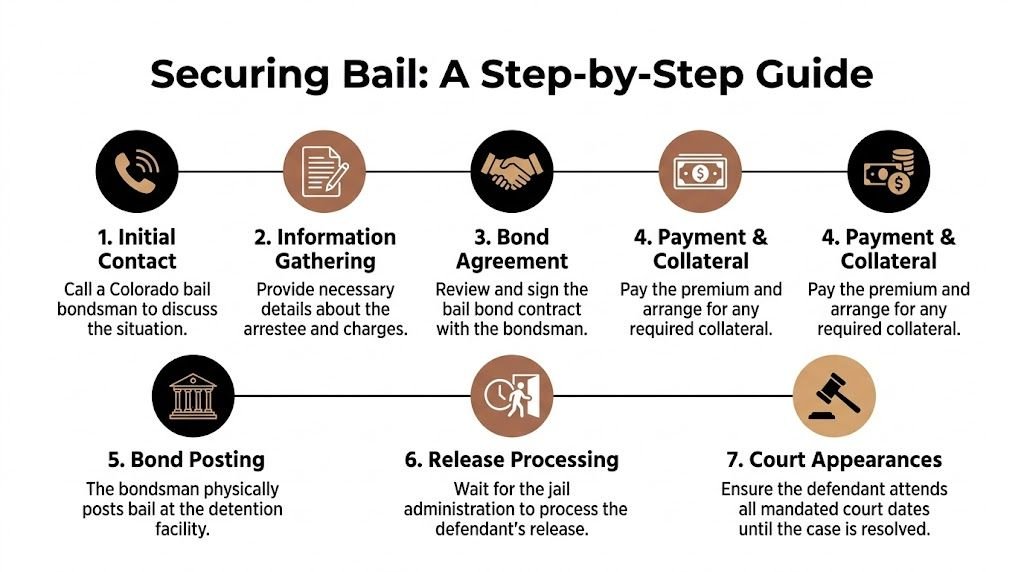
Once bail has been set, speed comes from sequence. The process begins after arrest and booking, and the first practical steps are to gather defendant details, contact a licensed bondsman for risk assessment, execute the contract, and then wait for the bond to be posted. Standard premium rates are 10% to 15% of bail, release can occur within 2 to 24 hours depending on facility processing, and incomplete information delays cases by 12+ hours in 40% of situations, according to this breakdown of how the bail bond process works step by step.
Here is the process in a format families can use.
Before you make the call
Gather as much of this as you can:
- Legal name. Nicknames slow things down.
- Date of birth. This helps separate similar names in jail rosters.
- Booking number. If you have it, use it every time.
- Detention facility. City arrests don't always mean city custody.
- Charges and bail amount. If bail isn't set yet, say that up front.
- Cosigner information. Employment, address history, and identification may matter.
- Basic financial picture. Be ready to discuss how the premium will be paid and whether collateral may be needed.
The families who save the most time usually prepare this before they start calling. The ones who don't often end up repeating the same conversation with three different people.
How to choose the right bondsman
Not all agencies handle urgent releases the same way. Some still rely on the old model where everyone drives to an office, signs paper contracts, waits for scanned copies, then waits again for someone to physically head to the jail.
That can work. It just isn't the best option when the arrest happened at night, the cosigner lives out of state, or the jail accepts electronic processing.
A better approach is to look for these things:
- True 24/7 response. Arrests don't happen on office hours.
- Statewide coverage. County lines shouldn't force you to start over.
- Remote paperwork. Electronic applications and signatures save real time.
- Clear reviews. Read what families say about communication under pressure. These client reviews from one Colorado agency and this second set of Google reviews from Colorado clients show the kind of practical details worth looking for.
- Plain answers about collateral. If an agent can't explain the obligations clearly, that's a problem.
If you're trying to understand the mechanics before hiring anyone, this guide on how to bail someone out is a useful reference.
Where modern electronic processing changes everything
Colorado families often waste hours without realizing it, as they think the only path is to drive to a jail, stand in line, hand over documents, and wait for a window clerk to accept paperwork.
That old workflow still exists in some situations. But many cases move faster when the application, contract, and payment are handled electronically first, especially when a cosigner is in another city or another state.
If the jail accepts a clean electronic posting workflow, the family's biggest job is accuracy, not travel.
That means the most valuable thing you can do is respond quickly to document requests, upload identification clearly, and read every signature page before you submit it.
A short visual overview can help if the process still feels abstract.
The order that usually works best
Confirm that bail is set
No surety bond can be posted until the amount and bond type are known.
Call with complete information
Missing details cause the biggest delays.
Complete the application
The cosigner and defendant information must match jail and court records.
Review the agreement carefully
Understand the premium, payment terms, collateral, and reporting expectations.
Submit documents and payment
Remote processing often avoids unnecessary travel and office delays.
Wait for bond posting
At this point, the bond company is working through the jail's system.
Prepare for release instructions
The defendant needs transportation, a phone, and a plan for the next court date.
What works is treating every form and phone call as part of one chain. What doesn't work is rushing through names, addresses, or dates. Small errors at the beginning have a habit of becoming long nights later.
Navigating Jail Logistics and Release Timelines
At 10:30 p.m., a family usually wants one answer. "How long until they're out?" The honest answer in Colorado is that once the bond is posted, the clock belongs to the jail.

That catches people off guard, especially if the paperwork was fast. A bondsman handles the bond. The detention facility handles the release. Those are separate steps, run by separate systems, and families feel the gap between them.
Why release time varies
Release timing depends less on how quickly you paid and more on what the jail still has to finish. Staff may need to complete classification, clear holds, confirm there are no other warrants, process property, finish medical review, or work through a shift change. A busy intake night can slow everything down even after the bond is accepted.
Colorado families also run into a practical difference between old and new posting methods. Years ago, a lot of this meant driving documents around, waiting on counters, and hoping the right person received the file before another delay hit. Now, many bonds can be handled electronically, which cuts out a lot of the family-side waiting and travel. That matters even more when the cosigner lives in another state and cannot get to a local office or jail on short notice.
If you want a clearer picture of the jail side, this guide on how long booking takes in jail explains why one facility can move much faster than another.
One more point matters for out-of-state families. If a cosigner is reviewing paperwork from outside Colorado and needs to translate legal documents before signing, do that early. Waiting until the bond is ready to post can add preventable delay.
County-specific realities in Colorado
Local experience saves time because each jail has its own habits, bottlenecks, and release rhythm. The legal standard may be statewide, but the practical experience is not.
For Jefferson County, these Golden bail bond details for Jefferson County are useful because release timing there often turns on intake volume, staffing, and the facility's current workflow.
For Arapahoe-area cases, this resource on Centennial bail bonds and Arapahoe County release help gives location-specific context that families rarely know to ask about during the first call.
Old-school posting versus modern systems
The biggest improvement in this process is simple. Families no longer need to do as much physical running around.
| Process style | What happens | Typical family experience |
|---|---|---|
| In-person paper workflow | Documents are signed physically and carried to the jail or clerk | More driving, more waiting, more handoff risk |
| Electronic workflow | Application, signatures, and payment are completed remotely before posting | Less travel and less friction, especially for out-of-state cosigners |
Electronic processing speeds up the part a bondsman controls. It does not force a jail to release faster. I tell families this every day because "bond posted" and "released from custody" are not the same update.
The practical move is to get ready while the jail works. Arrange a ride. Keep a phone available for the defendant if possible. Have clothing, medication information, and the next destination figured out before the release call comes in. Repeated calls to the jail or bond office usually do not speed anything up. Clear communication and realistic expectations help much more.
Your Legal Obligations and How to Avoid Forfeiture
Getting someone out is only half the job. Keeping the bond in good standing is where families either protect themselves or create a much bigger financial problem.
After release, the defendant must comply with all conditions and attend all hearings. A missed court date is the top failure point, with a 12% to 15% incidence, and co-signers can face an average cost of $25,000+ when liability is triggered. The same source says expert tracking protocols such as weekly check-ins reduce no-show risk by 75%, according to this forfeiture and post-release obligations overview.
The obligation that matters most
The number one rule is simple. Show up to every court date.
Not the important ones. Not the ones you remember. Every single one.
A missed appearance can trigger a bench warrant, bond forfeiture, recovery action, and direct financial exposure for the cosigner. If you're unfamiliar with the mechanics, this explanation of what a bond forfeiture is is worth reading before there's a problem.
What defendants and cosigners need to do right away
Use a written system. Verbal reminders are not enough.
- Track every court date. Put it in your phone, on paper, and on a shared family calendar.
- Follow every release condition. No-contact orders, travel limits, and sobriety conditions aren't suggestions.
- Stay reachable. If the bondsman calls, answer. If your address changes, report it.
- Protect paperwork. Keep bond documents, court notices, and payment records in one place.
- Coordinate transportation early. Court dates are missed because of bad planning more often than families expect.
Court compliance is cheaper than cleanup. Once forfeiture starts, your options narrow quickly.
Where families get into trouble
The worst mistakes usually look small at first. A defendant assumes the lawyer will handle reminders. A cosigner thinks one missed call from the bond office doesn't matter. Someone moves, changes numbers, or ignores a condition because they think the case is minor.
Those are expensive assumptions.
Language barriers and document confusion can also create avoidable trouble. If a family member needs help understanding paperwork from another jurisdiction or supporting records in another language, a guide on how to translate legal documents can help reduce errors before signatures or court filings create bigger issues.
What works is disciplined follow-through. What doesn't work is treating release like the end of the case.
Common Questions and Checklists for Colorado Families
By the time a family gets this far, the basic process usually makes sense. The remaining questions are more specific. They usually involve edge cases, remote signing, and what happens after the criminal case changes direction.
Common questions families ask
Can an out-of-state family member cosign?
Yes, in many situations remote processing makes that possible. The key issue isn't distance by itself. It's whether the agency can verify identity, receive documents cleanly, and complete signatures without delay.
Can I negotiate the premium?
In Colorado, fees are shaped by state-specific rules. The practical question is usually whether the bond amount and cosigner profile qualify for a lower rate under the terms discussed earlier, not whether the premium is negotiable in the casual sense.
What if charges are dropped later?
The criminal case outcome and the premium are separate issues. The premium pays for the surety service used to secure release. Families often misunderstand this point and expect the premium to work like a court deposit.
What if the person has an outstanding warrant too?
That can slow or block release depending on the warrant, the jurisdiction, and whether additional holds exist. This is one of the biggest reasons families shouldn't promise a pickup time before the jail confirms release is cleared.
Is a surety bond always the right choice?
Not always. Sometimes the full cash amount is available and makes more sense for that family. Sometimes the bond type set by the court limits the available options. The right answer depends on resources, urgency, and risk.
Checklist for local Colorado families
- Confirm the jail first. Don't assume the arresting city is the holding location.
- Collect exact identifiers. Legal name, date of birth, booking number if available.
- Ask whether bail is set and what type it is. That determines the available path.
- Choose one family coordinator. Mixed messages create delays.
- Keep transportation ready. Release can happen at an inconvenient hour.
- Store all documents together. Court notices get lost when several relatives are involved.
Checklist for out-of-state cosigners
- Prepare clear ID documents. Blurry uploads waste time.
- Stay by your phone. Signature requests and verification calls can come quickly.
- Use the same name and address everywhere. Mismatches slow approval.
- Read the indemnity agreement fully. Understand your financial responsibility.
- Ask how collateral, if any, will be handled. Don't assume. Confirm.
- Get the next court date in writing. Distance makes missed communication more dangerous.
The practical advantage for many Colorado families is that remote processing has replaced a lot of unnecessary driving, waiting rooms, and rushed counter service. That matters most when the cosigner is in another county, another state, or trying to coordinate release overnight while holding a job and family together.
If you need immediate help, Express Bail Bonds serves Colorado statewide and handles bail bond applications, signatures, and payment through an efficient electronic process designed to reduce delays and unnecessary travel. Families dealing with a late-night arrest, an out-of-state cosigner, or a county jail with different posting procedures can call or text for direct guidance, clear answers, and fast next steps.